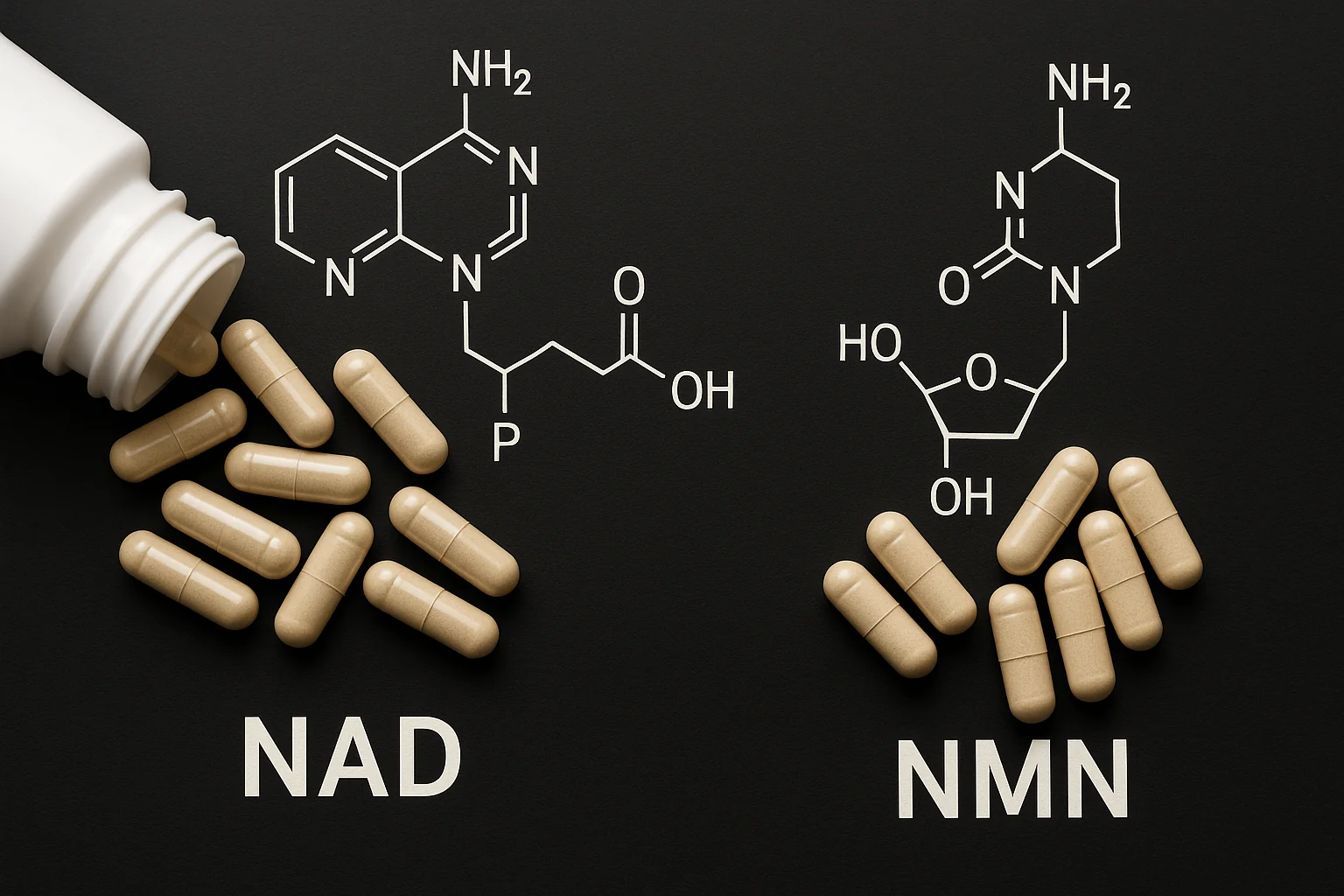

NAD+ vs NMN: what to choose for longevity (table)
NAD+ or NMN for longevity? Comparison of forms, dosages from human studies, and honest information about what is simply not in the u Bucha catalog.
Nicotinamide adenine dinucleotide, abbreviated as NAD+, is a cofactor present in hundreds of enzymatic reactions: from energy production in mitochondria to DNA repair and sirtuin activity. For several years, it has been known that its concentration in human tissues correlates negatively with age, and this observation underpins the entire NMN and NR supplement market. This article compares three forms that frequently come up in this discussion: NAD+ itself, its direct precursor NMN, and nicotinamide riboside. It also examines what human studies have really shown and where the evidence is weaker than marketing suggests. A practical note: the u Bucha store does not carry any preparation with NAD+, NMN, or NR, so this text serves as a guide on the topic rather than a summary of the offer.
KEY INFORMATION
• The concentration of NAD+ in human skin tissue decreases with age, while the activity of the consuming enzyme PARP increases (Massudi et al., PLoS One, 2012).
• Oral NAD+ has no clinical protocols; human studies focus on precursors: NMN and NR.
• NMN at a dose of 250 mg daily for 10 weeks improved insulin sensitivity in postmenopausal women with prediabetes (Yoshino et al., Science, 2021).
• NR at doses of 100, 300, and 1000 mg daily raised NAD+ in the blood by 22, 51, and 142 percent over two weeks (Conze et al., 2019).
• A 2026 study involving seven cohorts found no decrease in NAD+ in whole blood with age, challenging this measurement as a marker of aging (Trętowicz et al., Nature Metabolism, 2026).
• The u Bucha store catalog does not include products with NAD+, NMN, or NR (as of 2026-08-08).
What is NAD+ and why is its level studied in the context of aging?
NAD+ serves two distinct roles in the cell. The first is redox: the molecule accepts electrons and becomes NADH in glycolysis, the Krebs cycle, and beta-oxidation of fatty acids, driving ATP production in mitochondria. The second role is signaling. NAD+ is consumed by PARP enzymes that repair DNA damage, sirtuins that regulate gene expression and metabolism, and CD38, the main enzyme that breaks down this cofactor.
The hypothesis linking NAD+ to aging is based on measurements in human tissue. In a study of 49 skin samples taken from individuals aged from newborn to 77 years, NAD+ concentration negatively correlated with age in both sexes, and in men, PARP activity increased while SIRT1 activity decreased (Massudi i in., PLoS One, 2012). The authors proposed a mechanism: accumulating DNA damage excessively stimulates PARP, which consumes the NAD+ pool faster than the cell can replenish it.
This explains why supplements targeting NAD+ have entered longevity protocols. However, it is important to note the scale of the evidence. Massudi's work involves a single tissue and shows correlation, not causation, and the circulating claim of a "50% drop after forty" does not originate from this study or any other work that could be pointed to. A review from 2025 directly summarizes that the decline of NAD+ in humans has been consistently confirmed only in a limited number of studies (Vinten i in., 2025).
How do NAD+, NMN, and NR differ?
Three forms related to this pathway are available: NAD+ itself, nicotinamide mononucleotide (NMN), and nicotinamide riboside (NR). They differ in their position in the synthesis pathway and the number of studies in humans. The table below compares them based on characteristics that actually differ. It does not include prices or cost per serving, as the u Bucha store catalog does not contain any products from these three, and entering market prices would be guesswork.
| Feature | NAD+ | NMN | NR |
|---|---|---|---|
| Rola w szlaku | Ready cofactor used by enzymes | Direct precursor of NAD+ | Precursor converting to NMN |
| Oral absorption | Large molecule broken down in the digestive tract | Metabolites in plasma increase depending on the dose | Raises NAD+ in whole blood within two weeks |
| Doses from human studies | No established oral protocol | 250 do 1200 mg dziennie | 100 do 1000 mg dziennie |
| Strongest evidence in humans | No oral studies | Muscle insulin sensitivity after 10 weeks (Yoshino, 2021) | Wzrost NAD+ we krwi o 142 procent przy 1000 mg (Conze, 2019) |
| Greatest limitation | Does not fully enter the cell | Short trials, narrow populations | Wzrost markera bez wykazanego efektu klinicznego |
| W katalogu u Bucha | None | None | None |
What did NMN studies in humans show?
The study most cited by manufacturers is a Japanese safety study from 2020. Ten healthy men received a single oral dose of 100, 250, or 500 mg of NMN. No significant symptoms or changes in heart rate, blood pressure, and saturation were recorded, and the concentration of nicotinamide metabolites in plasma increased depending on the dose (Irie et al., Endocrine Journal, 2020). This is worth clarifying, as supplement descriptions cite this study as evidence of daily dose safety, while the study examined a single administration, not a regimen.
A stronger metabolic evidence came from a randomized study published in Science. Postmenopausal women with overweight or obesity and prediabetes took 250 mg of NMN daily for 10 weeks. In the NMN group, insulin-stimulated glucose uptake measured by the hyperinsulinemic clamp increased, as did insulin signaling in the muscle, which was not observed after placebo (Yoshino et al., Science, 2021). This is a narrow population and one endpoint, but methodologically sound.
The third trial concerns active individuals. Forty-eight amateur runners were divided into four groups: 300, 600, and 1200 mg of NMN daily and placebo, with 5 to 6 training sessions per week for six weeks. In the 600 and 1200 mg groups, oxygen uptake and power at ventilatory thresholds improved, while VO2max itself did not change in any group (Liao i in., 2021). The authors explain the effect as better oxygen utilization by the muscle, rather than an increase in oxygen capacity.
Does increasing NAD+ really slow down aging?
In a mouse model, the results are clear. C57BL/6N mice were given NMN for twelve months, throughout the normal aging period. The animals gained less weight, had a more efficient energy metabolism, greater physical activity, better insulin sensitivity and lipid profile, and better eye function than the control group, with no signs of toxicity (Mills et al., Cell Metabolism, 2016). This study built expectations for the entire category.
However, recent years have brought results that temper these expectations. A team that measured NAD+ in whole blood in seven independent cohorts using validated mass spectrometry methods found no decrease in concentration with age or after lifestyle interventions. The level did respond to nicotinamide riboside supplementation, meaning the method itself worked. The authors question the utility of NAD+ in blood as a marker of aging (Trętowicz et al., Nature Metabolism, 2026).
The second breakthrough concerns muscle. In a model of mice with NAD+ synthesis disabled by NAMPT in adult skeletal muscle, the cofactor concentration dropped by 85 percent, yet morphology, contractility, exercise tolerance, and mitochondrial respiratory capacity were preserved. Lifelong deficiency did not accelerate muscle aging (Chubanava i in., Cell Metabolism, 2025). The conclusion for the reader is simple: a decrease in NAD+ itself does not have to be the cause of what marketing attributes to it, and measurement in blood says little about what is happening in tissues.
How to raise NAD+ levels without NMN supplementation?
The best-documented intervention is exercise. In a study involving younger individuals (up to 35 years) and older individuals (over 55 years), twelve weeks of aerobic training increased NAMPT levels in skeletal muscle by 12 percent in younger and 28 percent in older individuals, while resistance training increased it by 25 and 30 percent respectively (de Guia i in., Physiological Reports, 2019). NAMPT limits the rate of the NAD+ salvage pathway, and its amount decreases with age, so exercise reverses just that element.
The second route is diet. Niacin and nicotinamide, two forms of vitamin B3, enter the NAD+ pool via the salvage pathway, while tryptophan feeds it through the de novo pathway. Both components are provided by a regular diet with meat, fish, legumes, and whole grains, and extreme deficiency of vitamin B3 (pellagra) leads to multi-organ symptoms. supplements. Therefore, deficiency carries a high stake, which does not mean that excess provides additional benefits to a well-nourished person.
The third conclusion is negative and also counts. Popular recommendations in guides, from intermittent fasting to sauna and cold baths, are based on mechanisms described in rodents, not on measurements of NAD+ in human tissues. A review from 2025 states directly that there is little published data on NAD+ dynamics in humans, and transferring results from animal models is not straightforward (Vinten i in., 2025). If you are looking for interventions with solid evidence in humans, exercise remains.
What to look for when purchasing and what you won't find at Bucha?
Let's start with a fact that changes the way you read this article. A review of the entire catalog of the u Bucha store through the Store API on August 8, 2026, covering the names and full descriptions of all 386 products, found not a single product with NAD+, NMN, or nicotinamide riboside. There is also no standalone resveratrol. Therefore, the product lineup cannot be filled with the store's offerings, and a text that would do so would describe phantom positions.
So what is actually in the catalog that touches on the topic? Products with B vitamins, including niacin and nicotinamide, which are forms of vitamin B3 that enter the NAD+ pool. You will find them in the category supplements, where they stand alongside products with magnesium, vitamin D3, and omega-3 fatty acids. These are not substitutes for NMN and should not be presented as such: they provide a basic substrate, not a direct precursor.
If you still buy NMN elsewhere, check three things on the label. First, the dose per serving, not per package, because research protocols fall within the range of 250 to 1200 mg daily, and without this number, you cannot compare products. Second, a purity declaration with a batch number and testing from an external laboratory. Third, the expiration date and recommended storage method, as manufacturers of these compounds most often indicate a cool and dry place.
What is known about the safety of NMN and NR?
Safety data are short-term, and this is their biggest limitation. For NMN, the best-documented single dose is up to 500 mg in healthy men, with no significant changes in vital or laboratory parameters (Irie et al., Endocrine Journal, 2020). For NR, we have an eight-week randomized trial with placebo control: doses of 100, 300, and 1000 mg daily raised NAD+ in whole blood by 22, 51, and 142 percent respectively over two weeks, with no difference in adverse events compared to placebo and no increase in LDL cholesterol (Conze i in., Scientific Reports, 2019).
What do we not know? First, the effects of supplementation longer than a few weeks in humans have simply not been studied. Second, there is no trial comparing NMN with NR on the same endpoints, so claims like “NMN beats NR” are based on comparing disproportionate studies. Third, a review from 2025 summarizes the effectiveness of NAD+ precursors in clinical trials in humans as limited, despite promising preclinical results (Vinten i in., 2025).
Caution is advised for individuals undergoing cancer treatment and those taking medications regularly. Not because harm has been demonstrated, but because the published data comes from small groups of healthy volunteers and does not cover such situations. The decision to supplement in chronic illness should be made with the attending physician, not based on a product description in an online store.
Frequently Asked Questions
What is the difference between NAD+ and NMN?
NAD+ is a ready-made cofactor used by enzymes, and NMN is its direct precursor from which the cell recreates NAD+. Oral NAD+ does not have an established clinical protocol because the molecule is broken down in the digestive tract. Human studies are conducted on precursors, namely NMN and nicotinamide riboside.
Ile NMN dziennie stosowano w badaniach u ludzi?
The range from published trials is 250 to 1200 mg daily for 6 to 10 weeks. The safety study by Irie and colleagues from 2020 examined single doses of 100, 250, and 500 mg in ten healthy men, not a treatment, and this distinction is often blurred in supplement descriptions.
Is NMN better than NR?
There is no study comparing both compounds on the same endpoints, so the answer is: unknown. NR has a longer trial with a placebo control and measured an increase in NAD+ in the blood, while NMN has metabolic evidence in muscle. Comparing these studies is like comparing incomparable results.
Does NAD+ or NMN supplementation extend lifespan?
There is no such evidence in humans. Annual administration of NMN to mice alleviated some age-related changes, but in humans, only intermediate markers have been measured in several-week trials. Lifespan was not an endpoint in any published trial. A review from 2025 summarizes the effectiveness of NAD+ precursors in clinical research as limited.
Is it worth testing NAD+ levels in the blood?
A 2026 study measured NAD+ in whole blood in seven independent cohorts and found no age-related changes or lifestyle intervention effects. The concentration responded only to supplementation. The authors question the value of this measurement as a marker of aging in healthy individuals.
Can I buy NMN or NAD+ at the u Bucha store?
No. A review of the entire catalog through the Store API on August 8, 2026, covering the names and descriptions of all 386 products, found no product with NAD+, NMN, or nicotinamide riboside. However, products with B vitamins, including niacin and nicotinamide, are available.
If you are looking for products that are actually in stock and support the daily intake of B vitamins, check out the category supplements, the only one in the store where these products are actually available. Catalog status checked on August 8, 2026.
This article is for informational and educational purposes and does not constitute medical advice. Before starting supplementation, consult your doctor, especially if you are taking medications regularly, are pregnant or breastfeeding, or have a chronic illness.
Author: Michał Waluk · Opublikowano: 2026-08-05 · Aktualizacja: 2026-08-08