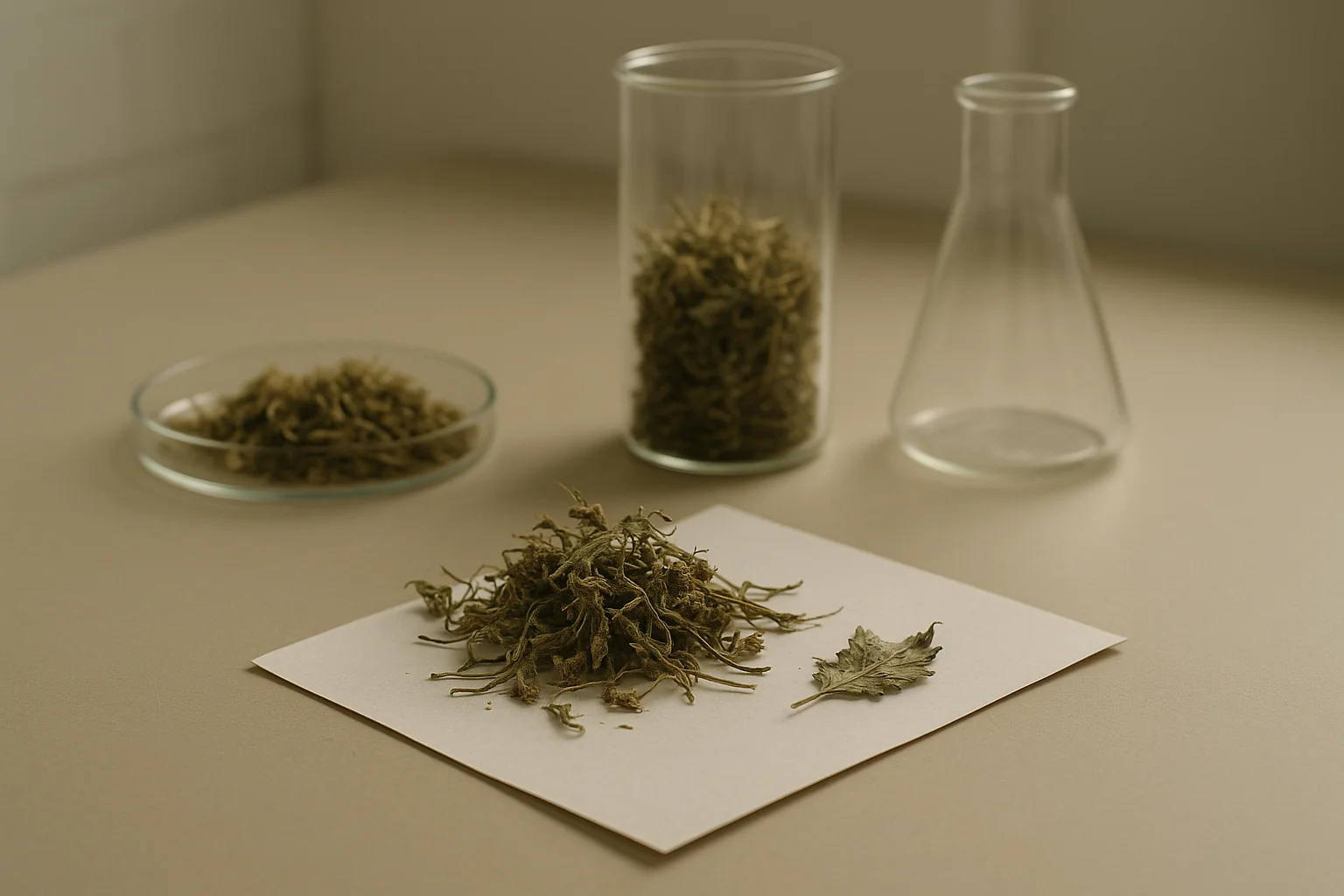

Sirius (Cannabis flos S-LAB): leading with caryophyllene and an undisclosed lineage
Sirius is an indica from the pharmacy, described by one source, with a profile led by caryophyllene. No one provides its lineage, and the same name is held by another, completely separate registration entry.
What is Sirius and where does this strain come from?
Sirius is an indica-dominant strain supplied to Polish pharmacies by S-LAB. Its origin cannot be specified: in the lineage graph of this compilation, its parents are marked as unknown because the breeder did not disclose them, and available descriptions do not indicate any pair of parental strains. The name of the star does not provide any genetic clues.
An empty lineage can be a result, not a gap in the query. In a compilation of 85 cultivars, as many as 25 have no established origin, and there are two reasons for this: either the breeder never provided a parental pair, or the circulating descriptions provide conflicting pairs, and none of them takes precedence. Entering parents by guess creates a false connection in such a graph, which then travels further, as once added kinship begins to be cited by subsequent services as a fact.
Caution is required regarding the name itself. Under the name Sirius, there was another entry in the Polish market, but from a different producer, and it happens to have a documented origin: sources indicate a cross of Chemdawg with Alien Tech, while Sirius is a trade name given to a strain previously known as Alien Dawg. Therefore, the common word in the name does not convey genetics in any direction, and that entry discusses osobny wpis. However, the declared genetics between the two are consistent, although it comes from a commercial description, not from laboratory analysis.
Which producers have this strain in Polish pharmacies?
One: S-LAB. The name Sirius appears in Polish pharmacy circulation also with a second registration entry, but it is managed by a different producer and treats it as a separate cultivar, as it has its own origin and description. At the time of data collection, neither of them was marked as available.
| Registration entry without a numerical component | Producer | Genetics according to the source | Lineage | Where described |
|---|---|---|---|---|
| Cannabis flos S-LAB | S-LAB | indica | nieustalony | this entry |
| Cannabis flos Tilray | Tilray | indica | Chemdawg x Alien Tech | separate entry about the Tilray position |
We intentionally omitted the numerical component from both registration names. For the S-LAB entry, which refers to the strain described on this page, the THC content ranges from 19.8% to 24.2%. The Tilray entry declares its own, lower value and has a separate entry in this compilation, so its numbers are not included here. Dried flower is a plant material, not a tablet measured on a scale, so the number entered into the name without a margin of one-tenth in either direction promises precision that the batch of raw material does not have.
Availability changes in a rhythm that is not visible from the name alone: the permit pertains to a specific batch from a specific producer, not to the strain in general, so the same name can disappear from pharmacies for several months and return under a changed registration entry. The database from which the profile comes marked both entries as unavailable. The current state is checked in the pharmacy, and a list of positions currently on the market is maintained by a review of available strains. The producer itself has 38 names in this listing and describes it in a separate discussion. This raw material should not be confused with dried flower from retail store category, which does not fall under the same issuance procedure.
What does Sirius smell and taste like?
The source description assigns a minty, fruity, and peppery note to this strain, with the peppery accent aligning with the leading terpene profile. However, these are catalog labels, not the result of sensory analysis, so they speak more about how the seller organizes the assortment than about the scent of a specific batch.
In the profile of this strain, one source lists eight compounds: bisabolol, humulene, caryophyllene, limonene, linalool, myrcene, nerolidol, and pinene. We provide them as ingredients, without shares, and the reason is numerical, not stylistic. The values listed next to these eight items sum to 97 in one registration version and to 99 in another, not to one hundred, so it is unclear what the missing remainder is or what the denominator refers to. Since it is unknown what constitutes the whole here, such a number measures nothing and only makes the catalog description resemble a laboratory result.
The same name receives a completely different set of scent descriptors in the second entry: camphoraceous, spicy, piney, with the same pepper in the background. Since both entries have an identical list of compounds in the database, and the scent description is different, the difference was made by someone describing the product, not the plant. The scent shifts along the way, as drying, storage conditions, and the age of the batch change the proportions of volatile components, and an open package smells different after a week than on the day of release. The strength of the effect says nothing about the scent.
How long does it take for Sirius to start working and how long does it last?
The route of administration determines the experience more than the strain itself. Inhalation from a vaporizer provides the first sensations within a few minutes and ends that same evening, while an ingested dose is felt much later and lasts longer. For Sirius as a single cultivar, no such measurement has been published, so the following description pertains to routes of administration.
The route of administration determines the course more than the variety itself. After vaporization, the substance passes from the lungs to the blood almost immediately, so the first sensations appear after a few minutes, the intensity increases for another ten to thirty minutes, and the whole effect lasts for two to four hours. After ingestion, the raw material first passes through the intestine and liver, so the first sensations are awaited from half an hour to two hours, and the episode can last six, sometimes eight hours. Hence the most common mistake with oral administration: anyone who thinks nothing is happening after thirty minutes and takes another dose will receive both doses at once. The above ranges describe the route of administration, not this variety; pharmacokinetic studies for a single cultivar have not been published.
The difference between the two entries bearing this name concerns the declared potency, not the timing: the manufacturer's margin shifts the value by one-tenth in either direction, while the moment of sensation remains where it is set by the route of administration. The method of taking the substance is determined by the attending physician.
What has been shown about the effects of this strain, and what is the seller's description?
Little has been demonstrated, and not on this strain. The evidence base for this project has two studies for caryophyllene, both on mice, both concerning pain and inflammation. Everything circulating about Sirius as a whole comes from catalog descriptions or patient reports, not from studies on this cultivar.
The first of these was published in 2008 in the Proceedings of the National Academy of Sciences (PNAS), signed by Gertsch J, Leonti M, Raduner S, Racz I, Chen JZ, Xie XQ, Altmann KH, Karsak M, Zimmer A (PMID:18574142). (E)-caryophyllene selectively bound to the CB2 receptor (Ki = 155 nM) and inhibited carrageenan-induced paw edema in wild-type mice, but not in CB2 receptor knockout mice (Cnr2-/-), indicating a CB2-dependent mechanism; the study did not include any anxiety tests.
The second study, from 2014 in European Neuropsychopharmacology (PMID:24210682), signed by Klauke AL, Racz I, Pradier B, Markert A, Zimmer AM, Gertsch J, Zimmer A, examined oral administration. Oral caryophyllene reduced the late inflammatory phase of pain in the formalin test in a CB2 receptor-dependent manner, with no effect on the early phase; in a neuropathic pain model, it alleviated thermal hyperalgesia and mechanical allodynia without developing tolerance with chronic administration.
Neither of the two studies tested caryophyllene on humans or in inhaled form from dried flower; both studies concern oral or systemic administration in mice in pain and inflammation models, not sleep or mood. The boundary thus lies along the model and route of administration, not just the number of studies.
What side effects have been reported for this strain?
None assigned to this name. The Polish reporting system links symptoms with the medicinal product and batch number, not with the cultivar, so there is no public compilation allowing us to state what has been reported specifically for Sirius. Below is what is known about dried flower as a group of raw materials.
Reports of adverse effects are collected for medicinal products with a batch number, not for the strain name, so the following pertains to hemp dried flower as a group of raw materials. The most frequently reported symptoms are dry mouth, red eyes, and increased heart rate. Dizziness upon rapid standing, daytime drowsiness, and temporary worsening of short-term memory are less frequently described, as well as anxiety that increases with dosage. A separate issue is medications taken concurrently, especially sedatives and those affecting coagulation: their assessment requires knowledge of the entire list of preparations, not just the description of the plant. We do not provide the frequency of these symptoms numerically, as public compilations for hemp dried flower in Poland do not separate them by individual products.
In Poland, the Office for Registration of Medicinal Products accepts reports, as does the entity responsible for the given preparation, and the form bears the product name from the packaging, not the cultivar name from the commercial description. Therefore, even after years of the strain being on the market, no statistics arise for the name itself.
What is known about vaporizing dried flower with such a profile?
Less than popular tables suggest. The boiling point of a terpene is not a threshold beyond which the compound begins to vaporize, and the setting on the vaporizer is not the temperature of the dried flower itself. For the profile of Sirius, there is one more thing: public data on boiling points are very uneven for its eight components.
Checking the PubChem database, which the project performed for eleven terpenes, yields the following for this profile: caryophyllene, limonene, linalool, myrcene, and pinene have boiling points listed along with measurement pressure; humulene has a measurement only under reduced pressure, 99-100 degrees at 3 mm Hg, almost in a vacuum; nerolidol has a number without a specified pressure; bisabolol is not listed in the database at all. Compiling such values in one column creates a table that appears comparable, but is not.
This does not imply any recommendation, and it is intentionally absent here: the method of taking the raw material is determined by the attending physician, and the pharmacy dried flower is dispensed by prescription. Why vaporization starts below boiling, is explained in a separate entry about the evaporation of terpenes, and where the discrepancies between the tables come from is explained by a discussion of their comparability. Caryophyllene itself, the terpene leading this profile, has its own discussion of the state of research.
Which pharmacy strains are related to Sirius?
None. In the pedigree graph of this compilation, Sirius does not appear on the parent side of any of the 85 cultivars, and its own parental pair remains undetermined, so there is no basis for deriving siblings. The kinship field in the order is empty, and this is a reading of data, not a gap to be filled.
The data shows a neighborhood of names without kinship. The same name is held by a position from another producer, for which sources provide parents, and this one compilation already shows that a common word is not enough: if the name proved anything, both positions would have the same pedigree, and one has it, the other does not.
The second mechanism is visible on the parent side throughout the compilation. The most frequently entered parental pairs are broad families, not individual plants: og kush appears as a parent of four cultivars, afghani and white widow three times each. Two strains sharing only such an ancestor are not siblings, because under that name lies an entire group, not an identified individual. An empty kinship list can therefore be a correct answer in this graph even where the pedigree is known, and with Sirius, whose parents have not been provided by anyone, there can be no other answer. The entire graph and the remaining positions from pharmacies collect. an overview of strains available in Poland.
Frequently Asked Questions about the Sirius Strain
Is Sirius an indica strain?
Yes. Both registered descriptions bearing this name classify the genetics as indica, and at this point, the sources do not differ. However, the assessment comes from the commercial description, not from genetic analysis.
What is the THC content in Sirius?
For the S-LAB position, it ranges from 19.8% to 24.2%. The manufacturer provides one nominal value, and the range is derived from a margin of one-tenth in either direction. The Tilray position with the same trade name has its own declaration and its own entry.
Which terpene leads the profile of this strain?
Caryophyllene. The source lists seven other compounds alongside it, but caryophyllene has the highest share in this comparison. We do not provide numerical shares because the values entered in the database do not sum to one hundred, and it is unclear what they refer to.
Is it known which strains contributed to the creation of Sirius?
No. None of the available sources provide a parental pair for this position, and in this comparison, 25 out of 85 cultivars are in the same situation. Guessing the parents based on the name creates false associations, so the field remains empty.
Is Sirius available in Polish pharmacies?
This is changing. The database from which the profile originates marked both positions as unavailable at the time of data collection, and permits pertain to individual batches, not the strain as such. The current status should be checked at the pharmacy.
Are Sirius and Tilray Sirius the same strain?
No. The only commonality is the trade name. The position of the second manufacturer has described origins and a separate entry in this comparison, while Sirius from S-LAB has no established parents, so the project treats them as two different cultivars.
Hemp dried flower is a pharmaceutical raw material dispensed by prescription in the Rpw category. The material is informational in nature and does not replace consultations with the attending physician or advice from a pharmacist.
Editorial text: redakcja ubucha.pl.