
Poison lettuce: properties, dosage, and safety
Poison lettuce, also known as wild lettuce: what has been shown in animals, why there are no studies in humans, what symptoms of poisoning have been described, and who should avoid it.
Poison lettuce (Lactuca virosa), also sold as wild lettuce, is a plant from the aster family. Its milky sap contains bitter sesquiterpene lactones: lactucin and lactucopicrin. The analgesic and calming effects of these compounds have been demonstrated in mice, but never in a controlled study in humans. The same plant circulates in trade under two names, and in supplement descriptions, it is accompanied by the word opium, which has no basis in its chemical composition. Below, I separate what has been measured from what has been repeated since the 19th century: what data comes from animal studies, why it is impossible to honestly provide a dosage, what symptoms of poisoning have been described in humans, and what the European food safety register says about this plant.
KEY INFORMATION
• The Polish botanical name of the species Lactuca virosa is poison lettuce; in Poland, the plant is an ephemeral, meaning a species sporadically introduced since the 19th century (Atlas of Plants of Poland).
• The effects are due to sesquiterpene lactones, primarily lactucin and lactucopicrin; the plant does not contain opium alkaloids (EFSA plant register, 2012).
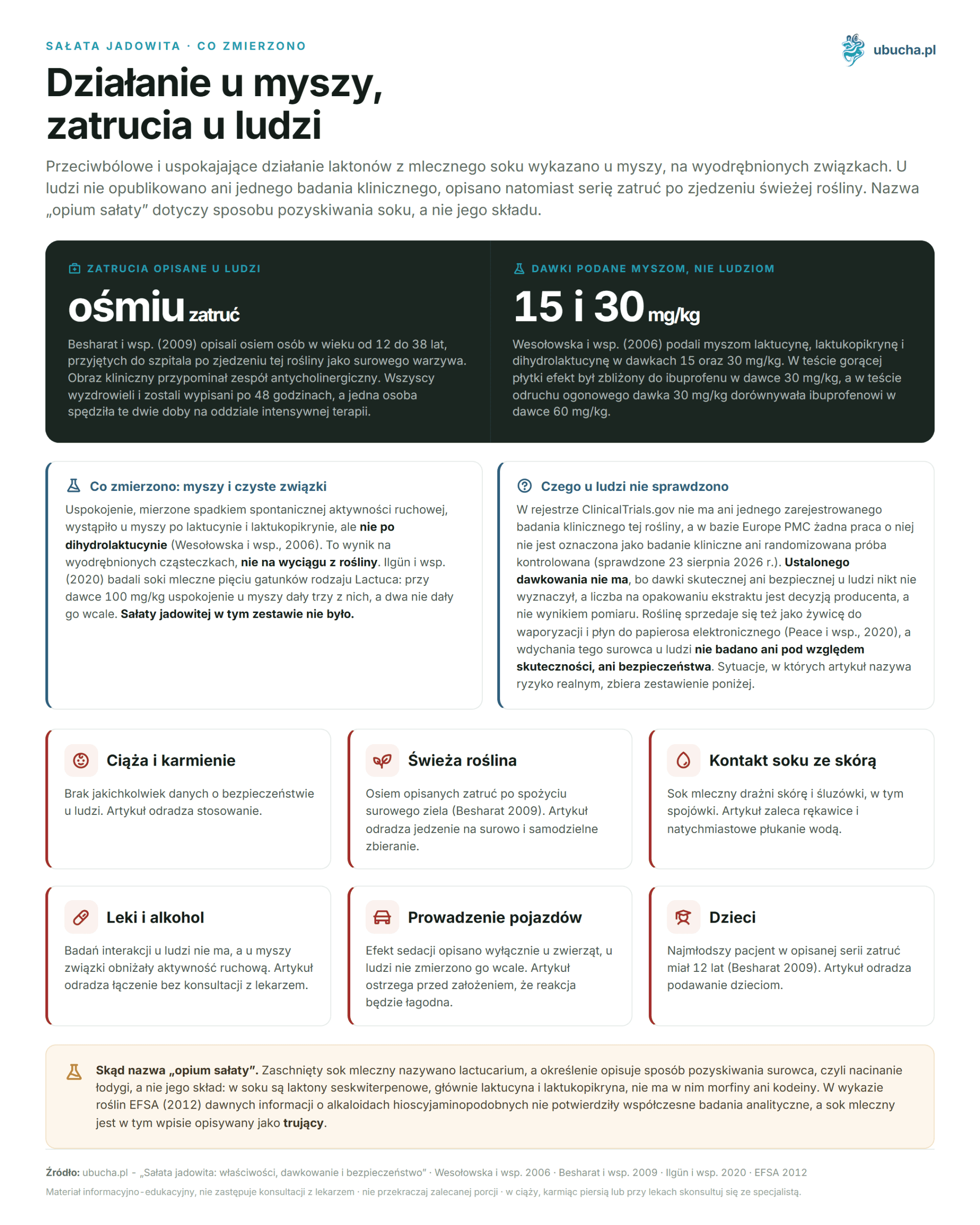
• In mice, doses of 15 and 30 mg/kg produced analgesic effects comparable to ibuprofen at a dose of 30 mg/kg (Wesołowska et al., 2006).
• In the ClinicalTrials.gov registry there is not a single registered clinical trial of this plant (checked on August 23, 2026).
• A series of eight poisonings in individuals aged 12 to 38 has been described; one of them spent 48 hours in the intensive care unit (Besharat et al., 2009).
• Previous reports of hyoscyamine-like alkaloids have not been confirmed by modern chemical analyses (EFSA plant register, 2012).
What is poison lettuce and is wild lettuce the same plant?
In the supplement trade, both names usually refer to the same species: Lactuca virosa. The Polish botanical name is poison lettuce, while wild lettuce is a commercial name that is convenient because it sounds less alarming. However, confusion can occur, as another relative grows in Polish thickets.
This relative is compass lettuce (Lactuca serriola), a common archeophyte found along roadsides and fallow lands. Poison lettuce itself originates from the western part of the Mediterranean basin and was introduced to Poland in the 19th century as a sporadically introduced plant that did not establish itself here (Atlas of Plants of Poland). So if someone claims to have collected wild lettuce in a Polish meadow, they were almost certainly holding compass lettuce, not the species from the supplement label.
A common feature of both is the white milky sap that flows from every cut part of the plant. It carries the bitter sesquiterpene lactones and irritates mucous membranes, conjunctiva, and skin. English literature refers to wild lettuce for both species at once, which is why some online reports attribute data collected on another species to poison lettuce.
What does the milky sap contain and where did the name opium lettuce come from?
Dried milky sap was called lactucarium, and this is where the term opium lettuce originated. The name describes the method of obtaining the raw material, which involves cutting the stem and collecting the coagulating milk, not its composition. The sap contains sesquiterpene lactones, but it does not contain morphine or codeine.
The history of this name is well documented in Polish. 19th-century Polish medical literature described lactucarium as a calming and analgesic agent with effects weaker than opium but free from its side effects, and pharmacists attempted to obtain it from plants cultivated in the country. The attempts made at that time to identify the substance responsible for this effect ended in failure, and medical practice had to rely on the dried sap itself (Trojanowska, 2005).
Modern chemistry has closed the case differently than advertising would like to close it. In the European EFSA plant register (2012) poison lettuce is listed with the annotation that the substances of interest are sesquiterpene lactones, and previous information about the presence of hyoscyamine-like alkaloids has not been confirmed by modern analytical studies. The same entry notes that the milky sap is described as toxic.
What have studies shown, and what has not been tested on humans?
The studies concern isolated compounds and laboratory animals. Wesołowska et al. (2006) administered lactucin, lactucopicrin, and 11beta,13-dihydrolactucin to mice at doses of 15 and 30 mg/kg. In the hot plate test, the effect was similar to ibuprofen at a dose of 30 mg/kg, and in the tail reflex test, the 30 mg/kg dose matched ibuprofen at a dose of 60 mg/kg.
Lactucopicrin was the most potent. Sedation, measured by a decrease in spontaneous motor activity, occurred after lactucin and lactucopicrin, but not after dihydrolactucin. This result is based on isolated molecules, not on an extract from the plant.
The second source of animal data is even further removed from a shelf product. Ilgün et al. (2020) studied the milky saps of five species of the genus Lactuca growing in Turkey, and at a dose of 100 mg/kg, three of them provided sedation in mice, while two did not provide any at all. Poisonous lettuce was not included in this set.
There is nothing to summarize in humans. In the ClinicalTrials.gov registry there is not a single clinical study of this plant, and in the European PMC database no paper on it is marked as a clinical study or randomized controlled trial (checked on August 23, 2026). This statement carries more information than any number that could be inserted in its place.
How is poisonous lettuce dosed, and is there a safe dose?
There is no established dosing, and no label will honestly provide it. No study has been published in humans that would determine an effective or safe dose, so the numbers printed on the packaging of extracts are the manufacturer's decision, not the result of measurement.
Animal data cannot be converted here into a capsule serving for three reasons at once. Pure compounds were administered, not an extract. Doses were calculated per kilogram of mouse body weight. The content of lactones in the raw material is variable: in HPLC measurement, it differed among species of the genus Lactuca to such an extent that some saps provided sedation, while others did not (Ilgün et al., 2020).
The practical conclusion is brief. If you are looking for a plant material with established dosing and data from human trials, poisonous lettuce is not a good choice, and better described are preparations from passiflory, rumianku or hops cones. If you still reach for an extract, treat the serving indicated on the packaging as the upper limit of an experiment worth discussing with a doctor. Products from this group can be found in the category of of plant extracts.
When does poisonous lettuce harm, and who should avoid it?
The milky sap irritates the skin and mucous membranes, and consuming the fresh plant has been described as a cause of poisoning. Besharat et al. (2009) presented eight individuals aged 12 to 38 years, admitted to the hospital after consuming this plant as a raw vegetable.
The clinical picture resembled anticholinergic syndrome: decreased consciousness, agitation, dry mucous membranes, dilated pupils, urinary retention, weakened peristalsis, and in some patients also ataxia, visual disturbances, hallucinations, nausea, and vomiting. Treatment was supportive. All recovered and were discharged after 48 hours, with one person spending those two days in intensive care due to prolonged loss of consciousness. No long-term complications were recorded.
This must be contrasted with the fact that the same plant is listed in EFSA plant register (2012) as a species whose entire above-ground part carries noteworthy substances. The table below collects situations in which the risk is real.
| Situation | What is known about it | What to do about it |
|---|---|---|
| Pregnancy and breastfeeding | No data on safety in humans | Do not use |
| Eating the fresh plant | Eight documented poisonings after consuming raw herb (Besharat 2009) | Do not eat raw, do not collect on your own |
| Contact of the juice with skin and eyes | Milk sap irritates the skin and mucous membranes, including the conjunctiva (Plant Atlas) | Gloves, immediate rinsing with water |
| Sedatives and alcohol | No studies on interactions in humans, in mice the compounds reduced motor activity | Do not combine without consulting a doctor |
| Driving vehicles | The sedative effect has only been described in animals, it has not been measured in humans at all | Do not assume that the reaction will be mild |
| Children | The youngest patient in the documented series of poisonings was 12 years old (Besharat 2009) | Do not administer |
The issue of the commercial form stands separately. Poison lettuce is sold today not only as dried herb and extract, but also as resin for vaporization and liquid for electronic cigarettes (Peace et al., 2020). Inhaling hot aerosol is a completely different route of administration than the one described in the 19th century.
Frequently Asked Questions
Is poison lettuce the same as wild lettuce?
In commercial practice, yes. Both names usually refer to the species Lactuca virosa, with poison lettuce being the botanical name and wild lettuce being the marketing name. In a botanical context, the term wild lettuce is sometimes used for compass lettuce, or Lactuca serriola.
Does poison lettuce contain opium?
No. The term opium lettuce refers to the dried milk sap, called lactucarium, and to the method of obtaining it by cutting the stem. The sap contains sesquiterpene lactones, mainly lactucin and lactucopicrin, not morphine or codeine.
How much poison lettuce can be safely taken?
Unknown. No studies have been published in humans that would determine an effective or safe dose, and the doses given to mice concerned pure compounds calculated per kilogram of body weight. The number on the extract packaging is a decision of the manufacturer, not a measurement result.
Does poison lettuce help with sleep?
There is no evidence in humans. Relaxation was measured in mice after administering lactucin and lactucopicrin, as well as after the milk juice of several other species of the genus Lactuca. None of these studies indicate whether and how the plant affects human sleep.
Can you smoke or vaporize poisonous lettuce?
Such products exist: wild lettuce is sold as powder, resin, and liquid for electronic cigarettes, and their composition is often the subject of chemical analyses. However, in humans, neither the efficacy nor the safety of inhaling this raw material has been studied.
Does poisonous lettuce grow in Poland?
Practically not. The species originates from the western part of the Mediterranean basin and is an ephemeral in Poland, meaning it is a plant sporadically introduced since the 19th century that has not established itself. Commonly found here is the compass lettuce.
Does poisonous lettuce interact with medications?
There are no interaction studies in humans, so the answer is: unknown. Since in animals, compounds from this plant reduced locomotor activity, combining it with sedatives, sleeping pills, or alcohol requires a conversation with a doctor, not personal experimentation.
What is the difference between poisonous lettuce and compass lettuce?
These are two different species of the same genus. Compass lettuce, Lactuca serriola, is a common archaeophyte along roadsides in Poland, and it is from this that cultivated lettuce was selected. Poisonous lettuce, Lactuca virosa, appears only accidentally in the Polish flora.
The article is informational and educational in nature and does not replace consultation with a doctor. If you are pregnant, breastfeeding, taking medications, or have chronic conditions, consult the use of supplements or herbs with a specialist.
Author: Michał Waluk · Published: 2026-08-24 · Updated: 2026-08-24