
Menthol, arnica, and capsaicin in muscle pain ointments - what works and what doesn't
Menthol, arnica, and capsaicin in muscle pain ointments: comparison based on evidence. Table from u Bucha.
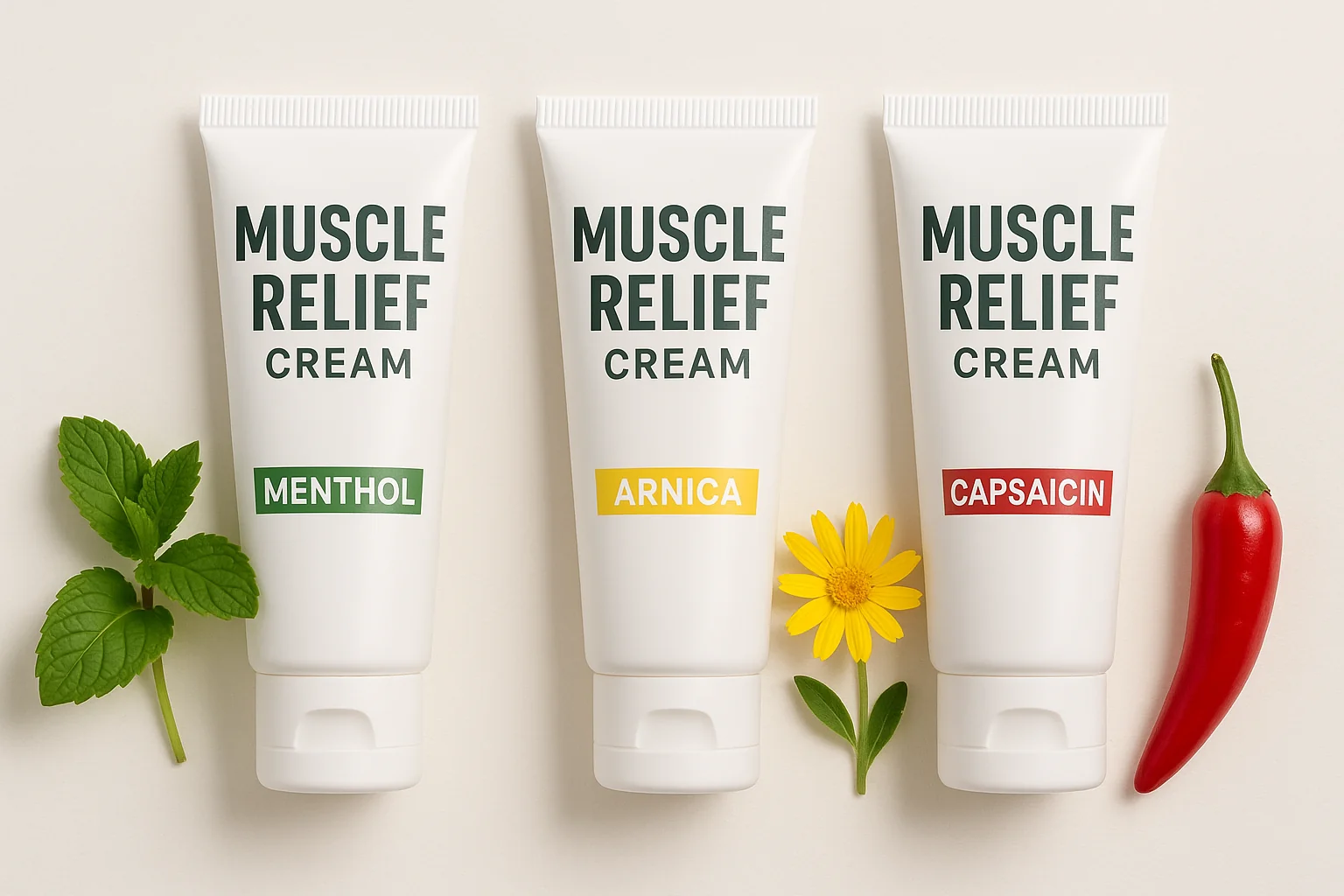
Pharmacy shelves are filled with muscle pain ointments, and their labels list dozens of active ingredients. Three of them - menthol, arnica, and capsaicin - appear most frequently. The question of whether this is just marketing or real pharmacology has a clear answer: each of these ingredients works, but in completely different ways and over different time horizons. A network review of meta-analyses published in British Journal of Sports Medicine assessing various types of topical treatment for musculoskeletal pain showed that none of these three ingredients dominates in terms of effectiveness - their effects are comparable and complementary (Derry et al., PMC, 2017). This article explains the mechanisms of each and helps choose the right one for a specific application.
KEY INFORMATION
• Menthol, arnica, and capsaicin work through three completely different mechanisms - menthol sensorially (TRPM8), capsaicin through desensitization of the pain receptor (TRPV1), arnica anti-inflammatorily (inhibition of NF-κB) (Derry et al., PMC 2017).
• Capsaicin only works after 2-4 weeks of regular use - one-time use causes burning, not relief.
• Menthol provides immediate, but temporary relief (30-90 minutes) - without treating the cause of pain.
• Arnica has moderate evidence for reducing pain and swelling after soft tissue injury (Cochrane, 2016).
Menthol - cold receptor and gate control theory
Menthol induces the well-known cooling sensation by activating the TRPM8 receptor (Transient Receptor Potential Melastatin 8) - an ion channel present in sensory neurons of the skin. TRPM8 is a cold sensor: it normally activates at temperatures below 26°C. Menthol activates this receptor chemically, without lowering tissue temperature - hence the characteristic "cold" sensation, even when skin temperature remains unchanged.
The pain-relieving mechanism of menthol is explained by the gate control theory of pain (gate control theory) by Melzack and Wall: the cold signal from Aδ fibers (fast nerve fibers) can "close the gate" to pain signals transmitted by slower C fibers in the spinal cord. The result is a temporary reduction in subjective pain sensation, although inflammation or tissue damage remains unchanged. An RCT study showed that 3.5% menthol in gel reduced muscle pain sensation by 32% for 30-60 minutes after application (Topp et al., PubMed, 2011).
Menthol is not a treatment. It is sensory override - a temporary masking of the pain signal by a competing sensory signal. For many people, such short-term relief (30-90 minutes) is sufficient after exercise or with muscle tension, but with chronic pain or recurring injury, it does not address the cause. Menthol ointments work quickly (5-15 minutes) and are suitable for occasional use before or after physical activity.
Arnika - helenalin, stan zapalny i dowody kliniczne
Mountain arnica (Arnica montana) is a plant used in folk medicine since the 16th century. Its active ingredient is helenalin - a sesquiterpene lactone with documented anti-inflammatory effects. Helenalin inhibits the transcription factor NF-κB, which is a key regulator of the inflammatory cascade - reducing the production of pro-inflammatory cytokines (IL-6, TNF-α). The result is a decrease in swelling and inflammatory pain (Lyss et al., PubMed, 1997).
Clinical evidence for arnica is of moderate quality. A Cochrane review (2016) assessing herbal topical preparations for soft tissue injuries found that arnica reduces pain and swelling compared to placebo, but the effects were clinically modest - comparable to NSAIDs (non-steroidal anti-inflammatory drugs) at low doses, but not better. Arnica works best for acute, recent muscle injuries and bruises, not for neuropathic pain or chronic joint degeneration.
An important limitation: the bioavailability of helenalin through intact skin is limited due to the size of the molecule and lipophilicity. Arnica preparations for external use typically have higher concentrations of extract than would be necessary for a systemic effect precisely because skin penetration is only partial.
| Ingredient | Mechanism | Duration of action | Strength of evidence | Best for |
|---|---|---|---|---|
| Menthol | Activation of TRPM8 (cold receptor); pain gate theory | Fast (5-15 min), transient (30-90 min) | Good - RCTs showed a 32% reduction in pain perception | Acute relief, post-exercise pain, muscle tension |
| Arnica | Inhibition of NF-κB by helenalin; anti-inflammatory action | Slower (1-4h), lasts longer | Moderate - Cochrane showed modest effects vs placebo | Acute injuries, bruises, swelling after injury |
| Kapsaicyna niska (0,025-0,1%) | Activation of TRPV1 → depletion of substance P | Efekt desensytyzacji po 2-4 tygodniach | Good with regular use; weak with a single application | Chronic pain, neuropathy, osteoarthritis |
| High capsaicin (8%) | Rapid, massive depletion of substance P | Effect after 1-2 applications, lasts 3 months | Bardzo dobra - zatwierdzona EMA/FDA (Qutenza) | Diabetic neuropathy, postherpetic |
Kapsaicyna - TRPV1, substancja P i desensytyzacja
Capsaicin is a chemical compound that gives chili peppers their characteristic heat. In a medical context, it acts through the TRPV1 receptor (Transient Receptor Potential Vanilloid 1) - an ion channel present in nociceptors (pain neurons). Activation of TRPV1 by capsaicin induces calcium ion influx into the cell, depolarizing the neuron and releasing substance P - a neuropeptide responsible for transmitting pain signals.
The paradox of capsaicin is that the substance that causes burning is also an analgesic - but only after some time. The mechanism works in two phases: the first phase is stimulation (burning, redness), the second phase is desensitization - depletion of substance P in nociceptors. With regular use (2-4 weeks for low concentrations of 0.025-0.1%), pain neurons become less reactive and transmit pain signals less effectively. This effect is lasting - not temporary like with menthol.
High-concentration capsaicin (8%) available as Qutenza is approved by the EMA (European Medicines Agency) and FDA for the treatment of neuropathic pain after shingles (postherpetic neuralgia) and diabetic neuropathy. One application (60-90 minutes under medical supervision) can provide relief for 3 months. This is a completely different mechanism than low capsaicin in homemade ointments - a literal 'burning out' of overactive nociceptors.
We have noticed that users often discontinue capsaicin ointment after the first use because the burning sensation is unpleasant and they mistakenly interpret it as evidence of the product's harmfulness. This is a mistake. The burning after the first application is a physiological response of TRPV1 - exactly what is supposed to happen. After 3-7 days of regular use, the burning significantly decreases as TRPV1 receptors begin to desensitize. Those who quit after the first use do not give capsaicin a chance to show its effects.
Other ingredients in the ointment - what else is worth knowing?
In addition to menthol, arnica, and capsaicin, muscle pain ointments often contain: camphor (mechanism similar to menthol - activation of TRPV3 and TRPM8, warming or cooling effect depending on concentration), methyl salicylate (‘wintergreen oil’) - an ester of salicylic acid with weak, local anti-inflammatory action comparable to aspirin, eucalyptus oil - a combination of menthol-like effects and anti-inflammatory properties, and hemp extract - discussed in separate articles, with endocannabinoid action through local CB1/CB2 receptors.
Diclofenac in gel form (e.g., Voltaren) is an NSAID in topical form with the strongest clinical evidence among all topical pain relievers - a Cochrane meta-analysis from 2016 showed its clear superiority over placebo for joint and muscle pain. However, diclofenac is a prescription or OTC drug at higher concentrations and works through a different mechanism (inhibition of COX-1/COX-2) than menthol, arnica, or capsaicin.
How to combine ointments with different ingredients?
Menthol and capsaicin should not be used simultaneously on the same area - simultaneous activation of TRPM8 (cold) and TRPV1 (heat) can cause strong, unpleasant burning and skin irritation. Use them alternately or on different parts of the body. Menthol in the morning for quick relief, capsaicin in the evening for a regular desensitization program - this is a sensible scheme.
Arnica pairs well with menthol - ready-made preparations combining both ingredients are available. Arnica acts on inflammation, menthol on pain perception - the mechanisms complement each other. Hemp ointment can be used alongside menthol or arnica without the risk of negative interactions - cannabinoid and thermosensitive receptors operate through different signaling pathways.
We have noticed that manufacturers of ointments often combine many active ingredients in one product (menthol + arnica + capsaicin + hemp), which sounds impressive on the label, but pharmacologically may be suboptimal. Each ingredient requires different action times and application frequencies. A product with low concentrations of all ingredients at once may be less effective than the separate use of one ingredient at an optimal concentration. One well-chosen ingredient at the right concentration is better than six ingredients in trace amounts.
When muscle pain ointment is not enough - warning signals
Topical preparations for muscle pain provide relief for strains, soreness, and tension. However, there are situations where reaching for another tube delays necessary diagnostics. Muscle pain lasting continuously for more than 6 weeks without a discernible mechanical cause, night pain that wakes you from sleep, accompanying swelling, redness, or fever - these are indications for medical consultation, not for switching to a stronger ointment.
Chronic musculoskeletal disorders, such as fibromyalgia or myositis (polymyositis), do not respond to topical TRPV1/TRPM8 medications - the pain mechanism is central or autoimmune, and no concentration of capsaicin will reach the spinal cord through the skin on the back. Studies evaluating fibromyalgia and topical analgesics (e.g., Arnold et al., J Rheumatol 2003) indicate that the basis of treatment is systemic pharmacology and physiotherapy, not topical preparations.
Allergies to ointment ingredients occur more frequently than one might think. Arnica contains sesquiterpene lactones (helenalin), which are potential contact allergens - a European review of contact allergies classifies arnica among plants with an increased risk of sensitization. Menthol at concentrations above 2% can irritate sensitive skin, and capsaicin is absolutely contraindicated on damaged skin and around the eyes. If a rash, blisters, or worsening pain instead of relief occurs after using the ointment - discontinue the product and consult a dermatologist or allergist.
How to assess the quality of ointments - what to look for when choosing?
The market for muscle pain preparations is saturated with products that differ radically in effectiveness. A label with ten active ingredients is not a guarantee of potency - the concentration of the active substance, the galenic form (gel, cream, ointment, patch), and skin penetration are key.
When choosing a menthol preparation, check the percentage concentration: below 1% is a cosmetic effect, 3-5% is the therapeutic range confirmed by studies. For capsaicin: 0.025-0.075% is OTC for regular use, 0.1-0.25% requires caution with initial applications, and Qutenza (8%) is for medical office use only. Arnica, on the other hand, does not have a standard established concentration - homeopathic products contain this substance in non-pharmacological dilutions; look for preparations with an extract standardized to at least 0.04% helenalin.
The galenic form affects penetration. Aqueous gels penetrate faster and have a cooling effect beneficial for menthol. Oily ointments create occlusion, which increases absorption through the skin, which is beneficial for capsaicin requiring regular exposure. Patches deliver the ingredient transdermally for many hours, which may be more convenient than multiple applications of gel - but do not increase the pharmacological effectiveness of the substance itself. According to EMA guidelines on the clinical development of pain medications the form of application should be matched to the planned dosing schedule.
When purchasing, also pay attention to whether the product has clinical studies or at least pharmaceutical certification (GMP), and not just cosmetic. A massage ointment is a different legal product than an OTC drug - the manufacturer's responsibility for confirming effectiveness is also different. Cosmetic preparations can only describe sensory effects (‘feeling of relief’, ‘relaxing effect’), not pharmacological analgesic action.
Frequently Asked Questions
Does menthol in ointments really reduce muscle pain?
Yes, but temporarily. Menthol activates the cold receptor TRPM8, which competes with the pain signal (gate control theory). An RCT study showed a 32% reduction in pain perception for 30-60 minutes after application of a 3.5% menthol gel (Topp et al., PubMed 2011). The effect is sensory, not therapeutic - it does not reduce inflammation or repair damaged tissue.
Does arnica work for post-workout soreness?
The evidence is moderate. A 2016 Cochrane review showed modest reductions in pain and swelling after soft tissue injury. Arnica inhibits NF-κB through helenalin, which reduces inflammatory cytokines. The effects are comparable to NSAIDs at low doses, but not better. It works best for acute injuries and bruises.
How does capsaicin work and how long does it take to see results?
Capsaicin binds to TRPV1, causing burning, and then depletes substance P responsible for transmitting pain. The desensitization effect appears after 2-4 weeks of regular use of low concentrations (0.025-0.1%). A single use causes burning without lasting relief - do not give up after the first application.
Can menthol and capsaicin ointment be used simultaneously?
It is not recommended on the same area - simultaneous activation of TRPM8 (menthol) and TRPV1 (capsaicin) can cause strong, unpleasant burning. Use alternately: menthol as needed for pain, capsaicin regularly in the evening in a desensitization program.
Which ingredients have the strongest scientific evidence?
Capsaicin 8% (Qutenza) has the strongest evidence - approved by EMA and FDA for the treatment of neuropathic pain. Menthol has good RCT evidence for short-term relief. Arnica - moderate quality evidence for anti-inflammatory effects (Cochrane 2016). None of these replace causal treatment for chronic pain.
This article is for informational and educational purposes and does not replace consultation with a doctor. If you are pregnant, breastfeeding, taking medications, or have chronic conditions, consult the use of supplements or herbs with a specialist.
Author: Michał Waluk · Published: 2026-05-04 · Updated: 2026-05-04