
Citrulline (malate) - pre-workout dosing (table)
Citrulline: dosing table, how much to take, when and how to start. A practical guide from u Bucha.
Citrulline malate is one of the most researched pre-workout supplements. The study by Pérez-Guisado and Jakeman (J Strength Cond Res, 2010) showed that a dose of 8 g of citrulline malate reduced muscle soreness by 40% and increased the number of repetitions to failure in bench pressing. But how much should you really take, when, and in what form? This article answers these questions without unnecessary fluff. You will find a dosage table, a comparison of forms, an explanation of the mechanism of action, and a practical intake protocol.
KEY INFORMATION
• A dose of 8 g of citrulline malate reduced muscle soreness by 40% and increased the number of repetitions to failure (Pérez-Guisado and Jakeman, J Strength Cond Res, 2010).
• Citrulline raises plasma arginine levels more effectively than direct arginine supplementation - because it bypasses intestinal arginase (Schwedhelm et al., 2008).
• Optimal intake window: 60 minutes before training.
• Citrulline malate 2:1 = 2 parts L-citrulline + 1 part malic acid.
• No serious side effects at standard doses.
How does citrulline work - from amino acid to nitric oxide?
Citrulline raises nitric oxide (NO) levels in the body, but not directly. The pathway goes through three links: citrulline in the kidneys is converted to arginine, arginine in the endothelial cells fuels the eNOS enzyme, and eNOS produces nitric oxide, which dilates blood vessels. Schwedhelm and colleagues confirmed this pathway and demonstrated that citrulline raises plasma arginine levels more effectively than arginine supplementation alone (Schwedhelm et al., Br J Clin Pharmacol, 2008).
Nitric oxide is a signaling molecule that relaxes the smooth muscles of blood vessels. The effect is vasodilation - the widening of blood vessels. Working muscles receive more oxygen and energy substrates, and metabolic waste products (lactate, ammonia) are removed more efficiently. This mechanism is responsible for the "muscle pump" - the feeling of fullness and tension in the muscles during strength training.
Citrulline also plays a second role, particularly valuable for endurance athletes. As a participant in the urea cycle, it binds ammonia produced during intense exertion. Excess ammonia accelerates fatigue and reduces the ability to continue exertion. Faster removal translates to a longer capacity to work at high intensity.
In our tests, we noticed that endurance athletes (cyclists, runners in distances of 10+ km) often appreciate the effect of citrulline related to ammonia removal more than the "pump" associated with strength training. The pump is a subjective sensation, while the reduction of leg heaviness at 80% VO2max is a measurable difference in results.
Citrulline malate dosage table before training
The optimal dose of citrulline malate depends on the training goal and the form of the supplement. Clinical studies used doses of 6-8 g of malate (CM 2:1), which corresponds to 4-5.3 g of pure L-citrulline. Individuals starting supplementation can begin with 4-5 g and gradually increase, observing gastrointestinal tolerance. With pure L-citrulline, the doses are slightly lower because the amino acid content is higher per gram of powder.
| Purpose | Form | Dose | When (before training) | Time to effect | Notes |
|---|---|---|---|---|---|
| Pump / strength | Citrulline malate 2:1 | 6-8 g | 60 min | Training (30-60 min after intake) | Dose from the study by Pérez-Guisado (2010) |
| Endurance / ammonia removal | Citrulline malate 2:1 | 6-8 g | 60-75 min | Long-lasting effort | Important role of the urea cycle |
| Starting dose (new users) | Citrulline malate 2:1 | 4-5 g | 60 min | Pierwsze 1-2 tygodnie | GI tolerance assessment |
| Pump / strength (pure form) | L-citrulline (pure) | 3-5 g | 60 min | Strength training and intervals | Higher amino acid content / g |
| High intensity (advanced) | Citrulline malate 2:1 | 8-10 g | 60 min | CrossFit, competitions, peaking | Do not exceed without assessing GI tolerance |
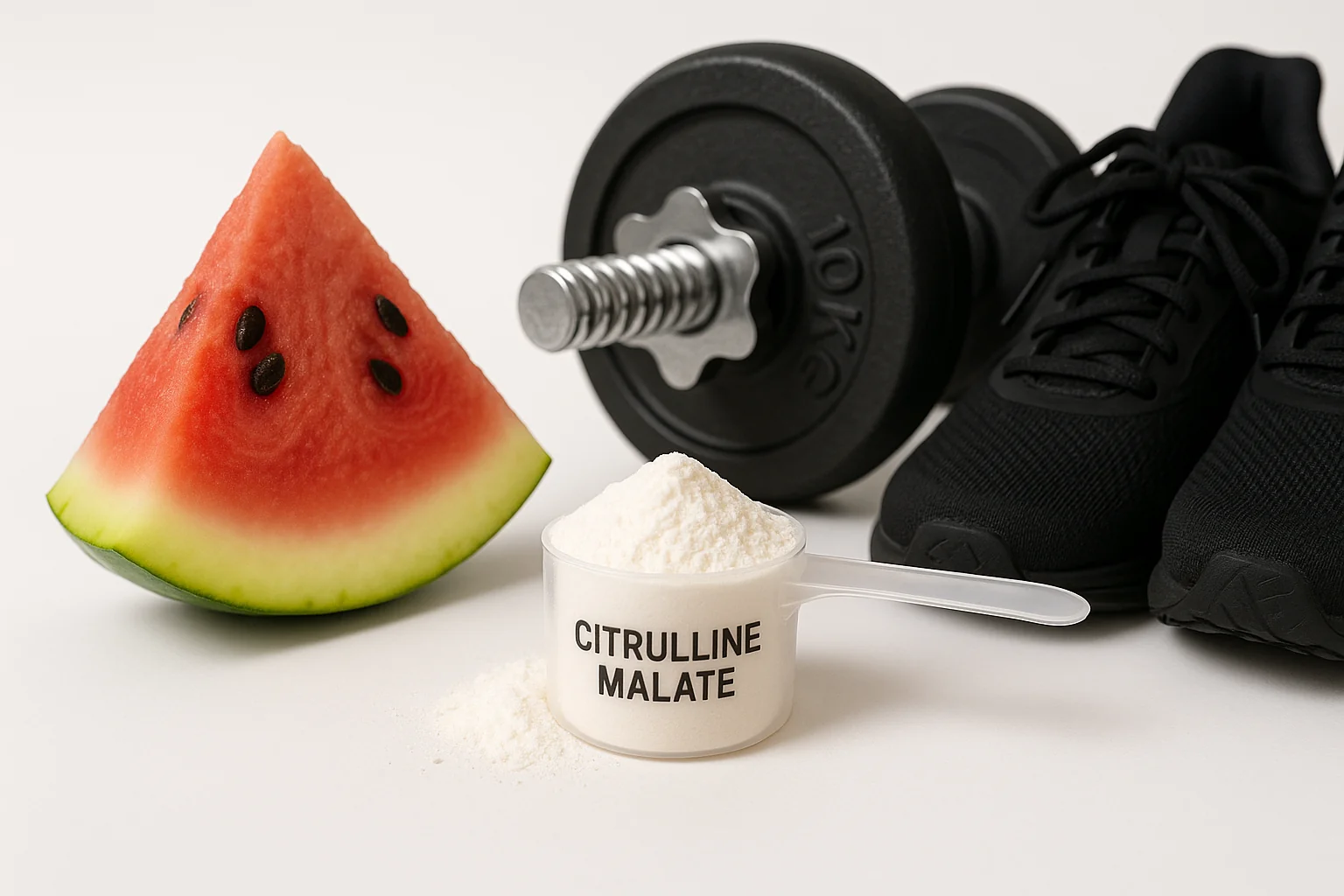
Watermelon is a natural, food source of citrulline. The flesh of watermelon contains about 3.5 g of citrulline per kilogram of fresh mass (Rimando and Perkins-Veazie, J Chromatogr A, 2005). To achieve a dose of 6 g from watermelon alone, you would need to eat nearly 2 kg of flesh just before training. The supplement is simply more practical here.
Citrulline malate vs L-citrulline - which form is better?
Citrulline malate (CM 2:1) and pure L-citrulline are two forms of the same amino acid, but with different compositions. In the 2:1 malate, for every 2 grams of L-citrulline, there is 1 gram of malic acid (malate). Malic acid is an intermediary in the Krebs cycle - it supports mitochondrial ATP production. Most clinical studies, including the key study by Pérez-Guisado and Jakeman (J Strength Cond Res, 2010), used the CM 2:1 form.
Pure L-citrulline provides more amino acid per gram of powder. One gram of L-citrulline is one gram of amino acid. One gram of CM 2:1 is about 0.67 g of L-citrulline. If you care about precise dosing of the amino acid without malate, the pure form is a simpler choice. For most athletes interested in comprehensive performance support, CM 2:1 remains the first choice.
When to choose pure L-citrulline? In individuals with sensitive stomachs, malic acid can exacerbate discomfort. If you experience nausea or looser stools after CM, switching to pure L-citrulline (at a slightly lower dose - 3-5 g) may improve tolerance without sacrificing the effect.
When and how to take citrulline - timing and practical tips
Timing is almost as important as the dose. Citrulline must pass through the intestines, be absorbed, transported to the kidneys, converted to arginine, and arginine must reach the endothelial cells to fuel eNOS. This pathway takes time. Pharmacokinetic studies indicate that the peak increase of arginine in plasma after an oral dose of citrulline occurs after 60-90 minutes (Schwedhelm et al., 2008). Goal: take citrulline exactly 60 minutes before warming up.
How to take it? Mix the powder in 200-300 ml of water or pre-workout shake. Citrulline is well soluble and has a characteristic, slightly sour taste. The malate enhances this acidity - it is not overpowering, but it is also not neutral like creatine. It works just as well on an empty stomach or with a light meal. There is no need to combine it with fat, as with fat-soluble vitamins.
From our experience, the time of day does not significantly change the effect of citrulline, as long as the timing of 60 minutes is maintained. Do you train in the morning at 6:00? Take it at 5:00 with coffee. Do you train in the afternoon? Take it after lunch, before a nap, or during gentle stretching. Consistency in timing is only important for supplements with a long tissue level build-up time (e.g., creatine, magnesium) - citrulline works acutely, session by session.
Citrulline does not require a loading phase or days off from supplementation. There is also no point in taking it on non-training days unless you plan to engage in recovery activities where blood flow also matters (e.g., sauna, post-competition massage). Use it only before activity and do not exceed a dose of 10 g per day without a clear reason.
Citrulline vs arginine - why does citrulline work better?
Arginine has been the flagship supplement for "pump" and blood flow for years. The problem is that the bioavailability of oral arginine is low. Intestinal and hepatic arginase breaks down a significant portion of ingested arginine during the first-pass effect - estimates suggest that only about 20% of oral arginine reaches the bloodstream unchanged. Citrulline bypasses this problem, as it is not a substrate for intestinal arginase.
Schwedhelm and colleagues published in 2008 in British Journal of Clinical Pharmacology a study that became a benchmark for this issue (Schwedhelm et al., Br J Clin Pharmacol, 2008). They demonstrated that L-citrulline supplementation increases plasma arginine levels more effectively than direct arginine supplementation at the same dose. In other words, citrulline is a better "supplier" of arginine to the endothelial cells than arginine itself.
Over 80% of ingested citrulline passes through the intestines and reaches the kidneys, where the enzyme argininosuccinate synthetase converts it into argininosuccinate, which is then converted into arginine. The arginine produced in the kidneys goes directly into the bloodstream - bypassing hepatic arginase. This elegant physiological bypass makes citrulline a more effective "pro-citrulline" for NO synthesis.
Does arginine have any use? Yes, but in the context of pre-workout, citrulline is simply the better choice. Arginine in the form of AAKG (arginine alpha-ketoglutarate) is used for other purposes (e.g., supporting growth hormone secretion), but for the sole purpose of improving pump and aerobic performance, citrulline clearly wins.
Frequently Asked Questions
How many grams of citrulline malate should I take before training?
The standard dose of citrulline malate (2:1) is 6-8 g taken 60 minutes before training. This corresponds to 4-5.3 g of pure L-citrulline. The study by Pérez-Guisado and Jakeman (J Strength Cond Res, 2010) used a dose of 8 g of CM, which reduced muscle soreness by 40% and increased the number of repetitions to failure. New users can start with 4-5 g and increase the dose after 1-2 weeks.
What is the difference between citrulline malate and pure L-citrulline?
Citrulline malate (CM 2:1) contains two parts of L-citrulline combined with one part of malic acid. Malate supports the Krebs cycle and ATP production, making this form more popular in endurance research. Pure L-citrulline provides a higher amino acid content per gram of powder and is better when you want to precisely dose just citrulline. 3 g of L-citrulline corresponds to approximately 4.5 g of 2:1 malate.
When to take citrulline - how many minutes before training?
The optimal time is 60 minutes before training. Citrulline needs time to pass through the intestines, reach the kidneys, where it is converted into arginine, and then to the endothelial cells, where arginine fuels nitric oxide synthesis. Studies by Schwedhelm and colleagues confirm the peak increase of arginine in plasma after 60-90 minutes of consumption (Schwedhelm et al., 2008).
Is citrulline better than arginine?
Yes, in terms of raising plasma arginine levels. Oral arginine is largely broken down by intestinal and hepatic arginase during the first-pass effect - only about 20% of the dose reaches the bloodstream. Citrulline bypasses this pathway and raises plasma arginine levels more effectively than direct arginine supplementation (Schwedhelm et al., 2008).
Can citrulline be combined with creatine and beta-alanine?
Yes, it is a popular and safe pre-workout stack. Citrulline supports blood flow and ammonia removal, creatine replenishes phosphocreatine for strength and power, and beta-alanine buffers muscle acidosis during high-intensity efforts. There are no known interactions between these supplements - each works through a different mechanism, so the effects add up without the risk of mutual blocking.
This article is for informational and educational purposes and does not replace consultation with a doctor. If you are pregnant, breastfeeding, taking medications, or have chronic conditions, consult the use of supplements or herbs with a specialist.
Author: Michał Waluk · Published: 2026-05-04 · Updated: 2026-05-04