
CBD for asthma and the respiratory system: can cannabidiol alleviate symptoms
Does CBD alleviate asthma symptoms? We check how many clinical studies exist, why smoking and inhaling oil are dangerous, and when to call an ambulance.
Asthma is a disease where a poor decision can be fatal. It affects over 300 million people worldwide, and a severe exacerbation can close airways within minutes. Therefore, the question in the title requires an exceptionally cautious answer. We checked the Europe PMC database, and the result is clear: there is not a single randomized clinical trial of cannabidiol in asthma patients in the literature. All we have are animal models and individual observations. This is too little to recommend anything and far too little to change treatment. Below, we show what research truly indicates, why inhaling anything with bronchial disease is a bad idea, and how to recognize when you need immediate help.
KEY INFORMATION
• There is no randomized clinical trial of CBD in asthma patients in Europe PMC. The two papers with asthma and cannabidiol in the title are animal models (Vuolo et al., 2015 and 2019).
• Treatment of asthma is determined by a physician. Self-discontinuation of controlling medication is dangerous.
• Smoking and vaporization are poor routes of administration in bronchial disease (Tashkin, Annals ATS, 2013).
• Vitamin E acetate was found in the lungs of 48 out of 51 EVALI patients (Blount et al., NEJM, 2020).
Can CBD replace asthma medications?
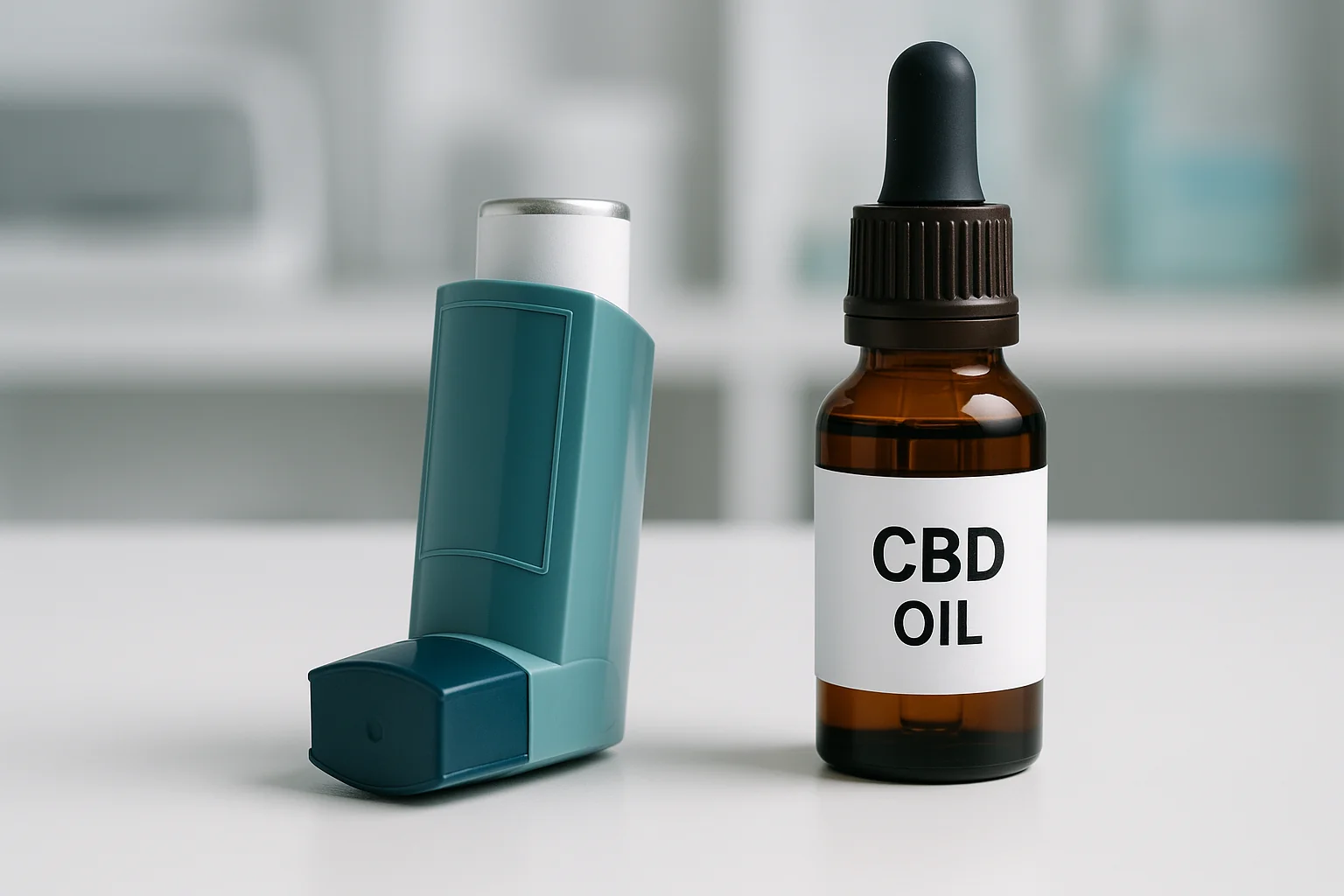
No, and it should never be used that way. Inhaled glucocorticoids and beta-2-mimetics have proven efficacy in asthma, while cannabidiol has no clinical studies supporting its use for this indication. The decision about what medications you take and in what doses is made by your attending physician, not an article on the internet.
This is the most important sentence in the entire text, so we will state it plainly: independently reducing the dose of inhaled glucocorticoids or discontinuing them in favor of a supplement is dangerous. The controlling medication does not act immediately; it suppresses inflammation that persists between attacks. When it is absent, inflammation quietly returns, and the first signal may only be a severe exacerbation. Similarly, one must not forgo rescue medication. An asthma attack is interrupted by a short-acting beta-2-mimetic administered via inhalation, not sublingual drops.
The authors of the review Lewandowska i wsp. (International Journal of Molecular Sciences, 2025) ask whether cannabinoids have any place in asthma treatment and cautiously respond: at most as hypothetical support for patients resistant to available pharmacotherapy, after studies that have not yet been conducted. No cannabidiol product is registered for asthma in Poland or the European Union.
Is there even one clinical study on CBD in asthma?
There are none. We checked this directly in Europe PMC on August 8, 2026. A query for works that simultaneously include asthma and cannabidiol in the title returns exactly two entries, both concerning rodents. A query for randomized clinical trials with cannabidiol and asthma returns not a single study in which asthma patients received CBD.
It is important to understand what this means. The absence of a study is not the same as evidence of ineffectiveness. It means that no one knows whether cannabidiol helps, does nothing, or harms a person with asthma. We do not know the answers to the simplest questions: does it change the number of exacerbations, and is it safe for someone who is already taking three inhaled medications? In medicine, the lack of safety data in a potentially life-threatening disease is treated as a risk, not as a green light.
That is why you will not find dosages in this article. There is no study from which they could be derived, and stating a number would suggest knowledge that no one possesses.
What did animal studies show and what did they not show?
They showed a reduction in inflammation and bronchial hyperreactivity in ovalbumin-sensitized rodents. They showed nothing about humans. These are two different things, and mixing them is the most common mistake in texts about cannabidiol and the respiratory system.
W pracy Vuolo i wsp. (Mediators of Inflammation, 2015) Rats with induced asthma received cannabidiol via intraperitoneal injection. Serum levels of IL-4, IL-5, IL-13, IL-6, and TNF-alpha decreased, while IL-10 levels remained unchanged. Four years later Vuolo i wsp. (European Journal of Pharmacology, 2019) the experiment was repeated on mice: cannabidiol reduced bronchial hyperreactivity, decreased the amount of collagen fibers in the walls of the airways and in the alveolar septa, and lowered inflammation markers in bronchoalveolar lavage fluid.
In the same 2019 study, the only human thread appears. The authors measured the expression of CB1 and CB2 receptors in induced sputum from asthma patients and found an inverse relationship between CB1 levels and lung function. No one administered cannabidiol to these individuals. This is an observation about the biology of the disease, not a treatment test. Also, note the route of administration in animals: intraperitoneal injection. It cannot be replicated with drops, gels, or especially not via inhalation.
How does the endocannabinoid system work in the respiratory tract?
Bidirectionally, and that is the crux of the matter. CB1 receptors are located on the endings of bronchial nerves, and the endocannabinoid anandamide can both inhibit and induce bronchoconstriction, depending on the tension of the vagus nerve. This was described by Calignano i wsp. (Nature, 2000) u gryzoni.
The same study reminds us of something that popular texts ignore: some asthma patients respond to tetrahydrocannabinol with paradoxical bronchoconstriction. Therefore, airway dilation after cannabinoids is not a rule, but one of two possible outcomes. In isolated human bronchi taken from 88 patients, tetrahydrocannabinol inhibited cholinergic contraction through presynaptic CB1 receptors (Grassin-Delyle i wsp., British Journal of Pharmacology, 2014).
And here a gap appears that is easy to overlook. These data concern tetrahydrocannabinol, which is a CB1 agonist. Cannabidiol is not a CB1 agonist, so the argument "CB1 dilates bronchi, therefore CBD dilates bronchi" is simply false. Cannabidiol is attributed anti-inflammatory effects through other pathways, generally described by Nagarkatti i wsp. (Future Medicinal Chemistry, 2009). A coherent mechanism is still just a hypothesis, not a result.
Dlaczego palenie konopi szkodzi drogom oddechowym?
Because smoke damages exactly that part of the respiratory system that is already diseased in asthma. Regular cannabis smoking causes visible and microscopic damage to large bronchi and is associated with symptoms of chronic bronchitis, which subside after cessation of smoking. This was shown by Tashkin (Annals of the American Thoracic Society, 2013), summarizing several decades of their own research.
The same review mentions two mechanisms that are particularly inconvenient in asthma: loss of cilia in bronchial epithelium and impaired ability of alveolar macrophages to kill microorganisms. Cilia are a cleansing system for the bronchi from mucus, and in asthma, there is too much mucus. Tashkin honestly notes that the pulmonary risk of cannabis smoking is lower than that of tobacco smoking and that a clear link with chronic obstructive pulmonary disease has not been established. However, this is not an argument for smoking in asthma, but rather that tobacco is worse.
There is little data on asthma patients themselves, and they are observational in nature. In an analysis of 552,160 hospitalizations due to asthma from 2016 to 2021, a diagnosis of cannabis dependence was associated with higher in-hospital mortality (adjusted odds ratio 2.40) and a higher risk of severe exacerbation (Sule-Saa i wsp., Cureus, 2025). This is a correlation, not a causal proof, but the direction is clear.
Can CBD oil be inhaled, nebulized, or dropped into an inhaler?
No. Oils are not intended for inhalation and there is no safe way to create an aerosol from oil for the lungs at home. The fat that reaches the pulmonary alveoli can cause lipid pneumonia, which is a chronic inflammatory response around oil droplets that cannot be quickly reversed.
The best-documented warning is the EVALI epidemic. Vitamin E acetate, added as a thickener to cannabinoid cartridges, was found in bronchoalveolar lavage fluid in 48 out of 51 patients and in none of the 99 individuals in the control group (Blount i wsp., New England Journal of Medicine, 2020). The substance was considered harmless until it reached the lungs.
Cannabidiol in aerosol form is also not neutral. Love i wsp. (American Journal of Respiratory Cell and Molecular Biology, 2025) They demonstrated that commercial vaporization cartridges produce cannabidiol quinone, which forms covalent bonds with the TOP2A protein in human respiratory epithelial cells, silencing cell cycle genes and inhibiting divisions. A broader review of the toxicology of inhaled vaporization products was gathered Traboulsi i wsp. (International Journal of Molecular Sciences, 2020). We noticed that oil manufacturers never declare suitability for inhalation, and this is not an oversight, but a conscious limit of responsibility.
What asthma symptoms require immediate help?
Those for which nothing is checked except calling emergency services at 112. An asthma exacerbation can escalate over hours or minutes, and some warning signals are mistakenly perceived as improvement. The table below collects symptoms for which one should not wait until morning.
| Warning signal | What it means |
|---|---|
| Shortness of breath worsens despite rescue medication | The exacerbation is getting out of control |
| No response to rescue medication or the need to repeat it every few minutes | A life-threatening state, medical help needed |
| Cyanosis of the lips, tongue, or fingers | Hypoxia, a state of immediate life threat |
| Speaking in single words, lack of strength to finish a sentence | Severe limitation of airflow |
| Wheezing diminishes, while shortness of breath intensifies | Airflow is so low that it does not generate sound |
| Drowsiness, confusion, agitation | Objaw hiperkapnii, wskazanie do pilnej interwencji |
Guidelines for managing acute exacerbations of obstructive diseases have been gathered Elsey i Allen (Clinical Medicine, 2021). No supplement is included in this algorithm, and there is no reason for it to ever be included.
Does CBD interact with asthma medications?
It may interact, as cannabidiol inhibits cytochrome P450 enzymes, through which some medications pass. A review Papakyriakopoulou i wsp. (British Journal of Clinical Pharmacology, 2026) describes the impact of cannabinoids on CYP3A4 and CYP2C19 as a real problem in polytherapy. Asthma often involves polytherapy.
| Lek | Metabolic pathway | What to ask the doctor |
|---|---|---|
| Teofilina | CYP1A2 | Narrow therapeutic window, monitoring concentration |
| Budezonid, flutykazon | CYP3A4 | Risk of increased systemic exposure |
| Montelukast | CYP3A4, CYP2C8, CYP2C9 | Possible change in medication concentration |
| Salbutamol, formoterol | Mainly outside of CYP | Unlikely interaction |
| Leki biologiczne | Protein distribution | Without the involvement of cytochrome P450 |
The table is a map of questions, not a verdict. The strength of each of these interactions depends on the dose of cannabidiol, the form of the preparation, and how well asthma is controlled. Only someone who sees your complete list of medications, such as your doctor or pharmacist, can make a determination.
It's important to know which way such an interaction works. Inhibition of the enzyme does not weaken the medication; it only increases its concentration in the blood, so the risk pertains to side effects, not loss of efficacy. With theophylline, symptoms of overdose can include nausea, palpitations, and tremors. Therefore, the conversation about cannabidiol in asthma begins with a list of medications, not with the choice of a product.
What to do if you are still considering CBD for asthma?
Start by talking to a pulmonologist or allergist and ask for a clear answer: yes or no. Be direct about which product you want to use and in what form. Bring the packaging and a list of all medications, including over-the-counter ones, to the appointment. Until this conversation, do not change anything in your asthma treatment.
If the doctor has no objections, there are three boundaries that should not be crossed under any circumstances. The form should be exclusively oral or sublingual, never inhaled. The asthma treatment plan remains unchanged, and you carry your rescue medication with you just like before. Any worsening of asthma control means stopping the supplement and contacting your doctor, not increasing the dosage.
We have noticed that most questions come from people who simply want to use their inhaler less frequently. This is understandable, but it is not the way to achieve the goal. Using the rescue medication less often is achieved through better control of inflammation, which means treatment set up with a doctor, and by removing triggers from the environment. A diary can be helpful: measuring peak expiratory flow, the number of uses of the rescue inhaler, and sleep quality. We discuss more about allergic mechanisms in the post CBD na alergie, and about immunity during the infection season in the post CBD and colds and immunity.
Frequently Asked Questions
Does CBD cure asthma?
No. There is not a single randomized clinical trial of cannabidiol in asthma patients in Europe PMC. Two studies that have asthma and cannabidiol in the title are animal models: Vuolo i wsp. (2015) on rats and Vuolo et al. (2019) on mice. Results from rodents do not automatically transfer to humans.
Can you smoke or vaporize CBD with asthma?
No. Regular smoking of cannabis damages the epithelium of the large bronchi, causes loss of cilia, and is associated with symptoms of chronic bronchitis (Tashkin, Annals ATS, 2013). Aerosol from a vaporizer also irritates hyperreactive airways. With bronchial disease, you inhale only what your doctor has prescribed.
Is it permissible to put CBD oil into a nebulizer or inhaler?
No. Oils are not intended for inhalation, and fat in the lung alveoli poses a risk of lipid pneumonia. Vitamin E acetate from vaping cartridges was found in the lungs of 48 out of 51 patients with EVALI and in none of the 99 healthy individuals (Blount i wsp., NEJM, 2020).
Can CBD replace inhaled glucocorticoids?
No. Inhaled glucocorticoids and beta-2 agonists have proven efficacy in asthma, while cannabidiol has no clinical trials supporting its use for this indication. The prescribing doctor decides on medications and their dosages. Self-reducing or discontinuing a control medication can lead to exacerbations and can be dangerous.
Does CBD interact with asthma medications?
Maybe. Cannabidiol inhibits CYP enzymes, including CYP3A4 and CYP2C19, thus altering the concentrations of medications metabolized this way (Papakyriakopoulou i wsp., BJCP, 2026). Theophylline, which has a narrow therapeutic window, and inhaled glucocorticoids metabolized by CYP3A4 require special attention.
When to call an ambulance for asthma?
When shortness of breath worsens despite rescue medication, when the medication stops working or needs to be repeated every few minutes, when cyanosis of the lips or fingers appears, when you speak in single words and cannot finish a sentence, and when drowsiness or confusion increases. The emergency number is 112.
Hemp oils for oral and sublingual use, including the CANNOVA line, can be found in the section oils in the u Bucha store. None of them are suitable for inhalation.
This article is for informational and educational purposes and does not constitute medical advice. Before starting to use cannabis or CBD for therapeutic purposes, consult a doctor, especially if you are taking other medications, are pregnant, or breastfeeding.
Author: Michał Waluk · Opublikowano: 2026-06-22 · Aktualizacja: 2026-08-08