
Psychobiotic: how gut bacteria affect mood and stress
Psychobiotic – what it is and how gut bacteria affect mood, stress, and anxiety. The best-studied strains, dosage, and a 4-week usage protocol.
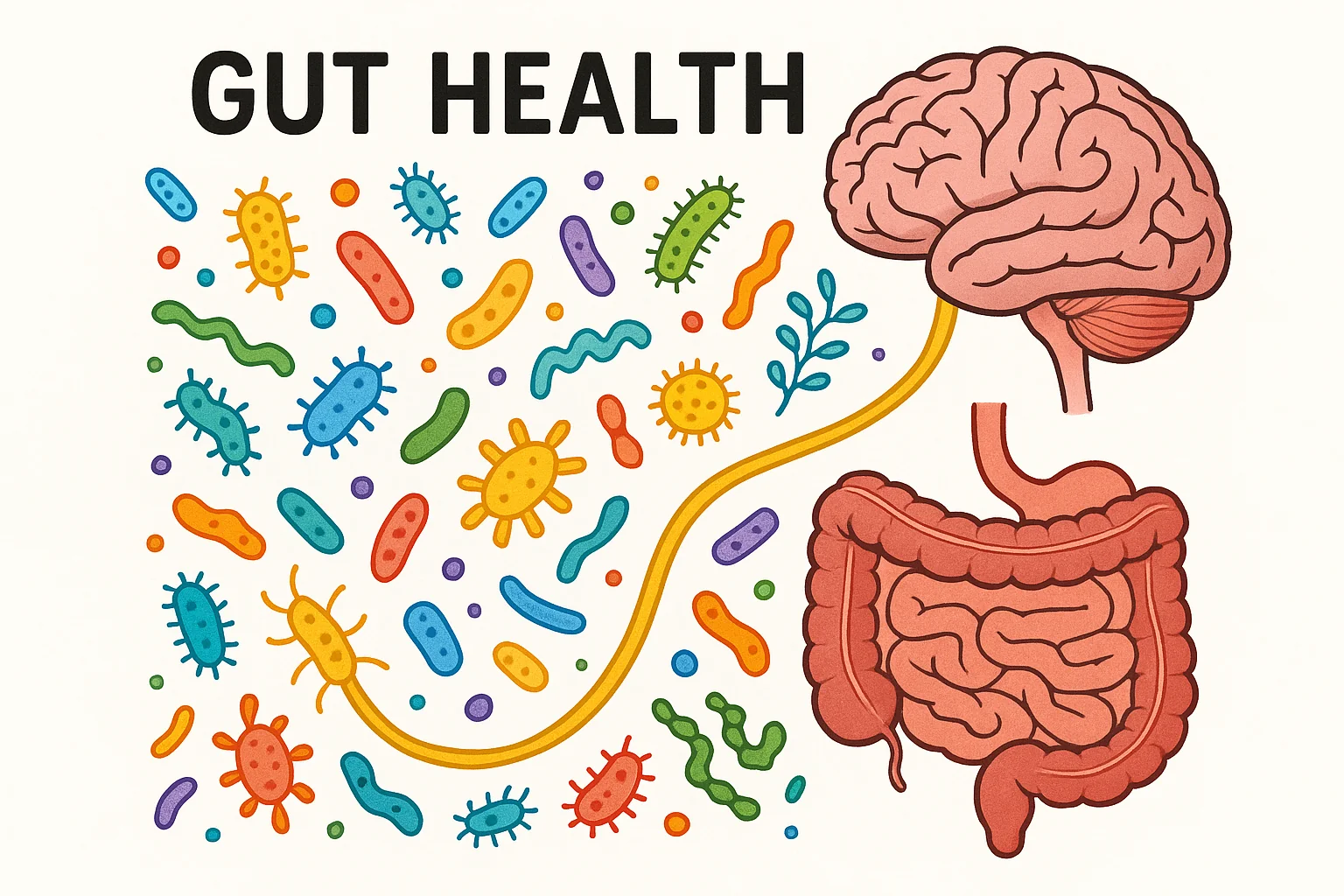
Over 90% of serotonin – a neurotransmitter crucial for mood, well-being, and emotional stability – is produced by gut cells, not the brain. This single fact has upended traditional understanding of mental health and opened a new area of research: psychobiotics. A psychobiotic is a probiotic with documented effects on mental functions through the gut-brain axis. This is not a metaphor or hypothesis – it is a field supported by randomized clinical trials with specific strains of bacteria. In Poland, the topic is still niche, but interest is growing rapidly. This article explains what psychobiotics are, which strains have real effects, how the gut-brain axis translates into mood and stress, and how to build a 4-week supplementation protocol.
KEY INFORMATION
• A study by Messaoudi et al. (British Journal of Nutrition, 2011) involving 55 adults showed that the combination of L. helveticus R0052 + B. longum R0175 significantly reduced cortisol in urine and anxiety scale scores compared to placebo over 30 days.
• 90% of serotonin is produced by enterochromaffin cells in the gut – the gut microbiome directly regulates this production through metabolites and signaling via the vagus nerve.
• Termin „psychobiotyk” wprowadzili Dinan, Stanton i Cryan (Biological Psychiatry, 2013) – zdefiniowali go jako żywy mikroorganizm wywierający pozytywny wpływ na zdrowie psychiczne przez oś jelito-mózg.
• The effects of psychobiotics are visible after 4–8 weeks of regular use – treatments shorter than 2 weeks do not yield measurable mental effects.
What is the gut-brain axis and why does it affect mood?
The gut-brain axis is a network of bidirectional communication between the gastrointestinal tract and the central nervous system. The channels of this communication include: the vagus nerve (the 10th cranial nerve, transmitting signals from the gut directly to the brain), the immune system (the microbiome activates immune cells that produce cytokines affecting the brain), the HPA axis (gut stress activates cortisol secretion), and microbiome metabolites (short-chain fatty acids – SCFA, GABA, serotonin, histamine). A review by Cryan et al. (Cell, 2019) summarizes a decade of research on this axis as one of the most important publications in the field of neuroscience.
Mikrobiom jelitowy zawiera biliony bakterii, grzybów i wirusów – łącznie ok. 38 bilionów komórek, mniej więcej tyle co komórek ludzkich. Nie jest statycznym „filtrem” – to aktywny organ endokrynny i neuroaktywny. Zaburzenia mikrobiomu (dysbioza) korelują ze zwiększoną częstością depresji, lęku i autyzmu w badaniach epidemiologicznych. Pytanie o kierunek przyczynowości (czy zły mikrobiom powoduje złe zdrowie psychiczne, czy odwrotnie) jest nadal badane, ale pierwsze badania interwencyjne z psychobiotykami sugerują efekt przyczynowy.
Which strains of psychobiotics have the best clinical evidence?
Not every probiotic is a psychobiotic. Effects on mental health have been demonstrated for several specific strains in controlled studies.
L. helveticus R0052 + B. longum R0175: The best-studied combination. Messaoudi et al. (British Journal of Nutrition, 2011) przeprowadzili RCT z podwójnie ślepą próbą z 55 uczestnikami. Przez 30 dni uczestnicy przyjmowali Probio-Stick (produkt zawierający te dwa szczepy) lub placebo. Wyniki: istotna redukcja wolnego kortyzolu w moczu (p=0,027), poprawa wskaźnika objawów somatycznych (HSCL-90) i wskaźnika lęku (HADS) w grupie probiotyk vs placebo. To solidne RCT, które czyni tę kombinację „złotym standardem” psychobiotyku.
L. rhamnosus JB-1: A study in a mouse model by Bravo et al. (PNAS, 2011) showed that L. rhamnosus JB-1 reduces anxiety and depression in mice by modulating GABA-A receptors – the same pathway as benzodiazepines, but without addictive effects. The effects disappeared after cutting the vagus nerve, confirming that the mechanism is neuronal. Human studies are promising but less numerous than for L. helveticus R0052.
L. acidophilus + B. bifidum + B. longum (multistrain mixtures): Several smaller RCTs have shown improvement in symptoms of depression and anxiety in patients with IBS (irritable bowel syndrome), where the coexistence of gut and mental symptoms is very common. A review by Simpson et al. (Frontiers in Psychiatry, 2021) analyzing 30 RCTs with a total of 1624 participants found a moderate but statistically significant improvement in symptoms of depression and anxiety with the use of multistrain probiotics compared to placebo.
How do psychobiotics affect cortisol and stress?
Cortisol is a key biomarker of chronic stress. In the study by Messaoudi et al. (2011), the psychobiotic L. helveticus R0052 + B. longum R0175 significantly lowered free cortisol levels in urine (a marker of 24-hour cortisol production) over 30 days with no effect in the placebo group. Mechanism: probiotic bacteria modulate the reactivity of the HPA axis through the vagus nerve and metabolites (SCFA), reducing excessive cortisol production in response to psychological stress.
: psychobiotics do not completely block cortisol – cortisol is essential for proper immune function, glucose regulation, and stress response. The action of psychobiotics is rather normalizing and adaptogenic: in individuals with chronic stress and elevated cortisol, it may lower it, while in those without stress, it does not show clinically significant effects on cortisol. This is a classic feature of an adaptogen – no effect when balance is maintained, compensatory action when balance is disturbed. In this respect, psychobiotics are the only probiotic that demonstrates a truly adaptogenic profile of action on the stress axis.
Our observations: Psychobiotics work best as part of a broader gut health strategy. Simply adding a psychobiotic capsule while consuming a diet high in sugar, processed foods, and low in fiber will yield minimal effects – probiotic strains need a substrate (prebiotics) to multiply in the intestines. The best results are seen in individuals who simultaneously increase their fiber intake (vegetables, legumes, oats) and fermented foods (yogurt, kefir, pickles) as prebiotics for the psychobiotic.
4-week psychobiotic protocol – how to use it effectively
Psychobiotic effects are not immediate. Probiotic colonies must stabilize in the microbiome, and neurochemical changes (serotonin production, modulation of the HPA axis) take time. Here is a practical protocol for 4 weeks:
Week 1–2 (adaptation): Start with the standard dose of the chosen psychobiotic (1–5 billion CFU daily), preferably in the morning with a meal. At the same time, increase your intake of prebiotics: 1 serving of fermented food or kefir daily, more vegetables and legumes. Transient gastrointestinal symptoms (gas, bloating) may occur – this is normal and temporary.
Week 3–4 (stabilization): Continue with the probiotic and prebiotics. During this period, the first effects on mood and stress tolerance begin to become visible. Keep a mood diary (0–10 scale every evening) – this will allow for an objective assessment of the effects. Limit alcohol and processed foods that disrupt the microbiome.
Assessment of effects after 4 weeks: if you see an improvement in mood, better stress tolerance, and regular digestion – continue. The effects of the psychobiotic persist with regular use. After discontinuation, probiotic colonies gradually diminish within 2–4 weeks, so the effects depend on the continuity of supplementation.
Practical tip: You can buy a psychobiotic from a pharmaceutical refrigerator or as a product shipped on ice – heat destroys live bacterial cultures. Check the storage temperature on the packaging: 2–8°C is the standard for most probiotics with live cultures. Products with lyophilized bacteria are more temperature-resistant and easier to transport, but may have slightly lower bioavailability than fresh cultures. When choosing between forms: enteric-coated capsule (EC) protects bacteria from stomach acid and is the optimal choice for strains sensitive to acidic environments, such as L. rhamnosus.
Psychobiotics and irritable bowel syndrome (IBS) – what do studies say?
IBS (Irritable Bowel Syndrome) and mood disorders coexist at a significantly higher frequency than random: an estimated 50–70% of IBS patients also have anxiety or depression. The gut-brain axis is likely a bidirectional cause – gut dysbiosis triggers mental dysfunction and vice versa. Psychobiotics as an intervention targeting both the gut microbiome and the nervous system are particularly interesting in IBS.
Badanie O’Mahony et al. (Gastroenterology, 2005) involving 77 IBS patients showed that B. infantis 35624 significantly reduced abdominal pain, bloating, and difficulties with bowel movements over 8 weeks compared to placebo, while also normalizing the IL-10/IL-12 ratio (a marker of immune balance). The gut effects were associated with improvements in mental symptoms in the same patients.
Kilka metaanaliz dotyczących probiotyków przy IBS wskazuje, że szczepy wieloszczepowe (L. acidophilus, L. rhamnosus, B. longum, B. bifidum) dają lepsze wyniki niż monoszczepy. Dla pacjentów z IBS-D (biegunkowy) sprawdzają się szczepy L. rhamnosus i L. acidophilus. Dla IBS-C (zaparciowy) – B. longum i B. bifidum. Ta specyficzność szczepów pokazuje, że „probiotyk” to nie jedna kategoria produktu, lecz wiele różnych bakterii o różnych właściwościach.
Psychobiotics and sleep – does the microbiome affect the quality of nighttime rest?
The relationship between the microbiome and sleep is a relatively new area of research. The microbiome modulates melatonin secretion (through the production of gut-derived serotonin as a precursor) and influences the circadian rhythm through signaling from the vagus nerve to the suprachiasmatic nuclei (SCN) – the biological clock in the hypothalamus.
Studies in animal models have shown that mice with germ-free intestines have disrupted circadian rhythms and reduced sleep quality. After colonization with probiotics, the rhythm normalizes. Thaiss et al. review (Nature, 2016) describes the microbiome as one of the regulators of circadian rhythm in mammals.
In humans, correlations between microbiome diversity and sleep quality have been confirmed in observational studies. The study by Smith et al. (Frontiers in Microbiology, 2019) with 26 participants showed a positive correlation between microbiome diversity (measured as alpha-diversity) and sleep efficiency and reduction of nighttime awakenings. However, this directionality is still under investigation – it is not yet known whether improving the microbiome directly improves sleep, or if both parameters depend on a common factor (e.g., diet and physical activity).
Psychobiotics and diet – what to eat to support psychobiotics?
The psychobiotic itself has limited effects without an appropriate diet. The gut microbiome is an ecosystem – probiotic psychobiotic strains need a substrate to reproduce and form stable colonies. The substrate is prebiotics – indigestible fibers and oligosaccharides that probiotic bacteria feed on.
The most important prebiotics for psychobiotics: inulin and FOS (fructooligosaccharides) in onions, garlic, leeks, and artichokes; beta-glucan in oats and barley; pectins in apples and citrus fruits; resistant starch in cooled potatoes and rice; polyphenols in berries, dark chocolate, and green tea. Schmidt et al. study (Psychopharmacology, 2015) showed that prebiotics (FOS + GOS) administered for 3 weeks reduced reactivity to negative emotional stimuli – a psychological effect associated with changes in the microbiome, achieved solely through a prebiotic diet without probiotics.
Stres sam w sobie zmienia skład mikrobiomu: przewlekły kortyzol niszczy szczelność bariery jelitowej (zwiększa „leaky gut”) i redukuje różnorodność bakteryjną, co zamyka błędne koło stres→dysbioza→więcej stresu→więcej dysbiozy. Psychobiotyk może ten cykl przerwać, ale tylko jeśli dieta dostarcza mu narzędzi do pracy.
Fermented foods (natural yogurt, kefir, kimchi, sauerkraut, tempeh, miso) are a natural source of live bacterial cultures. The study by Wastyk et al. (Cell, 2021) involving 36 healthy participants showed that a diet rich in fermented foods for 10 weeks significantly increased microbiome diversity and reduced 19 markers of inflammation – including CRP and IL-6. The effect was stronger than with a high-fiber diet without fermentation. This suggests that daily yogurt or kefir can be just as valuable as a psychobiotic capsule if it provides the appropriate strains and live cultures.
Learn more about ashwagandha – an adaptogen that reduces cortisol as a complement to psychobiotic therapy – in the article Ashwagandha and CBD together – synergy for stress.
It is also worth remembering that psychobiotics and adaptogens do not compete with each other. Ashwagandha reduces cortisol through a direct effect on the HPA axis, while the psychobiotic does so by normalizing the microbiome and signaling via the vagus nerve. The mechanisms are complementary, and using both together may provide an additive effect on stress tolerance – although there is a lack of clinical studies directly assessing this combination.
Frequently Asked Questions
What is a psychobiotic?
A psychobiotic is a live microorganism that, when consumed regularly, has a documented positive effect on mental health through the gut-brain axis. The term was introduced by Dinan et al. (Biological Psychiatry, 2013). Not every probiotic is a psychobiotic – specific strains of Lactobacillus and Bifidobacterium have demonstrated psychobiotic properties in clinical studies.
Which strains of psychobiotics are the best studied?
The best-studied combination is L. helveticus R0052 + B. longum R0175 (Probio-Stick): Messaoudi et al. (BJN, 2011) demonstrated a reduction in cortisol (p=0.027) and anxiety after 30 days in a RCT with 55 participants. L. rhamnosus JB-1 showed anxiolytic effects in mice through GABA-A modulation (Bravo et al., PNAS, 2011).
How long does it take for a psychobiotic to work?
The first effects are visible after 2–4 weeks, with full effects after 4–8 weeks of regular use. Treatments shorter than 2 weeks do not yield measurable mental effects. The study by Messaoudi et al. used the psychobiotic for 30 days as the minimum observation time.
How do psychobiotics affect mood?
Through five parallel mechanisms: stimulating the production of gut serotonin, communication via the vagus nerve, producing SCFAs that modulate inflammation, regulating the HPA axis and cortisol, and (for L. rhamnosus JB-1) modulating GABA-A receptors. None of these mechanisms works in isolation – together they create a psychobiotic effect.
Do psychobiotics replace antidepressants?
No. Psychobiotics are a support for mild to moderate stress and emotional discomfort in healthy adults. In cases of clinical depressive, anxiety, or other psychiatric disorders, consultation with a psychiatrist and appropriate treatment are essential. A psychobiotic can complement therapy, but not replace it.
How to use psychobiotics – dosage and time of day?
Once a day in the morning with a meal or 30 minutes before a meal. The minimum effective dose is 1–10 billion CFU per serving, depending on the strain. Store in the refrigerator. Do not combine with hot beverages (>40°C) – temperatures above 43°C inactivate the bacteria. Use for a minimum of 4 weeks, preferably 8–12 weeks continuously.
This article is for informational and educational purposes and does not replace consultation with a doctor. If you are pregnant, breastfeeding, taking medications, or have chronic conditions, consult the use of supplements or herbs with a specialist.
Author: Michał Waluk · Published: 2026-05-04 · Updated: 2026-05-04