
Bacopa monnieri: properties for memory and concentration and how to dose
Bacopa monnieri (brahmi) for memory and concentration. What studies involving humans have really shown, how long it takes to see effects, and what they did not show.
Bacopa monnieri, known as brahmi in Ayurveda, is one of the few herbs studied in healthy adults, not just in individuals with diagnosed cognitive disorders. However, the studies that form the basis of most claims about this plant speak more cautiously than they are usually quoted: the improvement pertains to the recall of new information and processing speed, not short-term memory or attention in all its dimensions. The effect appears after weeks, not days. This article breaks down these studies into their components: who participated, how long the study lasted, what improved, and what remained unchanged. You will also find a list of things that studies did not demonstrate, as with bacopa, this second list is as important as the first.
KEY INFORMATION
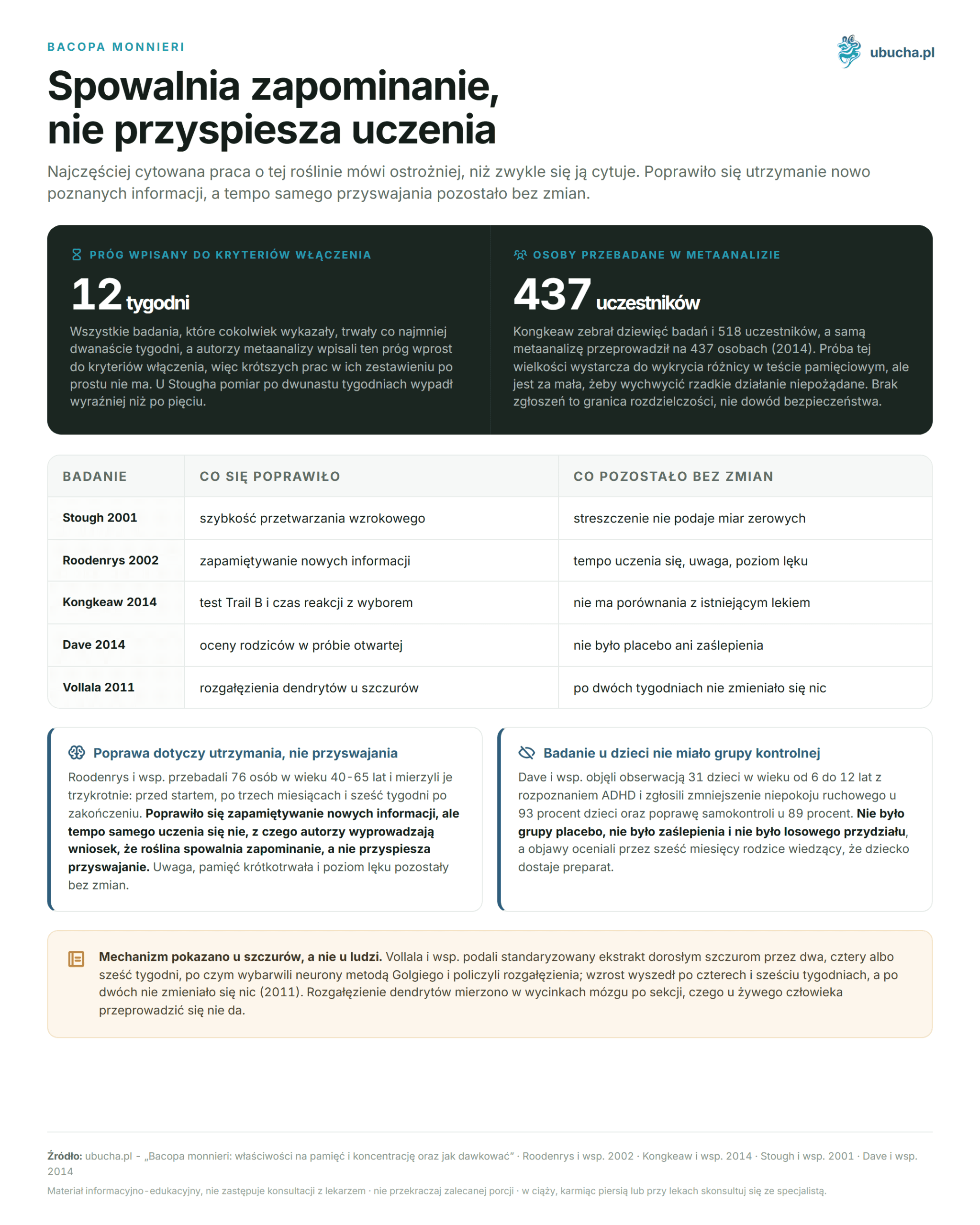
• Roodenrys et al. (Neuropsychopharmacology, 2002) studied 76 individuals aged 40-65 over three months in a double-blind placebo-controlled design. Recall of new information improved, while attention, short-term memory, and anxiety levels remained unchanged.
• Kongkeaw et al. (Journal of Ethnopharmacology, 2014) gathered nine studies and 518 participants. The effect is visible in the Trail B test and in reaction time with choice, meaning the speed of attention.
• The authors of this meta-analysis caution that the matter will only be resolved by a large study comparing bacopa directly with an existing drug. Such a study is still lacking.
• Bacopa is not a drug. This text describes the doses used in studies but does not provide a portion to measure at home.
How does bacopa monnieri affect the brain?
The best-documented mechanism is the stimulation of dendritic tree growth in neurons, which are the branches through which nerve cells exchange signals. However, this has been shown in rats, not in humans, and it's worth remembering this with every statement about "brain remodeling."
Vollala et al. administered a standardized extract of bacopa to adult Wistar rats in three doses per kilogram of body weight for two, four, or six weeks, then stained the neurons using the Golgi method and counted the branches. In two independent studies from 2011, one concerning the amygdala (Clinics), drugiej CA3 neurons of the hippocampus (Romanian Journal of Morphology and Embryology), the result was the same: a significant increase in the number of branches and the length of dendrites at the two higher doses after four and six weeks. After two weeks, there was no change. The animals learned faster in the T maze and better maintained the learned avoidance response.
This is a real premise, but not proof for humans. The doses were given here in relation to the body weight of the rodent, the extract was standardized differently than pharmaceutical preparations, and dendritic branching was measured in brain sections after dissection. Such measurements cannot be conducted on a living human. Thus, we have a coherent narrative: a change in the structure of neural connections in rodents, and in humans, a change in memory test results after a similarly long time. These two observations fit together, but have not yet been connected by a single study.
What did studies involving humans show?
Three studies carry most of what is known about bacopa in humans: better retention of newly learned information, faster reaction in some attention tests, and in one study, reduced situational anxiety. Each also lists a similarly long list of measures that did not change.
Stough i wsp. (Psychopharmacology, 2001) they administered 300 mg of bacopa extract (Keenmind preparation) or placebo to healthy adults in a double-blind setup, and neuropsychological tests were conducted at baseline and after five and twelve weeks. The speed of visual information processing improved, the rate of learning and memory consolidation measured by a word learning test improved, and the level of situational anxiety decreased.
Roodenrys i wsp. (Neuropsychopharmacology, 2002) they examined 76 individuals aged 40-65 and measured them three times: before the start, after three months, and six weeks after completion. The retention of new information improved, but the rate of learning itself did not, leading the authors to conclude that bacopa slows forgetting rather than speeding up acquisition. Attention, verbal and visual short-term memory, and recall of knowledge from before the study remained unchanged. The level of anxiety also remained unchanged.
Kongkeaw i wsp. (Journal of Ethnopharmacology, 2014) they gathered nine studies and 518 participants, and conducted the meta-analysis on 437 individuals. Only studies with placebo lasting at least twelve weeks and conducted without accompanying medications were included in the review. Improvement was observed in the Trail B test and in reaction time with choice, which the authors summarize as an effect on the speed of attention. They add that only a large study comparing bacopa with an existing drug will resolve the matter.
| Study | Who and for how long | What improved | What remained unchanged |
|---|---|---|---|
| Stough 2001 | healthy adults, 300 mg, 12 weeks, placebo | speed of visual processing, rate of learning, memory consolidation, situational anxiety | no data in the available summary |
| Roodenrys 2002 | 76 individuals aged 40-65, 3 months, placebo | retention of new information, meaning slower forgetting | rate of learning, attention, short-term memory, level of anxiety |
| Kongkeaw 2014 | meta-analysis of 9 studies, 518 participants, analysis on 437 | Trail B test, reaction time with choice, meaning speed of attention | no studies comparing bacopa with a drug |
The areas of improvement only partially overlap, and the effect on anxiety measured by Stough did not replicate in Roodenrys. This is an herb with moderate effects, not a substance that is felt by the user.
How long do you have to wait for the effect and why so long?
All studies that showed any results lasted at least twelve weeks. Kongkeaw et al. included this threshold directly in the inclusion criteria for the meta-analysis, so there are simply no shorter studies in their compilation. This is the strongest practical information from all this material.
In Stough's study, measurements were taken after five and twelve weeks, and the difference between these two points clearly tilts in favor of the latter. In Roodenrys' study, the first measurement after the start was only after three months, so this work says nothing about the earlier course. In rats, Vollala's boundary lay between the second and fourth weeks: after two weeks, dendritic branching did not differ from the control, but after four and six, it did.
The practical conclusion is uncomfortable for someone looking for support before a session or presentation. Bacopa does not have documented immediate effects. There is also no study that would check what happens after discontinuation, except for one measurement in Roodenrys six weeks after the study ended. If someone promises you an effect after a week, they are not basing it on these works. You can find a comparison of bacopa with other plants with similar promises in the entry about supplements for concentration and memory in light of research.
Does bacopa help children with ADHD?
There is one study that is cited in this context by almost everyone, and it is significantly weaker than it is often described. It is worth knowing it in detail, as it serves as a good example of the difference between a clinical study and a clinical study with a control group.
Dave i wsp. (Advances in Mind-Body Medicine, 2014) They observed 31 children aged 6 to 12 diagnosed with ADHD according to DSM-IV criteria at a center in Mumbai from 2008 to 2010. The children received 225 mg of standardized extract (BacoMind) daily for six months, and the severity of symptoms was assessed by parents using an observational scale before and after the treatment. A reduction in motor restlessness was reported in 93 percent of the children, improvement in self-control in 89 percent, and a decrease in attention deficit symptoms in 85 percent. Learning difficulties improved in 78 percent, impulsivity in 67 percent, and psychiatric problems in 52 percent of the participants.
These numbers look impressive, and that is precisely why a caveat must be added, which the authors themselves provide in the methodology description. The study was open-label. There was no placebo group, no blinding, and no random assignment. The symptoms were assessed by parents who knew that their child was receiving the treatment for six months, during a time when ADHD symptoms naturally change. In such a setup, it is impossible to separate the effect of the extract from the passage of time and the expectations of the person filling out the questionnaire. This study is a basis for designing a proper trial with a placebo, not a foundation for administering anything to a child. We discuss more about what is and what is not supported by research in our post about herbs and supplements for ADHD alongside treatment.
How to choose an extract and what to look for on the label?
The most important information on the packaging is the standardization for bacosides, meaning the declaration of what percentage of the extract consists of compounds considered active. Without this number, it is unclear how much raw material is contained in the declared weight of the capsule, and the differences between products can be substantial.
The second tip comes directly from the discussed studies. In Stough's work, a product described as Keenmind was used, while in Dave et al.'s study, it was BacoMind produced in Bangalore. These are not purchase recommendations, but rather information that the results pertain to specific, defined extracts, not just any powder from bacopa leaves. Kongkeaw et al. included only studies on standardized extracts in their meta-analysis, so all the material discussed here pertains to this specific form of the raw material.
The third point concerns the form. Powdered dried leaves and extract are not the same product, and they cannot be converted one to another at home, as the content of bacosides in the dried material depends on the plant's origin and the time of harvest. If you have dried material in your hands and not a standardized extract, none of the numbers from this article apply to it.
We consciously do not provide a daily dosage here. The doses mentioned above describe what was given to participants in specific studies, and nothing more. Whether and how much bacopa makes sense in your situation is determined by your doctor or pharmacist, especially if you are taking medications regularly.
Where does the name brahmi come from and what does Ayurveda say about it?
In Ayurvedic tradition, bacopa is classified as a medhya rasayana, meaning plants described as rejuvenating intellect and memory. This classification appears in scientific works on bacopa as a starting point, as it led researchers towards memory tests, rather than the other way around.
It is worth noting how accurately this traditional category aligns with what later emerged in studies, and how much it simultaneously diverged from them. Ayurveda spoke of intellect and memory as a whole. Studies involving humans showed a narrow slice: better retention of newly learned information and faster responses in some attention tests, with no impact on short-term memory and no effect on recalling knowledge that the participant already possessed. The tradition pointed to the plant and the area, but not the resolution of the effect.
Caution in such comparisons is warranted for another reason. The convergence between the old description and the contemporary result is easily noticed when the result is positive, but overlooked when it is zero. Ayurveda attributed effects of brahmi to epilepsy and mental disorders, and the studies discussed here do not cover these applications at all. Tradition can be a good guide for raising questions, but only research provides the answers. How bacopa compares to other plants with a similar tradition is described in the comparison of natural nootropics for concentration and memory.
Safety and interactions: who should be cautious?
The most commonly reported side effects of bacopa concern the gastrointestinal tract: discomfort in the upper abdomen, nausea, bloating, and loose stools. These usually intensify when taken on an empty stomach. These are observations described in the literature, not results from a study designed to count complications.
However, what is significantly more important is what the discussed studies could not detect by design. Roodenrys et al. studied 76 individuals, and Kongkeaw's meta-analysis included 437 participants. A sample of this size is sufficient to detect differences in memory test results, but it is too small to catch rare adverse effects. Therefore, the lack of reports in these studies is not evidence of safety, but rather a limitation of their resolution.
The second gap concerns medications. Kongkeaw et al. included only studies conducted without accompanying medications in their meta-analysis, which is methodologically correct and simultaneously means that we have no data on combining bacopa with pharmacotherapy from this material. Individuals undergoing chronic treatment, particularly neurologically and psychiatrically, should discuss bacopa with their attending physician, rather than drawing conclusions from results obtained on individuals not taking medications.
Separately: there are no studies on bacopa in pregnant and breastfeeding women, and studies in children are limited to the open-label trial described above with 31 participants. In both groups, the available material does not allow for any certain conclusions, and this is a different situation than demonstrating safety.
Frequently Asked Questions
Does bacopa monnieri really improve memory?
To a limited extent, yes. Roodenrys et al. (2002) showed better recall of new information in 76 individuals without affecting the rate of learning, attention, or short-term memory. A meta-analysis by Kongkeaw (2014) with 518 participants added an improvement in attention speed in reaction time tests.
How long does it take for bacopa to start working?
All studies that showed an effect lasted at least twelve weeks, and this threshold was included in the inclusion criteria of Kongkeaw's meta-analysis. In Stough's study, the measurement after twelve weeks was clearer than after five. No one has demonstrated immediate effects of bacopa, so it is not a remedy for a single evening.
What dose of bacopa was used in the studies?
Stough et al. administered 300 mg of standardized extract to healthy adults for twelve weeks, while Dave et al. gave 225 mg daily to children for six months. This describes research protocols, not recommendations. The appropriate portion for you is determined by a doctor or pharmacist.
Does bacopa monnieri have side effects?
The most commonly reported side effects are gastrointestinal issues, exacerbated when taken on an empty stomach. However, the largest meta-analysis included 437 participants, so the sample size is too small to detect rare complications. The lack of reports in these studies does not equate to demonstrating safety.
Does bacopa help children with ADHD?
The only widely cited study is an open trial by Dave et al. (2014) on 31 children, without placebo, blinding, or random assignment, with symptom assessment by parents. In such a setup, it is impossible to separate the effect of the preparation from the passage of time and expectations. This is insufficient to give anything to a child without consultation.
How does bacopa differ from caffeine?
Caffeine acts within minutes and its effect is self-reported. In the case of bacopa, none of the discussed studies measured immediate effects, and changes only emerged in tests after weeks. Therefore, one should not expect a clear subjective feeling of stimulation or evaluate the preparation after the first few days.
You can find plant extracts and herbal dried materials, including small-leaved bacopa, in the category herbs.
This article is for informational and educational purposes and does not constitute medical advice. Before starting supplementation, consult your doctor, especially if you are taking medications regularly, are pregnant or breastfeeding, or have a chronic illness.
Author: Michał Waluk · Opublikowano: 2026-05-29 · Aktualizacja: 2026-08-15