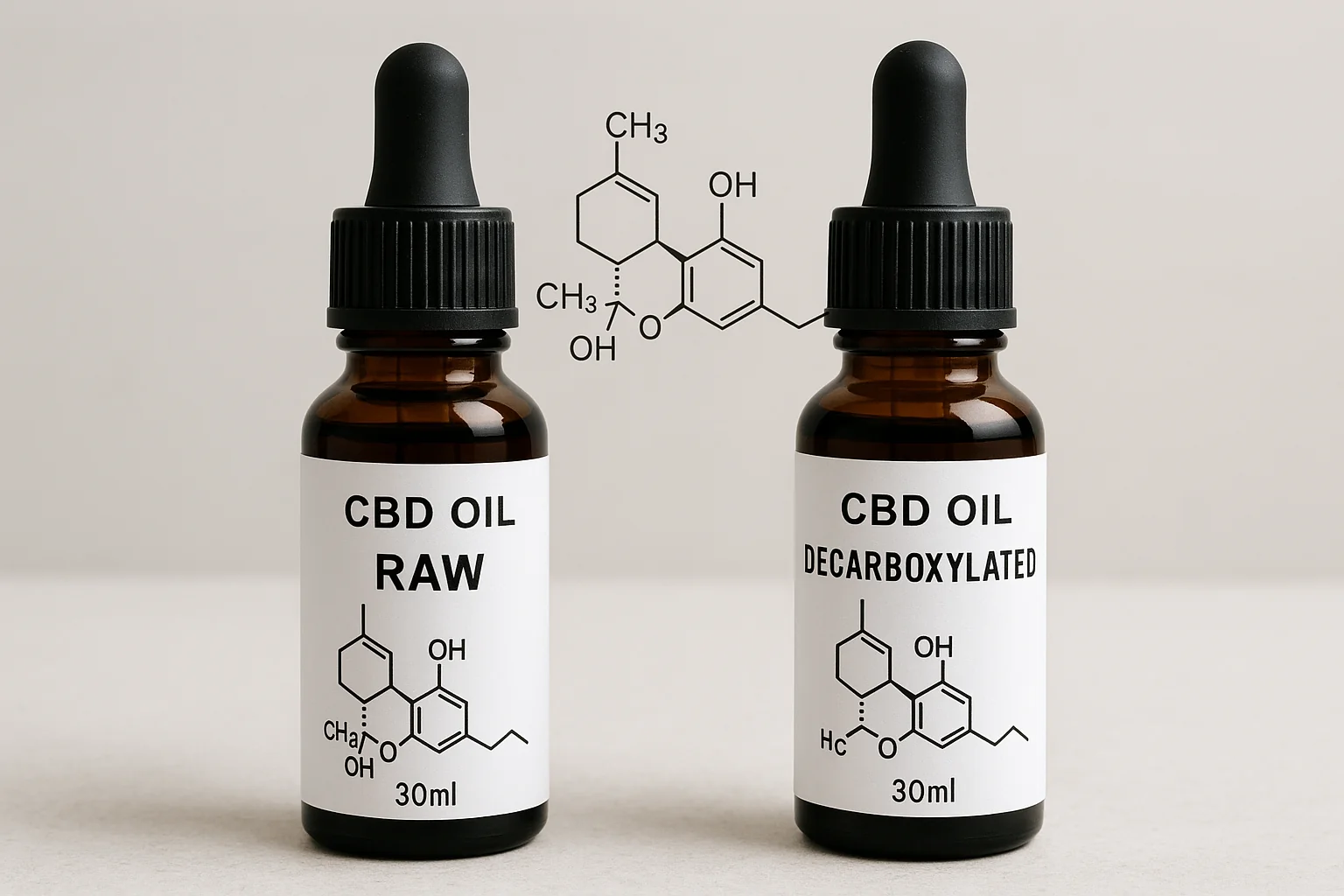

CBD RAW oil vs decarboxylated: what do they mean and which one to choose
CBD RAW or decarboxylated oil: how CBDA works, how to read batch testing, and what oils the u Bucha store has. Prices and cost for 100 mg as of August 8, 2026.
CBDA inhibits the COX-2 enzyme about nine times more strongly than COX-1, and this is due to the same carboxyl group that is removed by heating (Takeda i wsp., Drug Metabolism and Disposition, 2008). This is not just a curiosity for chemists. It is the reason why two bottles with identical percentages on the label can act differently. An oil described as RAW mainly contains the acidic form, which is CBDA. The decarboxylated oil has undergone controlled heating, during which CBDA becomes CBD. The price difference can be symbolic, but the difference in the action profile is not. Below you will find the mechanism of both forms, how to read the batch test results, and a comparison of sublingual oils that the u Bucha store has in stock today, along with the cost of 100 mg for each.
KEY INFORMATION
• CBDA inhibits COX-2 about nine times more strongly than COX-1 (Takeda et al., Drug Metabolism and Disposition, 2008).
• Decarboxylation is at 110-130°C for 30-60 minutes: CBDA becomes CBD.
• None of the eight sublingual oils in the store are described as RAW or decarboxylated.
• Six CANNOVA oils declare CBDA and CBGA in their profile. Cost for 100 mg: from 9.50 PLN to 22.50 PLN.
What is the difference between RAW CBD oil and decarboxylated oil?
RAW is an oil that predominantly contains CBDA, which is the acidic form of cannabidiol present in the living plant. Decarboxylated has undergone controlled heating, during which CBDA loses its carboxyl group and becomes CBD. It is the same molecule after removing one fragment, but the receptors react differently to both.
Cannabis does not produce CBD or THC directly. It produces their acidic precursors: CBDA and THCA. In the fresh, unheated plant, it is the acidic forms that make up the majority of the cannabinoid pool, and CBD appears only in trace amounts. Only heat or prolonged storage shifts this ratio.
The reaction itself is chemically simple. The CBDA molecule releases a carboxyl group in the form of carbon dioxide, leaving CBD. A producer aiming for a decarboxylated profile keeps the extract at 110-130°C for 30-60 minutes. A producer wanting to maintain the RAW profile skips this step and carefully monitors the temperature at every stage, from extraction to packaging.
The difference is noticeable even before opening the bottle. RAW has a dark green color from chlorophyll, a thicker consistency, and a distinctly herbal, bitter taste. The decarboxylated version has a golden amber color and tastes milder. However, color is a clue, not proof: the batch test result is what ultimately matters, as we discuss below.
Does CBDA work without decarboxylation?
Yes, and this is the most commonly misrepresented part of this story. CBDA has its own pharmacological profile, not the status of a semi-product waiting to be heated. Takeda i wsp. (Drug Metabolism and Disposition, 2008) they measured that it inhibits COX-2 with an IC50 of about 2 micromoles and with approximately nine times the preference for COX-1.
COX-2 produces prostaglandins responsible for pain and swelling. Non-steroidal anti-inflammatory drugs inhibit it, but the more popular ones do so non-selectively and also affect COX-1, which is the isoform that protects the stomach lining. The selectivity described for CBDA goes in the same direction that pharmacology has taken with coxibs. The authors also checked what conditions it depends on: after methylating the carboxyl group, the preference for COX-2 disappeared.
The second documented mechanism concerns nausea. Bolognini i wsp. (British Journal of Pharmacology, 2013) they demonstrated that CBDA blocks vomiting in the Suncus murinus and nausea behaviors in rats by enhancing the activation of the 5-HT1A receptor. The effect appeared at doses lower than those needed for CBD in the same model.
We noticed while organizing this text that store descriptions repeat one sentence: CBDA needs to be activated. The literature does not confirm this. Heating changes the action profile, but does not turn it on from scratch. It is also worth remembering the limits of this data: both studies describe animal models and in vitro systems, so transferring them directly to humans remains a hypothesis.
How does decarboxylation proceed and what happens to the oil?
Decarboxylation is heating the extract to 110-130°C for 30-60 minutes. Within this window, CBDA converts to CBD almost entirely, while most terpenes remain in the bottle. Outside of this window, losses begin, and in both directions.
Too low a temperature or too short a time results in a mixture: part of the pool is still acidic, part is already neutral, and the label only refers to percentages. Too high a temperature works in the opposite direction. Above 160°C, CBD oxidizes to CBN, terpenes evaporate, and the oil loses the scent that was supposed to be its hallmark.
Therefore, a trustworthy producer concludes the process with batch testing and shows the profile after decarboxylation, not before it. As a result, for decarboxylated CBD oil, CBD dominates, CBDA drops to trace amounts or is marked as "not detected," and the ratio of CBD to CBDA exceeds 10 to 1.
There is also a variant about which the product cards say the least: decarboxylation occurs on its own. Slowly, at room temperature, over months, and faster in heat and sunlight. A RAW oil purchased a year ago may have a different composition today than on the day it left the packaging facility, even though the label on the bottle hasn't changed.
The same reaction explains why heating oil in the kitchen is not a good idea for home decarboxylation. An oven maintains temperature with a tolerance of several degrees, and the difference between 130 and 165°C is the difference between CBD and CBN. The result can be an oil weaker than the original, but without the scent.
Which sublingual oils are currently on the shelf at u Bucha?
Eight items. Six are CANNOVA Natural oils in 10 ml bottles from the Oils category, and two are Green Out Pure XL in 20 ml bottles, assigned to the Green Out category. None of these eight is labeled as RAW or decarboxylated.
This is an important finding for this topic, so we will state it clearly. The cards for all six CANNOVA oils list CBDA and CBGA alongside CBD, CBDV, CBN, and CBG in the profile, meaning the acidic forms are declared there, just without specifying the ratios. The producer describes the extract as full-spectrum and obtained through cryo-extraction with alcohol, not as subjected to a separate decarboxylation stage. Green Out Pure XL lists one item in the composition, the hemp oil itself with a terpene profile, and says nothing about the acidic forms.
We established the order in the table based on the cost of 100 mg, as in the absence of a declared division between CBDA and CBD, this is the only comparable number between bottles of different capacities. We read the prices on August 8, 2026, from the public API of the store.
| Place | Product | What distinguishes | Cena (stan na 2026-08-08) | Koszt 100 mg |
|---|---|---|---|---|
| 1 | CANNOVA Natural CBD Oil 20%, 10 ml | 2000 mg in the bottle, about 6.7 mg per drop, profile with CBDA and CBGA | 190 zł | 9.50 zł |
| 2 | CANNOVA Natural CBD Oil 10%, 10 ml | 1000 mg in the bottle, about 3.34 mg per drop, the same extract | 110 zł | 11.00 zł |
| 3 | CANNOVA Natural CBD Oil 5%, 10 ml | 500 mg in the bottle, about 1.67 mg per drop, the smallest dosage jump | 65 zł | 13.00 zł |
| 4 | CANNOVA Natural CBG Oil 15%, 10 ml | 1500 mg in the bottle, equal to 5 mg per drop, CBG dominates | 240 zł | 16.00 zł |
| 5 | CANNOVA Natural CBG Oil 10%, 10 ml | 1000 mg in the bottle, about 3.34 mg per drop, CBG dominates | 175 zł | 17.50 zł |
| 6 | CANNOVA Natural CBG Oil 5%, 10 ml | 500 mg in the bottle, about 1.67 mg per drop, the cheapest entry into CBG | 100 PLN | 20.00 zł |
| 7 | Green Out Pure XL, 20 ml (O.G. Kush albo Critical Jack) | ponad 200 mg w butelce, sam olej konopny z profilem terpenowym | 45 zł (regularly 55 zł) | up to 22.50 zł |
How much does 100 mg cost in each of these oils?
From 9.50 zł to 22.50 zł, which is more than double the range for the same form of administration. The cheapest is CANNOVA CBD 20 percent, the most expensive is Green Out Pure XL, and between them, there is a clear relationship: the higher the concentration in the bottle, the lower the cost per milligram.
The difference seems insignificant until you multiply it by a year. At 20 mg per day, 5 percent oil costs 949 zł annually, while the 20 percent version costs 694 zł. That's over 250 zł savings just on concentration, with the same producer and the same extract.
Oils with CBG come out significantly more expensive in this calculation: from 16.00 zł to 20.00 zł for 100 mg compared to 9.50-13.00 zł for CBD. The reason is raw material, as CBG occurs in smaller amounts in the plant. However, for the topic of this article, it is more important that both variants declare the same full-spectrum profile with acidic forms.
Pure XL needs to be counted separately and carefully. The producer states "over 200 mg" of phytonutrients in a 20 ml bottle, which is a threshold, not a measurement, so 22.50 zł for 100 mg is the maximum value at a promotional price of 45 zł. When returning to the regular price of 55 zł, it comes out to 27.50 zł. Additionally, there are 30 days of usability after opening, which cannot be fully utilized with one serving per day.
Aktualne ceny sprawdzaj w kategorii Oils, a Pure XL w kategorii Green Out. If the number on the product card differs from the table, the card is binding.
Dla kogo profil kwasowy, a dla kogo dekarboksylowany?
In cases of inflammatory origin, a profile with preserved CBDA sounds more reasonable, as it has documented COX-2 inhibition. In cases of anxiety, insomnia, and neuropathic pain, CBD has a stronger backing, as it has been studied in humans. However, the boundary is soft and results from the distribution of evidence, not from a sharp division of mechanisms.
On the CBD side, the data is more specific. Shannon i wsp. (The Permanente Journal, 2019) They described a series of 72 adult patients, in whom anxiety scores decreased in 57 individuals, or 79.2 percent, and sleep quality improved in 48 individuals, or 66.7 percent. This is a case series without a control group, so it does not replace randomized studies, but it concerns humans, not rodents.
On the CBDA side, it is the opposite: the mechanisms are described precisely, only in animal models and in vitro. Therefore, the statement "RAW works better on joints" currently has no support in clinical research, although it has consistent support in pharmacology. These are two different qualities of evidence, and mixing them is the most common mistake in descriptions of this pair of products.
From our experience in conversations with customers, the same emerges as from the mechanism. People who did not achieve an effect with joint pain more often returned satisfied after using a product with a clear presence of acidic forms than after increasing percentages in the same bottle. This is an observation, not a research result, and should be treated as such.
The practical consequence is one. If you are just looking for your dose, start with a lower concentration, as the jump per drop is smaller: at 5 percent, a drop is about 1.67 mg, while at 20 percent, it's already about 6.7 mg. You can change the profile later; you establish the dose first. We outlined the scheme in the text about dawkowaniu CBD.
How to read a batch test for CBD and CBDA?
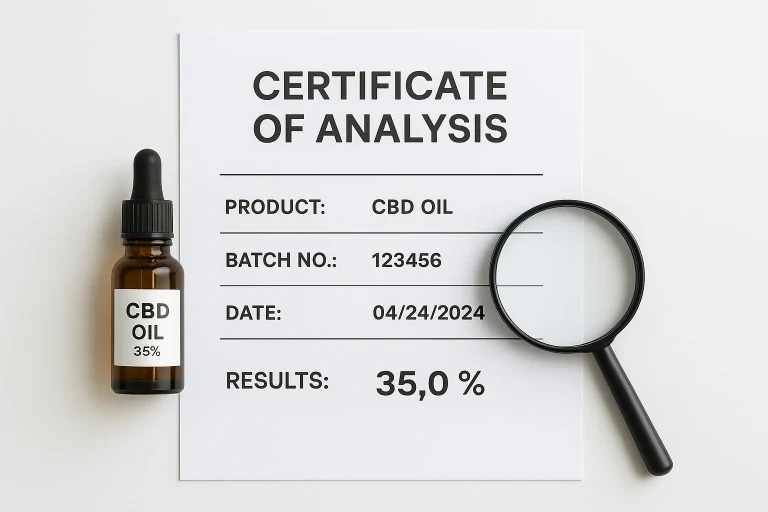
Look for two separate lines, CBD and CBDA, each with a value in mg per ml. The percentage on the label does not clarify anything, as it does not indicate the form of the content. Without this breakdown, you won't be able to distinguish RAW oil from decarboxylated oil, regardless of what the manufacturer has written on the front of the bottle.
The scale of discrepancy between the label and actual content is documented. Bonn-Miller et al. (JAMA, 2017) They tested 84 oils from 31 companies, and only 26 of them, or 31 percent, fell within a 10 percent tolerance of the declaration. THC was detected in 18 samples, up to 6.43 mg per milliliter. With acidic forms, the risk of discrepancy is even greater, as the composition changes after the result is issued.
How to interpret the report you already have in hand:
- CBDA clearly exceeds CBD, for example, 40 mg per ml versus 10 mg per ml: this is a RAW profile.
- CBD dominates, and CBDA falls below 5 mg per ml or is marked as "not detected": this is a decarboxylated profile.
- Both values are significant: this is a full-spectrum extract without a separate decarboxylation stage, meaning a mixed variant.
- A test date older than a year for RAW oil: the result describes more of the past than the content of the bottle.
Also check the batch number. The result should correspond to this packaging, not a series from two years ago, as with acidic forms, the passage of time realistically changes the composition.
How to store oil so that CBDA does not convert to CBD?
Coolness, darkness, and airtight closure. These three conditions slow down spontaneous decarboxylation, as heat, UV radiation, and the passage of time drive it. A refrigerator at 4-8°C or a dark cabinet below 15 degrees takes care of most of the issue.
The worst scenario is a bottle left in the car. The interior of a car on a sunny day can exceed 60°C, and at such a temperature, the conversion accelerates many times compared to room conditions. Another common mistake is keeping the oil on the kitchen windowsill, where both light and heat from the stove act simultaneously.
How much do you actually lose? When stored in the refrigerator and in darkness, the change in profile over the course of a year is minimal and imperceptible for most users. In heat and light, RAW oil can shift towards the decarboxylated profile within a few months, without any visible signal on the bottle.
You won't assess this by color change. A lighter hue or a weaker herbal scent may suggest that something has shifted, but they can also result from the oxidation of the carrier itself. Certainty comes only from retesting, which no one orders for a single bottle. A practical conclusion is simpler: for RAW profiles, buy smaller packages and use them up faster. We discuss durability more broadly in the text about przechowywaniu olejku CBD, and we break down the differences between types of extracts in the post full spectrum vs broad spectrum.
Frequently Asked Questions
What is RAW CBD oil?
RAW is an oil dominated by CBDA, the acidic form of cannabidiol present in the living plant. The extract has not been heated, so it retains acidic forms, chlorophyll, and terpenes. You will recognize it by its dark green color and bitter, herbal taste, but certainty comes only from the batch test result with separate lines for CBD and CBDA.
Co zmienia dekarboksylacja w olejku?
Heating in the range of 110-130°C for 30-60 minutes detaches the carboxyl group from the CBDA molecule. CBD is formed, and the oil lightens to a golden amber and becomes milder in taste. Above 160°C, the process continues: CBD oxidizes to CBN, and terpenes evaporate along with the scent.
Does CBDA work without heating?
Yes. Takeda et al. (Drug Metabolism and Disposition, 2008) measured that CBDA inhibits COX-2 with an IC50 of about 2 micromoles and with roughly nine times the preference for COX-1. Bolognini et al. (British Journal of Pharmacology, 2013) described its antiemetic action through the 5-HT1A receptor. Both studies concern animal models and in vitro research.
Jaka temperatura szkodzi olejkowi CBD?
Decarboxylation begins at around 110°C, meaning the transition from CBDA to CBD. Above 160°C, CBD oxidizes to CBN, and the oil loses terpenes. Storing in the refrigerator or at room temperature does not trigger this reaction immediately, but heat and light accelerate it over the course of months.
Czy sklep u Bucha ma olejek opisany jako RAW?
No. Eight sublingual oils available on August 8, 2026, do not have either RAW designation or information about decarboxylation on the card. However, six CANNOVA oils list CBDA and CBGA in the profile alongside neutral forms, meaning acidic forms are declared, just without specifying the proportions.
How to recognize the oil profile without batch testing?
Only as a guideline. A dark green color, thick consistency, and a bitter, grassy aftertaste suggest preserved acidic forms. Golden amber and a milder taste indicate a version after decarboxylation. The color also depends on the carrier and the degree of oxidation, so the laboratory result, not the appearance of the bottle, is decisive.
You can find a complete, up-to-date list of sublingual oils along with prices and declared content in the category Oils. Check it before purchasing, as the assortment changes more frequently than this compilation.
This article is for informational and educational purposes. It contains internal links to product categories available in the u Bucha store. Prices and specifications may change: check the current data on the product page before purchasing.
Author: Michał Waluk · Opublikowano: 2026-06-22 · Aktualizacja: 2026-08-08