
How to read a CBD certificate (COA): what to check before buying hemp oil
CBD oil analysis certificate step by step: batch number, testing date, laboratory accreditation, LOQ limit, and THC result. Check what this document confirms.
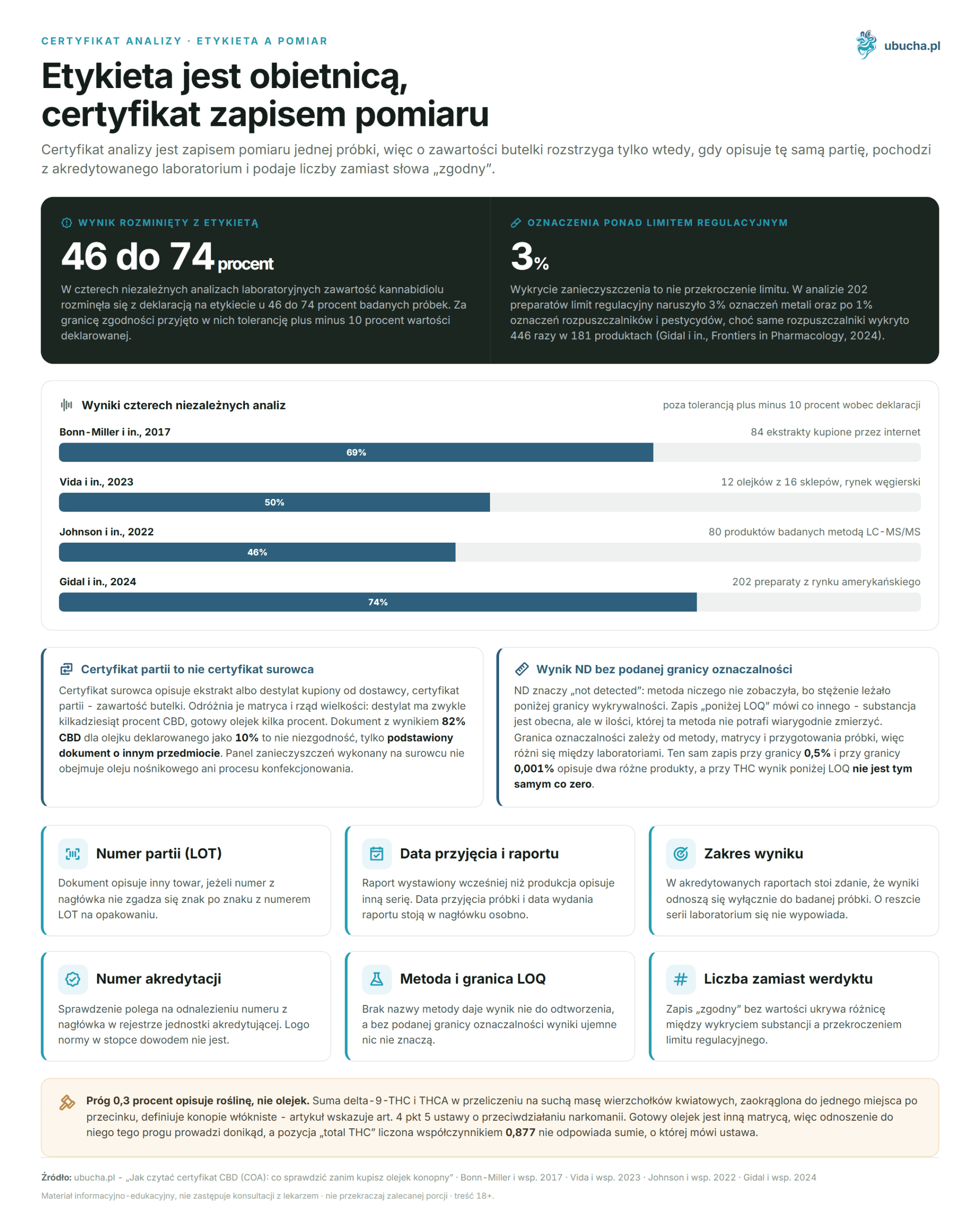
In four independent laboratory analyses of CBD products, the content of cannabidiol deviated from the declaration on the label in 46 to 74 percent of the tested samples. The label is a promise from the manufacturer. A Certificate of Analysis is a record of measurement. It is the only document that allows you to verify this promise, but it does not resolve anything on its own: what matters is whether it describes your batch, who issued it, and whether it provides numbers instead of the word "compliant". The format of such a report is not standardized in any way, so two documents for the same type of product can look completely different. Below you have a step-by-step procedure for reading such a document, from the header to the contamination table, along with the pitfalls that are easiest to overlook.
KEY INFORMATION
• In the study of 202 CBD products, 74% deviated from the declaration by at least 10% (Gidal et al., Frontiers in Pharmacology, 2024).
• The batch number on the certificate must match the LOT number on the packaging; otherwise, the document describes a different product.
• The threshold of 0.3% THC defines industrial hemp and is not a limit for the finished oil.
• A result of "ND" without a specified limit of quantification (LOQ) carries no information.
Why is the label on hemp oil not enough?
Because four independent studies showed the same phenomenon across three markets. The percentage of samples that fell outside the tolerance of plus or minus 10 percent from the declaration was 69%, 50%, 46%, and 74%. The variation is significant, but the trend is always the same.
The oldest of these studies covered 84 extracts purchased online: only 31% fell within the declared range, and THC was detected in 18 samples, up to 6.43 mg/ml (Bonn-Miller i in., JAMA, 2017). A Hungarian team searched 16 online stores in the local market and purchased 12 oils for testing: 6 were within tolerance, five contained less cannabidiol than declared on the label, and one more (Vida i in., Frontiers in Pharmacology, 2023). The worst of them had 39 percent of the declared potency. This is a measurement of one domestic market, not the entire Union, although three of the sixteen stores had foreign addresses, and among the purchased brands were companies shipping goods throughout Europe.
A study from Kentucky examined 80 products using the LC-MS/MS method: 37 of them, or 46%, deviated from the label by at least 10 percent, with 25 containing more CBD and 12 containing less (Johnson i in., Journal of Cannabis Research, 2022). The largest sample, 202 products from the open U.S. market, showed 74% deviations from the declared potency. Additionally, 26% of products did not match the type stated on the packaging, such as full spectrum, broad spectrum, or isolate (Gidal i in., Frontiers in Pharmacology, 2024). The differences between these types are explained in a separate entry about types of CBD extracts.
What must be included in the certificate header?
Six fields: the name of the laboratory with the accreditation number, sample designation along with the batch number, sample acceptance date, report issuance date, method name for each panel, and the signature of the person authorizing the result. A document without these fields is merely a printout of a table, not a test report.
| Field in the header | What to do with it |
|---|---|
| Numer partii (LOT, Batch) | Compare it character by character with the number on the packaging |
| Sample acceptance date and report date | A report issued before production describes a different batch |
| Description of the sample matrix | It determines whether the oil or raw extract was tested. |
| Laboratorium i numer akredytacji | Enter the number into the register of the accrediting unit |
| Method for each panel | The absence of a method means an unrepeatable result. |
| Limit of quantification (LOQ) | Without it, negative results mean nothing |
Pay attention to one more sentence that appears almost always in accredited reports: the results refer only to the tested sample. This is not a legal disclaimer but a description of reality. The laboratory tested a few milliliters sent by the client and does not comment on the rest of the batch at all.
What is the difference between a batch certificate and a raw material certificate?
A raw material certificate describes the extract or distillate purchased from the supplier before the manufacturer dilutes it with a carrier oil. A batch certificate describes the contents of the bottle. The first document refers to an intermediate product, while the second refers to what you actually consume, and one does not replace the other.
You can recognize them by two things. By the matrix: the report for raw material states "extract," "distillate," or "isolate," while the report for the finished product states "oil." By the order of magnitude of the result: distillate usually has several dozen percent CBD, while the finished oil has a few. If the seller shows a document with a result of 82% CBD for an oil declared as 10%, it is not a discrepancy but a substituted document regarding a different subject.
This has practical implications. A contamination panel conducted on raw material does not include the carrier oil or the packaging process itself, so metals or residues from the carrier fat remain outside the examination. We noticed while reviewing documents provided by sellers that the raw material certificate is often the only published report, and incidentally, the more impressive one, as it shows a high percentage of purity. If you want to know how much substance is in your bottle, you need a report for its batch number.
How to read the cannabinoid panel and THC result?
Start with the units, not the number. The certificate usually states mg/ml or mass percentage, while the label indicates milligrams in the entire package. Only after converting both values to a common unit can one speak of compliance or discrepancy.
A 10 ml oil with a declaration of 1000 mg is 100 mg/ml. If the report shows 92 mg/ml, there are 920 mg in the bottle, which is 8 percent below the declaration, thus within the tolerance accepted in studies. A separate trap is percentages: the carrier oil weighs less than water, about 0.91 to 0.95 g/ml, so 10 percent by mass gives approximately 92 mg/ml, not 100. Hence, many apparent discrepancies.
The second thing is acidic forms. In the raw plant, CBD mainly occurs as CBDA, and heating transforms it into a neutral form. Therefore, certificates provide total values: total CBD is CBD plus 0.877 mass of CBDA, similarly for THC. High CBDA with low CBD means the product is raw, not defective.
Finally, THC. The threshold of 0.3 percent, which is the sum of delta-9-THC and THCA calculated on the dry weight of the flower tops, rounded to one decimal place, defines the hemp plant. It stands in Article 4 point 5 of the Act on Counteracting Drug Addiction (t.j. Dz.U. 2023 poz. 1939), as amended by the Act of March 24, 2022 (Dz.U. 2022 poz. 763) and effective from May 7, 2022. The finished oil is a different matrix, so relating this threshold to it leads nowhere. This has practical implications when reading the certificate: the "total THC" position calculated with a factor of 0.877 does not correspond to the sum mentioned in the law. Read the THC result in mg/ml and multiply by the daily dose: this is the only number of practical significance, especially before a test for the presence of psychoactive substances.
What does ND mean, and what does a result below LOQ indicate?
ND stands for "not detected": the method saw nothing because the concentration was below the detection limit. "Below LOQ" means something else: the substance is present, but in an amount that this method cannot reliably measure. The first notation indicates a lack of signal, the second indicates a signal that is too weak.
The detection limit, marked as LOD, is the lowest concentration distinguishable from the noise of the equipment. The quantification limit, or LOQ, is higher and sets the threshold from which the result can be reported as a number. Both depend on the method, matrix, and sample preparation, so they differ between laboratories even for the same substance.
Hence the practical conclusion. The term "ND" without a stated LOQ carries no information, as it is unclear how low the laboratory could look. The same notation at a threshold of 0.5% and at a threshold of 0.001% describes two different products. Treat the result "Pass" or "Compliant" without a number the same way: you won't learn from it whether the sample barely passed the limit or missed it by two orders of magnitude. With THC, there is one more thing: a result below LOQ is not the same as zero.
How to read the contamination panel in the certificate?
Read the numbers, not the verdicts, because detecting a substance and exceeding the limit are two different things. In the analysis of 202 CBD products, heavy metals were detected 52 times in 44 products, solvent residues 446 times in 181 products, and pesticides 55 times in 30 products.
The scale of exceedances was incomparably smaller: the regulatory limit was violated in 3% of metal designations and in 1% of solvent and pesticide designations (Gidal i in., Frontiers in Pharmacology, 2024). This is the strongest argument for reading the values themselves. A document that instead provides the word "compliant" hides exactly this difference. Among metals, lead was the most frequently detected, while the highest concentrations among solvents were reached by hexane, xylene, and methanol.
Solvents are evaluated according to classes from the ICH Q3C guideline, not according to invented thresholds. Class one includes substances to be avoided, such as benzene. Class two is quantitatively limited: methanol up to 3000 ppm, hexane up to 290 ppm. Class three collects solvents with low toxic potential, including ethanol and isopropanol, with a limit of 5000 ppm. These values in ppm are calculated by the guideline assuming 10 g of product per day, so they are cautious for oils dosed in drops. There is no standard stating "ethanol below 0.1 percent", so referencing such a threshold is a quote from marketing material. The microbiological panel, included with food products, should also provide values instead of just "absent". What exactly is tested in these two panels and what is missing from them has been outlined separately in a post about pestycydach i mikrobiologii w produktach CBD.
How to check if the laboratory really has accreditation?
Take the accreditation number from the header and enter it into the public register of the accrediting unit. In Poland, it is maintained by Polskie Centrum Akredytacji, abroad respectively by DAkkS in Germany, UKAS in the United Kingdom, COFRAC in France, and A2LA in the United States.
The mere presence of an entry is only half of the verification. Accreditation according to ISO/IEC 17025 always has a scope, published as an annex to the accreditation certificate, and lists specific methods along with matrices. A laboratory accredited for testing metals in water does not have to be accredited for testing cannabinoids in plant oil. Comparing the scope with the methods listed in the report takes a minute and resolves more than the name of the unit itself.
What to avoid during this verification. The logo of the standard in the footer of the document is not proof of accreditation, as the graphic can be inserted arbitrarily. The declaration "tested in an independent laboratory" without a name and number also cannot be verified, thus adding no value. It also happens that the report comes from the manufacturer's internal laboratory: this does not disqualify the result, but removes its attribute of independence, which is what this whole procedure is about.
What to do if the seller does not have a certificate for your batch?
Email them requesting the report for the LOT number from the packaging and see what comes back. No regulation requires publishing such documents for dietary supplements in Poland, so the absence of a certificate on the site does not in itself determine anything. The response to the request does.
In the message, provide the batch number, purchase date, and product name, and ask for a full report in file form, not a screenshot of a table fragment. A good response includes a document with a batch number matching yours. An evasive response, sending a raw material certificate or a report for a different batch is a signal to look for another seller. It also happens that the manufacturer simply tests less frequently than they produce, and that is also information.
The most convenient option is a QR code on the label that leads directly to the report for a specific batch. Then, the entire verification comes down to comparing the number on the screen with the number on the bottle. Before you order anywhere, also review the general rules for safe shopping described in the post about this, where to buy CBD in Poland.
Frequently Asked Questions
What is the Certificate of Analysis (COA) for CBD oil?
This is a report from the analysis of a single sample. It states who conducted the analysis, when, by what method, and with what limit of quantification, as well as the numerical results for cannabinoids and contaminants. It refers solely to the sample received by the laboratory, so without a matching batch number, it says nothing about your bottle.
Does the 0.3% THC threshold apply to finished hemp oil?
No. The threshold of 0.3 percent of the total delta-9-THC and THCA defines industrial hemp as a plant and refers to the dry weight of the flower tops. The finished oil is a different matrix, so look for the THC result on the certificate given in mg/ml or in mass percentages and convert it to your daily dose.
What does the ND result on the analysis certificate mean?
ND means "not detected," which indicates a result below the detection limit of the method. It doesn't say much on its own, as everything depends on the sensitivity of the test. Next to the result, there must be the limit of quantification (LOQ). An ND notation with an LOQ of 0.5% and an LOQ of 0.001% describes two completely different products.
How to match the certificate to a specific bottle of oil?
Read the batch number from the packaging, labeled as LOT or Batch, and compare it character by character with the number in the report header. Also check the dates: a document issued before the production of your series describes a different batch. A QR code leading directly to the report shortens the verification to just a few seconds.
How to check the laboratory accreditation from the certificate?
Enter the accreditation number into the public register of the accrediting body: the Polish Center for Accreditation in Poland or DAkkS, UKAS, COFRAC, and A2LA abroad. Check not only the existence of the entry but also whether the scope of accreditation covers the specific method and matrix. The logo of the standard in the footer is not proof.
How much can the CBD result differ from the label?
Cited studies accept a tolerance of plus or minus 10 percent of the declared value, and this is a reasonable reference point. Before you consider a discrepancy as a manufacturer's error, convert the units: the report provides mg/ml or mass percentage, while the label states milligrams for the entire package. The carrier oil weighs less than water.
Certificates are easier to compare when you have several products in front of you, so start by reviewing the categories hemp oils and request a report for the batch of the one you choose.
This article is for informational and educational purposes. It contains internal links to product categories available in the u Bucha store. Prices and specifications may change: check the current data on the product page before purchasing.
Author: Michał Waluk · Opublikowano: 2026-05-29 · Aktualizacja: 2026-08-15