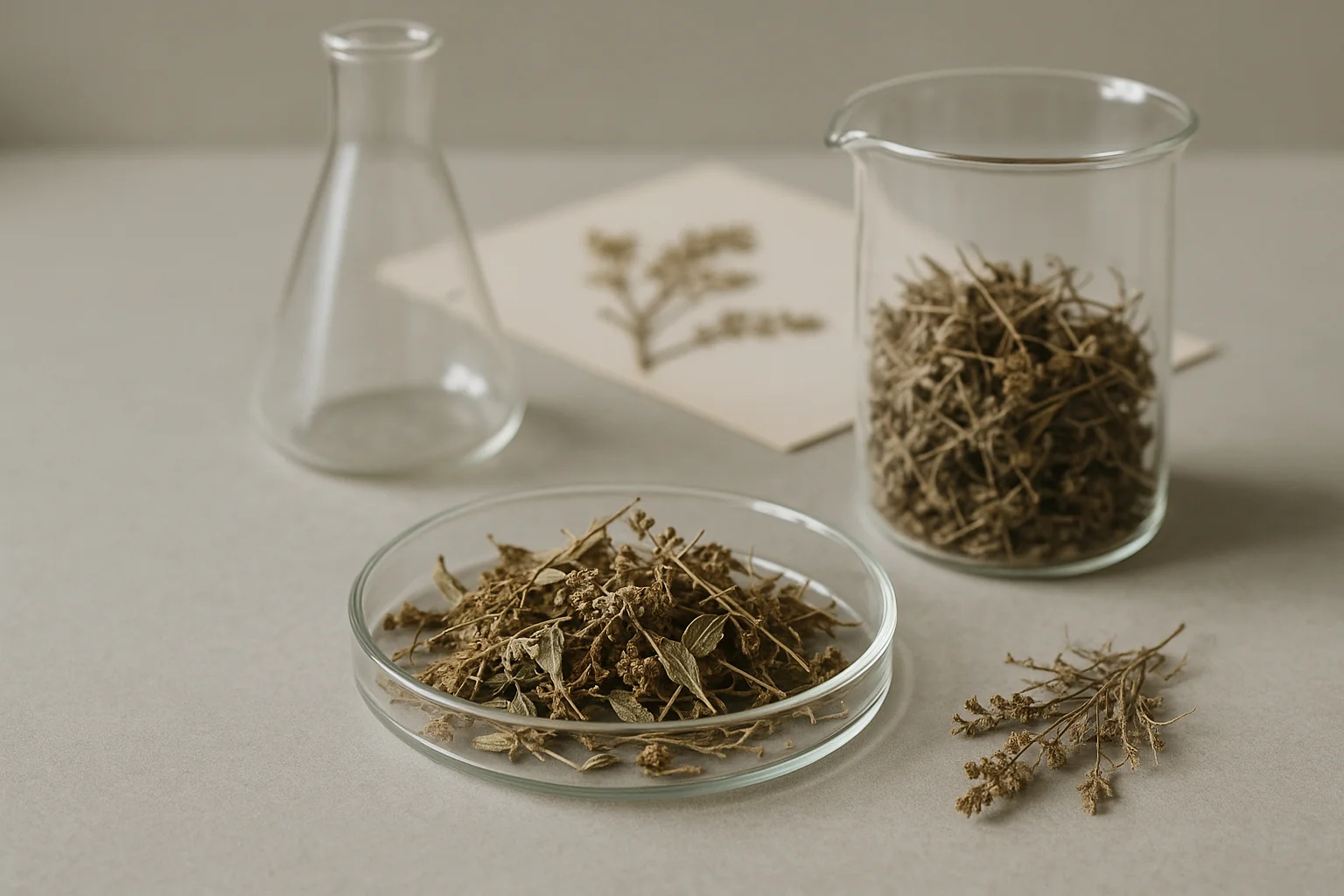

Mango (Cannabis flos S-LAB): a single source profile and unknown lineage
Mango is available in Polish pharmacies as a product from one manufacturer, and its terpene profile is described by a single source. We show what can be inferred from such a data set and what cannot.
What is Mango and where does this strain come from?
The lineage of Mango remains unknown. None of the sources gathered in this cluster provide the parents of this strain, and the name itself refers to the aroma, not to the breeding line. What is certain is that it reaches Polish pharmacies as dried flower from a single producer and is often described as a hybrid with a predominance of the Indian strain.
The unknown lineage here is an answer, not a lack of data. The breeder has not disclosed the cross, available commercial descriptions are silent about the parents, and those that suggest anything do not agree with each other enough to draw any conclusions. In a cluster built around the origin graph, a lineage entered by intuition is worse than an empty field: it creates a connection that then travels further as a fact, although no one has confirmed it.
The word in the name is not a clue. Mango is often a descriptor of aroma in catalogs of dozens of unrelated lines, and in the same set of pharmacy strains, there is another cultivar with this component, supplied by a completely different producer. The similarity of the name says nothing about kinship in either direction, just as the lack of a common word does not prove that two strains do not share a common ancestor.
Dried flower is a pharmaceutical raw material issued by a doctor's prescription in the Rpw category. The description below therefore pertains to the raw material available exclusively in pharmacies based on a prescription, and its purpose is to clarify the data, not to encourage reaching for this strain.
Which producers supply Mango to Polish pharmacies?
One. In the gathered inventory, Mango is supplied exclusively by S-LAB and corresponds to exactly one pharmacy entry, described by a single industry source. No other producer present in the Polish market reports a cultivar by that name, so comparing versions between suppliers does not have any material here.
| What does the pharmacy entry carry | Value |
|---|---|
| Producer | S-LAB |
| Registered name, without the numerical component | Cannabis flos S-LAB |
| Declared THC content | 16.2-19.8%, which is the declared value with the producer's tolerance |
| Genetics according to the source | hybrid with a predominance of the Indian strain |
| Number of entries in the inventory | one |
The registered name does not contain the cultivar name, and this is the most important trap with this producer. In the database from which the profile originates, the same registered name with the same declared content stands next to twenty-four different S-LAB cultivars, from Blueberry to White Widow. The pharmacy label itself does not determine which strain was issued: this is determined by the commercial description provided by the producer and the batch documentation.
Availability changes faster than the description. Entries disappear from circulation and return with subsequent batches, and the permit for the raw material has its expiration date. At the time of data collection, the source marked this entry as unavailable, which does not mean it will remain so for long. We keep the current state in one place, in the compilation of available strains, and it should be checked there instead of trusting the date on this page. It also states the list of other products from this manufacturer.
The online store does not issue raw material in the Rpw category, so what is available in it drought is a completely separate shelf, not the same entry as described here.
How does Mango smell and taste?
The source describes the aroma with four descriptors: mango, fruity, peppery, minty. The sales description adds a hashish note to this. These are catalog labels, not a result of measurement: no one has studied this strain through sensory analysis with a panel of evaluators. The scent also changes with the batch, storage conditions, and the age of the material.
The terpene profile describes one source and lists four components: caryophyllene, limonene, myrcene, and nerolidol. The set reads quite coherently with aroma descriptors: the peppery, spicy note corresponds to caryophyllene, citrus to limonene, earthy and slightly hoppy to myrcene, and the woody-floral background to nerolidol. The flavor when vaporizing can be less rich than the aroma of the dried flower, as some volatile compounds evaporate before the material is heated.
We do not provide numerical shares, and there is a solid reason for that. The four values that the source assigns to these compounds do not add up to a whole; there is more than a fifth missing, and no one says what is in that remainder or how it was calculated. Reading them as a percentage of the profile would confuse more than clarify, and they would appear to be a measurement, which they are not.
Separately, we describe what has been demonstrated for each of these compounds: for kariofilenu, limonene, mircenu and nerolidolu.
How long does it take for Mango to start working and how long does the effect last?
The answer depends on how the raw material is consumed, not on which strain was chosen. For Mango, there is no separate measurement: no study has tracked concentrations after administering this particular cultivar. Below is a description of the course according to the method of administration, common for the entire group of dried flowers.
The route of administration determines the course more than the variety itself. After vaporization, the substance passes from the lungs to the blood almost immediately, so the first sensations appear after a few minutes, the intensity increases for another ten to thirty minutes, and the whole effect lasts for two to four hours. After ingestion, the raw material first passes through the intestine and liver, so the first sensations are awaited from half an hour to two hours, and the episode can last six, sometimes eight hours. Hence the most common mistake with oral administration: anyone who thinks nothing is happening after thirty minutes and takes another dose will receive both doses at once. The above ranges describe the route of administration, not this variety; pharmacokinetic studies for a single cultivar have not been published.
The declared THC content range of 16.2-19.8% does not indicate the rate at which anything occurs. It describes how much substance is in the raw material, not how much reaches the blood or how quickly: that is determined by the method of intake, the efficiency of the device, and the temperature at which the dried flower is heated.
What is known and what is not known about the effects of the Mango strain?
Not much. No studies have been published specifically for Mango, so everything that can be cited pertains to a single compound from its profile: caryophyllene. Two studies that examined it were conducted on mice and cells, not on patients consuming this dried flower. The limitations of these studies are as important as their results.
The mechanism was described by the Gertsch team in 2008, in the journal PNAS, identifier PMID:18574142, and the result is as follows. (E)-caryophyllene selectively bound to the CB2 receptor (Ki = 155 nM) and inhibited carrageenan-induced paw edema in wild-type mice, but not in mice lacking the CB2 receptor (Cnr2-/-), indicating a CB2-dependent mechanism; the study did not include any anxiety tests.
Pain was addressed by the Klauke team six years later, in European Neuropsychopharmacology, identifier PMID:24210682, and here the result looks like this. Oral caryophyllene reduced the late inflammatory phase of pain in the formalin test in a CB2 receptor-dependent manner, with no effect on the early phase; in a neuropathic pain model, it alleviated thermal hyperalgesia and mechanical allodynia without developing tolerance with chronic administration.
Neither of the two studies tested caryophyllene on humans or in inhaled form from dried flower; both studies pertain to oral or systemic administration in mice in pain and inflammation models, not sleep or mood.
The rest of what circulates about this strain comes from the catalog. The source assigns it labels describing possible effects as relaxing and balanced, and the commercial description adds an image of slowly building euphoria. These are sales categories assigned to the strain by the describer, not results of observations conducted according to a protocol, and should be read as such.
What side effects have been reported after using the Mango strain?
None that could be attributed specifically to this strain. A register of side effects is maintained for medicinal products described by batch number, and the name of the cultivar does not appear in this description. The following paragraph therefore speaks about hemp flower as a group of raw materials, as only at this level such data exists.
Reports of adverse effects are collected for medicinal products with a batch number, not for the strain name, so the following pertains to hemp dried flower as a group of raw materials. The most frequently reported symptoms are dry mouth, red eyes, and increased heart rate. Dizziness upon rapid standing, daytime drowsiness, and temporary worsening of short-term memory are less frequently described, as well as anxiety that increases with dosage. A separate issue is medications taken concurrently, especially sedatives and those affecting coagulation: their assessment requires knowledge of the entire list of preparations, not just the description of the plant. We do not provide the frequency of these symptoms numerically, as public compilations for hemp dried flower in Poland do not separate them by individual products.
With this strain, there is one more obstacle. The registered name of this manufacturer does not carry the name of the cultivar and, with the same declared content, covers a whole list of other strains, so even a report described by batch number does not lead directly to Mango without referring to the batch documentation. Compiling one's own observations makes sense only when the batch number is recorded, not just the trade name.
At what temperature should Mango be vaporized?
One number cannot be given for this strain. The temperature set on the device is not the temperature of the dried flower, and the values circulating in terpene tables come from measurements taken at different pressures. Of the four compounds in this profile, three have measured boiling points, while the fourth does not have one in our collection.
| Compound | Boiling under atmospheric pressure | Note for measurement |
|---|---|---|
| caryophyllene | 257.5 °C | the same compound boils at 130 °C under reduced pressure (14 mmHg) |
| limonene | 177.8 °C | source records scattered between 175 and 178 °C |
| myrcene | 166.8 °C | consistent records around 167 °C |
| nerolidol | no values in the dataset | none of the collected sources provide atmospheric measurement |
The two numbers associated with caryophyllene are not contradictory. The higher one describes boiling under atmospheric pressure, while the lower one describes the same compound under reduced pressure, with a difference exceeding one hundred degrees. Tables comparing one to the other without specifying conditions appear to be a list of thresholds to set, but they are not. We break this down separately in the post about the comparability of temperature tables oraz w opisie the evaporation of terpenes from dried flower.
Additionally, there is a difference between the setup and the material. The air in the chamber, the device wall, and the dried flower itself have different temperatures at the same moment, and the faster the flow, the greater the discrepancy between them. We write about this in the text about why the vaporizer setting is not the temperature of the dried flower. For this reason, we do not provide a recommended range for Mango: it would be a number that looks like a measurement, but is copied from someone else's table.
Which strains are related to Mango?
None can be pointed out. The pedigree chart in this cluster connects strains through established parents, and for Mango, the parents are unknown, so the list of siblings remains empty. This is a result, not a gap to fill: adding relatives by guesswork would create connections that no one has ever confirmed.
The nearest example shows why the name is not enough. In the same comparison of pharmaceutical strains stands Chemango Kush, supplied by another producer, also with caryophyllene leading the profile. A common element in the name and a similar composition do not make them siblings: the first is a coincidence of words, the second a coincidence of chemistry, and neither is evidence of common ancestry.
The proximity of composition is not kinship. Strains sharing a dominant terpene can be compared by profile and are described as such in the text about kariofilenie, but such a comparison speaks to content, not origin. Similarly, the list of other products from the same manufacturer groups strains by supplier, not by cross.
If the breeder ever revealed the cross, this section would change along with the data. Until then, we maintain a complete list of strains, marking those for which the origin is established, in the cluster overview.
Frequently asked questions about the Mango strain
Is Mango dispensed by prescription?
Yes. Dried hemp is dispensed solely by a doctor's prescription, in the Rpw category, and this applies to every medicinal item described in this cluster.
What is the declared THC content in the Mango strain?
The source provides a range of 16.2-19.8% THC content, as the declared value has a ten percent tolerance from the producer. We do not provide a single number, as it would suggest precision that this record does not have.
Who supplies Mango to Polish pharmacies?
One manufacturer, S-LAB, corresponds to one pharmaceutical product. Availability can be intermittent, so the current status is checked in the list of available strains, not in the strain description.
Is the lineage of the Mango strain known?
No. The parents of this strain are not provided in any of the collected sources, and the name describes the aroma, not the breeding line, so the lineage field remains empty.
Which terpene is predominant in the Mango profile?
Caryophyllene. Alongside it, one source mentions limonene, myrcene, and nerolidol, without specifying the denominator to which the shares would refer.
Have there been clinical studies on the Mango strain itself?
No. The cited works concern caryophyllene, one of the compounds from its profile, and were conducted on mice and cells, not on patients using this dried flower.
The material is for informational purposes only and does not replace the advice of a doctor or pharmacist. The editorial text was prepared by redakcja ubucha.pl.