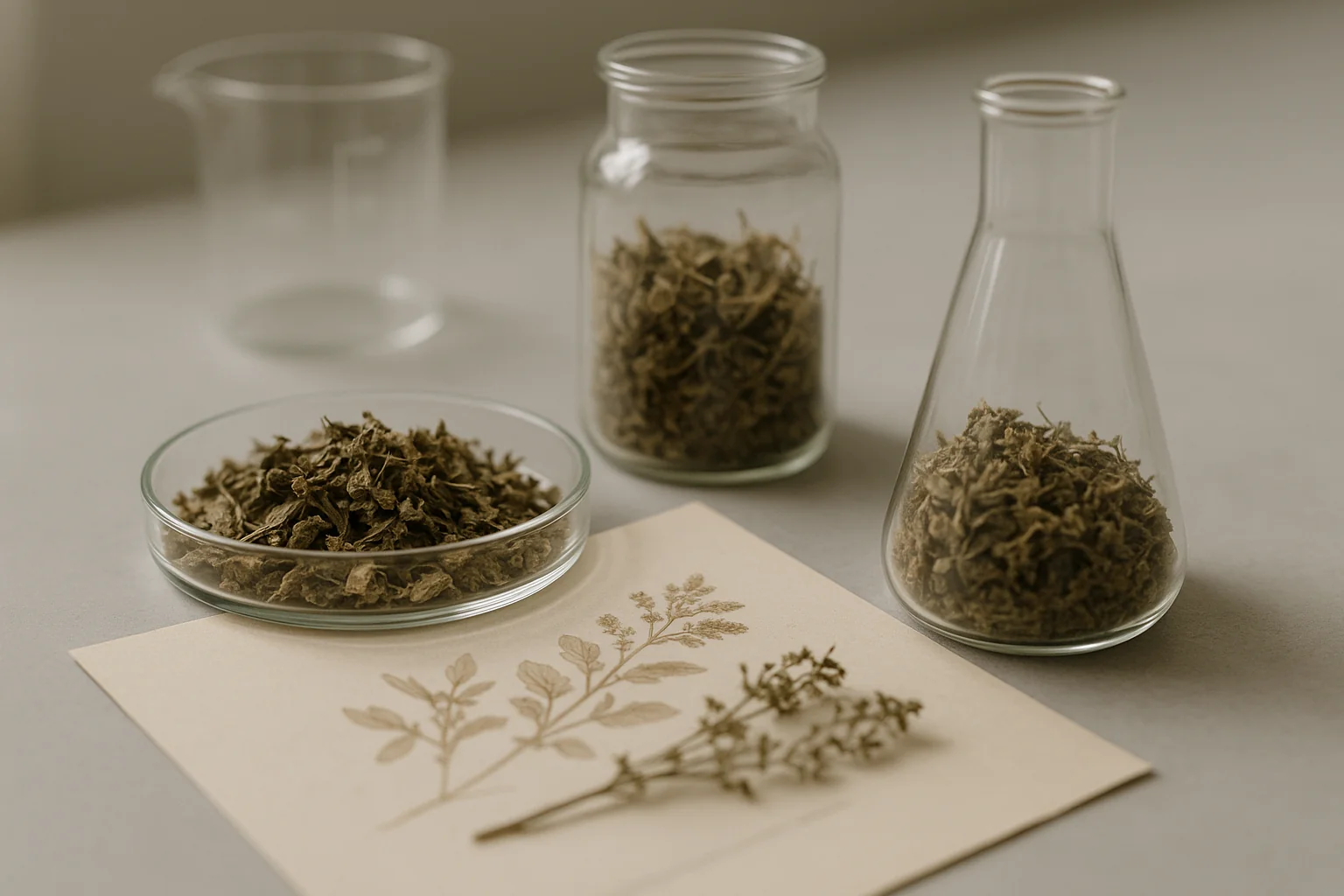

Afghan Kush (Cannabis flos Canopy Growth): a hashish landrace with an uncertain lineage
Afghan Kush has one version and lineage in Polish pharmacies, which no one has revealed. We gather what two Polish sources provide about it and show where the documentation ends and the seller's description begins.
What is this strain and where does it come from?
The lineage of Afghan Kush remains uncertain: no breeder has published a list of parents, and available databases only provide the name. Commercial descriptions place this strain among historical landraces from the Hindu Kush region, meaning populations cultivated locally for generations, rather than among modern hybrids. These two points are not contradictory.
A landrace is a population shaped by climate and local cultivation, not by breeding work with documented pair selection. No one has maintained documentation for it that could be reconstructed today, so the uncertain value in the pedigree graph of this cluster does not indicate a gap in our data, but rather the state of knowledge about the plant. The same is true for 25 out of 85 cultivars present in Polish pharmacies.
Caution is required regarding the name itself. The word 'afghani' functions among breeders as a style label, not as an identified plant, so its presence in the description proves nothing. Precisely for this reason, we do not assign parents to this strain based on intuition: origins noted by similarity of name create false connections that then circulate further online as fact.
Little can be confirmed. Both Polish databases describing this position classify it as indica and agree on this point. They also agree on the registration entry, in which Canopy Growth is listed as the producer of the raw material. Beyond that, there is nothing publicly available about the origin of Afghan Kush.
Which producers supply this strain to Polish pharmacies?
One. Afghan Kush is supplied to Polish pharmacies exclusively by Canopy Growth, under the medical brand Spectrum Therapeutics, and corresponds to one entry in the inventory of this cluster. Therefore, the question about differences between pharmacy versions has an empty answer here: there is nothing to compare, as there is no second producer of this name on the market.
| Producer | How the position appears in the register | How does this version differ |
|---|---|---|
| Canopy Growth, Spectrum Therapeutics brand | Cannabis flos, raw material attributed to Canopy Growth; both Polish sources provide the same entry | The only pharmacy version, so no point of reference |
Spectrum Therapeutics is a medical brand of Canopy Growth, which is why the packaging and description may feature two different names for the same raw material. A patient looking for a product under the brand name will see the manufacturer in the registry, while someone searching for the manufacturer will see the brand in the pharmacy catalog. These are not two products. We have compiled the remaining items from this supplier in a separate listing. portfolio Spectrum Therapeutics.
Availability in sales is variable. Permits, allocations, and deliveries shift in a monthly cycle, so a position visible today in several pharmacies can disappear for a quarter and then return under the same registration number. Therefore, we do not include the current list here: it is maintained separately. the compilation of available strains, maintained separately.
One of the sources describes the availability of this position as high, but this is a catalog assessment prior to publication, not the stock status of a specific pharmacy. Checking today looks the same as with any position in the Rpw category: it is inquired about by the doctor issuing the prescription or the pharmacist fulfilling the order.
How does this strain smell and taste?
Earthy and hash-like, with a spicy sharpness and a resinous pine note in the background. This is how Polish databases describe the aroma of this strain, and the musky-hashish impression is what distinguishes it from citrus positions in the same portfolio. The taste follows the scent and is sometimes described as heavy.
Behind this impression are four names: humulene, caryophyllene, myrcene, pinene. Both Polish sources provide exactly the same set, which is rare in this cluster: out of 24 strains described by both databases, the compositions match in three and diverge in 21. Afghan Kush belongs to those three, so it is one of the few positions where it is unnecessary to write that the sources contradict each other.
The heavy, hoppy-spicy side of the scent is associated with humulenem and kariofilenem, sosnowy akcent wnosi pinene, and the earthy background is myrcene. However, the caveat is this: databases describe the aroma and the set of names, not the result of an analysis of a batch released from the pharmacy, so an open package can present the accents differently.
We do not provide percentage shares for these names, and this is not about excessive caution. One database assigns the same weight to all four entries, meaning it does not contain any ranking, while the other provides a weighted order. The totals also vary: in one verified comparison, the shares add up to 46 percent, in another to 73, and in a third to 83. Thus, the denominator is different in each case, and the numbers from both sides cannot be compared.
How long does it take for the strain to take effect and how long does the effect last?
This is determined by the route of administration, not the cultivar itself. Inhaled vapor acts almost immediately and lasts for a few hours, while ingested material takes effect with a noticeable delay and lasts significantly longer. No one has measured these intervals separately for Afghan Kush.
The route of administration determines the course more than the variety itself. After vaporization, the substance passes from the lungs to the blood almost immediately, so the first sensations appear after a few minutes, the intensity increases for another ten to thirty minutes, and the whole effect lasts for two to four hours. After ingestion, the raw material first passes through the intestine and liver, so the first sensations are awaited from half an hour to two hours, and the episode can last six, sometimes eight hours. Hence the most common mistake with oral administration: anyone who thinks nothing is happening after thirty minutes and takes another dose will receive both doses at once. The above ranges describe the route of administration, not this variety; pharmacokinetic studies for a single cultivar have not been published.
Commercial descriptions attribute sedative effects to this strain, but the wording in the catalog does not change the above intervals. They arise from how the substance enters the bloodstream and would be the same for a strain described as stimulating. The difference between strains, if it exists, pertains to the character of the sensation, not the timing.
What is known, and what is not known about the effects of this strain?
The effects of myrcene have been measured in rodents, but not the effects of Afghan Kush in humans. No studies involving patients have been published for this strain, so any statement attributing a specific effect to it comes from seller descriptions or user reports. Below, we separate these two orders, as they usually get mixed up in descriptions.
There are three entries in the literature on myrcene. The work by Vale and colleagues from 2002 (Phytomedicine, PMID:12587690) described a decrease in motor activity and an extension of sleep induced by pentobarbital in mice after intraperitoneal administration, and a weak anxiogenic effect in the elevated plus maze. Rao and his team (1990, Journal of Pharmacy and Pharmacology, PMID:1983154) achieved a reduction in pain responses in mice, which were reversed by naloxone and yohimbine. Wagner and his team (2024, NeuroSci, PMID:39728677) administered myrcene in short puffs of vapor; in females, an anxiolytic effect was observed, while in males it appeared only after one puff. We gather all three together in a separate entry about mircenie.
In humans, myrcene alone has not been shown to alleviate insomnia at doses typical for inhalation of dried flower. The direction of the effect in rodents depends on the route of administration and sex: intraperitoneal injection in 2002 described a slightly anxiogenic effect, while inhalation in 2024 showed an anxiolytic effect in females. These two results do not negate each other; they simply show that the conclusion depends on conditions that no popular strain database provides.
There is little left on the description side: both databases classify this entry as indica, with one adding relaxing effects. This is a catalog declaration, not a result from a series released from a pharmacy, and it should be read as such.
What side effects have been reported for this strain?
None under this name. Public safety compilations do not maintain a column for cultivars, and Afghan Kush is one entry from one manufacturer in Polish pharmacies, so even if someone counted them separately, the sample would be too small to draw any conclusions. The following pertains to the entire group of raw material.
Reports of adverse effects are collected for medicinal products with a batch number, not for the strain name, so the following pertains to hemp dried flower as a group of raw materials. The most frequently reported symptoms are dry mouth, red eyes, and increased heart rate. Dizziness upon rapid standing, daytime drowsiness, and temporary worsening of short-term memory are less frequently described, as well as anxiety that increases with dosage. A separate issue is medications taken concurrently, especially sedatives and those affecting coagulation: their assessment requires knowledge of the entire list of preparations, not just the description of the plant. We do not provide the frequency of these symptoms numerically, as public compilations for hemp dried flower in Poland do not separate them by individual products.
This leads to another point. The strain name does not carry over safety history between products: if the same cultivar appeared in a pharmacy from a different manufacturer, it would be a different license and different batches, despite identical labeling on the packaging. Comparisons from different countries conducted under the same name cannot be aggregated either.
How to vaporize this strain?
The setting is chosen based on the composition, which starts here with myrcene. Myrcene boils around 167 degrees Celsius at atmospheric pressure, pinene lower, and caryophyllene much higher. However, the temperature table is not an instruction: the number on the device's display is not the temperature of the dried flower in the chamber.
The records collected in this project from the PubChem database give for myrcene 166-167 degrees Celsius, for pinene about 156, and for caryophyllene 256-259. Humulene falls out of such a comparison because the only available measurement was made under reduced pressure, at 99-100 degrees and 3 mmHg, and such a value should not be placed in the same column as boiling under atmospheric pressure. Popular terpene temperature tables mix both types of measurements, which is why they contain values lower by several dozen degrees. We break this down in a separate text about the comparability of such tables.
In practice, changing the setting shifts the proportions. Lower settings extract more light terpenes and fewer cannabinoids, while higher settings do the opposite, and the discrepancy can be noticeable in taste before it becomes apparent in sensation. We describe the ranges for individual compounds in the text about the evaporation of terpenes.
Vaporization as a route of administration also applies to dried flower available over the counter, for example from the category drought. This is a different raw material than the pharmaceutical entry described here and is not its equivalent or substitute, even though the device may be the same.
Which strains are related to it?
None. The pedigree chart in this cluster shows an empty list for Afghan Kush, which directly results from its undetermined origin: without known parents, it is impossible to identify siblings, and adding them based on name similarity would create connections that no one has documented. The name is therefore the worst possible clue.
The term kush in this context includes ten cultivars: five with established pedigrees and five without, among which are Afghan Kush, Hindu Kush, Master Kush, OG Kush, and Pink Kush. Blood Orange Kush has documented parents (lemon kush and guava kush), while Afghan Kush has none, even though both names share the same word. The common term thus says nothing about kinship in either direction.
It is worth noting separately the position that is most easily confused with Afghan Kush. Deep Breath has the same manufacturer, the same leading terpene, and similarly undetermined origin, so the data imprint of both strains almost completely overlaps. This does not imply any kinship. What distinguishes them is what is visible in the description: Deep Breath carries a resinous-citrus note and is described by one source, while Afghan Kush maintains a hashish-earthy character and has a consistent description in two. The portrait of the latter prowadzimy osobno.
Frequently asked questions about Afghan Kush
Does Afghan Kush have a known lineage?
No. No available source provides the parents of this strain, and commercial descriptions reduce it to a historical landrace from the Hindukush region. In the lineage graph of this cluster, the origin is marked as undetermined and is described as such in the text.
Which manufacturer supplies Afghan Kush to Polish pharmacies?
Spectrum Therapeutics, and this is the only version of this strain on the Polish market. In the registration entry, Canopy Growth is listed as the raw material manufacturer, whose medical brand is Spectrum Therapeutics.
What terpenes are mentioned by sources for Afghan Kush?
Humulene, caryophyllene, myrcene, pinene. Both Polish sources provide the same set. We do not provide percentage shares because the denominator is different in each comparison, and one of the sources assigns identical weight to all positions.
Is Afghan Kush related to Hindu Kush or Master Kush?
There is no evidence for that. All three strains have undetermined origins in this comparison, and the common word in the name is not evidence of kinship, as breeders use it as a category name.
How long does it take for dried flower to take effect when inhaled, and how long when taken orally?
After vaporization, the first sensations appear within a few minutes, and the effects last for two to four hours. After ingestion, one waits from half an hour to two hours for the onset, and the episode lasts six, sometimes eight hours. The ranges refer to the method of administration, not this strain.
Have any adverse effects been reported after using Afghan Kush?
Not under the strain name. The report is associated with the medicinal product and batch number, so there are no statistics for a single cultivar. For dried flower as a group, the main reported effects are dry mouth, red eyes, and increased heart rate.
At what temperature do the terpenes from this strain's profile evaporate?
Myrcene boils around 166-167 degrees Celsius, pinene around 156, caryophyllene 256-259. For humulene, only measurements under reduced pressure are available, so it cannot be compared with the others in one table.
The text is for informational purposes only and is not medical advice. Dried flower is a pharmaceutical raw material dispensed by prescription in category Rpw, and the appropriateness of its use is determined by the attending physician. Author: ubocha.