
Hemp cake: nutritional values and ways to use it
Hemp cake is the residue after pressing oil from seeds. How much protein and fiber it contains per 100 g, how to use it in cooking, and what THC limit applies in food.
Hemp cake is the pressed residue left after extracting oil from hemp seeds. It is a food product: it does not have psychoactive effects and does not contain cannabinoids in amounts that would have any effect. Pressing removes fat from the seeds, leaving protein and fiber, so the cake is nutritionally denser than the seed itself. The exact amount left depends on whether the seeds were hulled before pressing and how much fat was removed, which is why a single number printed on the packaging can be misleading. Below are measured ranges per 100 grams along with sources, the EU limit for THC in hemp seed products, and what can be made with hemp cake in the kitchen and on the farm.
KEY INFORMATION
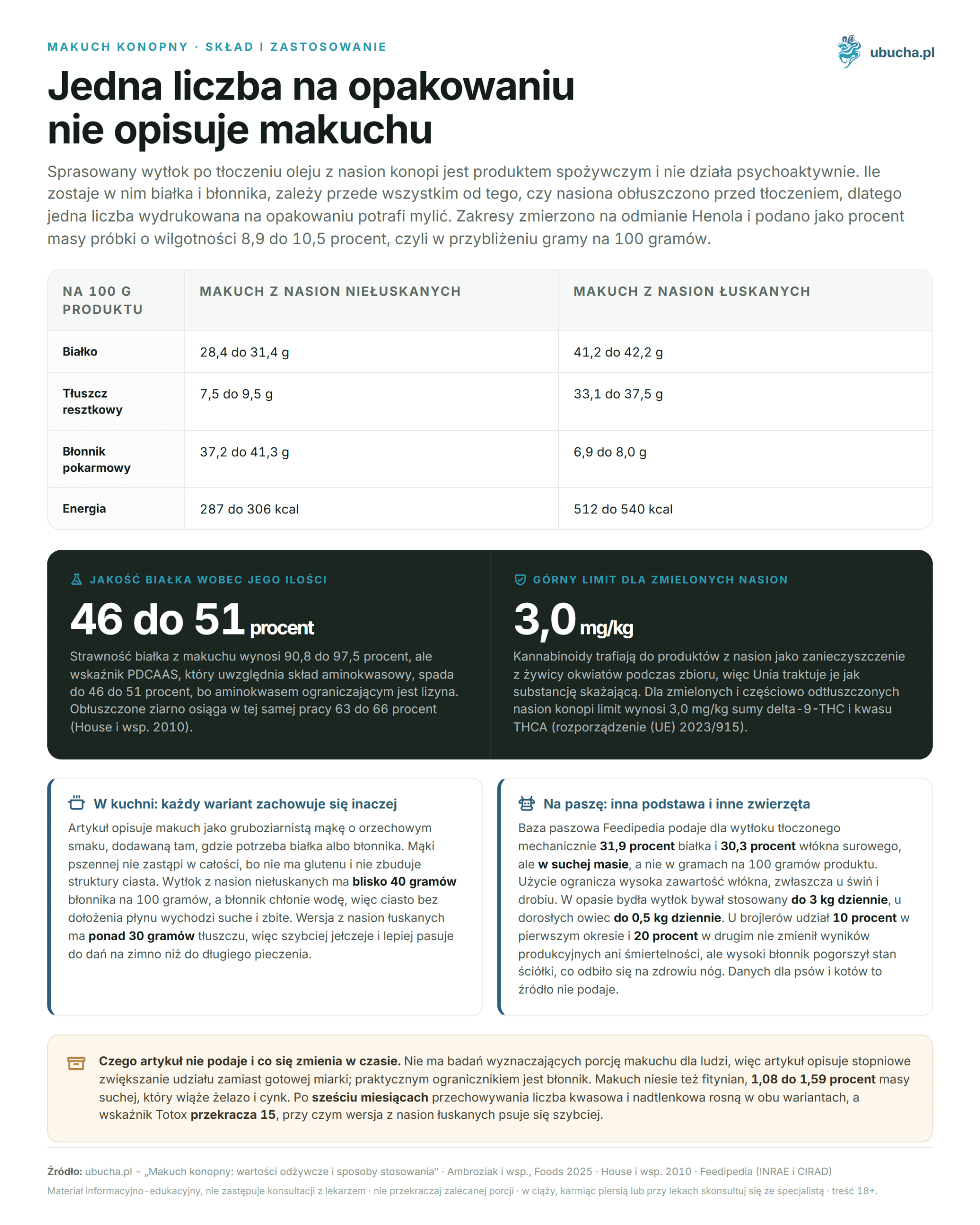
• Cake from unhulled seeds contains 28.4 to 31.4 g of protein and 37.2 to 41.3 g of dietary fiber per 100 g; from hulled seeds, 41.2 to 42.2 g of protein with 6.9 to 8.0 g of fiber (Ambroziak et al., Foods 2025).
• The energy value is 287 to 306 kcal per 100 g for the cake from unhulled seeds and 512 to 540 kcal for the cake from hulled seeds (Ambroziak et al. 2025).
• The Feedipedia feed database states that mechanically pressed cake contains 31.9 percent protein and 30.3 percent crude fiber in dry mass, with 11.5 percent residual fat (Feedipedia, INRAE and CIRAD).
• The protein from the cake has a digestibility of 90.8 to 97.5 percent, but the PDCAAS score is only 46 to 51 percent, as lysine is the limiting amino acid (House, Neufeld and Leson, J Agric Food Chem 2010).
• In the residual fat, polyunsaturated fatty acids make up 62 to 72 percent, and the ratio of omega-6 to omega-3 is about 3 to 1 (Ambroziak et al. 2025).
• For ground and defatted hemp seeds, the limit is 3.0 mg/kg of total delta-9-THC and THCA, and for seed oil, 7.5 mg/kg (Commission Regulation (EU) 2023/915, Annex I, point 2.6).
What is hemp cake and does it have psychoactive effects?
Cake is the residue left in the press after oil is extracted from the seeds. It does not have psychoactive effects because the psychoactive part of the plant is the flowering tops, not the seeds. The Polish law on combating drug addiction states this explicitly: it defines hemp other than fiber as the above-ground part of the plant excluding the seeds (Art. 4 point 37, Journal of Laws 2005 No. 179 item 1485).
Cold pressing does not extract all the fat: the cake usually retains 7 to 12 percent oil, depending on the precision of the press and the variety (Ambroziak et al. 2025, according to Callaway 2004 and House 2010). The ground cake is sold under the name hemp flour and then contains 13 to 15 percent fat.
Cannabinoids enter seed products as contaminants from the resin of the flowers during harvesting, which is why the EU treats them as a contaminating substance and sets an upper limit. For ground and partially defatted hemp seeds, it is 3.0 mg/kg of total delta-9-THC and THCA, for seed oil 7.5 mg/kg, and it has been in effect since January 1, 2023 (Regulation (EU) 2023/915). The cake falls under this first category.
The limit is based on toxicological data: EFSA adopted a reference acute dose of 1 microgram of delta-9-THC per kilogram of body weight. In the EFSA data collection from 2020, the median total THC and THCA was 150 micrograms per kilogram in hemp seeds and 225 in hemp flour, clearly below the acceptable level (EFSA 2020, report 5953). There is no separate entry for the cake in this collection.
What does hemp cake contain in 100 grams?
It primarily depends on whether the seeds were hulled before pressing. A team from Bydgoszcz University of Technology measured both variants on the Polish variety Henola: the cake from unhulled seeds is fiber-rich, while from hulled seeds it is protein and fat-rich (Ambroziak et al., Foods 2025).
| Per 100 g of product | Cake from unhulled seeds | Cake from hulled seeds |
|---|---|---|
| Protein | 28.4 to 31.4 g | 41.2 to 42.2 g |
| Residual fat | 7.5 to 9.5 g | 33.1 to 37.5 g |
| Dietary fiber | 37.2 to 41.3 g | 6.9 to 8.0 g |
| Ash (mineral components) | 5.6 to 6.4 g | 6.3 to 6.8 g |
| Energia | 287 to 306 kcal | 512 to 540 kcal |
It is given as a percentage of the sample mass with a moisture content of 8.9 to 10.5 percent, which is approximately grams per 100 grams. Feed data shows a similar picture: 31.9 percent protein in dry matter with a range of 27.3 to 36.1 and 30.3 percent crude fiber (Feedipedia). House and colleagues report an average of 40.7 percent protein, but with a standard deviation of 8.8 points, which speaks for itself about how batches differ (House et al. 2010).
The amount of protein is not the same as its quality. The digestibility of protein from cake is very high, ranging from 90.8 to 97.5 percent, but the PDCAAS score, which takes into account the amino acid composition, drops to 46 to 51 percent because the first limiting amino acid is lysine. In comparison: hulled grain alone achieves 63 to 66 percent in the same study.
The fat remaining in the cake is polyunsaturated at 62 to 72 percent, with an omega-6 to omega-3 ratio of about 3 to 1. Cake also contains phytic acid, ranging from 1.08 to 1.59 percent of dry mass, which binds iron and zinc, so it is not a product to eat instead of a meal.
How to use hemp cake in the kitchen?
The simplest way is to treat it like coarse flour with a nutty flavor and add it where protein or fiber is needed. It works well in bread and rolls, in pancakes, oatmeal, smoothies, homemade bars, and as part of a breading. It cannot completely replace wheat flour because it lacks gluten and will not build the structure of the dough.
The substitution is safe when you start with a small amount and add liquid. Cake from unhulled seeds has nearly 40 grams of fiber per 100 grams, and fiber absorbs water, so the dough will turn out dry and dense without adjustment.
The hulled seed version behaves differently. It has over 30 grams of fat per 100 grams, so it goes rancid faster and is better suited for cold dishes than for long baking. The same study from Bydgoszcz showed that after six months of storage, the acid and peroxide values increase in both variants, and the Totox index exceeds 15, meaning the fat is already oxidized.
Cake does not replace either oil or protein isolate; it stands between them. For pure fat, reach for olej konopny w kuchni, for pure protein, reach for hemp protein. The whole grain describes an entry about the nutritional values of hemp seeds, and an overview of forms can be found in the guide about hemp in the kitchen. Ready products are listed in the category hemp food.
Is hemp cake suitable for animal feed?
Yes, and it is its oldest application. The Feedipedia database, managed by INRAE, CIRAD, AFZ, and FAO, describes hemp cake as a feed material with good protein value, whose use is limited by high fiber content, especially in pigs and poultry (Feedipedia, hemp).
The results collected there are specific. In ruminants, cake has been used in cattle fattening up to 3 kg per day and in adult sheep up to 0.5 kg per day, and replacing rapeseed cake with it at a level of 20 percent of the dry matter of the diet did not worsen feed intake or nutrient utilization in sheep. It is also a good source of undegradable protein in the rumen.
In poultry, the picture is mixed. Trials on organic broilers with 10 percent inclusion in the first period and 20 percent in the second did not change production results or mortality, but high fiber worsened bedding conditions, which affected leg health. In laying hens, mixtures with up to 10 percent cake did not reduce egg production and enriched yolk fat with omega-3 fatty acids. Rabbits digest it worse because fiber reduces the digestibility of the entire diet.
What is missing in this source: data for dogs and cats. Feedipedia describes ruminants, poultry, pigs, and rabbits, so feeding cake to companion animals requires a conversation with a veterinarian.
Frequently Asked Questions
Does hemp cake contain THC?
Only trace amounts, and as a contamination transferred from the flowers during harvesting, not as a component of the seeds. The EU has set an upper limit of 3.0 mg per kilogram for ground and de-oiled hemp seeds for the sum of delta-9-THC and THCA. Cake falls under this provision of regulation 2023/915.
Does hemp cake have psychoactive effects?
No. Seeds are excluded from the statutory definition of cannabis other than fiber types, and cannabinoids in seed products are measured in milligrams per kilogram. In EFSA data from 2020, the median sum of THC and THCA in seeds was 150 micrograms per kilogram.
Is hemp cake the same as hemp flour?
Almost. Hemp flour is ground cake, meaning the same residue after oil pressing, only crushed and sifted. Partially de-oiled hemp flour usually retains 13 to 15 percent fat, and differences between batches mainly arise from the degree of de-oiling and whether the seeds were hulled.
How much protein does hemp cake contain?
From about 28 to over 42 grams per 100 grams, depending on the raw material. The residue from unhulled seeds contains between 28.4 to 31.4 grams, while hulled seeds contain 41.2 to 42.2 grams. Feed data gives 31.9 percent in dry matter.
Is hemp cake gluten-free?
Hemp seeds are not grains, so the residue itself does not contain gluten. The risk remains cross-contamination in the mill that also processes wheat. If you have celiac disease, look for the manufacturer's declaration, not just the product name.
How to store hemp cake?
Tightly, in a cool place and away from light, because the remaining oil is polyunsaturated and oxidizes. In a study of the Henola variety after six months, the acid and peroxide values increased in both variants, and the Totox index exceeded 15. The version with hulled seeds spoils faster.
How much hemp cake should be eaten daily?
There are no studies that determine a portion of cake for humans, and none of the open sources provide such a number. A practical limit is fiber: the residue from unhulled seeds has nearly 40 grams per 100 grams, so a large portion at once burdens the intestines. Increase the intake gradually.
How does hemp cake differ from hemp protein?
By the degree of purification. Cake is the whole residue after pressing, with fiber and the rest of the fat. Hemp protein is made from it by sifting out some of the fiber, so it has more protein and less fiber, but loses what was sifted out.
The article is informational and educational in nature and does not replace consultation with a doctor. If you are pregnant, breastfeeding, taking medications, or have chronic conditions, consult the use of supplements or herbs with a specialist.
Author: Michał Waluk · Published: 2026-08-24 · Updated: 2026-08-24