
Luteina i zeaksantyna na wzrok - dawkowanie i dla kogo (tabela)
Lutein and zeaxanthin for vision: dosage table, how much to take, when and how to start. A practical guide from u Bucha.
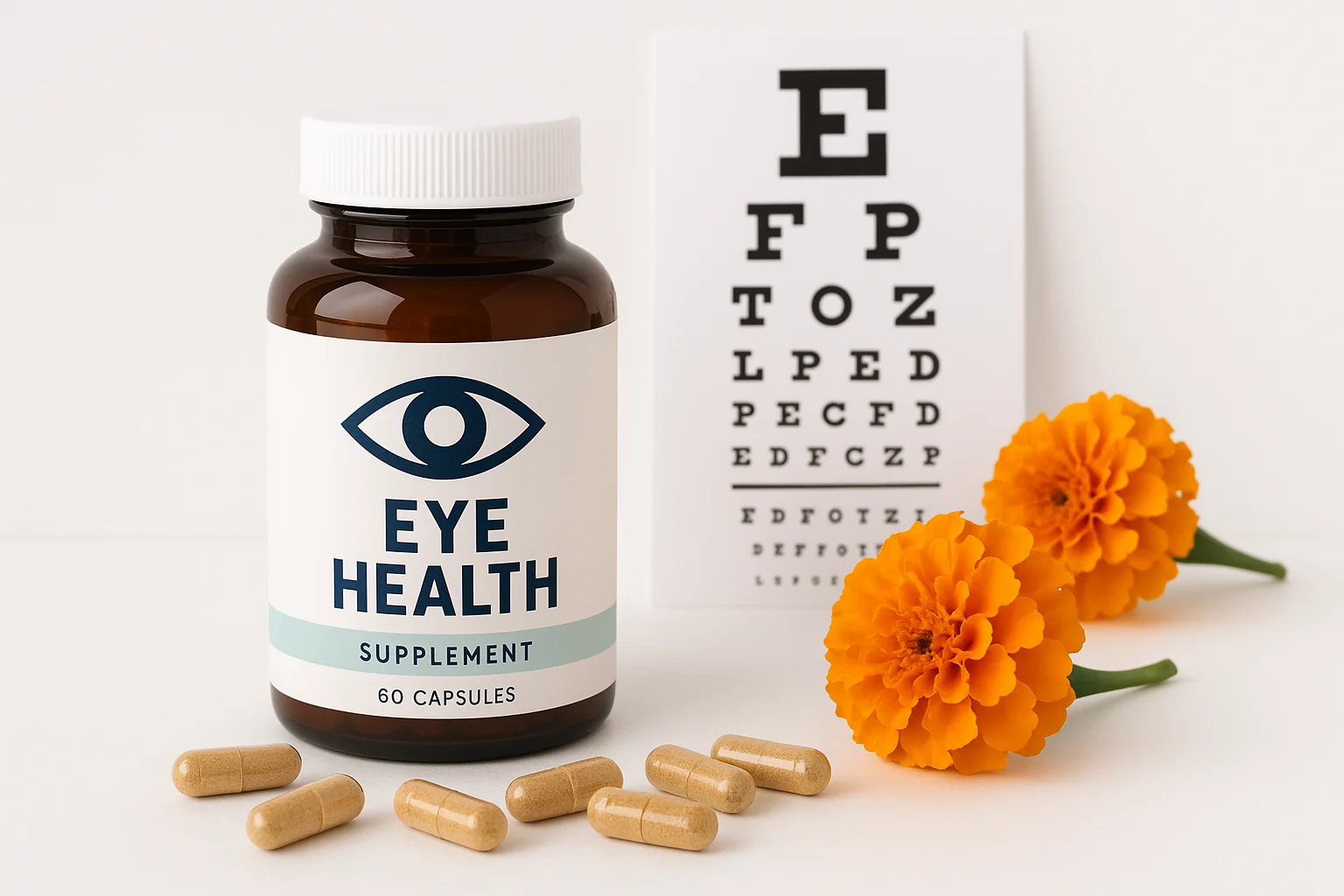
Lutein and zeaxanthin are the only carotenoids that selectively accumulate in the retina and the macula of the eye. The AREDS2 study (Age-Related Eye Disease Study 2), the largest clinical trial on eye health conducted by the NIH with over 4,000 patients, showed that supplementation of 10 mg of lutein and 2 mg of zeaxanthin daily reduces the risk of progression to advanced age-related macular degeneration (AMD) by 26% (AREDS2 Research Group, JAMA Ophthalmology, 2013). AMD is the most common cause of vision loss in people over 50 in developed countries. This article explains how both components work, who they are particularly important for, and how to dose them properly.
KEY INFORMATION
• Supplementation of 10 mg of lutein and 2 mg of zeaxanthin daily reduces the risk of progression of AMD by 26% (AREDS2, JAMA Ophthalmology 2013).
• Lutein and zeaxanthin form the macular pigment - a natural filter that protects photoreceptors from blue and UV light.
• Lutein and zeaxanthin are lipophilic carotenoids - always take them with a fatty meal.
• People working at screens, smokers, and those over 50 have increased requirements.
• The effects of supplementation are visible after 3-6 months of consistent use.
What are lutein and zeaxanthin and how do they protect vision?
Lutein and zeaxanthin are carotenoids from the xanthophyll group. The body does not synthesize them on its own - they must be obtained from diet or supplements. Once absorbed, they selectively accumulate in the retina, particularly in the macula (macula lutea) - the area responsible for central visual acuity, face recognition, and reading.
In the macula, they form the "macular pigment" (MPOD - macular pigment optical density), which serves two key functions. First: it acts as an optical filter that absorbs blue and ultraviolet light before it reaches the delicate photoreceptors (cones). Blue light emitted by LED screens and natural UV radiation are major factors in phototoxic damage to the retina. Second: it neutralizes free radicals generated by photochemical reactions in the retina - an area with one of the highest rates of oxidative metabolism in the entire body.
The difference between lutein and zeaxanthin: lutein concentrates in the peripheral areas of the macula, while zeaxanthin is found in the central fovea (fovea centralis), where cone density and visual acuity are highest. Both components work synergistically and should be taken together.
Dosage table for lutein and zeaxanthin
The table below summarizes the recommended doses for different groups and supplementation goals, based on data from clinical studies and ophthalmological guidelines.
| Goal / Group | Lutein dose / day | Zeaxanthin dose / day | Notes |
|---|---|---|---|
| AMD prevention (people over 50) | 10 mg | 2 mg | Dawka AREDS2 - najlepiej udokumentowana |
| Screen work (younger individuals) | 6-10 mg | 1-2 mg | Effects after 3-6 months |
| Early AMD or drusen | 10-20 mg | 2-4 mg | Definitely consult an ophthalmologist |
| Smokers (increased risk of AMD) | 10 mg | 2 mg | Avoid supplements with beta-carotene when smoking |
| General prevention (under 50 years old) | 6 mg | 1 mg | Possible supplementation only from diet (kale, spinach) |
What did the AREDS2 study really show?
The AREDS2 study is a key reference point for the entire field of vision supplementation. The National Eye Institute (NIH) study conducted from 2006 to 2012 on 4,203 participants with intermediate or advanced AMD in one eye tested various versions of the supplementation formula. Key finding: replacing beta-carotene (used in the original AREDS) with lutein and zeaxanthin yielded better results - a 26% reduction in the risk of progression of AMD with a formula containing 10 mg of lutein and 2 mg of zeaxanthin (AREDS2 Research Group, JAMA Ophthalmology, 2013).
An important detail: beta-carotene should not be used by smokers (it increases the risk of lung cancer in this group - as shown by the ATBC study). Lutein and zeaxanthin are safe for smokers, making them a better choice for the general population. The AREDS2 study completely changed the approach to AMD prevention - today, "vision" preparations contain lutein, not beta-carotene.
Citation capsule (AREDS2, 2013): In the AREDS2 study involving over 4,000 patients, the formula containing 10 mg of lutein and 2 mg of zeaxanthin reduced the risk of progression to advanced AMD by 26% compared to the formula without lutein/zeaxanthin. The effect was particularly pronounced in individuals with low dietary lutein intake (lowest quintile) - in this group, the risk reduction was about 35% (AREDS2 Research Group, JAMA Ophthalmology, 2013).
Who is lutein particularly important for?
The demand for lutein and zeaxanthin increases in several circumstances. First: age over 50 - the natural concentration of macular pigment decreases with age, and the risk of AMD sharply increases after age 60. Second: working with screens. LED screens emit proportionally more blue light than natural lighting. Several studies have shown that chronic exposure to screens lowers MPOD in individuals with low dietary lutein intake.
Third: smoking - it destroys carotenoids in the retina and increases oxidative stress in the retinal pigment epithelium. Smokers have about 40% lower lutein concentration in the retina than non-smokers with the same dietary intake. Fourth: a diet low in leafy green vegetables. Kale, spinach, and parsley are the best dietary sources of lutein - but a serving of spinach provides about 20 mg of lutein, which is difficult to regularly obtain solely from diet for many people.
We have noticed that lutein supplementation is one of the most commonly recommended by ophthalmologists, but at the same time one of the most frequently taken in too low a dose. An "eye" preparation with 1-2 mg of lutein is too little - effective preparations contain at least 6 mg, and for prevention, 10 mg of lutein per serving.
Luteina i zeaksantyna z diety - czy to wystarczy?
Diet can provide sufficient amounts of lutein and zeaxanthin - but it requires regular consumption of specific products. Raw kale contains about 26 mg of lutein per 100 g, raw spinach about 12 mg, parsley leaves about 5 mg, and egg yolks about 0.2-0.5 mg per egg (low content, but high bioavailability due to the fat matrix).
The bioavailability of lutein and zeaxanthin from the diet strongly depends on the presence of fat in the meal. The study by Unlu et al. showed that adding avocado or oil to a spinach salad increases lutein absorption by as much as 6-9 times compared to a salad without fat (Unlu et al., Journal of Nutrition, 2005). The same principle applies to supplements - taking a lutein capsule with a fatty meal is essential for good absorption.
The best dietary sources of lutein and zeaxanthin
Before reaching for a supplement, it is worth knowing how much lutein you can obtain from your diet. Kale is the absolute leader - 100 g of raw kale contains about 18-26 mg of lutein and zeaxanthin combined. Raw spinach provides about 12 mg/100 g, parsley leaves about 5 mg/100 g, green peas about 2.5 mg/100 g. Egg yolks have lower content (about 0.2-0.5 mg per egg), but exceptionally high bioavailability - lutein from yolk is absorbed 3-4 times better than from vegetables because it is surrounded by fat.
Key conclusion: with regular consumption of servings of kale or spinach with fat (olive oil, avocado), it is possible to provide 6-10 mg of lutein daily solely from diet. But "regularly" here means several times a week, which is rare in the Polish diet. For individuals who do not eat large amounts of leafy green vegetables, supplementation is the only practical way to achieve preventive doses.
Zeaxanthin has a narrower dietary profile than lutein. The main sources are corn (yellow), peppers (yellow and orange), and egg yolks. Corn provides about 0.9 mg of zeaxanthin per 100 g, yellow pepper about 0.6 mg/100 g. Dietary coverage of the therapeutic dose of zeaxanthin (2 mg daily) is more challenging than for lutein - supplementation is more justified here.
Lutein and brain health - an unexpected connection
Lutein and zeaxanthin accumulate not only in the retina but also in the brain - particularly in areas responsible for learning and memory. A study by Johnson et al. showed that higher levels of lutein in brain tissue correlate with better cognitive performance in seniors (Johnson et al., Nutrients, 2013). The mechanism involves protecting neurons from oxidative stress and an anti-inflammatory effect on microglia.
A study by Renzi-Hammond et al. found that supplementation with lutein and zeaxanthin for 12 months in healthy middle-aged adults improved complex memory test scores and visual processing speed (Renzi-Hammond et al., Nutrients, 2017). This is an interesting extension of lutein's applications beyond strictly ophthalmic uses - although the evidence base is significantly smaller than for AMD prevention.
In children, lutein is particularly important in the early years of life when the retina and brain are rapidly developing. Breast milk contains lutein, the concentration of which depends on the mother's diet. Breastfeeding women who consume leafy green vegetables provide their child with more lutein, which may have long-term implications for eye health and neurological development.
Frequently Asked Questions
How much lutein should I take daily?
The effective dose is 10 mg of lutein and 2 mg of zeaxanthin daily - the dose used in the AREDS2 study, which showed a 26% reduction in the risk of progression of AMD (AREDS2 Research Group, JAMA Ophthalmology, 2013). For general prevention (screens, younger age), 6 mg of lutein and 1 mg of zeaxanthin daily is sufficient.
Does lutein help with eye strain from screens?
Yes - lutein and zeaxanthin increase the optical density of the macular pigment (MPOD), which improves tolerance to blue light from screens and reduces glare. The effect of improved visual comfort is noticeable after 3-6 months of consistent supplementation.
What is the difference between lutein and zeaxanthin?
Lutein concentrates in the peripheral areas of the macula, while zeaxanthin is found in the central fovea, where visual acuity is highest. Both carotenoids work synergistically as a filter protecting photoreceptors from blue and UV light. They should be taken together in a ratio of about 5:1 (lutein:zeaxanthin).
When to take lutein - in the morning or evening?
The time of day doesn't matter - lutein and zeaxanthin are lipophilic carotenoids that accumulate in tissues gradually. Always take them with a fatty meal (e.g., with breakfast containing eggs or oil), which can increase bioavailability by 6-9 times (Unlu et al., Journal of Nutrition, 2005).
Does lutein help with AMD?
Yes - the AREDS2 study conducted by the NIH on over 4,000 patients showed that 10 mg of lutein and 2 mg of zeaxanthin daily reduces the risk of progression to advanced AMD by 26%. Lutein is now a standard component of ophthalmic preventive preparations. For already diagnosed AMD, supplementation is conducted under the supervision of an ophthalmologist.
This article is for informational and educational purposes and does not replace consultation with a doctor. If you are pregnant, breastfeeding, taking medications, or have chronic conditions, consult the use of supplements or herbs with a specialist.
Author: Michał Waluk · Published: 2026-05-04 · Updated: 2026-05-04