
Bromelaina na zapalenia i trawienie - dawkowanie (tabela)
Bromelain for inflammation and digestion: dosage table, how much to take, when and how to start. A practical guide from u Bucha.
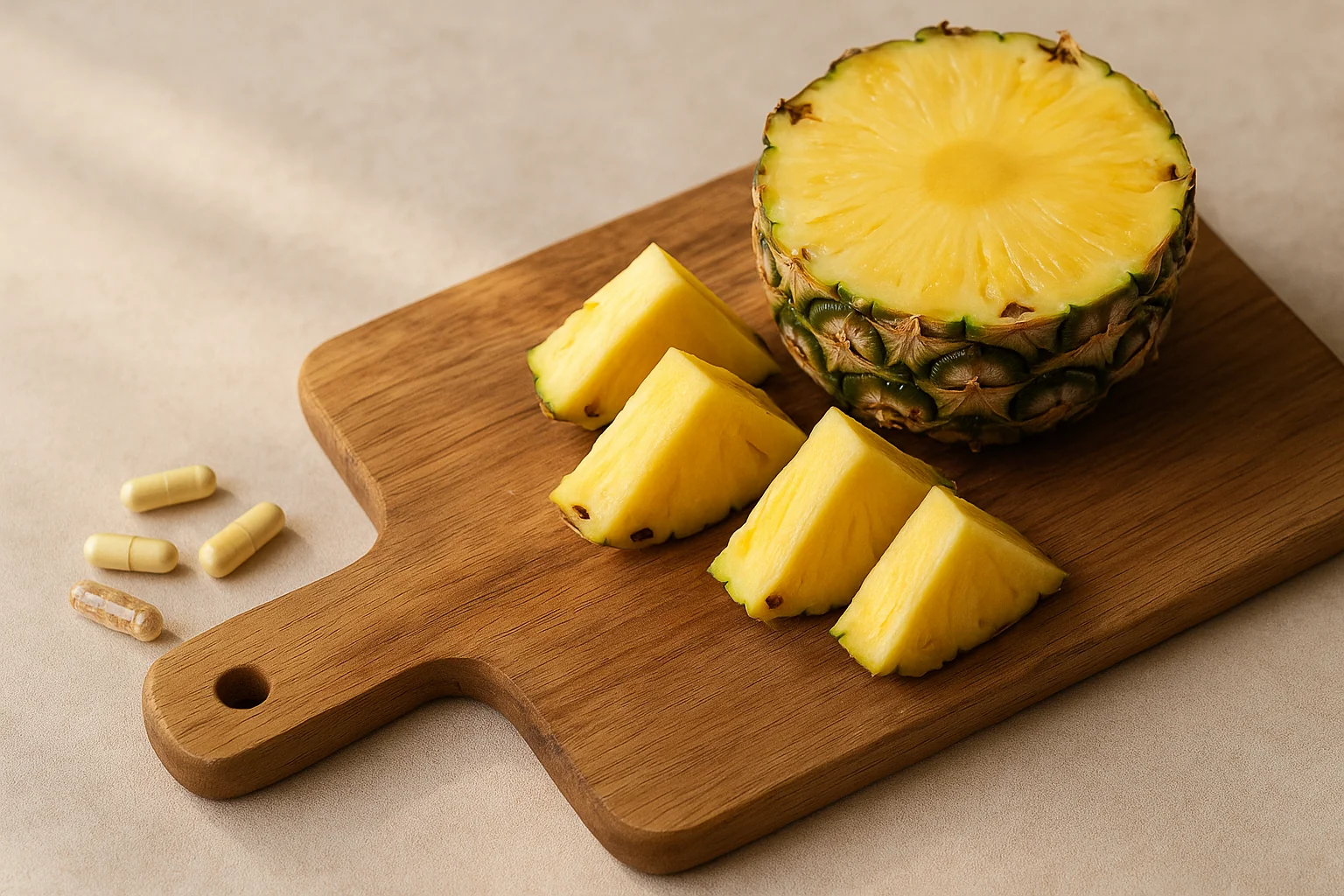
Bromelain is an enzyme extracted from the stem of the pineapple, which has intrigued scientists since the 1950s due to its anti-inflammatory and digestive support properties. A review of studies published in Biotechnology Research International (Pavan et al., PMC 2012) confirmed its multifaceted action - from reducing swelling to improving protein absorption. The problem is that different goals require different doses and different times of intake. This article presents a practical dosage table and explains when to take bromelain on an empty stomach and when with food.
KEY INFORMATION
• A clinical review confirms the action of bromelain at doses of 400-2000 mg daily (Pavan et al., PMC 2012).
• For inflammation and injuries - always on an empty stomach; for digestion - with a meal.
• Bromelain interacts with anticoagulants and antibiotics.
• The enzyme activity is measured in GDU/g units - the higher the result, the stronger the preparation.
• Effects in studies on pain/swelling are visible after 7-14 days of regular use.
What is bromelain and where does it come from?
Bromelain is a mixture of cysteine proteases - enzymes that break down proteins - isolated primarily from the stem of the pineapple (Ananas comosus). The fruit contains much less than the hard stem, which is why supplements are mainly produced from waste after pineapple processing. Enzymatic activity is expressed in GDU (Gelatin Digesting Units) or CDU (Casein Digesting Units) - a standard supplement contains 2400 GDU/g or more.
The action of bromelain is multifaceted. First - it digests proteins in the gastrointestinal tract, facilitating the absorption of amino acids. Second - when taken on an empty stomach, it is absorbed into the bloodstream and exhibits systemic effects: anti-inflammatory, anti-swelling, and likely immune-modulating. This duality is what makes the timing of intake crucial for the purpose of supplementation.
Studies from the 1970s and 1980s focused on its application in cardiology and otolaryngology (reduction of sinus swelling). Contemporary clinical studies include orthopedics, rehabilitation after surgeries, inflammatory bowel diseases, and supporting the absorption of antibiotics. The range of applications is broad, but all require appropriately selected doses.
Bromelain Dosage Table: Inflammation, Digestion, and Injuries
There is no single official daily dose of bromelain - there is a lack of regulatory harmonization comparable to vitamins. However, clinical data indicate clear ranges of effectiveness. A randomized study involving patients after knee arthroscopy confirmed a reduction in pain and swelling with 400 mg of bromelain taken twice daily for 14 days (Pavan et al., 2012). The table below organizes the dosage by purpose.
| Purpose of use | Daily Dose (mg) | Dose Division | Time of Intake | Treatment time |
|---|---|---|---|---|
| Supporting Protein Digestion | 250-500 mg | 1-2 x dziennie | With a meal or directly after | Continuous / as needed |
| Mild inflammatory conditions, prevention | 400-800 mg | 2 times a day | On an empty stomach - 30-60 minutes before a meal | 4-8 weeks |
| Sports injury, swelling, DOMS | 500-1000 mg | 2-3 x dziennie | Na czczo - rano i przed snem | 2-4 weeks |
| Postoperative swelling reduction | 1000-2000 mg | 3-4 x dziennie | On an empty stomach, as directed by a doctor | 1-3 weeks (under supervision) |
| Inflammatory conditions of the sinuses and respiratory tract | 400-600 mg | 2 times a day | On an empty stomach | 2-4 weeks |
How to read this table? If you are only concerned about digestion - take a low dose with food. If you want a systemic effect (inflammation, pain, swelling) - a higher dose on an empty stomach. Combining both goals simultaneously in the same portion is difficult because the enzyme "gets used up" on food proteins. Some people use two separate protocols: a small dose with lunch for digestion and a higher dose in the morning on an empty stomach for anti-inflammatory effects.
We have noticed that users often confuse these two protocols and take bromelain with food, only to be disappointed by the lack of anti-inflammatory effect. This is one of those cases where the timing of intake is more important than the dose itself.
How does bromelain work on inflammation?
The anti-inflammatory mechanism of bromelain is well documented today. The enzyme inhibits the synthesis of pro-inflammatory prostaglandins, lowers fibrin levels (a protein that causes swelling), and modulates cytokines - including TNF-alpha and IL-1-beta (Pavan et al., 2012). The result is a reduction in swelling, pain, and limited mobility in the joints.
A meta-analysis from 2016 assessed the effectiveness of bromelain in knee osteoarthritis. Results from six randomized studies showed a statistically significant reduction in pain and improvement in physical function compared to placebo, although the authors noted that the quality of the studies is moderate (Pavan et al., PMC). The findings are promising, but incomparable to strong NSAIDs - bromelain is a supplement, not a substitute for pharmacotherapy.
An important issue concerns bioavailability. For years, it was believed that enzymes are not fully absorbed through the intestines. However, pharmacokinetic studies using isotopically labeled molecules have shown that bromelain is absorbed in its enzymatically active form - even 40% of the dose reaches the bloodstream without deactivation (Maurer, Cellular and Molecular Life Sciences, 2001). This explains the observed systemic effects.
Bromelaina na trawienie - kiedy ma sens?
Bromelain breaks down peptide bonds in dietary proteins, supporting the work of pepsin and trypsin. This is practically significant for individuals with pancreatic insufficiency, the elderly (in whom enzyme production decreases), and those on high-protein diets, where the stomach may be overloaded. A study evaluating digestive enzyme supplementation in individuals over 60 years of age showed a significant improvement in amino acid absorption with doses of 250-500 mg of bromelain daily with meals (Maurer, 2001).
Does everyone need bromelain for digestion? No. Healthy individuals with normal digestive enzyme secretion will not experience significant benefits. Indications primarily include: bloating and a feeling of heaviness after protein meals, symptoms of dyspepsia, low stomach acidity, age over 60. In these cases, bromelain as part of enzyme therapy can genuinely improve digestive comfort.
A separate issue is inflammatory bowel disease (IBD). Several preclinical studies on animal models have suggested a protective effect of bromelain on the intestinal mucosa. However, there is insufficient clinical evidence in humans to make recommendations for this indication. Here, a consultation with a gastroenterologist is essential.
Safety and interactions of bromelain
Bromelain is considered safe for short-term use at standard doses. The European Food Safety Authority (EFSA) has not defined an upper limit for a safe dose, but literature reviews indicate that doses up to 2000 mg daily were well tolerated in clinical studies (EFSA). The most common side effects are gastrointestinal disturbances (nausea, diarrhea) and allergic reactions in individuals allergic to pineapple.
Drug interactions are a more serious issue. Bromelain inhibits platelet aggregation and may enhance the effects of anticoagulant medications - warfarin, clopidogrel, aspirin. When used concurrently, there is a risk of prolonged bleeding. Additionally, bromelain increases the absorption of amoxicillin and tetracycline into the bloodstream - which can be both an advantage (greater antibiotic effectiveness) and a disadvantage (higher risk of side effects).
From our experience, individuals taking bromelain together with anti-inflammatory medications without consulting a doctor risk intensifying the effects of NSAIDs. This combination requires clinical assessment - we do not recommend self-combining.
Bromelain in sports and rehabilitation - what studies say
One of the most practical applications of bromelain is accelerating recovery after physical exertion and injuries. A randomized study involving 20 marathon runners showed that supplementation with 400 mg of bromelain daily for 3 days after the race significantly reduced levels of muscle damage markers (CK - creatine kinase) and subjective muscle soreness compared to placebo (Maurer, Cell Mol Life Sci 2001). The reduction of DOMS (delayed onset muscle soreness) was noticeable within 24 hours of taking the supplement.
In orthopedics, bromelain is used as an adjunct to therapy after joint procedures - knee arthroscopy, Achilles tendon surgeries, and ligament reconstruction. A review from 2012 (Pavan et al.) documents clinical cases where the combination of bromelain with tryptamine and rutin (Phlogenzym product) showed effectiveness comparable to diclofenac in reducing postoperative swelling, with a better gastrointestinal tolerance profile (Pavan et al., PMC 2012). This is important for patients who cannot tolerate non-steroidal anti-inflammatory drugs.
For athletes, the timing of use is crucial: bromelain should be taken on an empty stomach immediately after training or competitions, and subsequent doses - in the morning before breakfast for 2-4 consecutive days. With intense physical exertion, doses of 500-750 mg twice daily are clinically justified. Athletes subject to anti-doping tests need not worry - bromelain is not a substance banned by WADA.
Bromelain and sinus and respiratory health
One of the lesser-known but well-documented uses of bromelain is supporting the treatment of sinus inflammation. A clinical study involving children with acute sinusitis showed that bromelain, as an adjunct to standard treatment, significantly shortened the duration of symptoms and improved nasal patency compared to conventional treatment alone (Glatthaar-Saalmüller et al., Phytomedicine 2003). The mechanism involves reducing mucosal swelling and thinning secretions through the proteolytic action of the enzyme.
The mucolytic effect of bromelain - the ability to thin mucus - is significant not only in sinusitis but also in chronic cough and upper respiratory infections. Bromelain works differently than typical mucolytics (like ACC): it does not directly alter the structure of mucins but digests plasma proteins that create thick secretions. The effect is gradual, but with doses of 400-600 mg on an empty stomach for 7-14 days, it can provide noticeable relief. In cases of recurrent sinus infections, bromelain may be part of seasonal prevention combined with vitamin C and zinc.
Frequently Asked Questions
How much bromelain should be taken daily for inflammation and pain?
For anti-inflammatory effects, doses of 500-2000 mg of bromelain are usually used daily, divided into 2-3 doses on an empty stomach. Clinical studies confirm the effectiveness of doses of 400-800 mg for reducing pain and swelling after injuries. Start with the lower limit and monitor tolerance for 7 days before potentially increasing.
Should bromelain be taken before or after meals?
It depends on the goal. For inflammation and injuries - always on an empty stomach (30-60 minutes before a meal or at least 2 hours after), because enzymes are not then used for digesting dietary proteins. For improving digestion - with or immediately after a meal. These two goals require different timing of intake.
Does bromelain interact with medications?
Yes. Bromelain can enhance the effects of anticoagulant medications (warfarin, aspirin, clopidogrel) and antibiotics (amoxicillin, tetracycline). It may also strengthen the effects of NSAIDs (Pavan et al., 2012). If you are taking prescription medications, consult your doctor about supplementation.
How long can bromelain be taken?
Most clinical studies evaluated use for 4-12 weeks. For short-term use after an injury, the treatment lasts 2-4 weeks. For longer supplementation, safety data is lacking - it is reasonable to take monthly breaks and consult a doctor after 8 weeks of use.
Is bromelain from pineapple the same as the supplement?
No. Pineapple contains bromelain mainly in the stem (core), not in the flesh, and in amounts too small for a therapeutic effect. A standardized supplement contains a concentrated enzyme (usually 2400 GDU/g or higher). Eating a few slices of pineapple will not replace the supplement for therapeutic purposes.
Does bromelain help with sinus inflammation?
Yes. A clinical study involving children with acute sinusitis showed that bromelain, as an adjunct to treatment, significantly shortened the duration of symptoms and improved nasal patency (Glatthaar-Saalmüller et al., Phytomedicine 2003). The mechanism involves reducing mucosal swelling and proteolytic thinning of secretions. A dose of 400-600 mg on an empty stomach for 7-14 days is used. Bromelain complements, but does not replace, antibiotic treatment in bacterial sinusitis.
Does bromelain speed up recovery after training?
Yes. Studies involving athletes show a reduction in muscle damage markers (CK) and a decrease in DOMS with 400-500 mg of bromelain taken on an empty stomach for 2-4 days after intense exercise. Bromelain is not a substance banned by WADA. Take it in the morning on an empty stomach and in the evening at least 2 hours after the last meal to avoid using the enzyme for digesting food proteins.
This article is for informational and educational purposes and does not replace consultation with a doctor. If you are pregnant, breastfeeding, taking medications, or have chronic conditions, consult the use of supplements or herbs with a specialist.
Author: Michał Waluk · Published: 2026-05-04 · Updated: 2026-05-04