

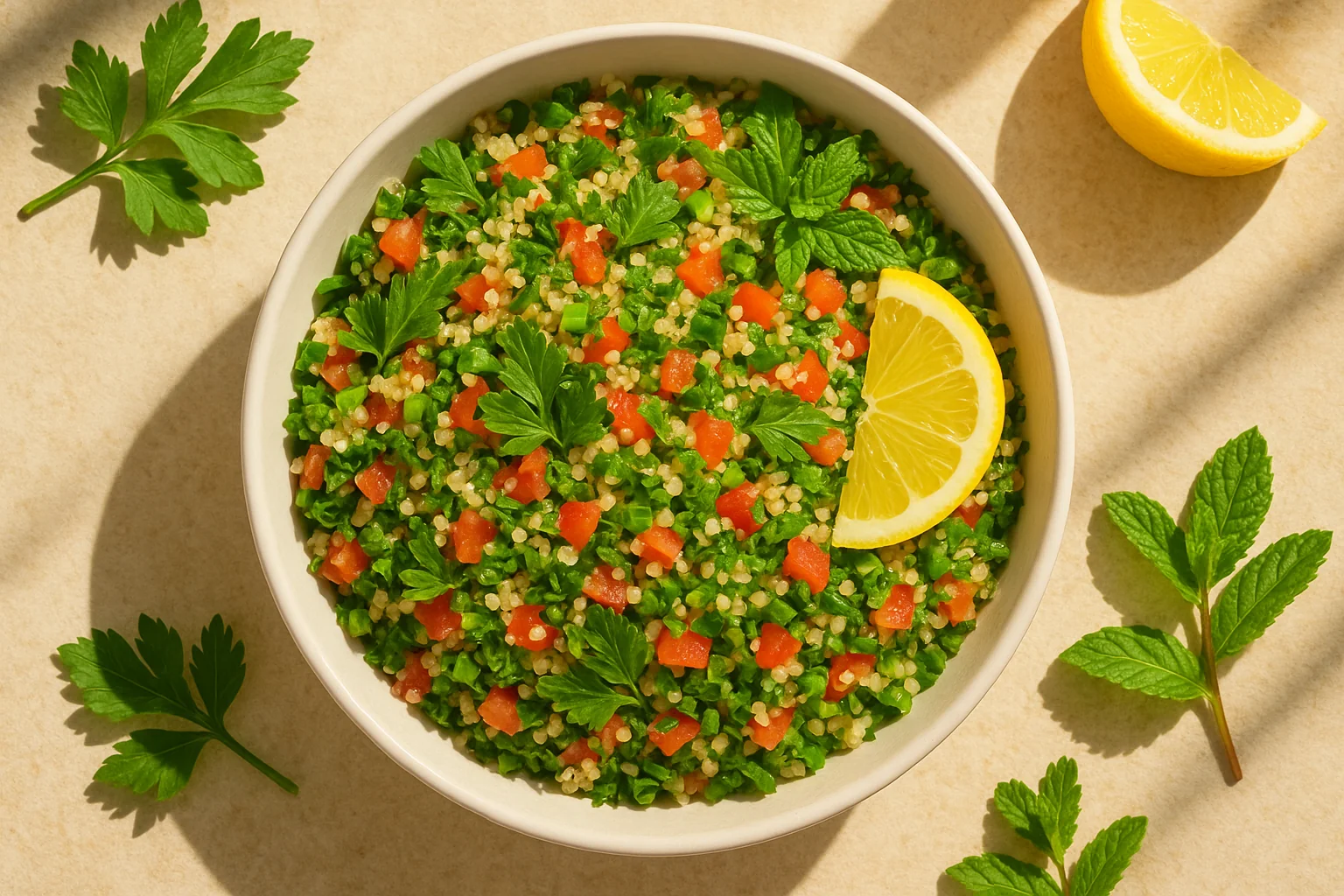

Tabbouleh with quinoa and hemp seeds – a fresh main salad
Tabbouleh with quinoa and hemp seeds – a fresh main salad full of herbs. Step-by-step recipe with nutritional values and storage tips.
Tabbouleh is one of those salads where herbs take center stage, and the grain is merely a backdrop. The classic Lebanese version contains bulgur – here we replace it with quinoa, which is gluten-free and provides complete plant protein. Hulled hemp seeds add nuttiness and a second layer of protein, complementing the amino acid profile of quinoa. The result is a light, intensely green, aromatic salad that works well as a standalone main dish or a side. Best after 1–2 hours of marinating in the fridge, when the flavors meld.
KEY INFORMATION
• Hulled hemp seeds contain about 31 g of protein per 100 g and all 9 essential amino acids (House et al., Food Chemistry, 2010).
• Quinoa contains about 14 g of protein/100 g of dry mass and is one of the few grains with complete amino acids (USDA FoodData Central, 2023).
• The omega-6 to omega-3 ratio in hemp seeds is about 3:1 – close to the optimal level for humans (Callaway, Euphytica, 2004).
• Fresh parsley provides about 1640 µg of vitamin K and 133 mg of vitamin C per 100 g – one of the most nutrient-dense components of greens.
What does adding hemp seeds to tabbouleh provide?
Traditional Lebanese tabbouleh consists of parsley, mint, bulgur, tomatoes, and olive oil. The protein content is moderate – about 5–7 g per serving. Hemp seeds change this equation: four tablespoons (40 g) provide about 12 g of protein with a complete amino acid profile. House et al. (Food Chemistry, 2010) confirm that hemp seeds contain all 9 essential amino acids, compensating for the deficiencies of quinoa, which is low in sulfur amino acids.
Quinoa instead of bulgur is a change that brings value on its own. Quinoa contains about 14 g of protein/100 g of dry mass according to USDA FoodData Central and is one of the few grains with a complete amino acid profile. Together with hemp seeds, it creates a protein-rich combination comparable to meat dishes – without meat, without dairy, without gluten. The taste? The nutty note of hemp seeds perfectly balances the acidity of lemon juice and the intensity of parsley.
From our experience, hemp tabbouleh tastes best exactly 2 hours after preparation – not fresh (too sharp herbs and lack of flavor integration) and not after a day (herbs too moist from tomato juices). Two hours in the fridge is the sweet spot: parsley slightly softens, mint releases essential oils into the dressing, and hemp seeds absorb the acidity of lemon.
Nutritional values – what does this serving provide?
One serving of tabbouleh (about 200 g) with quinoa, hemp seeds, herbs, and tomatoes provides about 280–310 kcal, 13 g of protein, 14 g of fat (mainly from olive oil and hemp seeds), and 28 g of carbohydrates. The fiber from quinoa and vegetables is about 5 g per serving. The vitamin K from parsley (about 1640 µg/100 g fresh) exceeds the daily requirement in one serving of the salad.
Ingredients – what do you need?
Proportions for 3–4 servings. Preparation time: 20 minutes + 30–120 minutes of marinating.
- 150 g of quinoa (quinoa)
- 4 tablespoons of hulled hemp seeds (about 40 g)
- 2 large bunches of flat-leaf parsley (about 80 g of pure leaves)
- 1 handful of fresh mint (about 20 g of leaves)
- 3 Roma tomatoes or 200 g of cherry tomatoes
- 2 spring onions or 1/2 small red onion
- 4 tablespoons of extra virgin olive oil
- 4 tablespoons of lemon juice (about 1.5 lemons)
- 1/2 teaspoon of salt
- 1/4 teaspoon of white pepper
- optional: 1/4 teaspoon of ground cumin
- optional: 1/2 cucumber (diced)
How to prepare tabbouleh with quinoa and hemp seeds – step by step?
Tabbouleh is a simple recipe, but it requires two things: good fresh parsley and time for marinating. Don't rush to serve – wait at least 30 minutes after mixing.
Step 1. Cook and cool the quinoa. Rinse the quinoa under cold water for 1 minute. Cook in 300 ml of water for 15 minutes over low heat. Spread on a plate or baking sheet and cool to room temperature. Hot quinoa will wilt the parsley after mixing – wait 20–30 minutes.
Step 2. Chop the herbs and vegetables. Tear the parsley leaves from the stems – discard the stems or save them for broth. Finely chop the leaves – they should be small (about 3–4 mm), not ground. Chop the mint. Dice the tomatoes (about 1 cm), draining excess juice. Slice the onion into thin rings.
Step 3. Make the dressing. In a bowl, mix the oil, lemon juice, salt, pepper, and optionally cumin. Taste – it should be distinctly tangy. The acidity of the lemon is the signature flavor of tabbouleh and should not be skimped on.
Step 4. Assemble the salad. To the cooled quinoa, add the hemp seeds and mix. Add the chopped herbs, tomatoes, and onion. Drizzle with the dressing and gently mix with a spoon. Do not use your hands – the delicate parsley leaves will lose their structure.
Step 5. Marinate and serve. Cover the bowl and refrigerate for at least 30 minutes (preferably 2 hours). Before serving, taste and adjust: more lemon, salt, or pepper. Serve at refrigerator or room temperature – do not heat the tabbouleh.
Tips and variations
Pomegranate version. Add a handful of pomegranate seeds to the tabbouleh – the sweet and sour seeds contrast with the sharpness of the parsley and the nuttiness of the hemp seeds. This is a popular Middle Eastern variant, particularly visually appealing.
Avocado version. Add 1 diced avocado just before serving (do not marinate – it will turn black). Avocado adds creaminess and healthy monounsaturated fats, which together with the PUFA from hemp seeds create an exceptionally beneficial lipid profile for the salad.
Winter version with sun-dried tomatoes. When fresh tomatoes are unavailable, use 60 g of oil-packed sun-dried tomatoes chopped into small pieces. The more intense umami flavor compensates for the lack of freshness.
Also compare our recipe for Buddha bowl with hemp dressing – another fresh, colorful bowl salad with hemp products as the base for the dressing.
Frequently Asked Questions
What is the difference between tabbouleh with quinoa and the traditional version?
Traditional tabbouleh uses bulgur – cracked wheat. Quinoa replaces it with a gluten-free alternative that has a higher protein content (14 g/100 g vs 12 g for bulgur). Hemp seeds add 9 g of protein and omega-3 fatty acids in a 3:1 ratio (Callaway, Euphytica, 2004) – the nutritional profile is clearly richer than the classic version.
How long can hemp tabbouleh be stored?
Store tabbouleh in the refrigerator for up to 3 days. Hemp seeds retain their values for several days. Quinoa contains about 14 g of protein/100 g (USDA, 2023). Before serving after storage, add a fresh squeeze of lemon juice and parsley leaves.
How much protein does tabbouleh with hemp seeds have?
One serving (200 g) provides about 12–14 g of protein. Quinoa and hemp seeds together create a complete amino acid profile – hemp seeds contain all 9 essential amino acids (House et al., Food Chemistry, 2010), complementing any deficiencies of quinoa.
Can dried parsley be used instead of fresh?
Tabbouleh requires fresh parsley – dried cannot replace the flavor, color, or texture. Fresh parsley provides about 1640 µg of vitamin K and 133 mg of vitamin C per 100 g. Dried loses 80–90% of these values. Without fresh parsley, it’s no longer tabbouleh.
This article is for informational and educational purposes and does not replace consultation with a doctor. If you are pregnant, breastfeeding, taking medications, or have chronic conditions, consult the use of supplements or herbs with a specialist.
Author: Michał Waluk · Published: 2026-05-04 · Updated: 2026-05-04