
Psyllium fiber for intestines and cholesterol - how to use (table)
Fiber: dosing table, how much to take, when and how to start. A practical guide from u Bucha.
Over 70% of adult Poles do not consume the recommended amount of dietary fiber by WHO, and the effects of this gap - constipation, elevated cholesterol, blood sugar fluctuations - affect millions of people (GUS, 2023). Psyllium husks, or Plantago ovata, are one of the best-researched and cheapest ways to supplement this deficiency. In this article, you will find a specific dosing table, an answer to the question of whether psyllium really lowers cholesterol, and a practical protocol for gradually introducing fiber - without stomach pain at the start.
KEY INFORMATION
• 7-10 g of psyllium daily lowers LDL by 5-10% - this is confirmed by a meta-analysis of 28 clinical studies (Abutair et al., Journal of Nutrition, 2016).
• Psyllium forms a gel in the intestines that slows down glucose absorption - helpful for insulin resistance and type 2 diabetes.
• Starting dose: 5 g (1 teaspoon) daily with at least 250 ml of water; increase every 3-5 days.
• EFSA confirmed that 10 g of psyllium husks daily normally maintains proper LDL levels in the blood (EFSA, 2012).
• Psyllium is non-addictive and safe for long-term use.
What is psyllium and how do its husks differ from regular fiber?
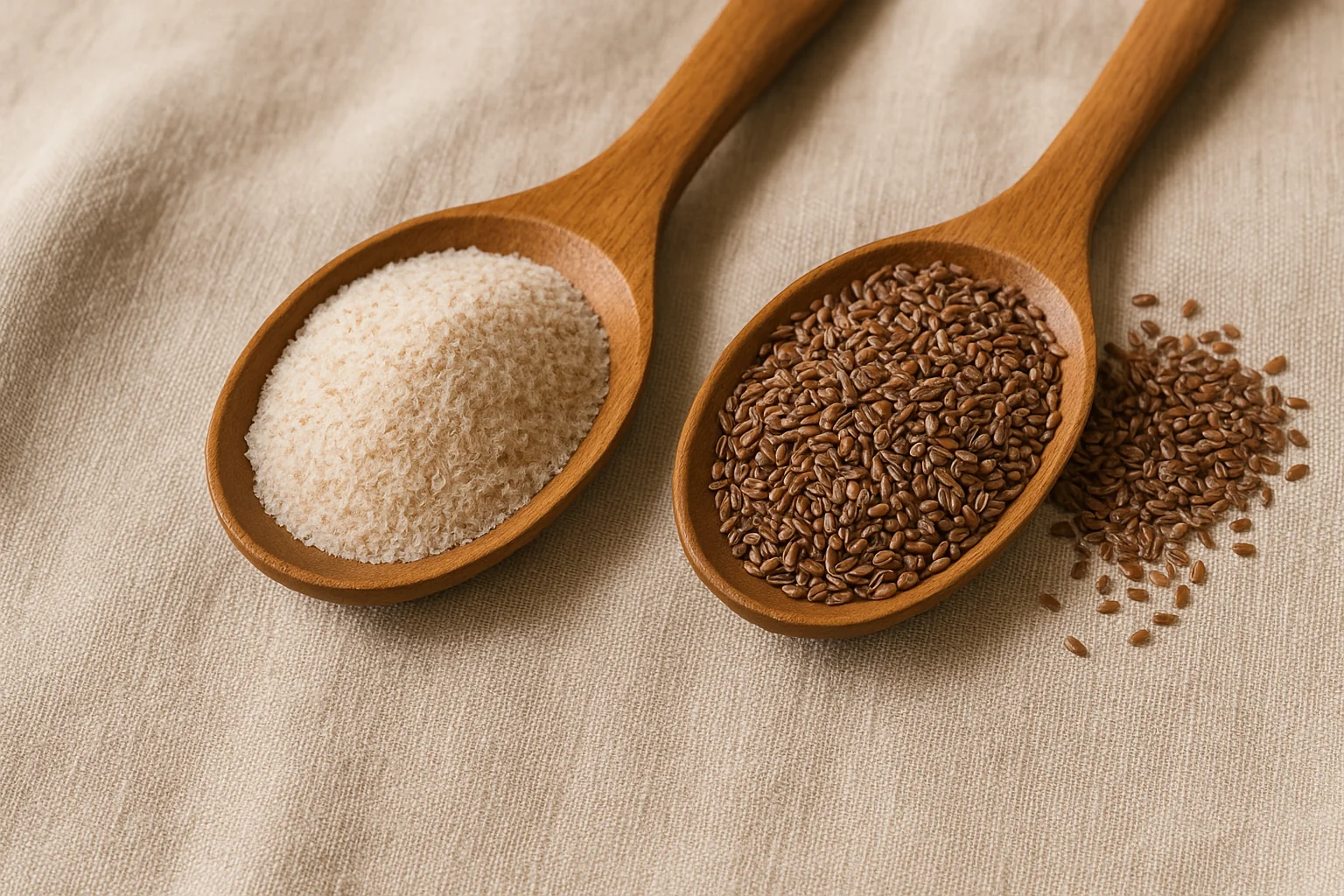
Psyllium (Plantago ovata) is a plant whose seed husks contain 67 to 71% soluble fiber, significantly more than oats or flaxseed (Jalanka et al., Gut Microbes, 2019). When psyllium husks come into contact with water, they absorb it up to 40 times their weight and form a sticky gel. This gel is responsible for all the key properties of the raw material - from regulating bowel movements to binding bile acids.
Regular insoluble fiber - from wheat bran or flaxseed - works mechanically: it swells and speeds up transit. Soluble fiber from psyllium does something more: it binds cholesterol and bile acids in the intestine, slows glucose absorption, and serves as food (prebiotic) for gut bacteria producing butyrate. Therefore, the effects of using psyllium are broader than with other forms of fiber.
We have noticed in tests that individuals transitioning from wheat bran to psyllium often report better tolerance and no bloating after a transitional adaptation period. This is due to the difference in the ratio of soluble to insoluble fractions: psyllium contains them in a ratio of about 70/30, while wheat bran is the opposite.
Psyllium dosage table by purpose and form
The Institute of Medicine (IOM) recommends adults consume 25-38 g of fiber daily from all sources, but in psyllium supplementation, doses of 5-15 g daily are typically used as a dietary supplement (Dietary Reference Intakes, National Academies Press, 2005). The table below includes typical usage patterns.
| Purpose of use | Daily dose (g of husks) | When to take | Minimum amount of water | Time of effect |
|---|---|---|---|---|
| Constipation, rhythm regulation | 5-10 g (1-2 teaspoons) | Morning or evening before a meal | 250-300 ml | 12-72 h |
| Lowering LDL | 7-10 g podzielone na 2 porcje | Before the main meal | 300 ml per dose | 4-8 tygodni regularnego stosowania |
| Stabilization of glycemia | 5-7 g before meals | 15 minutes before lunch or dinner | 250 ml | Effect on the meal visible immediately |
| Support for the microbiome (prebiotic) | 5-10 g raz dziennie | Any time with a meal | 250 ml | 2-4 weeks |
| Starting dose (any goal) | 3-5 g przez 5-7 dni | In the morning with water | 250 ml | Adaptacja mikrobiomowa 7-14 dni |
How to use this table in practice? Always start with the starting dose - regardless of the goal. Bloating at first is a normal reaction of gut bacteria to new food. If it does not exceed tolerance, maintain the dose for 5-7 days and only then increase it. A sudden introduction of 10 g at once almost always results in discomfort that discourages continuation.
Does psyllium really lower cholesterol - what do studies say?
The scientific evidence here is exceptionally strong. A meta-analysis of 28 randomized clinical trials showed that regular intake of 7-10 g of psyllium daily lowers LDL levels by an average of 5-10%, and total cholesterol by 4-6%, with no significant impact on HDL (Abutair et al., Journal of Nutrition, 2016). This level of effectiveness is comparable to lower doses of statins.
The mechanism is well understood. Psyllium gel binds bile acids in the lumen of the large intestine, preventing their reabsorption. The liver, wanting to regenerate the bile acid pool, must draw cholesterol from the blood - this directly lowers LDL. At the same time, psyllium blocks part of the absorption of dietary cholesterol by physically "trapping" it in the gel.
The FDA in the United States allows the statement on food labels: "a low-fat and low-cholesterol diet with psyllium may reduce the risk of heart disease." This is one of the few cases where a regulatory agency has approved a health claim for plant fiber. EFSA issued a similar opinion for the European market in 2012: 10 g of psyllium husks daily maintains normal LDL levels (EFSA Journal, 2012).
Does this replace cholesterol medications? No. In cases of significant hyperlipidemia, psyllium is a supplement to therapy, not a substitute. But for individuals with LDL at the upper limit of normal or in primary prevention, it is a safe, inexpensive intervention without the side effects typical of statins.
Psyllium and glycemia - how does it affect blood sugar levels?
The gel formed by psyllium in the digestive tract acts as a physical barrier slowing down digestive enzymes and glucose absorption. The result: postprandial blood sugar spikes are milder and slower. A systematic review from 2020, covering 25 interventional studies, confirmed that psyllium significantly lowers fasting glucose and hemoglobin A1c (HbA1c) levels in individuals with type 2 diabetes (Rao et al., Nutrients, 2019).
For people without diabetes but with insulin resistance, taking psyllium 15 minutes before a high-carbohydrate meal can reduce "glycemic spikes" - sudden increases in glucose that over the years increase metabolic risk. This is a simple and underrated strategy in a reduction and anti-inflammatory diet.
We have noticed that customers using psyllium before lunch (rather than in the morning on an empty stomach) report better appetite control in the second half of the day. The mechanism is likely - the gel slows gastric emptying, prolonging the feeling of fullness. This is an advantage that insoluble fiber does not provide.
How to avoid bloating and stomach pain at the beginning of use?
Bloating at the start is almost a guaranteed effect if someone begins with too high a dose or does not drink enough water. Gut bacteria ferment fiber fractions, producing gases in the process. This is a good sign for the microbiome, but unpleasant. How can this be minimized?
First: the amount of water is not a suggestion, it is a mechanical requirement. Psyllium without enough water can form too thick a gel, which slows down passage instead of regulating it. The minimum is 250 ml of water for every 5 g of husks. At higher doses, it is advisable to drink another glass of water an hour after supplementation.
Secondly: do not increase the dose faster than every 3-5 days. The microbiome needs time to produce enzymes to ferment the new substrate. Individuals with previous dysbiosis - after antibiotic therapy, with IBS - may need up to 2 weeks to adapt at a minimum dose of 3 g daily.
Third: avoid taking psyllium with medications. The gel may slow down the absorption of orally taken drugs. A safe rule: psyllium at least 2 hours before or after medications.
Psyllium and IBS - does it help with irritable bowel syndrome?
Irritable bowel syndrome (IBS) is one of the most common functional gastrointestinal disorders, affecting an estimated 10-15% of the adult population (Lovell et al., Clinical Gastroenterology and Hepatology, 2012). Psyllium is the only fiber that NICE (National Institute for Health and Care Excellence in the UK) recommends as a first-line treatment for IBS with constipation and IBS with alternating symptoms.
The mechanism is bidirectional. With IBS-C (with predominant constipation): psyllium increases stool bulk and speeds up transit by retaining water in the gel. With IBS-D (with predominant diarrhea): the same absorptive gel slows transit and binds excess water in the large intestine. This is a rare feature among fibrous substances - psyllium regulates in both directions, depending on the current state of the intestines.
A 2014 Cochrane review analyzing 12 randomized clinical trials found that psyllium significantly reduces the global IBS symptom score compared to placebo (RR 0.83; 95% CI 0.73-0.94) (Ruepert et al., Cochrane Database, 2011). Importantly - the effect was better than with supplementation of wheat bran. This is no coincidence: the high content of gelling fractions in psyllium and the low amount of fermentable FODMAP make this fiber well tolerated even by individuals with sensitive intestines.
With IBS and SIBO (small intestinal bacterial overgrowth), psyllium should be introduced very cautiously - in very small doses of 1-2 g for several weeks. Fermentation by bacteria in the wrong part of the gastrointestinal tract can exacerbate symptoms. If symptoms clearly worsen after a week on the minimum dose - this is a signal to consult the approach with a gastroenterologist before continuing.
Psyllium versus other forms of fiber - comparison
Not all dietary fibers work the same way. The following comparison shows what distinguishes psyllium from the most commonly used alternatives, which will help choose the right form for a specific purpose.
Wheat bran is the most popular source of insoluble fiber. It works mechanically, speeding up intestinal passage, but does not form a gel and does not bind bile acids. It is effective for constipation, but unsuitable for lowering cholesterol or stabilizing blood sugar. It can exacerbate IBS symptoms in sensitive individuals due to its high FODMAP content.
Flaxseed contains both gelling fractions (mucilaginous polysaccharides) and lignans with estrogen-like effects. It is richer in omega-3 fatty acids than psyllium, but the effect on LDL is less well documented. It can be used interchangeably with psyllium for constipation, but for cholesterol purposes, psyllium has a stronger evidence base.
Inulin and FOS (fructooligosaccharides) are highly fermentable fibers that act as gut prebiotics. Excellent for building the microbiome, but often cause significant bloating with IBS. They are not suitable as a substitute for psyllium for glycemic or cholesterol purposes - the mechanism of action is different.
In summary: psyllium is the only fiber that combines strong effects on cholesterol (confirmed by the FDA and EFSA), glycemic regulation, and regulation of bowel rhythm with good tolerance by IBS. For someone looking for a versatile fiber - this is the best-supported choice.
Frequently Asked Questions
How much psyllium should I take daily for constipation?
For constipation, usually 5-10 g of psyllium husks daily (about 1-2 teaspoons) is sufficient, taken with at least 250 ml of water. Start with 5 g and increase every 3-5 days, observing tolerance. The peristaltic effect is usually seen after 12-72 hours. A clinical study from 2019 confirmed the superiority of psyllium over lactulose in functional constipation (Jalanka et al., Gut Microbes, 2019).
Does psyllium lower cholesterol?
Yes, this is well clinically proven. A meta-analysis of 28 studies showed that 7-10 g of psyllium daily lowers LDL by an average of 5-10% (Abutair et al., Journal of Nutrition, 2016). The FDA allows a relevant health claim for foods containing psyllium, and EFSA has confirmed this effect for European consumers.
What time of day should I take psyllium?
Psyllium for constipation is best taken in the morning before breakfast - it supports regular bowel movements in the first half of the day. For glycemia: 15 minutes before the main meal. For cholesterol: 2 servings of 5 g each, in the morning and before lunch. The key rule that remains unchanged at all times: at least 250 ml of water per serving.
Can psyllium be taken daily for a long time?
Yes, psyllium is safe for long-term use. Unlike chemical laxatives, it does not cause dependency and does not harm the defecation reflex. EFSA confirmed the safety of psyllium fiber with regular use in 2012 (EFSA Journal, 2012). Annual supplementation is not associated with any adverse effects.
What are the side effects of psyllium?
The most common side effects are bloating and gas at the beginning of use - a result of fermentation by gut bacteria. These symptoms usually subside after 1-2 weeks of microbiome adaptation. Allergic reactions are rare in individuals allergic to psyllium. The most important safety principle: always drink at least 250 ml of water, as psyllium without fluids can become too thick for the intestines.
This article is for informational and educational purposes and does not replace consultation with a doctor. If you are pregnant, breastfeeding, taking medications, or have chronic conditions, consult the use of supplements or herbs with a specialist.
Author: Michał Waluk · Published: 2026-05-04 · Updated: 2026-05-04