
L-theanine and caffeine together: how this stack works and why it is better than just coffee
L-Theanine + Caffeine 2:1 (200 mg L-Theanine + 100 mg Caffeine) – Alpha wave synergy and focus without the jitters. Owen 2008 Nutr Neurosci. How and when to use 2026.
A cup of coffee in the morning - an obvious choice for many. But those familiar with the nuances of nootropics know that caffeine alone has a serious drawback: hand tremors, increased anxiety, heart palpitations, and a crash after a few hours. L-theanine - an amino acid naturally present in tea leaves - is one of the most studied modulators of caffeine's effects. Together they create a '2:1 stack', which has been the subject of several randomized clinical studies. The results are clear: the combination of 200 mg L-theanine + 100 mg caffeine provides clear, measurable cognitive benefits - focus, reaction time, alertness - with significantly fewer side effects than caffeine alone. Why does this stack work and how should it be used?
KEY INFORMATION
• Owen et al. (Nutritional Neuroscience, 2008) demonstrated in an RCT that the combination of 200 mg of L-theanine + 100 mg of caffeine improves focused attention and reaction time better than either substance alone.
• The 2:1 ratio (L-theanine : caffeine) is the optimal proportion from clinical studies - equivalent to one cup of coffee (about 100 mg of caffeine).
• L-theanine increases the activity of alpha brain waves (8-12 Hz), characteristic of a focused relaxation state, without sedation.
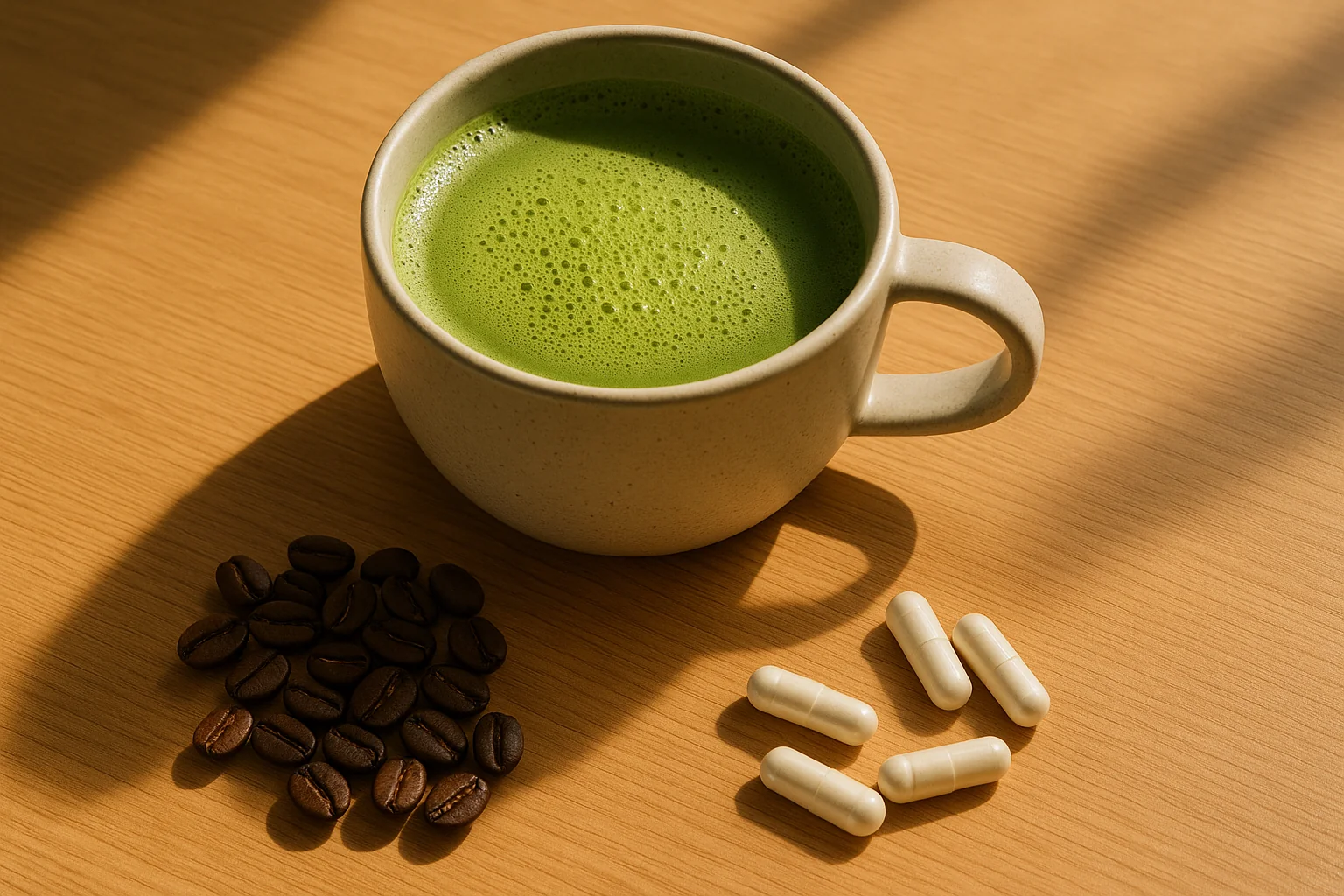
• Matcha naturally contains L-theanine and caffeine - hence its effect is different from black coffee.
What is L-theanine and where does it come from?
L-theanine is a non-protein amino acid, naturally occurring in tea leaves (Camellia sinensis) and some edible mushroom species. In a standard cup of green tea, you will find about 20-40 mg of L-theanine; in matcha (due to the shading cultivation method that increases L-theanine synthesis) - 30-50 mg per cup. Isolated L-theanine as a supplement is available in capsules or powder in doses of 100-200 mg.
L-theanine crosses the blood-brain barrier through active amino acid transport. In the brain, it increases alpha wave activity (8-12 Hz) in EEG recordings - waves typical of a focused relaxation state, alert attention without distraction or drowsiness. This is a state that Zen monks described as 'calm awareness' - and only modern neuroscience has confirmed its electrographic correlates. L-theanine also acts as a GABA-B receptor agonist and modulates glutamatergic activity in the brain, reducing neuronal excitability without blocking consciousness.
How do caffeine and L-theanine affect each other?
Caffeine primarily works by blocking adenosine receptors A1 and A2A - adenosine is a molecule whose increasing concentration during wakefulness signals the brain of fatigue and the need for sleep. By blocking these receptors, caffeine halts the feeling of fatigue and increases dopaminergic and noradrenergic activity, providing energy, focus, and alertness. However, this same mechanism is responsible for undesirable effects: increased blood pressure, heart palpitations, hand tremors, and elevated cortisol levels at higher doses.
L-theanine modifies this picture in several ways. First, it increases alpha waves - putting the brain into a state of initial 'relaxation' before activation by caffeine. Second, it modulates dopamine and norepinephrine release induced by caffeine - enhancing focus while simultaneously reducing excessive arousal. Third, it increases GABA (gamma-aminobutyric acid) production - the main inhibitory neurotransmitter that reduces anxiety. Owen et al. (Nutritional Neuroscience, 2008) in a double-blind, randomized, crossover study with 24 healthy volunteers demonstrated that the combination of 200 mg of L-theanine + 100 mg of caffeine improved reaction time on attention tasks, reduced the number of errors, and increased subjective alertness better than placebo, caffeine alone, or L-theanine alone.
How to use the L-theanine + caffeine stack?
The optimal dose is 200 mg of L-theanine + 100 mg of caffeine (2:1 ratio) taken together 30-60 minutes before a task requiring focused attention. The effect begins after 30-45 minutes (kinetics similar to caffeine alone) and lasts 3-5 hours.
Where to get the individual ingredients? Caffeine comes from coffee (a typical cup of espresso is 60-100 mg), tea (green tea: 30-50 mg/cup, matcha: 30-50 mg/cup) or caffeine supplements. L-theanine: exclusively from supplements or matcha. One cup of matcha naturally provides a similar ratio - about 30-50 mg of L-theanine + 30-50 mg of caffeine, which means lower doses but a similar ratio. The effect of matcha is milder than a full supplemental dose. If you drink coffee (100 mg of caffeine), for 'stacking' you need 200 mg of L-theanine supplementally - tea alone is not enough.
Our observations: People who replace their morning coffee ritual + L-theanine supplement often report a noticeable improvement in focus after just the first week - without the need to increase their coffee dose. The most commonly noted difference vs coffee alone: fewer 'racing thoughts' during creative work and a longer ability to maintain focus on a single task for 90-120 minutes. It's a subtle but repeatable effect.
Does L-theanine also work on its own?
L-theanine without caffeine is effective in other contexts. At a dose of 100-200 mg, it reduces subjective stress and anxiety without sedation - unlike benzodiazepines or tranquilizers, it does not cause drowsiness or impair cognitive functions. Kimura et al. (Biological Psychology, 2007) demonstrated that 200 mg of L-theanine reduced subjective stress and lowered heart rate during acute cognitive stress within 30-45 minutes of administration.
Applications of L-theanine without caffeine: evening intake before sleep (reducing mental activity, facilitating falling asleep), intake in high-stress situations without the need for additional stimulation (exams, presentations for those who do not tolerate caffeine), combining with magnesium glycinate for a stronger relaxing effect without drowsiness. L-theanine does not cause dependence, does not show tolerance, and is safe for regular use. You can find more about natural supplements for concentration and memory in the article Natural nootropics - ranking of 5 supplements.
Safety and limitations of the stack
The L-theanine + caffeine stack is safe for healthy adults at doses from studies (200/100 mg). Caffeine at a dose of 100 mg corresponds to one small coffee - a dose safe for most people. L-theanine shows no toxicity at doses up to 1200 mg per day (the safe limit from studies in animals and humans). When to be cautious: hypertension (caffeine temporarily raises blood pressure), generalized anxiety disorders with caffeine sensitivity, GERD (caffeine exacerbates reflux symptoms), pregnancy (the caffeine limit of 200 mg/day according to WHO includes the entire day, not a single dose). The effect of L-theanine alone is not a problem with the above conditions - it is caffeine that requires limitation.
Frequently Asked Questions
What is the optimal ratio of L-theanine to caffeine?
2:1 (L-theanine : caffeine). The standard dose is 200 mg of L-theanine + 100 mg of caffeine. Owen et al. (Nutritional Neuroscience, 2008) they confirmed in RCT that this combination improves focused attention and reaction time better than either substance alone.
How does L-theanine modify the effects of caffeine?
L-theanine increases alpha brain wave activity (focused relaxation), modulates dopamine and norepinephrine release induced by caffeine, and enhances GABAergic activity. The effect: focused alertness without the jitters, heart palpitations, and anxiety typical of caffeine alone.
Does matcha contain L-theanine and caffeine?
Yes - matcha naturally contains about 30-50 mg of caffeine and 30-50 mg of L-theanine per cup (ratio about 1:1). The effect is milder than a full supplemental dose (200/100 mg), but it's a natural, balanced stack.
When to use the L-theanine + caffeine stack?
30-60 minutes before tasks requiring focused attention: creative work, studying, presentations. Not after 2:00-3:00 PM (the half-life of caffeine 4-6 h disrupts sleep). Ideally once a day, 5-6 times a week.
Can L-theanine be taken alone - without caffeine?
Yes. 100-200 mg of L-theanine independently reduces stress and anxiety without sedation. Kimura et al. (Biol Psychol, 2007) demonstrated a decrease in heart rate and subjective stress after 30-45 minutes following the administration of 200 mg. In the evening, it may help with falling asleep. It is not addictive and does not show tolerance.
This article is for informational and educational purposes and does not replace consultation with a doctor. If you are pregnant, breastfeeding, taking medications, or have chronic conditions, consult the use of supplements or herbs with a specialist.
Author: Michał Waluk · Published: 2026-05-04 · Updated: 2026-05-04