

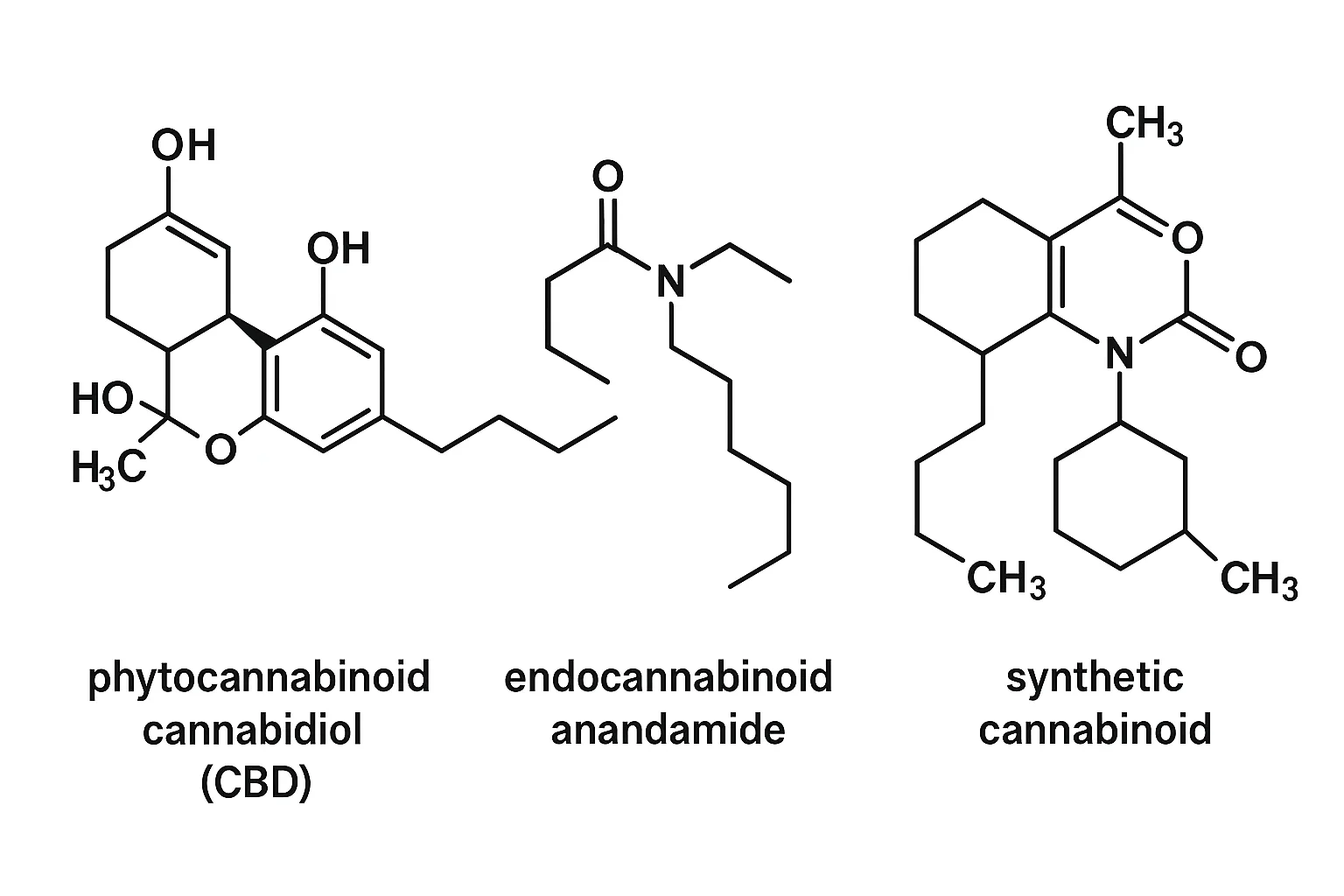

Phytocannabinoids vs endocannabinoids vs synthetic - differences (table)
Fitokannabinoidy vs endokannabinoidy vs syntetyczne: porownanie, roznice i co wybrac. Tabela od u Bucha.
The term 'cannabinoid' can refer to three completely different classes of chemical compounds: those produced by plants, those produced by your own body, and those synthesized in the laboratory. Their only common feature is that they all interact with the endocannabinoid system. However, the mechanisms, potency, and safety profiles are fundamentally different. According to data from the European Monitoring Centre for Drugs and Drug Addiction (EMCDDA), synthetic cannabinoids account for a disproportionately high number of hospitalizations and deaths compared to natural cannabinoids (EMCDDA, Synthetic Cannabinoids Report, 2024). This article explains exactly how these three classes differ and why this knowledge is practically significant.
KEY INFORMATION
• Phytocannabinoids (CBD, THC, CBG) - produced by plants, partial agonists or modulators of CB1/CB2 receptors.
• Endocannabinoids (anandamide, 2-AG) - produced by the body, act locally, and are quickly broken down.
• Synthetic cannabinoids (JWH-018, AM-2201) - laboratory production, full agonists of CB1 with 2-100× higher affinity than THC, extremely dangerous.
• CBD indirectly increases the level of endocannabinoids by inhibiting the FAAH enzyme that breaks down anandamide.
• There are no documented deaths solely from natural THC overdose; deaths from synthetic cannabinoids are regularly reported.
The endocannabinoid system - a common basis for all three classes
To understand the differences between the three classes of cannabinoids, one must first understand what they all interact with - the endocannabinoid system (ECS). The ECS was discovered in the 1980s and 1990s as a side effect of research into the mechanism of action of THC. It turned out that THC does not create new signaling pathways in the brain - it interacts with an existing, evolutionarily ancient system that humans (and all vertebrates) have possessed for millions of years.
The ECS consists of three components: cannabinoid receptors (CB1 and CB2), endogenous ligands of these receptors (endocannabinoids), and enzymes that synthesize and break down endocannabinoids. The CB1 receptor is one of the most abundant receptors in mammalian brains - particularly dense in the basal ganglia, hippocampus, cerebral cortex, and cerebellum. CB2 predominates in immune system cells and peripheral tissues. The ECS regulates neurotransmission, immune response, energy metabolism, pain perception, sleep, and many other physiological processes.
All three classes of cannabinoids - phyto, endo, and synthetic - 'speak' to the ECS through the same receptors, but with very different precision, strength, and effect. This can be likened to a lock and keys: CB1 and CB2 receptors are the locks. Endocannabinoids are the original keys - they fit perfectly, open gently, and are quickly taken away. Phytocannabinoids are well-fitting copies - they open similarly, though not identically. Synthetic cannabinoids are a master key - they open with great force, often damaging the lock in the process.
Phytocannabinoids - diversity and mechanisms of action
The Cannabis sativa plant produces over 100 different phytocannabinoids. The most well-known are: THC (delta-9-tetrahydrocannabinol), CBD (cannabidiol), CBG (cannabigerol), CBN (cannabinol), CBC (cannabichromene), and THCV (tetrahydrocannabivarin). Each of them has a different binding profile with receptors and different biological properties.
THC is a partial agonist of the CB1 receptor - it binds to it and activates it, but not 'completely'. This causes psychoactive effects (euphoria, altered perception of time, increased appetite), but also creates a natural safety ceiling: above a certain dose, the effects stop increasing proportionally. Therefore, natural THC overdose is exceptionally rare and does not cause respiratory arrest - unlike opioids and synthetic cannabinoids.
CBD is not an agonist of CB1 or CB2 receptors - it does not bind to them directly or binds very weakly. It acts through other mechanisms: it inhibits the FAAH enzyme that breaks down anandamide (raising its concentration), modulates TRPV1, GPR18, GPR55, and 5-HT1A receptors. This explains why CBD does not produce psychoactive effects - it does not activate CB1, which is responsible for the effects of THC. CBD is also a negative allosteric modulator of CB1 - the presence of CBD reduces THC's affinity for the receptor, which is a mechanism for the observed 'softening' of THC effects by CBD.
Phytocannabinoids other than THC and CBD - CBG, CBN, CBC, THCV - are in the phase of intensive research. CBG exhibits antibacterial, neuroprotective properties and may act as an antagonist of CB1 receptors at low doses. CBN (a degradation product of THC) is a weak agonist of CB1 with sedative properties. CBC inhibits the reuptake of anandamide.
Comparison table - phytocannabinoids vs endocannabinoids vs synthetic
| Feature | Phytocannabinoids (CBD, THC, CBG) | Endocannabinoids (AEA, 2-AG) | Synthetic cannabinoids (JWH-018, etc.) |
|---|---|---|---|
| Source | Plants (Cannabis, others) | Human body | Chemical laboratory |
| Chemical structure | Terpenoids / C21 cannabinoids | Fatty acid amides (AEA) / glycerols (2-AG) | Diverse (naphthylindoles, pyrolobenzimidazoles, others) |
| Affinity for CB1 | Moderate (THC), weak or none (CBD) | Moderate (AEA partial agonist) | Very high - 2-100× higher than THC |
| Type of CB1 agonism | Partial agonist (THC) / modulator (CBD) | Partial agonist (AEA), full (2-AG) | Full agonist (no plateau effect) |
| Duration of action | Godziny (2-8 h) | Minutes (rapid breakdown by FAAH/MAGL) | Godziny-doby (wolna eliminacja) |
| Risk of hospitalization | Niskie (CBD), niskie-umiarkowane (THC) | Not applicable (endogenous) | Bardzo wysokie - dokumentowane zgony |
| Legal status in Poland | Legal (CBD, CBG); THC by prescription | Endogenne - poza regulacjami | Illegal (designer drugs, 2010 Act) |
| Detectability in tests | THC detectable; CBD not typically detected | Not tested | Variable - new compounds often evade tests |
Data update: May 04, 2026 | Sources: EMCDDA 2024, Pertwee et al. Pharmacol Rev 2010, Mechoulam & Parker 2013
Endocannabinoids - natural keys to the ECS system
Anandamide (AEA - arachidonoylethanolamide) is the first discovered endocannabinoid, described by Mechoulam in 1992. The name comes from the Sanskrit word "ananda" - bliss. Anandamide is a partial agonist of CB1, produced in neurons "on demand" in response to cell depolarization. Once released into the synapse, it binds to CB1 receptors on the presynaptic neuron and inhibits further neurotransmitter release - this is a retrograde signaling mechanism unique to the ECS.
After fulfilling its role, anandamide is quickly broken down by the enzyme FAAH (fatty acid amide hydrolase) back into arachidonic acid and ethanolamine. The lifespan of anandamide in the synapse is literally minutes. It is this enzymatic inactivation that distinguishes endocannabinoids from phytocannabinoids: externally administered CBD lasts in the body for hours, while anandamide lasts for minutes. Inhibition of FAAH by CBD leads to an extended action time of anandamide in the synapses, which is one of the mechanisms behind the biological effects of CBD.
2-AG (2-arachidonoylglycerol) is the second key endocannabinoid, present in the brain at concentrations 170 times higher than anandamide. Unlike anandamide, 2-AG is a full agonist of CB1 and CB2. It is broken down by the enzyme MAGL (monoacylglycerol lipase). MAGL inhibitors, studied as potential pain relief and neuroprotective drugs, by increasing the concentration of 2-AG, may exhibit strong cannabinoid effects without psychoactivity.
Synthetic cannabinoids - why are they so dangerous?
Synthetic cannabinoids were originally developed as research tools - compounds for studying CB1 and CB2 receptors in laboratory conditions. John W. Huffman, a chemist from Clemson University, synthesized hundreds of such compounds in the 1990s, some of which made it into the scientific literature with precise chemical formulas. In the mid-2000s, "designer drug" manufacturers exploited these publications for mass synthesis and sale as "legal marijuana substitutes."
The fundamental problem with synthetic cannabinoids arises from their pharmacology: they are full agonists of CB1 with very high affinity - 2 to 100 times stronger than THC. THC is a partial agonist, meaning that above a certain dose, the effect stops increasing - there is a natural safety plateau. Synthetic cannabinoids, as full agonists, do not have this plateau: a higher dose always yields a stronger effect, with no upper limit. This translates into unpredictable and life-threatening reactions: tachycardia, seizures, loss of consciousness, psychosis, and cardiac arrest.
An additional risk factor: new synthetic cannabinoids appear faster than the law can ban them. EMCDDA identified over 280 different synthetic cannabinoids on the European legal high market in 2024 (EMCDDA, 2024). Each new compound is practically unknown toxicologically, there is no data on safe doses, and the user does not know what they are buying. Accidental mixing of several synthetic cannabinoids in one "herbal" blend multiplies the risks exponentially.
How do phytocannabinoids modulate endocannabinoids?
Phytocannabinoids and endocannabinoids are not neutral towards each other - phytocannabinoids actively modulate the levels and actions of endocannabinoids. This discovery changes the understanding of how CBD works in the body. It was long thought that CBD is a "weak" cannabinoid because it binds poorly to CB1 and CB2 receptors. However, it turns out that CBD has a different, indirect mechanism: it inhibits the FAAH enzyme that breaks down anandamide, allowing anandamide to persist longer in the synapses.
The result is an enhancement of the endogenous cannabinoid signal without directly stimulating the receptors. This is a "soft" mechanism - CBD does not impose a new signal but amplifies the existing one. This has safety implications: the effects of CBD are modulated by the natural state of the ECS of the person taking it. A person with low anandamide may experience a more pronounced effect from CBD (because there is more anandamide to preserve) than a person with an optimal ECS level.
CBG, on the other hand, may act as an antagonist of CB1 and CB2 receptors at low concentrations - this means that CBG can block THC's access to the receptors, explaining observations that cannabis strains richer in CBG produce a less intense psychoactive effect at the same THC content. Animal studies confirm this mechanism, although clinical data in humans is still limited.
How can phytocannabinoids support "endocannabinoid deficiency"?
The concept of Clinical Endocannabinoid Deficiency (CECD) was proposed by Ethan Russo in 2004 and developed in subsequent works. The hypothesis suggests that a deficiency of endocannabinoids (low anandamide, low ECS activity) may underlie a group of diseases that are difficult to explain by classical mechanisms: migraines, fibromyalgia, irritable bowel syndrome. A common feature of these conditions is pain hypersensitivity, sleep disturbances, and poor response to conventional treatment.
Phytocannabinoids - particularly CBD - could theoretically "supplement" the endocannabinoid deficiency by inhibiting FAAH (raising anandamide) and by directly or indirectly modulating ECS receptors. This is a mechanistic hypothesis that partially explains why some patients with these conditions report improvement when using CBD. However, CECD remains a hypothesis - there are no direct clinical tests measuring endocannabinoid levels before and after CBD supplementation in large patient groups.
Practical implications for CBD users: if CBD works for you for sleep, stress, or pain - one of the likely mechanisms is indeed the enhancement of the endogenous anandamide signal, rather than direct stimulation of CB1 receptors. This explains why CBD acts differently than THC (a direct CB1 agonist) and why the effects of CBD are more subtle and long-term than the immediate effects of THC.
Do any plants other than cannabis contain phytocannabinoids?
Yes - Cannabis sativa is the most well-known, but it is not the only plant producing compounds active against the ECS system. Several other plants contain phytocannabinoids or their pharmacological analogs. Echinacea (purple coneflower) contains N-alkylamides that bind to CB2 receptors and may modulate the immune system. This is one of the possible mechanisms behind the observed immunomodulatory effects of echinacea, although the phytocannabinoids in echinacea are less studied than those from hemp.
Hops (Humulus lupulus) contain beta-caryophyllene - a terpene that is also a ligand for CB2 receptors. Beta-caryophyllene is also present in cannabis, black pepper, cloves, and rosemary. As the only terpene classified as "dietary cannabinoids" by EMCDDA, beta-caryophyllene is being studied for its anti-inflammatory and neuroprotective properties by binding to CB2. It does not cause psychoactivity - CB2 does not mediate the psychoactive effects of THC.
Cacao (Theobroma cacao) contains N-oleoylethanolamine (OEA) and N-linoleoylethanolamine - fatty acid amides structurally similar to anandamide, which may inhibit FAAH and modulate the ECS indirectly. This is one of the proposed mechanisms for the well-documented mood-enhancing effect after consuming dark chocolate. However, the levels of these compounds in typical culinary doses are incomparably lower than in CBD supplements.
Frequently Asked Questions
What are phytocannabinoids?
Phytocannabinoids are cannabinoids produced by plants - primarily by hemp (Cannabis sativa), but also by Echinacea, hops, or black pepper. The most important are CBD, THC, CBG, CBN, and CBC. They interact with the human endocannabinoid system through CB1 and CB2 receptors. THC is a partial agonist of CB1; CBD works through different mechanisms - mainly by inhibiting the FAAH enzyme.
What are endocannabinoids?
Endocannabinoids are cannabinoids produced by the body itself. Anandamide (AEA) and 2-AG (2-arachidonoylglycerol) are the two most important. They act as retrograde neurotransmitters - regulating synaptic activity through CB1 and CB2 receptors. They are synthesized on demand and quickly broken down by the enzymes FAAH and MAGL. CBD indirectly raises their levels by inhibiting FAAH.
What are synthetic cannabinoids and why are they dangerous?
Synthetic cannabinoids are laboratory molecules acting on CB1 and CB2, but as full agonists with 2-100× higher affinity than THC. The lack of a safety plateau means that a higher dose always yields a stronger effect - causing tachycardia, seizures, psychosis, and death. EMCDDA identified over 280 such compounds on the European designer drug market in 2024 (EMCDDA, 2024).
Can CBD (phytocannabinoids) increase the level of endocannabinoids?
Yes, indirectly. CBD inhibits the FAAH enzyme responsible for breaking down anandamide - as a result, anandamide lasts longer in the synapses. This is one of the main mechanisms of CBD action. Higher anandamide means an enhanced endogenous cannabinoid signal. CBD does not directly stimulate receptors but "extends" the action of the body's natural endocannabinoids.
What are the biggest differences between phytocannabinoids and synthetic ones?
Phytocannabinoids (CBD, THC) are partial agonists or modulators of CB1 with a natural safety plateau - no deaths from THC overdose alone. Synthetic cannabinoids are full agonists with several times higher affinity, without a plateau - leading to deaths. Phytocannabinoids have thousands of years of history of human use; synthetic cannabinoids are new, untested toxicologically compounds.
Can the endocannabinoid system "get used to" phytocannabinoids and reduce natural endocannabinoid production?
This is a valid question about the long-term effects of CBD supplementation. Evidence suggests that regular use of CBD does not cause downregulation of CB1 receptors or a decrease in anandamide production - unlike THC. Chronic use of THC leads to downregulation of CB1 receptors (tolerance), which requires breaks ("tolerance break"). CBD works differently - through FAAH and allosteric mechanisms, not through direct stimulation of CB1. There is no clinical evidence of physical dependence on CBD or a decrease in endogenous anandamide production with regular CBD use.
This article is for informational and educational purposes and does not constitute medical advice. Before starting to use cannabis or CBD for therapeutic purposes, consult a doctor, especially if you are taking other medications, are pregnant, or breastfeeding.
Author: Michał Waluk · Published: 2026-05-04 · Updated: 2026-05-04