
Kurkuma i kurkumina: właściwości przeciwzapalne i jak zwiększyć wchłanianie
Ile kurkuminy jest w przyprawie, w jakich warunkach zmierzono słynne 2000% po piperynie, co pokazują metaanalizy nad bólem stawów i jakie ryzyka opisano.
Kurkumina jest jednym z najczęściej badanych związków roślinnych i jednocześnie jednym z najbardziej spornych. Prac są tysiące, ale w 2017 roku zespół chemików medycznych opisał ją jako substancję, która zakłóca testy przesiewowe i generuje wyniki fałszywie dodatnie. Do tego dochodzi problem wchłaniania: standardowy proszek przechodzi przez jelito prawie bez śladu w osoczu. Ten tekst rozdziela trzy rzeczy, które w poradnikach zwykle się zlewają, czyli przyprawę, wyciąg standaryzowany i wyniki prób klinicznych. Zobaczysz, w jakich warunkach zmierzono słynne 2000% po piperynie, co naprawdę pokazują metaanalizy nad bólem stawów i dlaczego amerykańska sieć nadzoru nad uszkodzeniami wątroby zaczęła notować przypadki po preparatach z kurkumą.
KLUCZOWE INFORMACJE
• Metaanaliza 15 badań z udziałem 1621 osób wykazała mniejszy ból stawów, a jakość dowodów w skali GRADE oceniono od umiarkowanej do wysokiej (Zeng i in., Bioscience Reports, 2021).
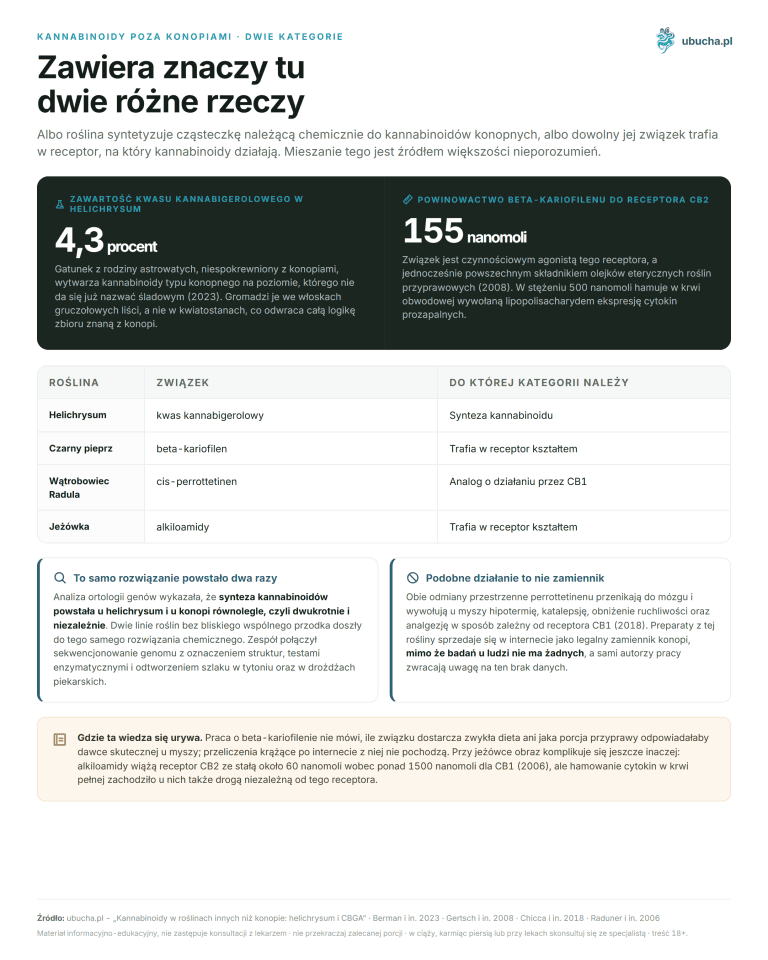
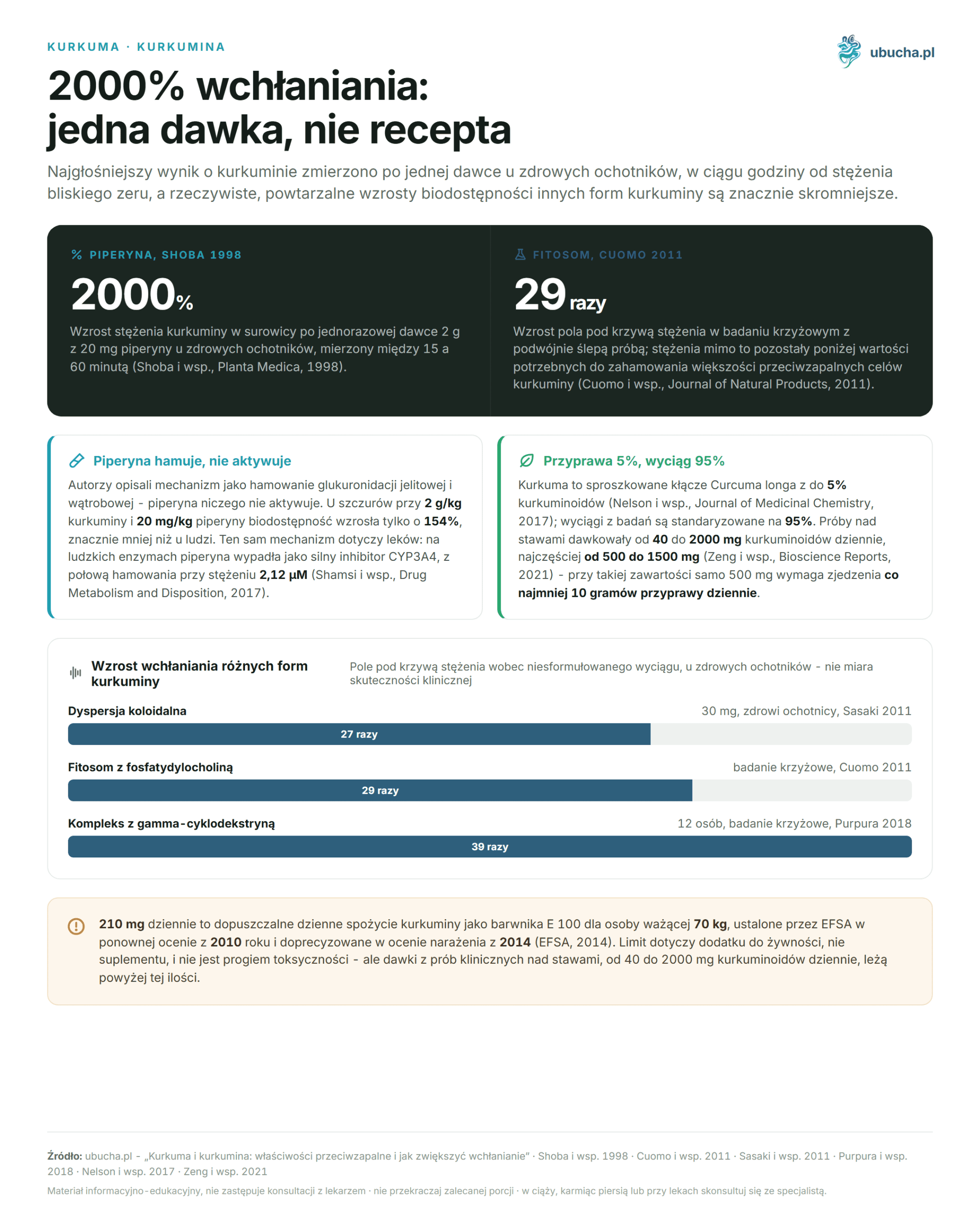
• Wzrost o 2000% po piperynie zmierzono po jednej dawce 2 g u zdrowych ochotników, w oknie od 15 do 60 minuty (Shoba i in., 1998).
• Przyprawa zawiera do 5% kurkuminoidów, wyciąg standaryzowany 95%.
• Sieć DILIN opisała 10 przypadków uszkodzenia wątroby po kurkumie, w tym jeden zgon.
Czym różni się kurkuma jako przyprawa od wyciągu standaryzowanego?
Kurkuma to sproszkowane kłącze rośliny Curcuma longa i zawiera do około 5% kurkuminoidów. Suplementy opierają się na wyciągu standaryzowanym na 95%, czyli mniej więcej dwudziestokrotnie mocniejszym. Dawki, przy których badano kurkuminę w próbach klinicznych, liczą się w setkach miligramów czystych kurkuminoidów, więc łyżeczka przyprawy w curry ich nie zastąpi.
Zawartość do 5% podaje przegląd chemii medycznej kurkuminy w Journal of Medicinal Chemistry (Nelson i in., 2017). Sama frakcja kurkuminoidów nie jest jednorodna: składa się z kurkuminy, demetoksykurkuminy i bisdemetoksykurkuminy, a proporcje zależą od odmiany i sposobu suszenia. Próby kliniczne nad stawami, które zebrała metaanaliza Zeng i współpracowników, stosowały od 40 do 2000 mg kurkuminoidów dziennie, najczęściej od 500 do 1500 mg. Przy zawartości do 5% na same 500 mg trzeba by zjeść co najmniej 10 gramów przyprawy dziennie.
Do tego dochodzi filtr regulacyjny, o którym poradniki milczą. Dopuszczalne dzienne spożycie kurkuminy jako barwnika E 100 wynosi 3 mg na kilogram masy ciała, czyli około 210 mg dla osoby ważącej 70 kg. Wartość ustalił panel EFSA w ponownej ocenie z 2010 roku, a przypomina ją uściślona ocena narażenia z 2014 roku (EFSA, 2014). Limit dotyczy dodatku do żywności, nie suplementu, i nie jest progiem toksyczności. Pokazuje jednak, że dawki stosowane w próbach klinicznych leżą powyżej ilości, którą regulator uznał za rutynowo bezpieczną w codziennej diecie. To dobry powód, żeby nie traktować suplementu jak przyprawy w większym opakowaniu.
Czy piperyna naprawdę zwiększa wchłanianie kurkuminy o 2000%?
Ta liczba pochodzi z jednej pracy z 1998 roku i opisuje bardzo konkretny pomiar. Jednorazowa dawka 2 g kurkuminy z 20 mg piperyny u zdrowych ochotników, stężenia w surowicy mierzone między 15 a 60 minutą. To nie jest wynik długiej suplementacji ani żaden efekt zdrowotny.
Shoba i współpracownicy (Planta Medica, 1998) sprawdzili to równolegle u szczurów i u ludzi. U szczurów, przy 2 g/kg kurkuminy i 20 mg/kg piperyny, biodostępność wzrosła o 154%. U ludzi po 2 g samej kurkuminy stężenia w surowicy były nieoznaczalne albo bardzo niskie, a po dodaniu piperyny wzrost wyniósł 2000%. Autorzy opisali mechanizm jako hamowanie glukuronidacji jelitowej i wątrobowej, czyli spowolnienie rozkładu. Piperyna niczego nie aktywuje.
Zauważyliśmy przy zestawianiu etykiet, że dwie rzeczy giną przy cytowaniu tej liczby. Po pierwsze, 2000% liczy się od bazy bliskiej zeru, więc stężenia bezwzględne i tak zostają niskie. Po drugie, to samo hamowanie enzymów dotyczy leków. W porównaniu na ludzkich enzymach rekombinowanych piperyna wypadła jako silny inhibitor CYP3A4, z połową hamowania przy stężeniu 2,12 µM, oraz CYP1A2; wobec CYP2C9 i CYP2D6 działała słabo (Shamsi i in., Drug Metabolism and Disposition, 2017). Hamowanie enzymów tej rodziny spowalnia rozkład leków, które są ich substratami, a przez CYP3A4 przechodzi znaczna część preparatów na receptę. Jeśli przyjmujesz cokolwiek na stałe, to jest moment na rozmowę z farmaceutą, a nie na sięgnięcie po kapsułkę z pieprzem w składzie.
Które formy kurkuminy mają zmierzoną wyższą biodostępność?
Trzy formy mają opublikowane pomiary u ludzi: fitosom z fosfatydylocholiną około 29 razy, dyspersja koloidalna 27 razy, kompleks z gamma-cyklodekstryną 39 razy. Wszystkie te liczby to porównania pola pod krzywą stężenia wobec niesformułowanego wyciągu, a nie miary skuteczności klinicznej.
Cuomo i współpracownicy (Journal of Natural Products, 2011) porównali fitosom z odpowiadającą mu mieszaniną kurkuminoidów w badaniu krzyżowym z podwójnie ślepą próbą. Wchłanianie było około 29-krotnie wyższe, ale autorzy dodali zastrzeżenie, które rzadko trafia na opakowania: w osoczu wykrywano wyłącznie metabolity drugiej fazy, a stężenia i tak pozostawały poniżej wartości potrzebnych do zahamowania większości przeciwzapalnych celów kurkuminy.
| Forma | Zmierzony wzrost | Warunki pomiaru |
|---|---|---|
| Wyciąg 95% z piperyną | o 2000% | 2 g jednorazowo, zdrowi ochotnicy, Shoba 1998 |
| Fitosom z fosfatydylocholiną | około 29 razy | badanie krzyżowe, tylko metabolity fazy 2, Cuomo 2011 |
| Dyspersja koloidalna | 27 razy | 30 mg, zdrowi ochotnicy, Sasaki 2011 |
| Kompleks z gamma-cyklodekstryną | 39 razy | 12 osób, badanie krzyżowe, Purpura 2018 |
Sasaki i in. (Biological and Pharmaceutical Bulletin, 2011) zmierzyli 27-krotny wzrost po 30 mg, a Purpura i in. (European Journal of Nutrition, 2018) 39-krotny dla gamma-cyklodekstryny u 12 osób. Mnożniki rzędu stu i więcej, krążące w materiałach handlowych, nie mają odpowiednika w tych publikacjach.
Co pokazują metaanalizy nad kurkuminą i bólem stawów?
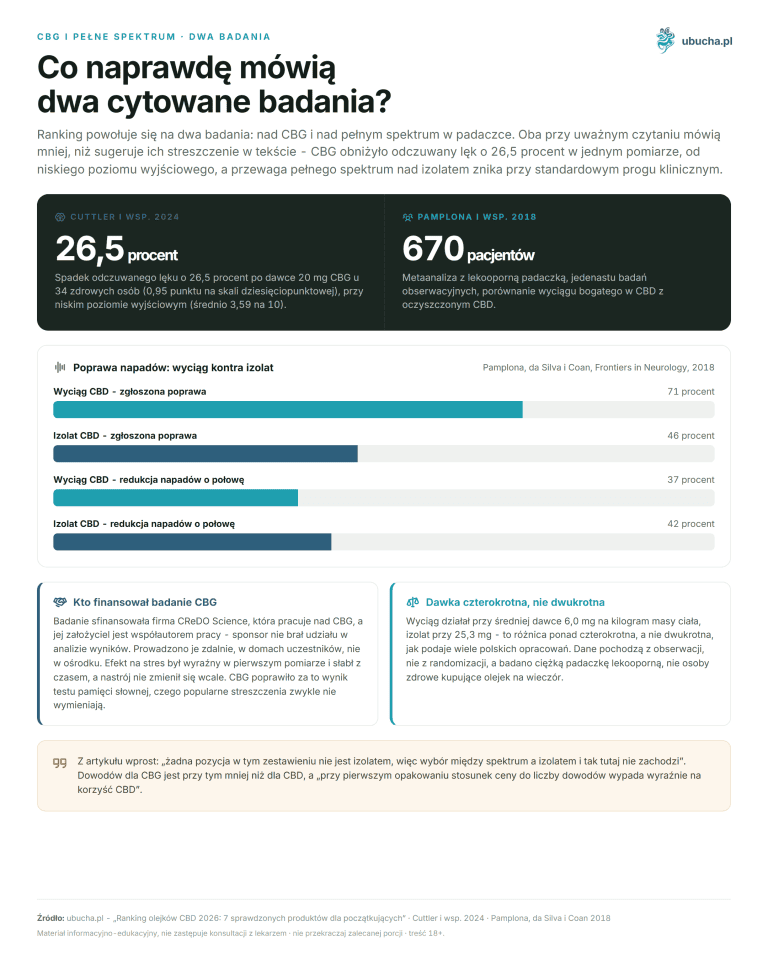
Kilka metaanaliz zgodnie znajduje mniejszy ból, ale z zastrzeżeniami. Przegląd 15 badań z udziałem 1621 osób ocenił jakość dowodów w skali GRADE jako wysoką dla bólu i sztywności mierzonych skalą WOMAC oraz umiarkowaną dla skali VAS, dla funkcji stawu i dla zdarzeń niepożądanych. Heterogeniczność części wyników była przy tym wysoka.
Zeng i in. (Bioscience Reports, 2021) podają I2 na poziomie 69% dla porównania z placebo w skali VAS i 75% dla funkcji w skali WOMAC. Autorzy wskazują dwunasty tydzień jako ważny punkt czasowy, bo dopiero wtedy ból, funkcja i sztywność poprawiły się jednocześnie. Częstość zdarzeń niepożądanych nie różniła się od placebo. Bideshki i in. (Phytotherapy Research, 2024) zestawili 11 metaanaliz w przeglądzie parasolowym i potwierdzili spadek w obu skalach. Hsiao i in. (Complementary Therapies in Medicine, 2021) porównali dawki wysokie i niskie na 1258 uczestnikach i nie znaleźli między nimi różnicy, co osłabia myślenie „więcej znaczy lepiej”.
Osobno warto odczytać dwie prace Belcaro, cytowane w polskim internecie na okrągło. Liczba 58% spadku sumarycznej skali WOMAC i wydłużenie dystansu marszu z 76 do 332 metrów pochodzą z rejestru produktowego na 50 osobach prowadzonego przez 3 miesiące (Panminerva Medica, 2010), a nie z pracy ośmiomiesięcznej na 100 pacjentach, która ukazała się w Alternative Medicine Review. Żadna z nich nie jest badaniem z podwójnie ślepą próbą i obie dotyczą jednego preparatu firmowego. To wsparcie, nie rozstrzygnięcie.
Czy kurkumina obniża markery stanu zapalnego?
Dla białka C-reaktywnego dowody są dość spójne, dla interleukiny 6 już nie. Metaanaliza 21 badań z udziałem 1705 osób z chorobą zwyrodnieniową kolana wykazała istotny spadek CRP i TNF-alfa, ale żadnej istotnej różnicy dla OB, IL-1beta, IL-6 ani PGE2.
Hsueh i in. (BMC Complementary Medicine and Therapies, 2025) podają dla CRP standaryzowaną różnicę średnich -0,906, a dla TNF-alfa -0,921. Przy TNF-alfa warto spojrzeć na koniec przedziału ufności: sięga on -0,026, czyli niemal zera, a test wrażliwości pokazał, że wynik nie jest tak stabilny jak ten dla CRP. Pozostałe cztery markery nie osiągnęły istotności statystycznej. Wcześniejsza metaanaliza obejmująca 9 badań nad CRP i 23 nad hs-CRP w różnych stanach zapalnych znalazła spadek obu, przy czym spadek CRP widziano przy dawkach do 1000 mg dziennie i przy interwencjach dłuższych niż 10 tygodni, a spadek hs-CRP przy tych samych dawkach, ale interwencjach nieprzekraczających 10 tygodni (Gorabi i in., Phytotherapy Research, 2022).
Dla IL-6 obraz jest niejednolity. Derosa i in. (Pharmacological Research, 2016) w 9 badaniach z randomizacją znaleźli spadek o 0,60 pg/ml, wyraźniejszy u osób z wysokim wyjściowym stężeniem. Cztery lata i kilkanaście badań później, w węższej grupie ze zwyrodnieniem kolana, ten sam efekt się nie potwierdził. Wniosek praktyczny brzmi ostrożnie: kurkumina obniża jeden marker w miarę powtarzalnie, a przy pozostałych wynik zależy od tego, kogo się bada.
Dlaczego chemicy nazywają kurkuminę związkiem zakłócającym testy?
Bo w testach przesiewowych daje wyniki fałszywie dodatnie niezależnie od badanego celu. W 2017 roku zespół Nelsona zaklasyfikował kurkuminę jednocześnie jako PAINS, czyli związek zakłócający testy przesiewowe, i jako IMPS, czyli pozorne panaceum metaboliczne. To jedna z ważniejszych rzeczy, jakie można o niej wiedzieć.
Praca ukazała się w Journal of Medicinal Chemistry (Nelson i in., 2017). Autorzy wskazują kilka mechanizmów pozorowanej aktywności: kurkumina fluoryzuje i zaburza odczyty optyczne, chelatuje metale, reaguje z białkami i rozkłada się w warunkach testu. Skutek jest bardzo praktyczny. Część literatury podstawowej opisuje nie działanie kurkuminy na dany cel, lecz artefakt pomiaru. Autorzy podsumowali także, że mimo ponad 120 prób klinicznych żadne badanie z podwójnie ślepą próbą i kontrolą placebo nie zakończyło się wtedy sukcesem.
Tekst wywołał ostrą polemikę, na którą ci sami autorzy odpowiedzieli w ACS Medicinal Chemistry Letters. Wniosek dla czytelnika nie brzmi „kurkumina nie działa”. Brzmi inaczej: dowody z probówki są w tym akurat przypadku wyjątkowo słabym argumentem, a liczy się to, co pokazały badania na ludziach z twardym punktem końcowym.
Co badania mówią o kurkuminie poza stawami?
Poza stawami dowody są słabsze i opierają się na pojedynczych, niepowtórzonych badaniach. Najmocniejsze wyniki dotyczą stanu przedcukrzycowego i pamięci u osób bez otępienia, ale każde z tych badań prowadzono w jednym ośrodku, na grupie od kilkudziesięciu do dwustu kilkudziesięciu uczestników.
Chuengsamarn i in. (Diabetes Care, 2012) podawali wyciąg kurkuminy 240 osobom ze stanem przedcukrzycowym przez 9 miesięcy. W grupie placebo cukrzycę typu 2 rozpoznano u 16,4% uczestników, w grupie kurkuminy u nikogo. Wynik pochodzi z jednego ośrodka w Tajlandii i nie został powtórzony w niezależnej próbie tej wielkości. Small i in. (American Journal of Geriatric Psychiatry, 2018) przez 18 miesięcy podawali 40 osobom bez otępienia dyspersję koloidalną odpowiadającą 90 mg kurkuminy dwa razy dziennie i odnotowali poprawę pamięci werbalnej o wielkości efektu 0,63.
Bywa też słabiej, niż podają streszczenia. W badaniu nad depresją 60 osób przydzielono do kurkuminy, fluoksetyny albo obu, na 6 tygodni. Odsetki odpowiedzi nie różniły się istotnie między grupami (Sanmukhani i in., Phytotherapy Research, 2014), więc zdanie o skuteczności porównywalnej z lekiem jest przy tej liczbie uczestników za mocne. W onkologii badanie fazy pierwszej na 25 osobach ze zmianami przednowotworowymi, przy dawkach do 8 g dziennie, dało poprawę histologiczną u części pacjentów, ale u jednej z czterech osób z dysplazją szyjki macicy i u jednej z siedmiu z leukoplakią zmiany mimo leczenia przeszły w raka (Cheng i in., Anticancer Research, 2001).
Jakie są realne ryzyka i interakcje kurkuminy?
Udokumentowane są trzy: polekowe uszkodzenie wątroby po preparatach o zwiększonej biodostępności, osłabienie działania leków metabolizowanych przez CYP3A4 oraz obniżenie wchłaniania żelaza. Amerykańska sieć DILIN opisała 10 przypadków uszkodzenia wątroby, z których pięć wymagało hospitalizacji, a jeden zakończył się zgonem z powodu ostrej niewydolności.
Halegoua-DeMarzio i in. (The American Journal of Medicine, 2023) zwracają uwagę na rozkład w czasie: wszystkie zdarzenia zgłoszono od 2011 roku, sześć od 2017. Siedmiu z dziesięciu pacjentów miało allel HLA-B*35:01, którego częstość w tej grupie wyniosła 0,450 wobec 0,056-0,069 w populacji kontrolnej, a trzy z siedmiu przebadanych preparatów zawierały piperynę. Ryzyka bezwzględnego z serii przypadków wyliczyć się nie da, ale wzorzec jest wyraźny: przy żółtaczce, ciemnym moczu albo świądzie odstaw preparat i zgłoś się do lekarza.
Osobno stoi interakcja, którą poradniki mylą co do kierunku. Przy lekach immunosupresyjnych ryzykiem nie jest przedawkowanie, tylko utrata działania. Hsieh i in. (Scientific Reports, 2014) podawali szczurom ewerolimus samodzielnie i razem z kurkuminą w dawce 50 albo 100 mg/kg. Ekspozycja na lek spadła o 70,6% i 71,5%, a stężenie maksymalne o 76,7%. Mechanizmem okazała się wyraźna aktywacja CYP3A4 przez metabolity kurkuminy, silniejsza niż jej hamujący wpływ na glikoproteinę P. To badanie na zwierzętach, nie u ludzi, ale kierunek jest odwrotny niż przy piperynie i dla biorcy przeszczepu oznacza ryzyko zbyt niskiego stężenia leku.
Żelazo to trzecia sprawa. Smith i Ashar (Cureus, 2019) opisali niedokrwistość z niedoboru żelaza u 66-letniego lekarza, który przyjmował sześć kapsułek wyciągu z kurkumy dziennie. Badania krwi wróciły do normy dwa tygodnie po odstawieniu. Kurkumina wiąże żelazo w jelicie, więc przy leczeniu niedoboru zachowaj kilkugodzinny odstęp. Przy lekach przeciwzakrzepowych obraz jest spokojniejszy, niż się powtarza: w badaniu klinicznym u pacjentów przyjmujących warfarynę albo dabigatran dziesięciodniowa suplementacja fitosomem kurkuminy nie zmieniła wartości INR, a u osób na kwasie acetylosalicylowym, tyklopidynie lub klopidogrelu nie zmieniła czasu krwawienia (Hu i in., European Review for Medical and Pharmacological Sciences, 2018). Było to jednak krótkie badanie jednego preparatu, więc kontrola INR po zmianie suplementacji pozostaje rozsądnym minimum. Ostrożność obowiązuje też przy kamicy żółciowej oraz w ciąży i podczas karmienia.
Najczęściej zadawane pytania
Poniżej odpowiedzi na pytania, które najczęściej wracają przy kurkumie i kurkuminie.
Ile kurkuminoidów zawiera przyprawa, a ile wyciąg standaryzowany?
Sproszkowane kłącze kurkumy zawiera do około 5% kurkuminoidów, a wyciągi używane w badaniach są standaryzowane na 95%. Różnica jest mniej więcej dwudziestokrotna. Dawki rzędu setek miligramów kurkuminoidów, które stosowano w próbach klinicznych, są dla przyprawy nieosiągalne w rozsądnej ilości jedzenia.
Czy piperyna jest konieczna, żeby kurkumina zadziałała?
Nie jest konieczna, bo mierzalny wzrost wchłaniania dają też fitosom z fosfatydylocholiną, dyspersja koloidalna i kompleks z gamma-cyklodekstryną. Piperyna silnie hamuje enzym CYP3A4, przez który przechodzi wiele leków, więc przy stałym przyjmowaniu leków to argument, żeby zapytać farmaceutę przed połączeniem.
Jakie dawki kurkuminy stosowano w badaniach nad stawami?
W próbach objętych metaanalizą Zeng i współpracowników z 2021 roku stosowano od 40 do 2000 mg kurkuminoidów dziennie, najczęściej od 500 do 1500 mg. Porównanie dawek wysokich i niskich na 1258 uczestnikach nie wykazało różnicy w uldze w bólu (Hsiao i in., 2021).
Po jakim czasie w badaniach pojawiała się różnica?
Autorzy metaanalizy 15 badań z udziałem 1621 osób wskazują dwunasty tydzień jako ważny punkt czasowy, bo dopiero wtedy ból, funkcja i sztywność poprawiły się jednocześnie. Z tego powodu zalecają stosowanie wyciągu dłużej niż 12 tygodni, jeśli w ogóle ma być oceniane.
Czy kurkumina może uszkodzić wątrobę?
Opisano takie przypadki. Amerykańska sieć DILIN zebrała 10 zdarzeń uszkodzenia wątroby powiązanych z kurkumą, pięć wymagało hospitalizacji, jedno zakończyło się zgonem z powodu ostrej niewydolności (Halegoua-DeMarzio i in., The American Journal of Medicine, 2023). Siedmiu z dziesięciu pacjentów miało allel HLA-B*35:01.
Kto powinien zachować szczególną ostrożność?
Osoby z kamicą żółciową i niedrożnością dróg żółciowych, przyjmujące leki przeciwzakrzepowe lub immunosupresyjne, leczone onkologicznie, suplementujące żelazo z powodu niedoboru oraz kobiety w ciąży i karmiące. Przyprawa w kuchni to inna skala niż wyciąg standaryzowany w kapsułce.
Kapsułki z kurkumą i czarnym pieprzem oraz inne preparaty ziołowe znajdziesz w kategorii suplementy. Pisaliśmy też o kolagenie i resweratrolu.
Artykuł ma charakter informacyjno-edukacyjny i nie stanowi porady medycznej. Przed rozpoczęciem suplementacji skonsultuj się z lekarzem, zwłaszcza jeśli przyjmujesz leki na stałe, jesteś w ciąży lub karmisz piersią albo chorujesz przewlekle.
Autor: Michał Waluk · Opublikowano: 2026-06-15 · Aktualizacja: 2026-08-11