
Decriminalization vs legalization of marijuana: what are the differences (table)
Decriminalization, depenalization, and legalization of marijuana are three different legal models. A comparative table, the legal status in Poland, and examples from Europe.
Germany legalized recreational marijuana in April 2024. Malta was the first in the Union to do so in December 2021. Portugal decriminalized all drugs back in 2001. And Poland? It still punishes possession of any amount. In public debate, the terms “decriminalization,” “legalization,” and “depenalization” are often used interchangeably, although they describe three different solutions, with varying effects for citizens, the market, and public health. This text clarifies the concepts, presents them in a table, and shows what each of these models actually changes. We base our findings on legal acts and reports from public agencies. At the end, you will find an explanation of why the legal hemp market in Poland operates independently of this debate.
KEY INFORMATION
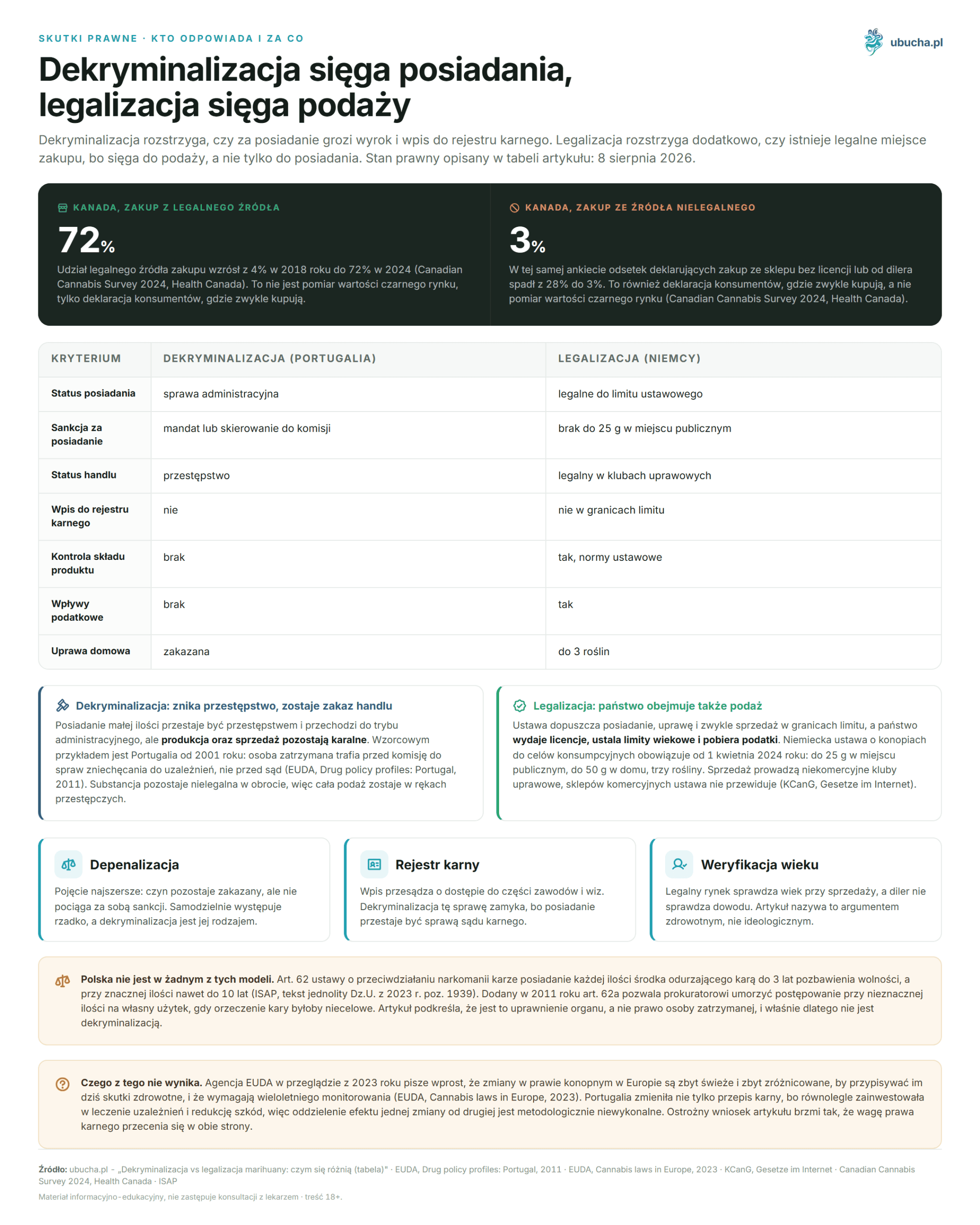
• In Canada, the share of legal sources increased from 4% in 2018 to 72% in 2024 (Canadian Cannabis Survey 2024, Health Canada).
• Decriminalization removes criminal liability for possession, but trafficking remains a crime.
• Legalization creates a regulated market: licenses, taxes, and composition control.
• Poland has not decriminalized marijuana; Article 62a only gives the prosecutor discretionary power to dismiss.
What is the difference between decriminalization, legalization, and depenalization?
These are three different degrees of leniency by the state. Depenalization removes the penalty, decriminalization removes criminal liability, and legalization allows the act within a regulated system. Only the latter creates a legal market. The first two only concern what threatens a person detained with a small amount on them.
- Depenalization this is the broadest concept. The act remains prohibited, but does not incur sanctions. It occurs rarely on its own.
- Decriminalization is a form of decriminalization: possession of a small amount ceases to be a crime and moves to an administrative mode. Production and sale remain punishable. A typical example is Portugal since 2001 (EUDA, Drug policy profiles: Portugal, 2011).
- Legalization allows possession, cultivation, and usually sale within the limits of the law. The state issues licenses, sets age limits, and collects taxes. This is how Canada has operated since 2018 and Germany since April 1, 2024.
The distinction is not academic. The applicable model determines the answer to two practical questions: whether possession carries a sentence and a criminal record, and whether there is a legal place to purchase. Decriminalization answers affirmatively only to the first question, leaving supply outside the law.
What does the comparison of these three models look like in a table?
The following comparison shows the differences where they matter to the citizen: sanctions, criminal record, access to a product with known composition. As a reference point, we added Poland, which follows a penal model, to illustrate how much further the other two solutions go.
| Criterion | Penalizacja (Polska) | Dekryminalizacja (Portugalia) | Legalizacja (Niemcy) |
|---|---|---|---|
| Status posiadania | Crime (Article 62 of the Act) | Sprawa administracyjna | Legalne do limitu ustawowego |
| Sankcja za posiadanie | Up to 3 years in prison, up to 10 years for a significant amount | Mandat lub skierowanie do komisji | Brak do 25 g w miejscu publicznym |
| Status handlu | Crime | Crime | Legalny w klubach uprawowych |
| Entry in the criminal record | Possible | no | Not within the limit |
| Product composition control | none | none | Tak, normy ustawowe |
| Tax revenues | none | none | yes |
| Home cultivation | Zakazana | Zakazana | Up to 3 plants |
| Other countries in this model | Szwecja, Francja | Czechy, Belgia | Kanada, Malta, Luksemburg |
Stan prawny opisany w tabeli: 8 sierpnia 2026.
Two columns are most significant in everyday life. A criminal record entry determines access to certain professions and visas, while composition control decides whether the consumer knows what they are buying at all. Decriminalization resolves the first issue but does not touch the second. Legalization encompasses both, as it addresses supply, not just possession.
Has Poland decriminalized marijuana?
No. Poland remains one of the more restrictive countries in the EU on this matter. Article 62 of the Act on Counteracting Drug Addiction punishes possession of any amount of a narcotic with a penalty of up to 3 years in prison, and for a significant amount, even up to 10 years (ISAP, tekst jednolity Dz.U. z 2023 r. poz. 1939).
The law does not define what constitutes a significant amount. The boundary is set by jurisprudence and can vary in different courts, usually ranging from several dozen to several hundred grams. For a detained person, this means that the severity of the penalty is determined by the court's interpretation, not the number stated in the regulation.
In 2011, Article 62a was added to the law. The prosecutor can dismiss the proceedings if the amount is insignificant, intended for personal use, and a penalty would be inappropriate given the circumstances of the case. This is an authority of the body, not a right of the detained person. Two very similar cases in two prosecutors' offices can end differently, and that is why Article 62a is not decriminalization, although it is sometimes presented that way in debate. How this provision works in practice and what the jurisprudence considers an insignificant amount is described in the text about posiadaniu marihuany w Polsce.
Proposals for changes have been submitted to the Sejm multiple times, and none have passed the full legislative process as of August 2026. Before basing any decision on media reports about "new laws", check the current wording of the law in ISAP. Headlines often outpace the Journal of Laws by months, and sometimes even by legislative terms.
Which European countries have changed their laws and what does it entail?
Europe does not have a single model. Portugal opted for the decriminalization of all substances, Germany for regulated legalization, and the Netherlands for tolerated sales without legal production. These differences allow for comparisons of outcomes, as the social and economic conditions in these countries are similar.
Portugal has treated possession of any drug for personal use as an administrative matter since 2001. A detained person goes before the commission for discouraging addiction, not before a court. The Cato Institute report from 2009 summarized the first decade of this policy: usage rates were among the lowest in the EU, and drug-related health harms clearly decreased (Greenwald, Cato Institute, 2009).
Germany has taken a different path. The Cannabis Consumption Act (KCanG) has been in effect since April 1, 2024, allowing adults to possess up to 25 g in public and up to 50 g at home, as well as cultivate three plants. Non-commercial cultivation clubs conduct sales; the law does not provide for commercial shops (KCanG, Gesetze im Internet).
Malta legalized possession of up to 7 g and cultivation of four plants in December 2021, becoming the first country in the EU. Luxembourg allowed home cultivation of up to four plants from July 21, 2023, while maintaining the criminalization of possession of larger amounts in public (Police Grand-Ducale, 2023).
The Netherlands is often described as a country of legalization, although it is not. Sales in coffeeshops are tolerated, while production and wholesale remain criminal offenses: this is the famous backdoor problem. The government launched an experiment with a controlled supply chain, which properly began on April 7, 2025, in ten municipalities (Government.nl).
Does easing the law increase marijuana consumption?
There is no evidence that merely easing the law raises consumption, but there is also no strong evidence for the opposite thesis. The EUDA agency states in its 2023 review that changes in cannabis law in Europe are too recent and too varied to attribute health effects to them today, and that they require long-term monitoring (EUDA, Cannabis laws in Europe, 2023).
The Portuguese case is the best documented, as it has lasted the longest. The difficulty lies in the fact that Portugal changed not only the criminal provision: simultaneously, it invested in addiction treatment and harm reduction. Separating the effect of one change from another is methodologically impossible, so neither side of the debate can honestly claim that "the same removal of penalties" produced the observed outcome.
We noticed, while reading subsequent reports for this text, that journalism on both sides selectively cites the same documents. Proponents omit that the Portuguese reform was a package, not a single provision. Opponents omit that the anticipated wave of increased consumption did not materialize. A cautious conclusion is as follows: criminal law is one of many factors, and its weight is overestimated in both directions.
What does legalization provide that decriminalization does not?
Decriminalization removes the risk of a sentence from the consumer, but leaves the entire supply in the hands of criminals. Only legalization transfers the trade to a system with licenses and composition control, thus taking the market away from dealers. This is evident in Canadian data: the share of legal sources of purchase increased from 4% in 2018 to 72% in 2024.
The same survey shows the other side of the change. The percentage of individuals declaring purchases from illegal sources fell from 28% to 3% (Canadian Cannabis Survey 2024, Health Canada). This is not a measurement of the black market's value, but a declaration from consumers about where they usually buy. However, the difference is too significant to be explained solely by the burden of the survey.
The legal market also provides three things that no decriminalization model offers: known product composition, tax revenues, and age verification at the point of sale. A dealer does not check ID and does not disclose THC content. This is a health argument, not an ideological one, and it appears in European agency documents as a basis for regulation, not as a political demand.
What is the legal status of CBD in the context of this debate?
Hemp products have a separate legal basis in Poland and do not depend on what happens with recreational marijuana. The Act on Counteracting Drug Addiction defines hemp as varieties of Cannabis sativa in which the sum of THC and tetrahydrocannabinolic acid does not exceed 0.3% of dry mass (Article 4, point 5 of the Act, Journal of Laws of 2023, item 1939).
The same threshold applies in EU agriculture. The European Parliament and Council Regulation 2021/2115 raised the permissible THC content in varieties eligible for direct payments from 0.2% to 0.3% and has been in effect since 2023 (EUR-Lex, Regulation 2021/2115). The older regulation 1307/2013, which some articles online still refer to, mentioned 0.2% and is no longer the basis for this limit. The number 0.3% actually has a botanical origin, not a pharmacological one: it originated from taxonomic work from 1976.
In practice, this means that by purchasing dried flower from industrial hemp or hemp oils from a seller who provides a certificate of analysis (CoA), you are acting within the bounds of the law. The certificate shows the actual THC content in a specific batch, and it is this document, not the label declaration, that serves as proof of compliance with the 0.3% threshold.
Summary: what this legal status changes for you
The three concepts in the title describe three levels: no penalty, no crime, legal market. Poland is not at any of these levels, as possession of any amount of marijuana remains a crime, and Article 62a only provides a discretionary loophole for the prosecutor. If you follow news about changes, verify them in ISAP, not in headlines.
For consumers of legal hemp products, the conclusion is simpler. Hemp flower and oils from fiber varieties with THC content not exceeding 0.3% are legal in Poland regardless of the outcome of the debate on recreational marijuana, as they are based on a different regulation and a different definition of the plant. The analysis certificate from the seller acts as a safeguard: it shows that the batch is within the statutory threshold. The rest is politics, which can change with each term, but does not alter the status of what you are buying today.
A practical tip at the end: with any information about changes in the law, check whether it pertains to personal possession or commercial trade. These are two separate areas of regulation, and a change in one does not automatically transfer to the other. Most misunderstandings in public discourse arise from mixing these two frameworks.
Frequently Asked Questions
What is the decriminalization of marijuana and what does it mean in practice?
Decriminalization removes criminal liability for possessing a small amount: instead of a court sentence, a fine or referral to a commission is threatened. The substance remains illegal in trade, and trafficking is still a crime. A typical example is Portugal since 2001, where a detained person is referred to a commission for discouraging addiction, not to a criminal court.
What is the legalization of marijuana?
Legalization allows possession, cultivation, and usually sale within limits set by law. The state issues licenses, sets age limits, collects taxes, and controls product composition. This is how Canada has operated since 2018, Malta since 2021, and Germany since April 1, 2024. The market is legal but strictly regulated.
What is the difference between decriminalization and depenalization?
Depenalization is a broader concept: it means the removal of penalties for a given act, even if the act remains prohibited. Decriminalization is a type of depenalization that specifically removes criminal liability, meaning no court, sentence, or entry in the register. In the Polish debate, both terms are often used interchangeably, although they differ in scope.
Has Poland decriminalized marijuana?
No. Article 62 of the Act on Counteracting Drug Addiction (Journal of Laws of 2023, item 1939) punishes possession of any amount with a penalty of up to 3 years of imprisonment. Article 62a gives the prosecutor the option to dismiss charges for a small amount for personal use, but this is the authority of the body, not the right of the detained person.
Which European Union countries have gone the furthest in legalization?
Malta legalized possession of up to 7 g and the cultivation of four plants in December 2021, being the first in the Union. Luxembourg allowed home cultivation from July 21, 2023. Germany, as the first major EU country, entered regulated legalization on April 1, 2024, with a limit of 25 g in public.
Are dry herb and CBD oils legal in Poland?
Yes. The Act on Counteracting Drug Addiction defines fiber hemp as varieties in which the sum of THC and tetrahydrocannabinolic acid does not exceed 0.3% dry weight. Products from such varieties are legal regardless of the debate about recreational marijuana. A Certificate of Analysis (CoA) confirms that the threshold has not been exceeded.
If you are looking for hemp products with a certificate of analysis, check the category drought in the u Bucha store.
The article is for informational and educational purposes and does not constitute legal advice. The legal status described in the article is valid as of the publication date: regulations regarding hemp may change. Before making a decision, consult a lawyer or current legal acts.
Author: Michał Waluk · Opublikowano: 2026-07-15 · Aktualizacja: 2026-08-08