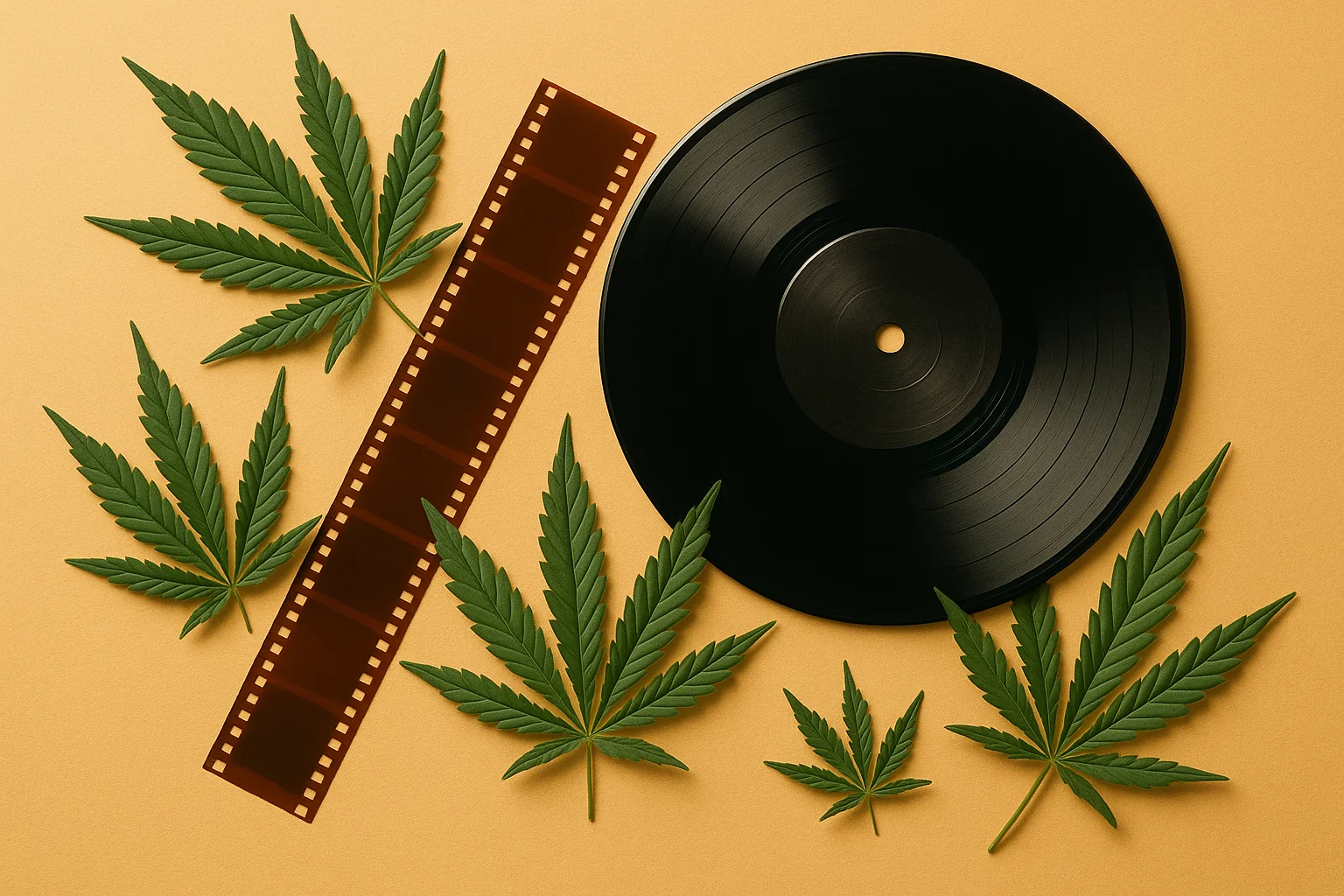

Cannabis in pop culture, film, and music - a brief history (guide)
Konopie w popkulturze, filmie i muzyce — co to, jak dziala i na co. Zrozumialy przewodnik u Bucha.
Few plants have accompanied humanity as intensely in artistic creation as cannabis. From the mystical rituals of ancient cultures, through the literary salons of 19th-century Paris, to the album covers of rappers and dialogues in Hollywood comedies - marijuana and culture have gone hand in hand for centuries. It’s not just about intoxication: cannabis has become a symbol of rebellion, spirituality, creativity, and over time also controversy and political struggle. This guide traces how the plant entered the mainstream and what films, music, and literature say about it from the 1930s to the present.
KEY INFORMATION
• The film “Reefer Madness” from 1936 - originally propaganda - has over time become a cult parody, a symbol of the absurdity of the anti-drug narrative of the 30s.
• Cypress Hill, as the first mainstream rappers openly singing about marijuana, sold over 18 million records worldwide (RIAA).
• The term “420” originated from a group of students in California in 1971 and has become a global code of cannabis culture.
• Bob Marley treated ganja as a sacrament of the Rastafari religion - his album “Legend” is the best-selling reggae album in history (over 30 million copies).
Where do cannabis and culture intersect? A brief prehistory of the artistic connection
The connection between cannabis and art and spirituality goes back thousands of years. Ancient Hindu texts describe bhang - a cannabis drink - as a meal given by the god Shiva to ascetics and warriors. Iranian Scythians used cannabis in funeral ceremonies as early as the 5th century BCE, as confirmed by archaeological excavations (Russo, Journal of Cannabis Therapeutics, 2007). For thousands of years, this plant was not a drug but an herb, a raw material, and a ritual.
In Europe, the first artistic fascination with hashish appeared in 19th-century Paris. In 1844, psychiatrist Jacques-Joseph Moreau de Tours founded the famous “Club des Hashischins” - an association of Parisian intellectuals experimenting with hashish for creative purposes. Members included Charles Baudelaire, Alexandre Dumas, Théophile Gautier, and Gérard de Nerval. Baudelaire described his experiences in “Les paradis artificiels” (1860), creating one of the first literary portraits of cannabis intoxication.
It is worth noting that the Parisian “Club des Hashischins” was essentially a research group - its members treated hashish as a tool for exploring the limits of consciousness, not as entertainment. This approach, which we would now call “exploring expanded consciousness,” anticipated the psychedelic revolution of the 60s a full century earlier.
In the United States, cannabis arrived with a wave of immigrants from Mexico in the early 20th century. Jazz musicians in New Orleans and Chicago were the first to openly associate marijuana with musical creativity. Louis Armstrong smoked marijuana throughout his life and spoke openly about it, calling it “the herb.” Cab Calloway recorded “Reefer Man” in 1932 - a song that became the first mainstream musical number referencing cannabis culture.
Era propagandy: „Reefer Madness” i narodziny czarnej legendy (1930-1960)
In 1936, the film „Reefer Madness” hit the screens - a propaganda production funded by civic associations opposing marijuana. The film tells the story of a group of teenagers whose one „joint” drives them to madness, murder, and suicide. The budget was minimal, and the acting was catastrophic. But the message was clear: marijuana destroys lives immediately and without exception.
The paradox of history: „Reefer Madness” survived in the archives and was discovered by the counterculture in the 1970s. Instead of scaring, it began to entertain. Students watched it at „midnight screenings” as a comedic parody of anti-drug exaggeration. In 2005, a musical based on the film was created. A work intended to instill fear became a symbol of the absurdity of moral panic - and one of the most important documents of cannabis pop culture.
The 1940s and 50s were a period in America of tightening laws and media silence around marijuana. Harry Anslinger, head of the Federal Bureau of Narcotics, actively campaigned against cannabis, linking it to jazz and „dangerous minorities”. The lack of reliable education and demonization in the media built a myth that lasted for decades.
Rewolucja kontrkultury: lata 60. i 70. - marihuana jako symbol buntu
The late 1950s and the entire 1960s saw an eruption of counterculture in the United States. The Beat Generation - Allen Ginsberg, Jack Kerouac, William Burroughs - openly referred to experiences with marijuana and other substances as sources of literary creativity. Ginsberg wrote in „Howl” (1956): „I saw the best minds of my generation destroyed by madness.” The rebellion against convention required the rejection of everything that the „well-fed society” deemed appropriate - including the prohibition of marijuana.
The music of the 60s - psychedelic rock, folk protest, and then Woodstock - intertwined cannabis with the idea of freedom and peace. The Beatles, Rolling Stones, Jimi Hendrix, Janis Joplin - it’s impossible to discuss these names today without the context of cannabis counterculture. Bob Dylan reportedly first smoked marijuana with the Beatles in 1964, which influenced their later sound experiments. This story, though unverifiable in detail, became part of pop culture mythology.
Reggae and Rastafari: Ganja as a Sacrament
In Jamaican Rastafari culture, marijuana - called ganja or „holy herb” - serves as a sacrament. Rastafarians believe that smoking cannabis allows for direct contact with Jah (God) and achieves a state of meditative clarity known as „reasonings”. It is not recreation, but a religious ritual deeply rooted in biblical interpretation.
Bob Marley, Peter Tosh, and Bunny Wailer - creators of The Wailers - brought this message to global awareness. Marley sang in „Legalize It” directly about the right to use ganja as a religious practice. His album „Legend” (released posthumously in 1984) sold over 30 million copies, becoming the best-selling reggae album of all time. Marley was not just a musician - he was an emissary of a culture in which cannabis was an integral part.
Reggae as a genre smuggled cannabis culture into Europe, Latin America, Africa, and Asia. It was through reggae that millions of people around the world first encountered cannabis symbolism not as a warning, but as an element of spirituality and community. The connection was so strong that today a cannabis leaf on a t-shirt is often associated with reggae rather than drug policy.
Hip-hop: Marijuana from the Streets to the Mainstream (90s and 2000s)
The 1990s were the era when marijuana moved from counterculture to the mainstream through hip-hop. Cypress Hill - a Latino trio from Los Angeles - were pioneers: their debut album from 1991 featured „Stoned Is the Way of the Walk” and „Light Another” as open anthems in praise of marijuana. Throughout the 90s, Cypress Hill sold over 18 million records worldwide, proving that cannabis-themed content sells massively (RIAA).
Dr. Dre and Snoop Dogg on the album „The Chronic” (1992) created the „G-Funk” aesthetic - party music from Compton, where smoking blunts was as natural a part of the image as gold jewelry. Snoop Dogg became the face of marijuana in entertainment for decades. Wiz Khalifa, Kid Cudi, Mac Miller - subsequent generations of hip-hop artists treated marijuana not as a provocation, but as an element of authenticity and lifestyle.
From the perspective of cannabis culture observers, a clear trend emerges: where jazz musicians and hippies of the 60s smoked in secret or as an act of rebellion, contemporary hip-hop artists smoke publicly, as the environment has long ceased to treat marijuana as a controversial topic. This is a normalization through culture that has outpaced legal normalization by two decades.
Kino konopne - od klasyki do Apatow generation
Movies with marijuana at the center create their own micro-genre. Cheech & Chong - a Mexican-Canadian comedic duo - built their career entirely on humor related to smoking marijuana. Their debut film „Up in Smoke” (1978) grossed over 28 million dollars on a budget of just 2 million. The secret? Authenticity and a lack of lecturing the audience - Cheech and Chong’s films did not moralize, they simply laughed at the everyday life of a smoker.
The 90s and 2000s brought „Dazed and Confused” by Richard Linklater (1993) - a film about the last day of school in Texas in the 70s, where smoking marijuana is a rite of passage, not a scandal. The famous character Wooderson (Matthew McConaughey) achieved iconic status in pop culture. „Half Baked” (1998), „Friday” (1995), „Jay and Silent Bob Strike Back” (2001) - the list of films where marijuana is not a backdrop but a protagonist is long.
The Apatow generation of the 2000s - Judd Apatow, Seth Rogen, James Franco - moved this genre into new decades. „Pineapple Express” (2008) combined cannabis comedy with action cinema. Seth Rogen became the face of „stoner comedy” for a new generation, while also being an active advocate for legalization. Marijuana in Hollywood transitioned from a taboo subject to material for film stars with Oscars.
Symbol „420” i inne kody kultury konopnej
No element of cannabis culture is more recognizable than the number 420. The history of its origin dates back to 1971 in San Rafael, California, where a group of students - known as „the Waldos” - would meet at 4:20 PM after school to search for an allegedly abandoned marijuana plantation. The plantation was never found, but the code „420” began to function as a password among them.
The popularizer of „420” became fans of the band Grateful Dead, with whom the „Waldos” had connections. In the 1980s, a flyer inviting people to „4:20 on 4/20” circulated among Dead fans across the States. High Times published it in 1991, and the date of April 20th permanently entered the global calendar of cannabis culture. Today, in many states in the USA, legalization is dated precisely to April 20th - not by coincidence.
Cannabis culture has produced a rich vocabulary of codes and symbols: the cannabis leaf as a logo, the number 420, the term „420 friendly” on dating sites indicating tolerance towards smokers, „4:20 PM” as a symbolic hour. Each of these codes has a specific history and social function - they create a sense of community in an environment that has had to operate in secrecy or on the edge of the law for decades.
Konopie w reklamie, grach i mediach cyfrowych - era normalizacji
Since the 2010s, with the progress of legalization in the USA and Canada, marijuana has emerged from the semi-darkness of alternative culture into the commercial mainstream. Cannabis brands commission advertising campaigns from professional agencies, CBD products are advertised in lifestyle press, and Snoop Dogg has his own line of cannabis products „Leafs by Snoop”. Culture has come to the law, not the other way around.
In video games, marijuana has appeared for years - from virtual dealers in „Grand Theft Auto” to plants for cultivation in simulators. Streaming platforms like Netflix and HBO produce documentary series about the history of marijuana („The Legend of 420”, „Murder Mountain”) and fictional dramas about the cannabis business („Weeds”, „Disjointed”). Media normalization has outpaced legal normalization in most European countries by at least a decade.
In Poland, cannabis culture has a different dynamic than in the USA - the law remains restrictive, but the market for legal cannabis products (CBD flowers, oils, gummies) is growing at an impressive rate. The u Bucha blog sits at the intersection of this changing culture and consumer education - here you can learn about cannabis without hype and without fear-mongering.
Frequently Asked Questions
Which film is considered the first classic of cannabis culture?
The first iconic film of the cannabis subculture is considered to be „Reefer Madness” from 1936 - a propaganda horror that over time became a cult parody. However, the proper cannabis cinema became the films of Cheech and Chong from the 70s, particularly „Up in Smoke” (1978), which grossed over 28 million dollars on a budget of 2 million.
What music genres are most associated with cannabis culture?
Cannabis culture has most strongly rooted itself in reggae (Bob Marley, Peter Tosh), hip-hop (Cypress Hill, Snoop Dogg, Dr. Dre), and 60s psychedelic rock. Each of these genres treated marijuana differently: reggae associated it with spiritual ritual and Rastafarianism, hip-hop with urban everyday life, and rock with experimentation and counterculture.
Where does the term „420” come from and how did it enter pop culture?
The term „420” comes from a group of students from San Rafael High School in California, who in 1971 would meet at 4:20 PM after classes to search for an abandoned marijuana plantation. Fans of Grateful Dead popularized this code in the 1980s, and today April 20th is an unofficial holiday of cannabis culture celebrated worldwide.
Do cannabis appear in literature and art outside the 20th century?
Yes. Cannabis has inspired artists and writers for thousands of years. In 19th century Paris, the famous „Club des Hashischins” operated, where writers like Baudelaire, Dumas, and Balzac experimented with hashish for creative purposes. Baudelaire described these experiences in the essay „Les paradis artificiels” (1860), one of the first literary descriptions of cannabis intoxication.
How have the media changed the perception of marijuana from the 30s to today?
The media radically changed the narrative about marijuana. The 30s-50s were an era of propaganda („Reefer Madness”), the 60s-70s brought countercultural politicization, and the 80s-90s saw the „Just Say No” campaign. Since the 2010s, the medical and business narrative has dominated, supported by legalization in the USA and Canada - marijuana has transformed from a symbol of rebellion into a consumer product worth billions of dollars.
This article is for informational and educational purposes and does not replace consultation with a doctor. If you are pregnant, breastfeeding, taking medications, or have chronic conditions, consult the use of supplements or herbs with a specialist.
Author: Michał Waluk · Published: 2026-05-04 · Updated: 2026-05-04