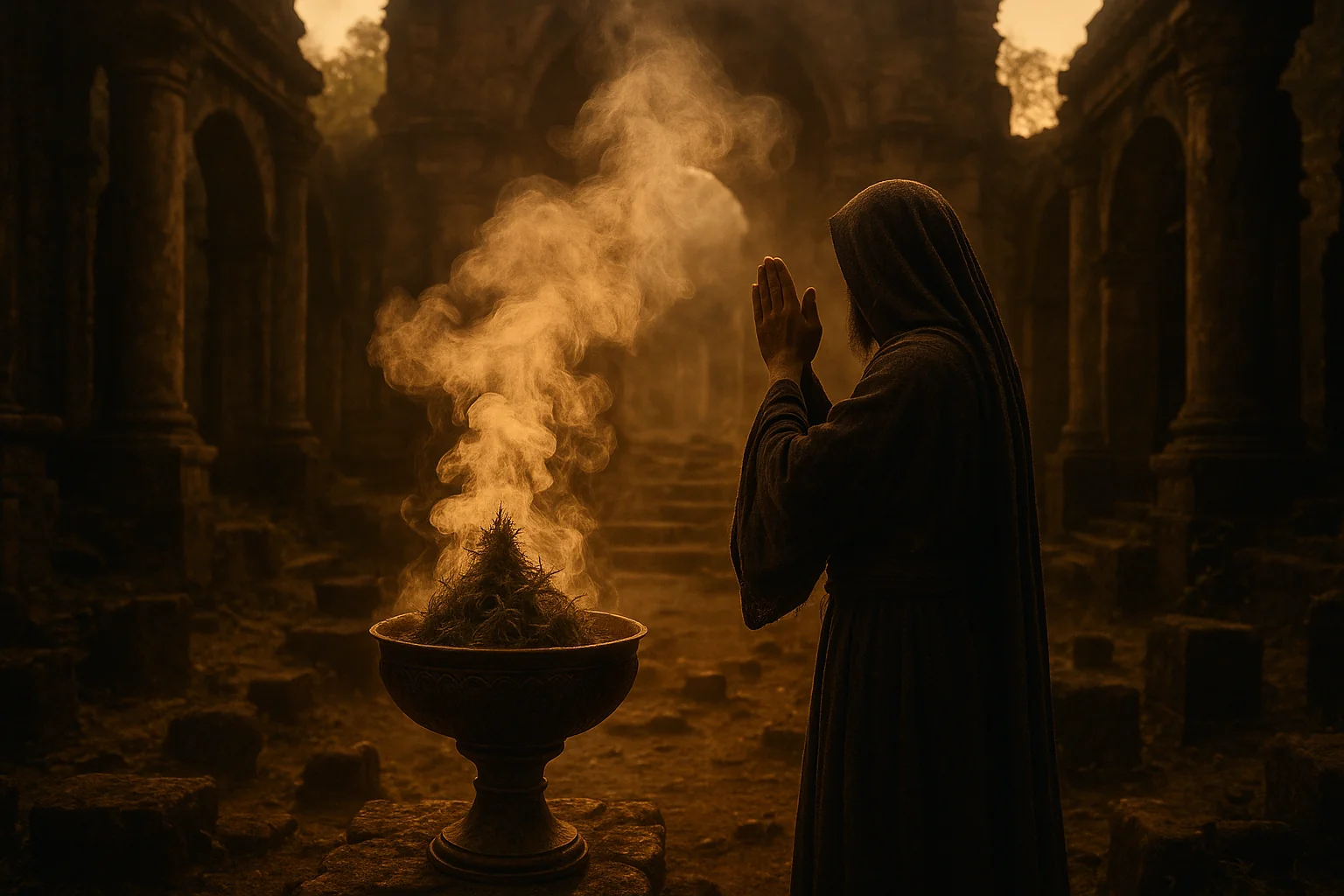

Cannabis in religion - from Rastafari to ancient rituals (guide)
Konopie w religii — co to, jak dziala i na co. Zrozumialy przewodnik u Bucha.
Cannabis is one of the oldest plants cultivated by humans - and one of the few that has accompanied people not only in practical but also in deeply spiritual contexts. From Scythian kurgans on the Ukrainian steppes, through Hindu temples dedicated to Shiva, to Jamaican Rastafarian communities - cannabis appears repeatedly as a plant that transcends boundaries, a mediator between the human and divine worlds. This guide presents these historical and cultural connections with a factual approach.
KEY INFORMATION
• Cannabis appears in a religious context on at least four continents and over several millennia - from ancient China and India to contemporary New Age movements.
• Rastafarians treat ganja as a sacrament with biblical justification - it is the only known contemporary denomination where smoking cannabis is a central liturgical act.
• Herodotus described Scythian rituals involving cannabis around 440 B.C.E. - confirmed by archaeological excavations at Ukrainian kurgans.
• Hindu bhang, consumed ceremonially during Maha Shivaratri and Holi, is one of the longest uninterrupted traditions of using cannabis in a religious context.
Ancient India - Shiva, bhang, and five sacred plants
In Hindu tradition, cannabis has a millennia-long sacred history. The Rigveda - one of the oldest religious texts in the world (circa 1500-1200 B.C.E.) - mentions the plant 'vijaya' (literally 'victorious') as one of the five sacred plants that protect against evil. Although the identification of vijaya with cannabis is not undisputed among Sanskrit scholars, this connection is accepted by many researchers of the history of religious botany (Clarke and Merlin, Cannabis: Evolution and Ethnobotany, 2013).
The strongest connection of cannabis with Hinduism is the worship of Shiva - the god of destruction, transformation, and yoga. Shiva is often depicted as an ascetic meditating in the Himalayas, and in iconography, he appears with a chillum (a clay pipe) filled with bhang or ganja. Legends describe Shiva resting under a cannabis bush after a difficult journey and discovering its properties. Bhang - a traditional drink made from leaves, milk, spices, and sugar - is ceremonially consumed during Maha Shivaratri (Shiva's Great Night) and Holi festivals throughout the Indian Subcontinent. This is one of the longest unbroken traditions of sacred use of a psychoactive plant in the world.
Scythians and Herodotus - the oldest written testimony of ritual cannabis
The earliest description of the ritual use of cannabis in written sources comes from the Greek historian Herodotus, who in 'Histories' (circa 440 B.C.E.) described the funeral customs of the Scythians - nomadic warriors inhabiting the steppes of present-day Ukraine and Kazakhstan. After burying their leader, the Scythians would build small tents, place iron bowls with heated stones inside, and throw cannabis seeds on them. Herodotus writes: 'they emit a cry of pleasure; it replaces their bath.' The ritual had a purifying and mourning character at the same time.
For centuries, historians treated this description as a colorful anecdote or exaggeration. A breakthrough occurred in 1929 when Russian ethnobotanist Sergey Rudenko discovered a complete set for inhaling cannabis vapors in the Scythian kurgan of Pazyryk in Altai - wooden vessels, bronze bowls, remnants of seeds (Pazyryk burials). Subsequent excavations at Ukrainian burial mounds confirmed this pattern repeatedly. Herodotus was not lying.
| Culture / Religion | Period | Form and Context of Use |
|---|---|---|
| Ancient China | From circa 2700 B.C. | Medicine, offerings, and shamanic divination sessions |
| Ancient India (Hinduism) | From circa 1500 B.C. | Bhang during Maha Shivaratri and Holi; the cult of Shiva |
| Scythians (Eurasia) | Ok. VI-IV w. p.n.e. | Funeral and cleansing rituals - inhaling vapors |
| Ancient Egypt | Ok. 1550-900 p.n.e. | Ritual medicine, temple incense |
| Zoroastrianism (Persia) | c. 6th century BCE | “Haoma” - a ritual entheogenic plant, its identity with cannabis is disputed |
| Rastafari (Jamaica) | Since the 1930s | Ganja jako sakrament - „reasoning sessions” i modlitwa |
Rastafari - the only contemporary religion with cannabis as a sacrament
The Rastafari movement was born in Jamaica in the 1930s as a response to colonialism, racism, and poverty in the Afro-Jamaican community. The roots of the movement trace back to the thoughts of Marcus Garvey and the cult of Haile Selassie - the Emperor of Ethiopia, whom Rastafari recognized as the return of the Messiah (Jah). Cannabis - referred to in this movement as “ganja,” “holy herb,” or “the sacrament” - holds a unique place in Rastafari: it is viewed not as a drug, but as a means of prayer and a tool for drawing closer to God.
The biblical justification for Rastafarian use of ganja is based on several passages: Genesis 1:29 (“I give you every seed-bearing plant”), Psalm 104:14 (“He makes grass grow for the cattle and plants for man’s labor”), and Revelation 22:2 (the leaves of the tree of life “for the healing of the nations”). Ganja is ceremonially smoked during “reasoning sessions” - communal prayer meetings where discussion, the Bible, and smoke intertwine in a spiritual act. Unlike recreational use, intention is key: smoking must be an act of conscious spirituality, not entertainment.
The legal status of Rastafarian ganja use is a fascinating field of tension between religious freedom and drug law. In 2015, Jamaica decriminalized the possession of small amounts of cannabis and explicitly exempted religious use by Rastafari from criminal regulations - becoming the first country in the world to recognize this faith as a legal basis for sacramental use of the plant. U.S. states, Australia, and several other countries have ongoing court cases regarding this issue - with varying outcomes.
Ancient China and Egypt - cannabis in shamanic and priestly contexts
In ancient China, cannabis played both a practical (fiber, food) and spiritual role. Taoist shamans (wu) used cannabis incense during divination sessions and contact with the spirit world - according to texts from the Zhou Dynasty (1046-256 BCE), cannabis smoke “opened the gates to the world of ancestors.” The Chinese medical encyclopedia Shennong Bencao Jing (circa 1st century CE, attributed to the legendary Emperor Shennong) describes cannabis as one of the four “divine pharmaceuticals” used in both medicine and spiritual practices.
In Egypt, traces of cannabis appear in both medical and ritual contexts. The Ebers Papyrus (c. 1550 BCE) describes cannabis in medicinal recipes, and excavations in Thebes (Luxor) have shown the presence of cannabis pollen in tombs from the New Kingdom period. Groundbreaking research published in the Journal of Ethnopharmacology (2020) The team of Rosalie David detected THC residues in the mummy of a priestess from around 900 BCE - suggesting a ritual or medicinal context for the plant's use by the Egyptian clergy. However, there is little direct evidence of cannabis use in Egyptian liturgy - most researchers exercise caution in interpretation.
Contemporary spiritual movements and cannabis - from New Age to the Church of Cannabis
The traditions of sacred cannabis use are not limited to antiquity and Rastafari. In the second half of the 20th century and the 21st century, new spiritual movements emerged that incorporated cannabis into their practice - often referencing the above traditions but adapting them to a contemporary context. The most well-known is the First Church of Cannabis, founded in Indiana in 2015 by Bill Levin immediately after the passage of the Religious Freedom Restoration Act. The organization received official status as a religious organization, sparking a heated debate about the boundaries of religious freedom and drug law in the U.S. However, courts have denied legal protection for the sacramental use of cannabis by this organization, citing the neutrality of drug law.
In New Age and neo-shamanic circles, cannabis is sometimes treated as a “teacher plant” - a concept borrowed from Amazonian shamanic traditions, where plants like ayahuasca, peyote, or iboga are considered beings with their own spiritual wisdom. This approach is far from recreational: sessions are conducted in a structured ritual context, with intention, preparation, and integration of experiences. Religious scholars like Benny Shanon and Michael Winkelman describe this trend as part of a broader phenomenon of the “psychedelic renaissance” - a resurgence of interest in psychoactive substances in the context of spirituality and therapy.
In Poland, the religious context of cannabis use is practically absent as an organized movement - Polish law does not provide for religious exceptions for controlled substances, and such practices function solely in private spaces. This is a significant difference compared to Jamaica (Rastafari) or India (bhang during Holi), where sacred use is culturally rooted and legally tolerated under certain circumstances. The debate about where religious freedom ends and criminal law begins is likely to intensify as Western countries liberalize cannabis regulations.
Frequently Asked Questions
What role does cannabis play in Rastafarian religion?
In the Rastafari movement, marijuana (referred to as “ganja” or “holy herb”) is a sacrament used for meditation, prayer, and drawing closer to Jah (God). Rastafari derive justification from the Bible (Genesis 1:29, Psalm 104:14). Smoking ganja in “reasoning sessions” is a spiritual act. The movement originated in Jamaica in the 1930s - Jamaica was the first to decriminalize religious use of cannabis by Rastafari in 2015.
Was cannabis used in ancient Egypt?
Yes - archaeobotanical studies have shown the presence of cannabis in Egyptian tombs and temples. The Ebers Papyrus (circa 1550 BCE) describes cannabis in medicinal mixtures used ritually. In 2020, researchers detected THC residues in the mummy of a priestess from around 900 BCE (Journal of Ethnopharmacology, 2020), although the interpretation of the ritual context requires caution.
What role did cannabis play in Hinduism?
In Hinduism, bhang (a drink made from cannabis leaves) is associated with the worship of Shiva. It is ceremonially consumed during the Maha Shivaratri and Holi festivals. The Rigveda mentions “vijaya” as one of the five sacred plants. Shiva is often depicted in iconography with a chillum - this is one of the longest uninterrupted traditions of sacred use of a psychoactive plant in the world.
Did the ancient Scythians use cannabis ritually?
Yes - Herodotus described Scythian funeral rituals involving the inhalation of cannabis vapors around 440 BCE. The description was confirmed by excavations: a complete inhalation set was discovered in the Pazyryk kurgan (Altai) with remnants of cannabis seeds. Later excavations in Ukrainian kurgans have repeatedly confirmed this pattern (Pazyryk burials).
Are there mentions of cannabis in the Bible?
This is a contentious topic. Researcher Sula Benet (1936) proposed that the Hebrew “qaneh bosm” (an ingredient in the holy anointing oil in Exodus 30:23) refers to Cannabis. The hypothesis is popular among Rastafari and some researchers, but there is no consensus - “qaneh bosm” is also identified as calamus or other aromatic plants. Rastafari also cite Genesis 1:29 as a general biblical justification.
This article is for informational and educational purposes and does not replace consultation with a doctor. If you are pregnant, breastfeeding, taking medications, or have chronic conditions, consult the use of supplements or herbs with a specialist.
Author: Michał Waluk · Published: 2026-05-04 · Updated: 2026-05-04