
Kolagen grass-fed vs morski: jaka jest różnica i który wybrać
Kolagen grass-fed czy morski? Porównujemy typy, dowody na wchłanianie i koszt grama kolagenu w siedmiu preparatach ze sklepu u Bucha. Ceny: 2026-08-08.
Producenci kolagenu morskiego reklamują go jako lepiej przyswajalny, a producenci wersji grass-fed jako pełniejszy w typach. Obie strony mają rację tylko połowicznie. Jedyne ludzkie badanie, które porównało źródła kolagenu bezpośrednio, zestawiło hydrolizat z łusek ryb ze skórą świńską, a nie z wołowiną, i objęło pięciu ochotników (Ohara i wsp., 2007). Reszta różnic sprowadza się do stopnia hydrolizy, zestawu typów i ceny. W sklepie u Bucha stoi dziś siedem preparatów kolagenowych: sześć na kolagenie rybim i jeden na bydlęcym z hodowli pastwiskowej. Porównujemy je jedną wspólną miarą, czyli kosztem grama kolagenu, i sprawdzamy, co z badań klinicznych wynika dla skóry, a co dla stawów. Dowiesz się, kiedy dopłata za wersję morską ma pokrycie, a kiedy płacisz za etykietę.
KLUCZOWE INFORMACJE
• Jedyne ludzkie porównanie źródeł zestawiło kolagen rybi ze świńskim u pięciu ochotników, a nie z wołowym (Ohara i wsp., 2007).
• Kolagen morski dostarcza typ I, bydlęcy grass-fed typ I oraz III.
• W ofercie sklepu koszt grama kolagenu rozciąga się od 0,40 zł do 4,50 zł.
• Przy alergii na ryby zostaje kolagen bydlęcy albo kurzy.
Czym różni się kolagen grass-fed od morskiego?
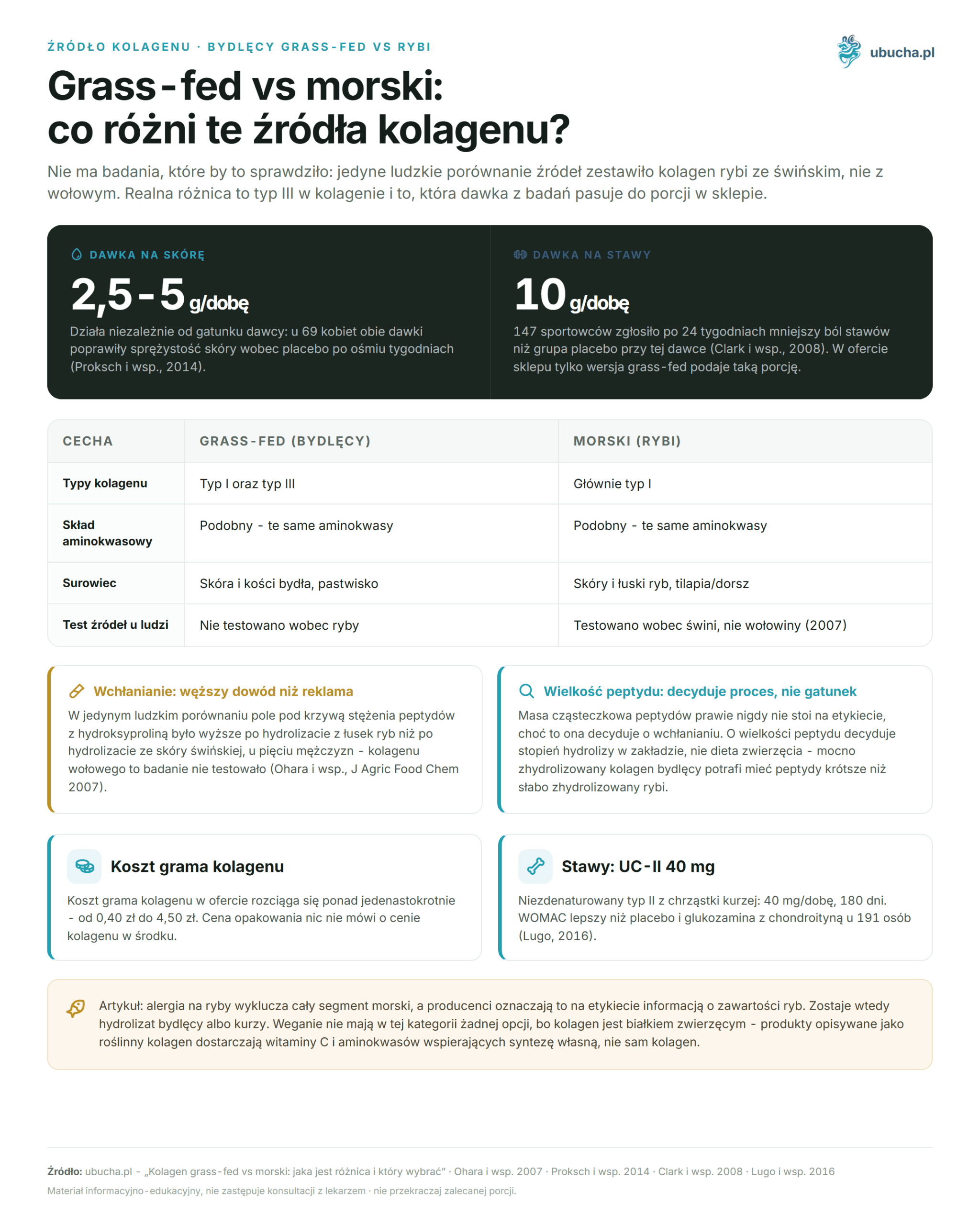
Różnią się gatunkiem dawcy i zestawem typów kolagenu. Grass-fed to hydrolizat ze skór i kości bydła karmionego trawą pastwiskową, dostarczający typ I oraz typ III. Morski powstaje ze skór i łusek ryb, a jego zasadniczym składnikiem jest typ I. Sama etykieta grass-fed opisuje sposób hodowli, nie skład peptydów.
Skład aminokwasowy obu form jest do siebie bardzo zbliżony, bo w każdym kolagenie dominują glicyna, prolina i hydroksyprolina. Praktyczna różnica leży gdzie indziej: typ III współtworzy warstwę siatkowatą skóry właściwej oraz ściany naczyń, a w preparatach rybich zwykle go nie ma. Producent bydlęcy sprzedaje więc dwa typy w jednej porcji, producent rybi jeden.
Certyfikat pastwiskowy ma znaczenie hodowlane i środowiskowe, nie biochemiczne. Nie zmienia sekwencji peptydów ani ich długości, bo o tym decyduje enzymatyczna hydroliza w zakładzie, a nie dieta zwierzęcia. Porównuj deklarowaną masę kolagenu w porcji, a nie hasło z frontu opakowania. Surowiec rybi bierze się najczęściej ze skór i łusek tilapii lub dorsza, czyli z produktu ubocznego przetwórstwa. Co robi w organizmie każdy z typów i dlaczego typ II stoi osobno, rozłożyliśmy w tekście o typach kolagenu I, II i III.
Czy kolagen morski naprawdę wchłania się lepiej?
Prawdopodobnie tak wobec kolagenu świńskiego, ale dowód jest węższy, niż sugeruje reklama. W jedynym ludzkim badaniu porównawczym pole pod krzywą stężenia peptydów z hydroksyproliną było istotnie wyższe po hydrolizacie z łusek ryb niż po hydrolizacie ze skóry świńskiej (Ohara i wsp., J Agric Food Chem 2007). Badanie objęło pięciu mężczyzn i nie testowało kolagenu wołowego.
Wcześniejsza praca tego samego zespołu pokazała, czym te peptydy są: po wypiciu hydrolizatu głównym związkiem wykrywanym w osoczu jest dipeptyd Pro-Hyp, a szczyt stężenia przypada 1-2 godziny po spożyciu (Iwai i wsp., J Agric Food Chem 2005). Testowano tam skórę świńską, kurze łapki i chrząstkę, więc żadna z tych publikacji nie mówi o przewadze ryby nad wołowiną.
Zauważyliśmy przy zestawianiu etykiet, że masa cząsteczkowa peptydów prawie nigdy nie jest na nich podana, choć to ona decyduje o wchłanianiu. Wielkość peptydu wynika ze stopnia hydrolizy, czyli z procesu, a nie z gatunku dawcy: mocno zhydrolizowany kolagen bydlęcy potrafi mieć peptydy krótsze niż słabo zhydrolizowany rybi. Liczby w rodzaju „dwa razy lepsza przyswajalność” nie mają pokrycia w pracy, do której udało nam się dotrzeć. Czym peptydy kolagenowe różnią się od kolagenu nieprzetworzonego i co z tego wynika dla etykiety, porównaliśmy w tekście o peptydach kolagenowych.
Który kolagen wybrać na skórę, a który na stawy?
Na skórę wystarcza 2,5-5 g hydrolizatu dziennie i działa on niezależnie od gatunku dawcy: w badaniu z udziałem 69 kobiet obie dawki poprawiły sprężystość skóry wobec placebo po ośmiu tygodniach (Proksch i wsp., 2014). Na stawy dowody dotyczą dawki 10 g dziennie albo osobnego preparatu, czyli niezdenaturowanego kolagenu typu II.
Druga praca tego zespołu objęła 114 kobiet w wieku 45-65 lat przyjmujących 2,5 g peptydów kolagenowych. Po ośmiu tygodniach objętość zmarszczek wokół oczu spadła o 20% wobec placebo, a zawartość prokolagenu typu I w skórze wzrosła o 65% (Proksch i wsp., 2014). To najmocniejszy dowód skórny, jaki mamy, i nie rozstrzyga sporu o gatunek dawcy.
Dla stawów punktem odniesienia jest praca ze 147 sportowcami, którzy przez 24 tygodnie przyjmowali 10 g hydrolizatu w płynie i zgłaszali mniejszy ból stawów niż grupa placebo (Clark i wsp., 2008). Przegląd piśmiennictwa z 2006 roku dodaje, że doustny hydrolizat wchłania się i gromadzi w chrząstce (Bello i Oesser). Osobną ścieżką jest niezdenaturowany typ II z mostka kurzego: 40 mg dziennie przez 180 dni poprawiło wynik WOMAC bardziej niż placebo i niż glukozamina z chondroityną u 191 osób (Lugo i wsp., 2016). Po jakim czasie efekt bywa mierzalny i jak sprowadzić różne formy do wspólnego mianownika, opisaliśmy w tekście o kolagenie na stawy i skórę.
Jakie kolageny ma sklep u Bucha i ile kosztują?
Siedem preparatów, z tego sześć na kolagenie rybim i jeden na bydlęcym grass-fed. Ceny opakowań mieszczą się w wąskim przedziale 99-139 zł, ale koszt jednego grama kolagenu różni się w tej siódemce ponad jedenastokrotnie, bo porcja dzienna niesie od 0,73 g do 12 g. Zestawienie porządkuje je od najtańszego grama.
| Nr | Produkt | Źródło i co wyróżnia | Kolagen w porcji | Cena | Koszt 1 g |
|---|---|---|---|---|---|
| 1 | Boski Kolagen 315 g | bydlęcy grass-fed, typ I i III | 10 000 mg | 118,99 zł | 0,40 zł |
| 2 | Aura Care Moc Piękna 500 ml | rybi w płynie, z kwasem hialuronowym | 12 000 mg | 139 zł | 0,58 zł |
| 3 | Aura Care Moc Młodości 500 ml | rybi w płynie, z MSM i adaptogenami | 11 000 mg | 139 zł | 0,63 zł |
| 4 | Aura Care PREMIUM Piękno 200 g | rybi w proszku, z krzemem i biotyną | 5 500 mg | 129 zł | 0,78 zł |
| 5 | Aura Care PREMIUM Aktywność 200 g | rybi w proszku, z glukozaminą i chondroityną | 5 500 mg | 129 zł | 0,78 zł |
| 6 | Aura Care Kawa Kolagenowa 220 g | rybi w kawie rozpuszczalnej, z cynkiem | 2 000 mg | 99 zł | 1,38 zł |
| 7 | Aura Care Esencja Kolagenowa 50 ml | rybi typu I w kroplach, z witaminami B | 733 mg | 99 zł | 4,50 zł |
Ceny pochodzą ze sklepu ubucha.pl, stan na 8 sierpnia 2026. Koszt grama policzyliśmy z deklarowanej zawartości kolagenu w porcji dziennej i liczby porcji w opakowaniu. Jedyny grass-fed w tym zestawieniu wypada najtaniej w przeliczeniu na gram i jako jedyny podaje porcję 10 g, czyli dawkę stawową z badań klinicznych. Preparaty rybie celują w skórę i mieszczą się bliżej dawki 2,5-5 g. Pełną listę znajdziesz w kategorii suplementy.
Na co patrzeć na etykiecie kolagenu?
Na trzy liczby: masę kolagenu w porcji dziennej, liczbę porcji w opakowaniu i gatunek dawcy. Dopiero z nich wychodzi koszt grama, a ten rozjeżdża się w ofercie od 0,40 zł do 4,50 zł. Cena samego opakowania nie mówi nic o tym, ile kolagenu naprawdę kupujesz.
Skrajne wartości z wykresu mają swoje wytłumaczenie. Kawa kolagenowa i esencja w kroplach to formy wygodne, a nie ekonomiczne: pierwsza niesie 2 g kolagenu w porcji, druga 0,73 g, więc płacisz również za sposób podania. Jeśli liczy się dawka, wybierasz proszek albo płyn z kilkoma gramami kolagenu w porcji dziennej.
Alergia na ryby wyklucza cały segment morski, a producenci oznaczają to na etykiecie informacją o zawartości ryb. Zostaje wtedy hydrolizat bydlęcy albo kurzy. Weganie nie mają w tej kategorii żadnej opcji, bo kolagen jest białkiem zwierzęcym: preparaty opisywane jako roślinny kolagen dostarczają witaminy C i aminokwasów wspierających syntezę własną, co nie jest tym samym produktem i ma znacznie węższą dokumentację. Zauważyliśmy też, że część preparatów rybich deklaruje typ I i III, choć kolagen ze skór i łusek to w przewadze typ I, więc deklarację typu czytaj razem ze składem.
Najczęściej zadawane pytania
Czym różni się kolagen grass-fed od morskiego?
Grass-fed pochodzi z bydła karmionego trawą i dostarcza typ I oraz III. Morski powstaje ze skór i łusek ryb, więc daje głównie typ I. Skład aminokwasowy obu form jest zbliżony, a o wielkości peptydów decyduje stopień hydrolizy, nie gatunek dawcy.
Czy kolagen morski wchłania się lepiej niż bydlęcy?
Nie ma badania, które by to sprawdziło. Jedyne ludzkie porównanie źródeł wykazało wyższe stężenie peptydów po hydrolizacie z łusek ryb niż po hydrolizacie ze skóry świńskiej, u pięciu ochotników (Ohara i wsp., 2007). Kolagenu wołowego w tym badaniu nie było.
Który kolagen jest lepszy na stawy?
Dla stawów przebadano dawkę 10 g hydrolizatu dziennie: 147 sportowców zgłosiło po 24 tygodniach mniejszy ból niż grupa placebo (Clark i wsp., 2008). Bardziej swoisty jest niezdenaturowany kolagen typu II z chrząstki kurzej, w dawce 40 mg dziennie.
Ile kolagenu dziennie ma sens?
Na skórę 2,5-5 g dziennie, bo tyle podawano w badaniach z pomiarem sprężystości i zmarszczek (Proksch i wsp., 2014). Na stawy 10 g dziennie. W ofercie sklepu porcja dzienna niesie od 0,73 g do 12 g kolagenu, więc etykietę trzeba przeliczyć.
Który kolagen wybrać przy alergii na ryby?
Kolagen morski jest wtedy wykluczony, łącznie z płynami, proszkami i kawą kolagenową na bazie ryb. Bezpieczną alternatywą jest hydrolizat bydlęcy grass-fed albo kurzy. Producenci preparatów rybich podają informację o zawartości ryb w wykazie alergenów.
Czy istnieje kolagen dla wegan?
Nie w sensie dosłownym, bo kolagen jest białkiem zwierzęcym. Produkty opisywane jako roślinny kolagen to zestawy witaminy C i aminokwasów wspierające syntezę własną organizmu. Ich dokumentacja kliniczna jest wyraźnie uboższa niż dokumentacja hydrolizatów zwierzęcych.
Kolageny rybie i bydlęcy grass-fed z tego zestawienia znajdziesz w kategorii suplementy w sklepie u Bucha.
Artykuł ma charakter informacyjno-edukacyjny i nie zastępuje konsultacji z lekarzem. Jeśli jesteś w ciąży, karmisz piersią, przyjmujesz leki lub masz schorzenia przewlekłe, skonsultuj zastosowanie suplementów lub ziół ze specjalistą.
Autor: Michał Waluk · Opublikowano: 2026-06-15 · Aktualizacja: 2026-08-08