
Colostrum for athletes - does it protect against respiratory infections
Colostrum for athletes: a reliable answer based on research. u Bucha.
Intensive physical training weakens immunity - and this is not a myth. The phenomenon known as "open window" describes the time window after exhausting effort when the level of secretory IgA in saliva drops, and the risk of upper respiratory infections increases. A triple-blind RCT published in 2006 showed that supplementation with bovine colostrum for 8 weeks reduced the number of respiratory infection episodes in elite cyclists by about 50% compared to placebo (Crowe et al., Eur J Nutr, 2006). This is one of the best-designed studies in this field. What is behind this effect and for whom does colostrum make sense?
KEY INFORMATION
• The triple-blind RCT (Crowe et al., 2006) showed a ~50% reduction in respiratory infections in elite cyclists with 20 g of colostrum for 8 weeks.
• Mechanism: colostrum supplements secretory IgA (sIgA) lowered by intensive training - the "open window" effect.
• Effective dose in studies: 20-60 g daily for at least 8 weeks during intensive training.
• Colostrum is not a justified ergogenic aid - its strength lies in immunology, not endurance.
• Athletes under anti-doping control should choose products with the Informed Sport certification.
What is colostrum and what does it contain?
Colostrum is the first milk secreted by female mammals within 24-72 hours after giving birth. Bovine colostrum (bovine colostrum, BC) is richer in many bioactive components than cow's milk and - importantly - retains biological activity after processing and lyophilization. Its composition differs from milk in several key aspects.
Immunoglobulins make up 10-15% of the protein in bovine colostrum, compared to below 1% in milk. IgG predominates (about 70-80% of immunoglobulins), but IgA and IgM are also present. Growth factors - IGF-1, IGF-2, TGF-β - stimulate the regeneration of epithelial tissues, including intestinal. Lactoferrin exhibits antibacterial and antiviral activity. Proline-rich polypeptide (PRP) modulates immune system activity. This composition is significantly more complex than standard whey protein.
Immunoglobulins from bovine colostrum do not penetrate in significant amounts through the intestine into the bloodstream in adults - their main action is to protect the mucous membranes of the gastrointestinal tract and indirectly modulate the immune system by interacting with lymphocytes in the gut-associated lymphoid tissue (GALT). However, secretory IgA from colostrum may act protectively locally in the mouth and throat before being digested.
Mechanizm „open window” i rola kolostrum
The "open window" phenomenon has been well described in sports medicine. After intense exertion (marathon running, multi-stage cycling, heavy strength training), the level of secretory IgA (sIgA) in saliva drops by 30-50% for 3-24 hours (Gleeson, J Appl Physiol, 2007). sIgA is the first line of defense for the mucous membranes of the nose and throat against viruses and bacteria. Its deficiency increases susceptibility to viral infections, which then develop into full-blown respiratory inflammation.
Elite athletes training at high volumes have chronically lower levels of sIgA than recreational athletes - and chronically higher rates of upper respiratory infections. This is a paradox: the higher the level of sport, the greater the risk of illness. Bovine colostrum works through two complementary mechanisms: it directly provides IgG and IgA in saliva (before digestion), and indirectly stimulates the gut immune system to produce its own immunoglobulins.
We have noticed that research on colostrum and athlete immunity is mainly conducted on elite endurance athletes (cyclists, long-distance runners, swimmers). The effect on recreational athletes training 3-4 times a week is less studied and likely smaller - because the "open window" is shorter and less profound at lower training intensities. Colostrum makes the most sense with high training volume and frequent competitions.
Overview of Key Clinical Studies
Aside from the Crowe study (2006) on cyclists, subsequent RCTs consistently confirm the effect on mucosal immunity. The Brinkworth et al. (2004) study on the Australian rowing team showed maintenance of higher sIgA levels after 8 weeks of colostrum supplementation vs whey protein with an identical training protocol (Brinkworth et al., Eur J Appl Physiol, 2004). The effect was more pronounced in athletes with the lowest baseline levels of sIgA.
The meta-analysis by Śliwiński et al. (2022, 9 RCTs) confirmed a significant effect of colostrum on sIgA levels in athletes - but the effect on actual incidence of infections was significant in only 3 out of 9 studies. Interpretation: colostrum consistently raises the immune biomarker (sIgA), but the translation to clinical endpoints (number of infections) is more variable and depends on the population, training intensity, and season.
| Study | Population | Dose / duration | Outcome on Immunity |
|---|---|---|---|
| Crowe et al., 2006 | Elite Cyclists | 20 g / 8 weeks | -50% respiratory tract infections |
| Brinkworth et al., 2004 | Rowers (AUS team) | 60 g / 8 weeks | Higher sIgA vs whey |
| Shing et al., 2007 | Road Cyclists | 20 g / 10 days | Higher sIgA after training |
| Śliwiński et al., 2022 (meta) | Various disciplines | Meta 9 RCT | Istotny efekt na sIgA; efekt na infekcje - zmienny |
Practical aspects of colostrum supplementation
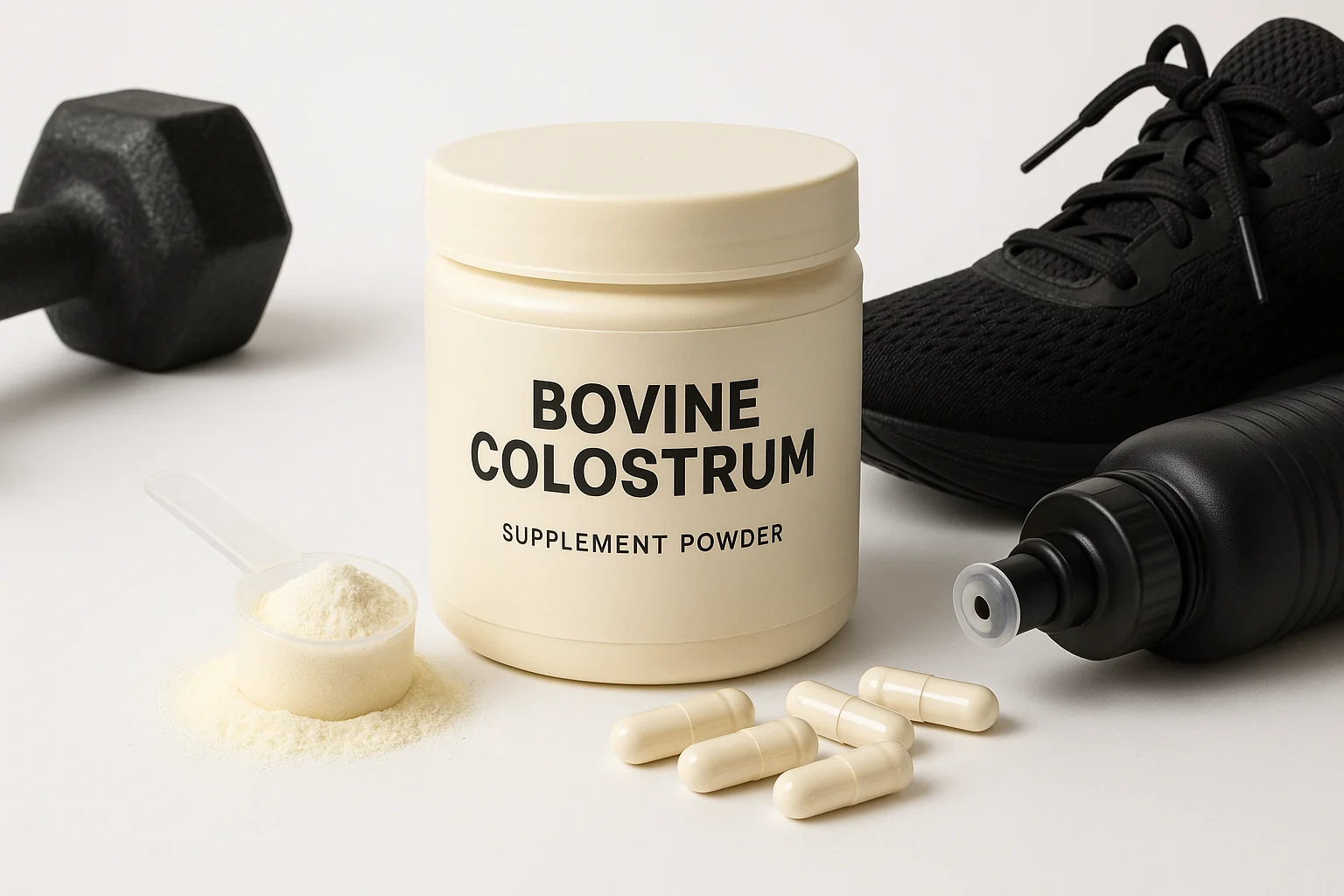
Bovine colostrum is available in powder, capsule, and tablet form. Standardization for IgG content is a key quality parameter - look for products with at least 25-30% IgG (by weight). Powder is flexible in dosing and cheaper; capsules are more convenient for travel and during training camps.
Timing of supplementation matters. Studies have used colostrum throughout the entire period of intensive preparations - 8-12 weeks before an important competition or season. Taking it for 2-3 weeks occasionally does not yield consistent effects. An analogy to vaccination: the effect requires time to build an immune response.
Important disclaimer for athletes competing in drug-tested sports: bovine colostrum contains natural growth hormones, including IGF-1. WADA does not prohibit colostrum (since 2010, after a prior monitoring period), but choose products with Informed Sport or Cologne List certification to avoid the risk of cross-contamination.
Colostrum and the athlete's gut - an additional dimension of action
Intensive physical effort - especially prolonged running or cycling - increases intestinal permeability. The phenomenon known as "leaky gut" occurs during exercise due to the redistribution of blood to the muscles at the expense of the intestines, leading to ischemia and damage to the intestinal epithelium. Studies have shown an increase in endotoxemia (bacterial lipopolysaccharides in the blood) after prolonged exertion, which may contribute to chronic inflammation in endurance athletes (Jeukendrup et al., Eur J Appl Physiol, 2000).
Bovine colostrum contains growth factors (IGF-1, TGF-β) and lactoferrin, which have protective effects on the intestinal epithelium. The study by Playford et al. (2001) showed that colostrum reduced intestinal permeability in volunteers exposed to NSAIDs (indomethacin) compared to placebo (Playford et al., Clin Sci, 2001). Subsequent studies on athletes (Marchbank et al., 2011) confirmed this effect with 20 g of colostrum daily for 14 days - the increase in intestinal permeability after intense running was significantly lower in the colostrum group.
This second mechanism of action of colostrum - protecting the intestinal barrier - may complement the immunological effect (sIgA) and explain why the effects are more pronounced in athletes in a heavy training phase than in recreational exercisers. An "leaky" gut allowing bacterial endotoxins activates systemic inflammation, weakening the mucosal immunity of the respiratory tract. Colostrum may tackle this problem from two sides simultaneously.
Frequently Asked Questions
Does colostrum really reduce the incidence of respiratory infections in athletes?
Yes - the triple-blind RCT by Crowe et al. (2006) showed about a 50% reduction in infection episodes in elite cyclists with 20 g of colostrum for 8 weeks vs placebo (Eur J Nutr, 2006). A meta-analysis of 9 RCTs confirms a consistent effect on sIgA, although the translation to clinical infections varies between studies.
How does colostrum affect IgA levels in athletes?
Intensive training lowers secretory IgA (sIgA) by 30-50% for several hours after training - the "open window" effect. Colostrum contains immunoglobulins and stimulates GALT to produce its own sIgA, maintaining its level higher after training than placebo (Brinkworth et al., 2004).
What dose of colostrum is used in studies?
Clinical studies used 20-60 g of freeze-dried colostrum daily for 8-12 weeks. A dose of 20 g for 8 weeks showed the most consistent effect on immunity. Lower doses (10 g) yield weaker and less consistent results. Standardization of the preparation to a minimum of 25-30% IgG is important.
Does colostrum improve athletic performance beyond immunity?
The data is mixed. Several studies showed moderate benefits for strength and muscle mass, but a meta-analysis by Shing et al. did not find a significant advantage over whey protein for performance parameters. Colostrum has the strongest justification in the context of mucosal immunity, not as an ergogenic aid.
Is bovine colostrum safe for humans?
Yes - a good safety profile in studies up to 12 months. Contraindicated in case of allergy to cow's milk proteins. Athletes under anti-doping control should choose certified products (Informed Sport, Cologne List) due to the natural IGF-1 in colostrum. WADA has not banned colostrum since 2010.
This article is for informational and educational purposes and does not replace consultation with a doctor. If you are pregnant, breastfeeding, taking medications, or have chronic conditions, consult the use of supplements or herbs with a specialist.
Author: Michał Waluk · Published: 2026-05-04 · Updated: 2026-05-04