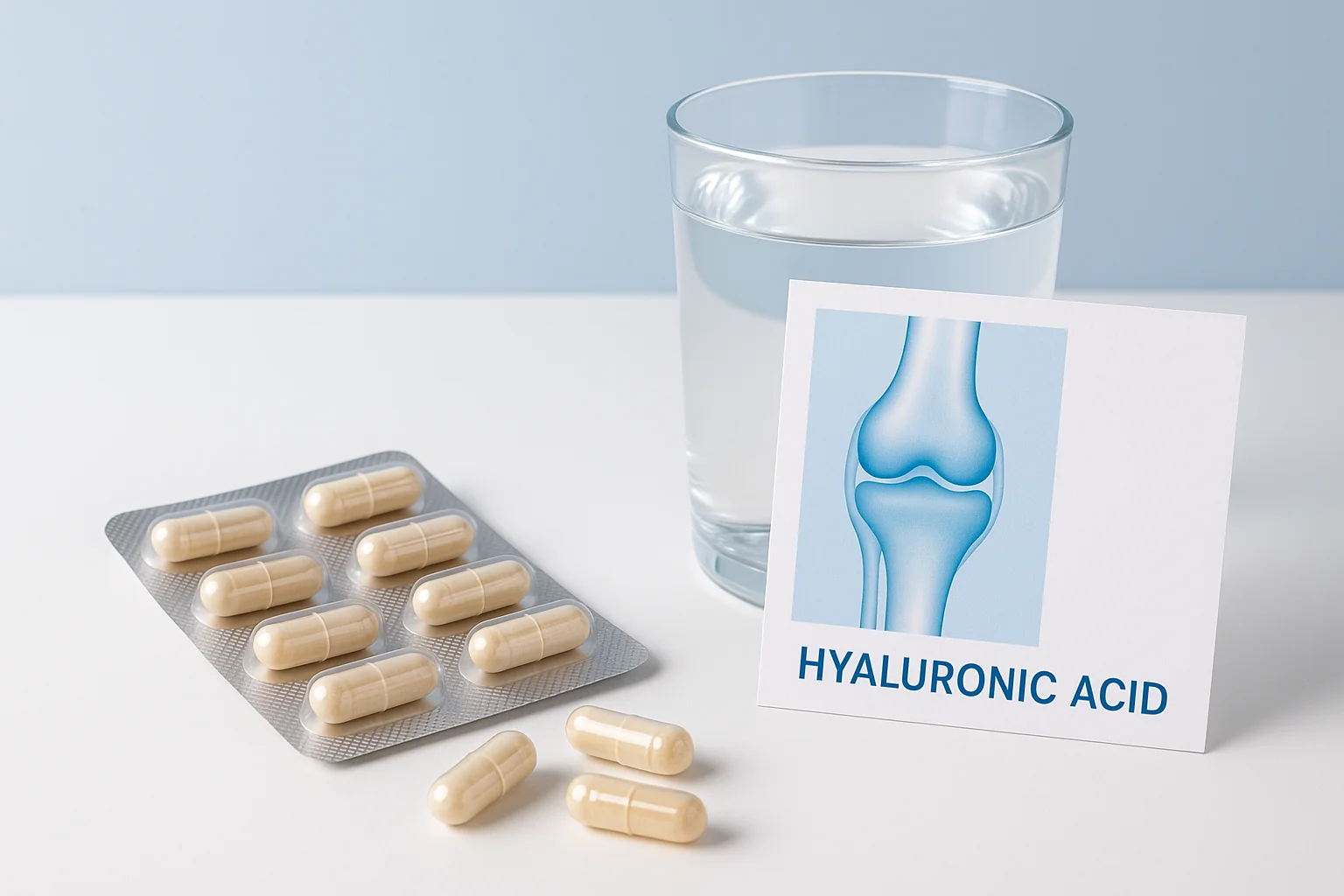

Oral hyaluronic acid for skin hydration and knee pain - evidence
Oral hyaluronic acid for skin hydration and knee pain: a reliable answer based on research. u Bucha.
Hyaluronic acid is primarily known for injections that fill wrinkles and joint injections. Oral supplementation sounds less intuitive - since HA is digested in the intestines, how can it reach the skin or cartilage? It turns out that the mechanism of action is indirect but real, and clinical studies with randomization confirm measurable effects. A study published in Nutrition Journal showed improvement in skin hydration and reduction in knee pain with 200 mg of HA daily for 12 months (Tashiro et al., Nutr J, 2012). This article analyzes what is known and what is still unknown.
KEY INFORMATION
• Oral HA does not reach the skin directly - it stimulates fibroblasts to produce HA endogenously through oligosaccharides absorbed from the intestine.
• RCTs confirm improvement in skin hydration with 120-200 mg HA/day for 8-12 weeks (Oe et al., 2017).
• The Tashiro study (2012) showed a reduction in knee pain when climbing stairs after 12 months of supplementation with 200 mg of HA.
• The effect is slower than with injections - a minimum of 4-8 weeks of regular use is needed.
• Good safety profile - no known drug interactions.
How does oral hyaluronic acid work in the body?
Hyaluronic acid is a polysaccharide (glycosaminoglycan) made up of pairs of molecules: glucuronic acid and N-acetylglucosamine. After oral administration, digestive enzymes break it down into oligosaccharides and monosaccharides. These fragments are absorbed in the small intestine and enter the bloodstream, then reach the tissues (Balogh et al., Nutrition, 2008).
The mechanism of action on the skin is twofold. First, HA oligosaccharides stimulate skin fibroblasts to increase their own synthesis of hyaluronic acid - a paracrine effect. Second, they inhibit the activity of hyaluronidases - enzymes that degrade HA - which slows down the natural aging of the skin matrix. It is not about 'supplementing' HA as with injections, but about stimulating the skin's own repair mechanisms.
In the case of joints, the mechanism is similar: HA oligosaccharides stimulate synoviocytes (cells of the synovial membrane) to produce HA, improving the viscosity of synovial fluid. The effect is subtler than with direct injection, but it works systemically - on all joints simultaneously, not just the one where the injection was given.
What do clinical studies say about skin hydration?
The study by Oe and colleagues (randomized, double-blind, n=60) published in Journal of Clinical Biochemistry and Nutrition showed that 120 mg of HA daily for 12 weeks significantly improved facial skin hydration (measured with a corneometer), reduced wrinkle depth, and improved subjective skin assessment compared to placebo (Oe et al., J Clin Biochem Nutr, 2017). The effects were statistically significant and visible after 4-8 weeks.
A meta-analysis published in Nutrients (Balazs et al., 2021) collected data from 6 RCTs and demonstrated a consistent, significant effect of oral HA on skin hydration - the standardized mean difference (SMD) was 0.58 (95% CI: 0.25-0.91), corresponding to a moderate effect (Bukhari et al., Nutrients, 2021). Studies used HA with a molecular weight of 300 kDa - 1 MDa, which corresponds to typical supplemental preparations.
We noted that most studies on oral HA come from Japan and are funded by supplement manufacturers - this is an important methodological caveat. Independent European studies are rarer. Nevertheless, the consistency of results among different research groups, various doses, and populations suggests that the effect is real, although its magnitude may be somewhat inflated in sponsored studies.
What do clinical studies say about knee pain?
The study by Tashiro and colleagues (2012, n=33, randomized, double-blind) evaluated 200 mg of HA daily for 12 months in individuals with knee pain during daily activities. The results showed a significant reduction in pain when climbing stairs and standing up from a chair compared to placebo - the effect was visible after 4 months and increased throughout the year of observation (Tashiro et al., Nutr J, 2012).
An earlier study by Sato and colleagues (2009) on a Japanese population used a lower dose (60 mg/day) and showed a smaller but still significant effect. Data suggest a dose-response relationship in the range of 60-200 mg daily. Above 200 mg, the additional benefit is not clear - this is natural receptor saturation.
Important caveat: studies concern mild to moderate knee osteoarthritis. In cases of severe osteoarthritis with significant cartilage loss, oral HA supplementation does not replace intra-articular injections or orthopedic intervention. The supplement may be effective as an adjunct and prevention - not as monotherapy for advanced degenerative disease.
Doustny HA vs iniekcje dostawowe - dla kogo co?
Intra-articular injections (viscosupplementation) are a standard orthopedic procedure - HA is injected directly into the joint space. The effect appears after 1-4 weeks and is more pronounced in moderate osteoarthritis. A Cochrane meta-analysis (Rutjes et al., 2012) showed a significant but moderate effect of viscosupplementation on pain in knee osteoarthritis (Rutjes et al., Ann Intern Med, 2012). The procedure carries a risk of joint infection (rare, about 0.001%) and bleeding at the injection site.
Oral supplementation works more slowly (8-12 weeks to effect), but is convenient, non-invasive, and systemic. It is an option for individuals with mild symptoms who want prevention or adjunctive treatment, as well as for those for whom injections are contraindicated or unavailable. Both methods can be used in parallel - they do not exclude each other.
Molecular weight of HA - does the size of the molecule matter?
Hyaluronic acid varies in molecular weight (Mw): from about 50 kDa (low Mw, oligomers) to over 1 MDa (high Mw, linear chains). This difference has biological consequences that the supplement industry often overlooks. High Mw HA (above 500 kDa) exhibits anti-inflammatory effects and is a natural component of synovial fluid. Low Mw HA (below 50 kDa) can paradoxically act pro-inflammatory by activating TLR2/TLR4 receptors - this is a tissue damage signaling mechanism (Termeer et al., J Exp Med, 2002).
For oral supplements, the molecular weight of the starting HA has limited practical significance - digestive enzymes break it down into similar oligosaccharides regardless of the initial Mw. Therefore, the standardization of the manufacturing process and the bioavailability of biologically active fragments are more important. Clinical studies used HA with Mw 300 kDa - 1 MDa with comparable results on skin and joints.
It is also worth noting the source of HA. The traditional raw material is an extract from rooster combs (birds) - rich and proven, but unsuitable for people with poultry allergies or those on a vegan diet. HA from bacterial fermentation (Streptococcus equi or Bacillus subtilis) is increasingly available - chemically identical, free from allergenic animal proteins, certified as vegan-friendly. For most users, both forms are biologically equivalent.
How long should oral HA be taken to assess the effect? A minimum of 8 weeks for skin, a minimum of 4 months for joints. Shorter treatments (4 weeks) often do not yield measurable effects - this is the most common reason for the opinion that it 'doesn't work'. HA accumulates in tissues slowly, and fibroblasts need time to adjust the expression of extracellular matrix synthesis genes. Consistency is more important here than dosage.
Frequently Asked Questions
Does oral hyaluronic acid really reach the skin?
Not directly - but indirectly, yes. After digestion into oligosaccharides, HA fragments are absorbed into the bloodstream and stimulate skin fibroblasts to produce endogenous HA and inhibit hyaluronidases. The effect is real and confirmed in several RCTs, but requires at least 4-8 weeks of regular use (Oe et al., 2017).
What dose of oral HA is effective for the skin?
Clinical studies used 80-200 mg daily. The study by Oe et al. (2017) showed a significant improvement in skin hydration with 120 mg over 12 weeks. The optimal point is 120-200 mg/day. Higher doses do not yield proportionately higher effects. Effects appear after 4-8 weeks - shorter treatments are less reliable.
Does oral hyaluronic acid help with knee pain?
Yes - the study by Tashiro et al. (Nutr J, 2012) showed a reduction in knee pain when climbing stairs and standing up after 12 months of supplementation with 200 mg of HA daily. The effect increased throughout the year of observation. This applies to mild to moderate osteoarthritis - it does not replace orthopedic treatment in advanced disease (Tashiro et al., 2012).
How does oral HA differ from joint injections?
Joint injections work faster (1-4 weeks) and more distinctly in moderate osteoarthritis, but they are an invasive procedure. Oral supplementation works slower (8-12 weeks), systemically, and without the risk of infection - an option for mild symptoms and prevention. Both methods can be used concurrently.
Is oral hyaluronic acid safe?
Yes - the safety profile is good, with no known drug interactions. Occasional gastrointestinal discomfort at higher doses. Individuals with poultry allergies should choose HA from fermentation (plant-based). There is no data on pregnant women - caution is advised.
This article is for informational and educational purposes and does not replace consultation with a doctor. If you are pregnant, breastfeeding, taking medications, or have chronic conditions, consult the use of supplements or herbs with a specialist.
Author: Michał Waluk · Published: 2026-05-04 · Updated: 2026-05-04