
Spasticity in multiple sclerosis - why muscle tone is controlled by CB1, not CB2
Spasticity in multiple sclerosis — the mechanism explained simply, based on research. u Bucha.
Multiple sclerosis (MS) affects over 45,000 people in Poland, and spasticity - painful, involuntary muscle contractions and stiffness - is one of the most debilitating symptoms of the disease. Conventional medications like baclofen or tizanidine provide relief to only some patients and carry sedation and dizziness as side effects. Cannabinoids, especially the Sativex preparation approved by the EMA, show effectiveness where other drugs fail. Why? The answer lies in the anatomy of the receptors - CB1 dominates in the central nervous system precisely where spasticity is generated.
KEY INFORMATION
• CB1 dominates in the CNS - spinal cord and brain - making it a key therapeutic target in MS spasticity (Pertwee, British Journal of Pharmacology, 2010)
• Sativex (THC:CBD 1:1) is approved by the EMA for treatment-resistant spasticity in MS and is available in Poland by prescription
• CB2 is a peripheral and immunological receptor - its role in spasticity is secondary, although important for neuroinflammation in MS.
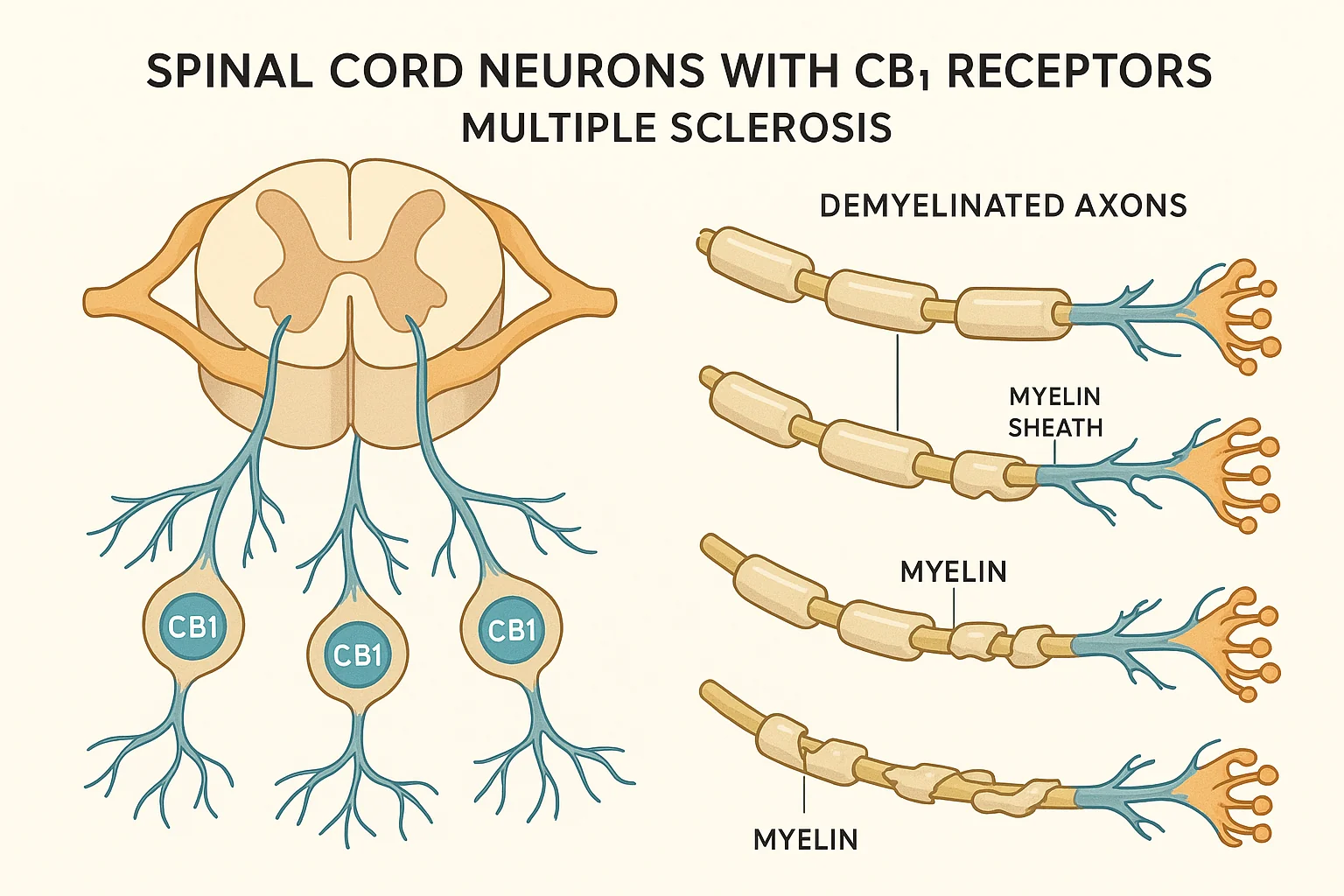
• MS spasticity is excessive excitation of motoneurons - CB1 in motor neurons reduces this excitation through presynaptic inhibition.
What is spasticity and why does MS cause it?
Spasticity in MS affects 60-80% of patients during their lifetime with the disease (Kister et al., Neurology, 2013). The mechanism of its occurrence is closely related to the pathophysiology of MS: demyelination of the pyramidal tracts (corticospinal pathways) disrupts the descending inhibition of spinal motor neurons. Normal nerve communication along the motor pathways involves a balance of excitatory (glutamatergic) and inhibitory (GABAergic) signals. When myelin is damaged, inhibitory signals do not reach the spinal cord effectively.
Result: excessive excitation of alpha motoneurons in the anterior horns of the spinal cord - motoneurons responsible for muscle contraction. Muscles receive a "contraction command" without a balancing "relaxation command." Clinical effects include increased deep reflexes, clonus, painful involuntary contractions, and stiffness - collectively assessed on the Ashworth scale or NRS scale (0-10).
Why is CB1, and not CB2, crucial for spasticity?
The CB1 receptor is one of the most densely distributed GPCR receptors in the brain and spinal cord - CB1 expression is particularly high in the striatum, cerebral cortex, cerebellum, and spinal cord (Pertwee, British Journal of Pharmacology, 2010). Activation of CB1 by cannabinoids (endogenous or exogenous) causes presynaptic inhibition of neurotransmitter release - both glutamate (excitatory) and GABA (inhibitory). The main net effect in motor neurons is a reduction of excessive excitation.
CB2 has a completely different distribution: it is concentrated in immune system cells (lymphocytes, macrophages), brain microglia, and peripheral tissues. CB2 is an immunological receptor - its role primarily involves modulating the inflammatory state, not regulating muscle tone. In MS, CB2 is extremely important for inhibiting neuroinflammation (progression of myelin damage), but it is not the receptor that "unlocks" spastic muscles. This is why selective CB2 preparations do not exhibit antispastic effects.
We noticed an interesting issue in the literature: in the EAE mouse model (experimental autoimmune encephalomyelitis, which is a model of MS), administration of CB1 agonists reduces spasticity measured by limb tone without affecting the progression of demyelination. Conversely, administration of CB2 agonists slows disease progression but does not change muscle tone. These two receptors act on two different layers of MS: CB2 on the cause (inflammation), CB1 on the symptom (spasticity).
How does THC activate CB1 and reduce spasticity?
THC (delta-9-tetrahydrocannabinol) is a partial agonist of CB1 with a high affinity for this receptor. In spinal motor neurons, activation of CB1 by THC triggers a signaling cascade: coupling with Gi/Go protein → inhibition of adenylate cyclase → reduction of cAMP levels → opening of potassium channels (hyperpolarization) and closing of calcium channels → reduction of glutamate release from the presynaptic cleft.
Final effect: the alpha motoneuron is less excited, neuromuscular synapses "slow down," and the muscle receives fewer contraction stimuli. Spasticity decreases. The scale of the mechanism is clear in the study of Sativex in MS patients: in a randomized placebo-controlled trial, the reduction of spasticity on the NRS scale averaged 1.3 points vs placebo after 4 weeks of therapy (Collin et al., European Journal of Neurology, 2010).
The role of CBD in spasticity - indirect, but significant.
CBD has weak direct affinity for CB1 as an agonist - it cannot replicate the antispastic effect of THC through CB1 on its own. However, CBD modifies the effect of THC (reducing its psychoactive side effects) and exerts its own mechanisms of action on muscle tone through other pathways (Argueta et al., Int J Mol Sci, 2020):
- Inhibition of FAAH - increased levels of anandamide, which is an endogenous CB1 agonist.
- Modulation of TRPV1 - desensitization of pain channels in nociceptors (see previous article).
- Anti-inflammatory action on microglia through PPAR-gamma - indirectly slowing demyelination.
- Modulation of glycine receptors - additional muscle-relaxing effect.
Therefore, the combination of THC + CBD (as in Sativex 1:1) exhibits pharmacological synergy unavailable to either cannabinoid alone. CBD "optimizes" the effect of THC, it does not replace it in the context of spasticity.
Sativex - what do clinical studies show?
Nabiximols (Sativex), an oral spray containing 2.7 mg of THC and 2.5 mg of CBD per dose, is the first cannabinoid approved by the EMA for a specific clinical indication. The mechanism involves CB1 agonism (THC) combined with modification by CBD. The clinical trial program included over 2000 patients with MS (Novotna et al., European Journal of Neurology, 2011).
Key findings: responders (patients with at least a 20% reduction in spasticity over 4 weeks) constituted 47-68% of those treated, depending on the study. This is a significantly higher percentage than in placebo groups (33-40%). Importantly from a clinical perspective - Sativex has been approved for patients for whom other medications (baclofen, tizanidine, dantrolene) have failed. This means that the CB1 mechanism offers something that is not available in the standard therapeutic arsenal.
From our literature review, it appears that the clinical discussion is currently focused on the question of who is a "responder" to nabiximols - identifying response biomarkers is an active area of research. It seems that patients with a clear inflammatory component of MS (relapsing-remitting type) respond better than those with primary progressive MS - which correlates with the role of CB2 in modulating inflammation.
Table: CB1 vs CB2 in the context of MS and spasticity
| Feature | CB1 | CB2 |
|---|---|---|
| Main location | CNS - brain, spinal cord. | Lymphocytes, microglia, peripheral tissues |
| Role in MS | Spasticity, pain, tremor | Neuroinflammation, progression of demyelination |
| Endogenous agonist | Anandamide (AEA), 2-AG | 2-AG (dominates), AEA |
| Effect of THC | Strong agonist → analgesia, relaxation | Weaker agonist → anti-inflammatory effect |
| CBD action | Weak affinity (indirect via FAAH) | Modulation via PPAR-gamma, limited CB2 |
| Clinical evidence in MS | Sativex - EMA approved, spasticity. | Animal models - limited clinical data. |
Endocannabinoid spinal tone - what changes in MS?
In a healthy spinal cord, endocannabinoids (anandamide and 2-AG) are produced "on demand" by postsynaptic neurons and act retrogradely on presynaptic synapses - suppressing excessive release of glutamate or GABA. This mechanism of endogenous synaptic modulation keeps muscle tone in check. In MS, this system is disrupted.
Demyelination and neuroinflammation lead to changes in CB1 receptor expression in the spinal cord. Post-mortem studies of spinal tissue from MS patients have shown both upregulation of CB1 in areas affected by inflammation and regional loss of CB1-containing neurons (Benito et al., Brain, 2007). This is the paradox of MS: the body tries to compensate for damage by strengthening the CB1 system, but the progressive degeneration of neurons ultimately reduces the receptor base.
A practical consequence for therapy: cannabinoid preparations delivered externally (like THC in Sativex) can "replace" the deficient endogenous cannabinoid tone in the spinal cord - where the body's own endocannabinoid system is too damaged to maintain control over spasticity. This is not merely symptomatic relief - it is pharmacological restoration of lost neurochemical regulation.
Practical aspects of using cannabinoids in MS spasticity
The approval of Sativex by the EMA and its availability in Poland by prescription place cannabinoids in a different legal category than most CBD preparations available over the counter. Sativex is a second-line medication - used after the failure of at least two standard antispastic medications. The usage protocol involves gradual titration of the dose: the patient starts with 1-2 doses per day and increases by 1 dose daily up to a maximum of 12 doses, seeking the "therapeutic window" - the lowest dose providing acceptable relief without intensified side effects (Zajicek et al., Lancet Neurology, 2012).
The side effects of THC (dizziness, psychoactivity, sedation) are the main clinical limitation. Here, CBD plays the role of a "moderator" - CBD acts as a negative allosteric modulator of CB1, reducing the maximum response (but not the potency) of THC on CB1. In simpler terms: CBD "softens" the psychoactive effects of THC while retaining its antispastic properties. Therefore, the 1:1 ratio in Sativex is pharmacologically justified, not arbitrary.
Frequently Asked Questions
Why do cannabinoids act on spasticity in MS through CB1 and not CB2?
CB1 is the dominant receptor in the CNS - spinal cord and brain - where spasticity is generated. CB2 is the receptor of the immune system and peripheral tissues. Spasticity in MS results from excessive excitation of spinal motoneurons, and CB1 in these neurons reduces this excitation by presynaptic inhibition of glutamate (Pertwee, BJPh, 2010).
Is Sativex approved for spasticity in MS?
Yes - nabiximols (Sativex, THC:CBD 1:1) is approved by the EMA and available in Poland by prescription for adults with MS experiencing spasticity resistant to other treatments. Its action occurs through CB1 agonism in the spinal cord, reducing excessive motoneuron activity. The study by Collin et al. (EJN, 2010) showed a significant reduction in spasticity vs placebo.
How is spasticity measured in MS and what do studies show?
The standard scale is the modified Ashworth scale (0-5) or NRS (0-10). Studies of Sativex have shown that 47-68% of treated patients achieve clinically significant reductions in spasticity (over 20%). Novotna et al. (EJN, 2011) confirmed efficacy in patients unresponsive to standard medications, highlighting the uniqueness of the CB1 mechanism.
Does CBD alone without THC affect spasticity?
CBD has weak direct affinity for CB1, so the antispastic effect through CB1 is limited. CBD indirectly modulates muscle tone by increasing anandamide levels (inhibiting FAAH), TRPV1, and glycine receptors. However, THC, as a strong CB1 agonist, is irreplaceable in directly reducing spasticity - which is why the combination of THC + CBD works synergistically.
What other mechanisms, besides CB1, explain the action of cannabinoids in MS?
Besides CB1, cannabinoids act through CB2 in microglia (inhibiting neuroinflammation and slowing demyelination), PPAR-gamma (neuroprotection, anti-inflammatory action), TRPV1 (modulating neuropathic pain in MS), and glycine receptors (additional muscle relaxant effects). This multi-faceted action explains the clinical benefits that extend beyond mere reduction of muscle tone.
This article is for informational and educational purposes and does not replace consultation with a doctor. If you are pregnant, breastfeeding, taking medications, or have chronic conditions, consult the use of supplements or herbs with a specialist.
Author: Michał Waluk · Published: 2026-05-04 · Updated: 2026-05-04