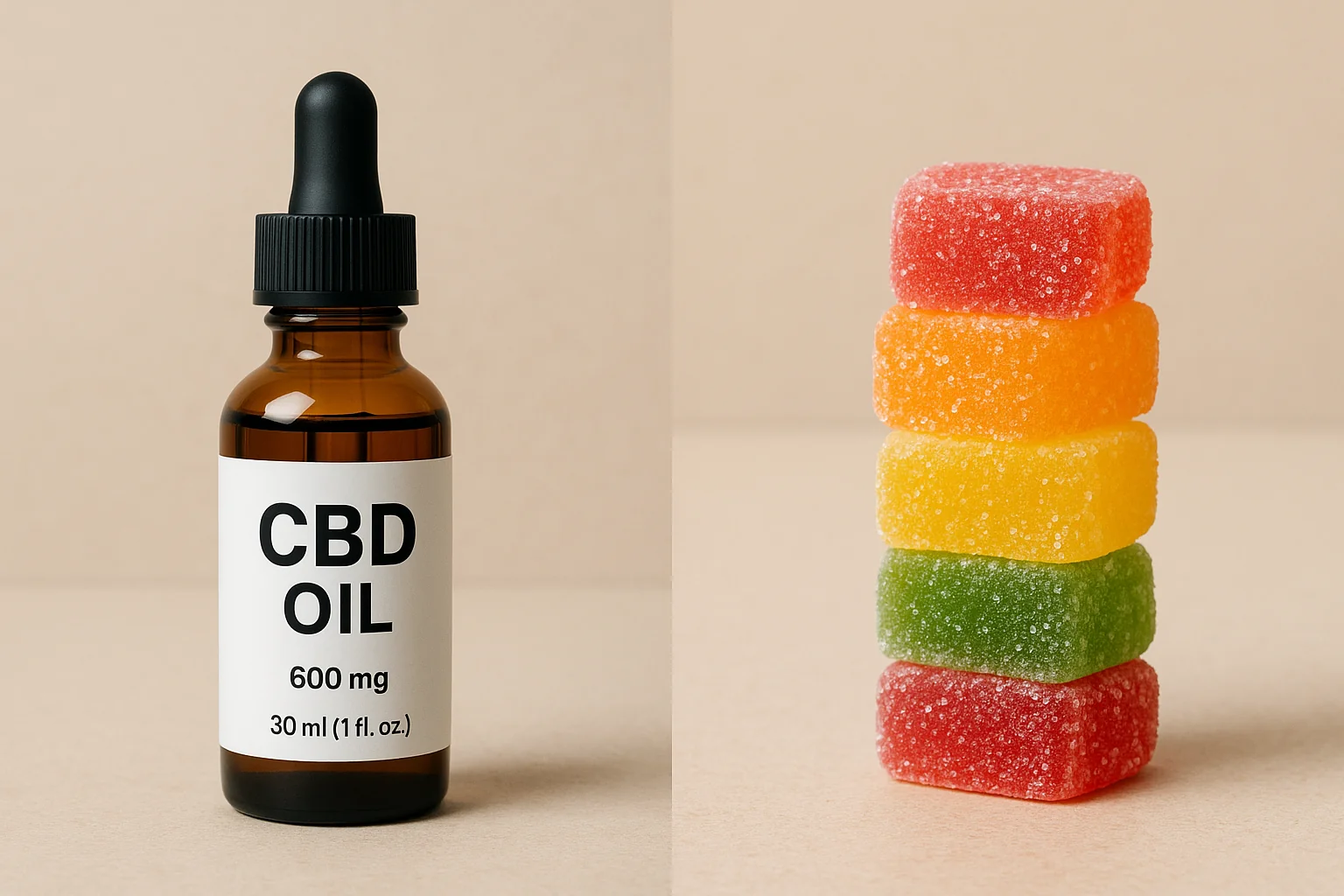

CBD gummies vs CBD oil: what to choose for yourself - comparison 2026
CBD gummies or CBD oil? We compare absorption, duration of action, and the real cost of 100 mg on products from the u Bucha shop, prices from August 8, 2026.
The u Bucha store currently has forty items in the gummies category and six in the oils category, so the question of format choice is practical, not theoretical. However, there are many numbers surrounding this choice that half of the Polish internet repeats and that no study confirms. This text separates one from the other. It shows what is really known about the absorption of cannabidiol from drops and gummies, how much 100 mg realistically costs in each of these formats in this specific store, and how to tell if the format doesn't fit your daily routine. All prices come from the store's Store API and have a stated date of status. After reading, you can calculate any new item from the offer yourself.
KEY INFORMATION
• Absolute bioavailability of cannabidiol has only been measured in humans for smoking, 31% (Millar et al., Frontiers in Pharmacology, 2018).
• Popular figures of 20-35% for drops and 6-15% for gummies have no source in research.
• One hundred milligrams from gummies costs here from 5.93 PLN, from oil from 9.50 PLN.
• A fatty meal increases daily exposure to oral cannabidiol by 45% (Birnbaum et al., Epilepsia, 2019).
How does the absorption of CBD from oil differ from that of gummies?
With oil, you hold it under your tongue, and part of the cannabidiol penetrates through the mucosa directly into the bloodstream. A gummy travels through the stomach, intestine, and liver, and the liver takes its share before the substance enters the general circulation. This one difference in the route of administration accounts for most of the discrepancies between the two formats.
The figures that half the industry repeats, namely 20-35% for drops and 6-15% for oral forms, sound precise but have no backing in the literature. A systematic review by Millar et al. (Frontiers in Pharmacology, 2018) gathered all available pharmacokinetics of cannabidiol in humans and summarized an uncomfortable truth for marketing: absolute bioavailability was measured only for one route of administration, smoking, where it was 31%. For sublingual drops and capsules, no such measurement has been published.
This does not mean that there is no difference. The first-pass effect through the liver is well described for fat-soluble substances, and there is no reason to believe that cannabidiol would be an exception. It only means that no one has measured the scale of this difference, so a statement like "you will absorb exactly three times less from a gummy" is just a guess dressed in numbers.
The practical conclusion is simpler than it seems. Comparing milligrams from the oil label to milligrams from the gummy label is misleading because both numbers refer to the content in the package, not to what reaches the bloodstream. A meaningful measure is your own reaction with a consistent dose maintained for two weeks.
How quickly does CBD oil work, and how long do gummies last?
Sublingual drops start working sooner than gummies, and this aligns with the data. Peak concentration after sublingual drops appeared in studies after 1.67 and 2.17 hours, while after oral mucosal spray, it was between 1.64 and 4.2 hours (Millar et al., 2018).
See what this means for the popular claim of effects in 15-30 minutes. Initial sensations can indeed come that quickly, but peak blood concentration occurs much later. If you take drops for evening relaxation and feel nothing after twenty minutes, it doesn't mean the dose was too small. It means the substance is still on its way.
Gummies start later because they first need to dissolve in the stomach. The manufacturers present in this store provide a daily dose of one to two gummies and do not declare the duration of effects, which is fair: such measurements for hemp gummies simply do not exist. For the same reason, the common claim of six to eight hours of effect has no source to refer to.
The rhythm of the day reveals more than tables do. The oral format fits where the dose is to be regular and roughly equal every day. Drops fit where you want to change the dose from day to day and observe which level of relaxation is suitable for you. If you are looking for a nighttime option, the topic expands in the entry. CBD for sleep: oil or gummies with melatonin.
Which oils and gummies are actually available in the u Bucha store?
Category oils currently has six items: three with cannabidiol and three with cannabigerol, all from one brand, in 10 ml bottles. The category jelly candy has forty items, but the hemp raw material is in thirty of them. The remaining ten are gummies with mushrooms, vitamins, or just L-theanine.
This asymmetry matters when choosing. On the drops side, you have one line and three strengths, so the decision comes down to concentration. On the gummies side, you have a dozen recipes with additions like motherwort, melatonin, or valerian. If you are looking for cannabidiol with a specific herbal ingredient, the oil won't provide that.
Below are seven items from both formats with the content in milligrams, sorted by the cost of 100 mg. Without this column, the comparison means nothing because the capacities are incomparable.
| Place | Product | What distinguishes | Contents | Price | Koszt 100 mg |
|---|---|---|---|---|---|
| 1 | CANNOVA + motherwort, gummies 25 mg/piece, 60 pieces. | The largest package in the comparison, with the addition of motherwort herb. | 60 x 25 mg = 1500 mg | 89.00 PLN | 5.93 zł |
| 2 | CBD Lemon Gummies Pure CBD 750 mg TOPICAL, 30 pieces. | Szerokie spektrum, barwnik z kurkumy zamiast syntetycznego | 30 x 25 mg = 750 mg | 45.00 zł | 6.00 PLN |
| 2 | Hemp Gummies Broad25 Scandinavian Fruits, 30 pieces. | The same cost as above, with a profile of forest fruits. | 30 x 25 mg = 750 mg | 45.00 zł | 6.00 PLN |
| 4 | CANNOVA Natural CBD Oil 2000 mg, 20%, 10 ml | The strongest oil in the offer, full spectrum. | 2000 mg w 10 ml | 190.00 zł | 9.50 zł |
| 5 | CANNOVA Natural CBD Oil 1000 mg, 10%, 10 ml | One drop is about 3.34 mg, a convenient dose step. | 1000 mg w 10 ml | 110.00 zł | 11.00 zł |
| 6 | CBD Gummies 300 mg, 30 pieces, full spectrum. | 10 mg per piece, the smallest step among gummies. | 30 x 10 mg = 300 mg | 35.00 zł | 11.67 zł |
| 7 | CANNOVA Natural CBD Oil 500 mg, 5%, 10 ml | One drop is about 1.67 mg, the mildest entry. | 500 mg w 10 ml | 65.00 zł | 13.00 zł |
Prices are from the Store API of the u Bucha store, as of August 8, 2026. Names in the table have been abbreviated.
What is cheaper: 100 mg from oil or from gummies?
On the shelf, gummies are cheaper, which is a surprise for anyone who knows the industry certainty about the superiority of drops. One hundred milligrams from gummies costs here from 5.93 zł, from oil from 9.50 zł. The difference reaches sixty percent in favor of the format that is commonly considered more expensive.
Where does the discrepancy between this calculation and what other guides say come from? From the fact that those compare averaged market prices, not the offer of a specific store. Here, on the drops side, there is one brand in the premium segment, while on the gummies side, there are several manufacturers competing on price. The catalog decides the outcome more than physiology.
The calculation changes when you account for the difference in absorption. Be cautious in assuming that half of what you get from a gummy reaches the bloodstream compared to drops. Then the effective cost of 100 mg from the cheapest gummies rises to about 11.90 zł, and the advantage shifts to the 20% oil for 9.50 zł. The equilibrium point occurs at a difference of about 1.6 times, and since no one has measured it, treat this calculation as a range, not a result.
The practical conclusion is this: with large daily doses, the 20% oil will usually be cheaper, while with small and irregular doses, gummies win. The threshold also shifts based on how much product you can use before the expiration date. The cheapest 100 mg in a jar of sixty pieces won't help if you only reach for a gummy once a week.
When is it better to reach for oil, and when for gummies?
The choice is determined by four questions: do you want to adjust your dose smoothly, can you tolerate the plant taste, are you taking the supplement outside the home, and how many mg do you plan to take daily? The answers usually align consistently in one direction, making the decision obvious.
Reach for oil if:
- you want to change the dose by single milligrams because you are still looking for your level
- you take more than 40 mg daily and are looking for the lowest cost at this scale
- the distinct plant taste of hemp oil does not bother you
- you take the supplement at home, at a regular time, without rushing
Reach for gummies if:
- you want a ready-made dose without measuring and counting drops
- zabierasz suplement do pracy, do samolotu albo na wyjazd
- the taste of hemp oil discourages you enough that you forget about supplementation
- you are looking for cannabidiol combined with motherwort, melatonin, or valerian
There is no one-size-fits-all answer; the answer is tailored to how your typical day looks. If gummies specifically are your direction, you can find their overview in the post CBD Gummies: ranking of the top five and how to choose the right one.
How to convert the dose between drops and gummies?
Drops provide a finer step. In 5% oil, one drop is about 1.67 mg of cannabidiol, in 10% oil about 3.34 mg. The gummies in this store have 10 mg or 25 mg each and cannot be sensibly divided, as the raw material does not have to be evenly distributed in the gummy mass.
The conversion looks like this in practice. A dose of 10 mg is six drops of 5% oil, three drops of 10% oil, or one gummy from the 300 mg line. A dose of 25 mg is fifteen drops of 5% oil, about eight drops of 10% oil, or one 25 mg gummy. Gummy manufacturers recommend no more than two gummies per day, and it doesn't make sense to exceed that ceiling.
Eating does more than just make a minor adjustment. In the study by Birnbaum et al. (Epilepsia, 2019) a fatty meal increased the peak concentration of cannabidiol by 41%, and the daily exposure by 45% compared to administration on an empty stomach. If you take a gummy once in the morning on an empty stomach and once in the evening after dinner, you are getting two different doses from the same product. Establish one time and stick to it.
When changing formats, do not transfer milligrams one-to-one. Start with the lower dose of the new product, give yourself two weeks, and only then adjust. Two weeks is the minimum because a single day will tell you more about how you slept than about the supplement's effects.
How to store both formats and which is easier to take on a trip?
Oil is more sensitive. The manufacturer of hemp oil from the category Green Out It is recommended to store in the refrigerator after opening and to consume within thirty days, while an unopened bottle has a minimum shelf life of twelve months. The gummies in the jar can withstand room temperature, but they stick together and lose shape in the heat.
On the go, the difference is even more pronounced. A 10 ml bottle fits within the liquid limit for carry-on luggage, but it still ends up in a transparent bag and may be inspected during security checks. A jar of gummies passes through without questions, won't leak, and doesn't require a dropper. However, when traveling outside the EU, check the legal status of cannabis products in the destination country, as it may differ from Poland.
We noticed while reviewing the labels in this offer that gummy manufacturers declare a daily serving, while oil producers often do not. This is a detail that changes daily use. With gummies, you have a ready framework, while with drops, you have to establish it yourself. If you don't want to keep your own notes, the format with the declared serving will prove to be more convenient.
You don't have to treat both formats separately. Many people keep a bottle at home for the evening and a jar in their backpack for trips. In that case, count the total daily amount of milligrams from both sources, not each one separately.
Frequently Asked Questions
Which works faster: CBD oil or gummies?
Sublingual drops act faster than gummies, but not as much as the popular saying of fifteen minutes suggests. In the review by Millar et al. (Frontiers in Pharmacology, 2018), peak concentration after sublingual drops appeared after 1.67 and 2.17 hours. Gummies start even later, as they first need to dissolve in the stomach.
How much cannabidiol is absorbed from oil, and how much from gummies?
No one has measured this in humans. Millar et al. (2018) reviewed all available pharmacokinetics of cannabidiol and found only one measurement of absolute bioavailability: 31% for smoking. The figures of 20-35% for drops and 6-15% for gummies, repeated by stores and guides, have no source in research.
How many gummies correspond to one serving of oil?
Counting just the content: a 10 mg serving is six drops of 5% oil, three drops of 10% oil, or one gummy from the 300 mg line. A 25 mg serving is fifteen drops of 5% oil or one 25 mg gummy. When changing formats, start with the lower serving of the new product.
Are CBD gummies more expensive than oil?
Not at the u Bucha store. One hundred milligrams from gummies costs from 5.93 PLN, while from oil it costs from 9.50 PLN, which is more than half more. When accounting for the poorer absorption of the oral form, the advantage of gummies disappears, and the equilibrium point is around a 1.6 times difference.
Can you combine CBD oil with gummies?
Yes, and many people do: a bottle at home for the evening, a jar in the backpack for trips. The condition is to count the total daily sum of milligrams from both sources. Gummies producers recommend a ceiling of one to two gummies per day, and this limit includes all supplementation.
Does eating change the effect of CBD gummies?
Clearly. In the study by Birnbaum et al. (Epilepsia, 2019), a fatty meal increased the peak concentration of cannabidiol by 41% and the daily exposure by 45% compared to fasting administration. A gummy taken in the morning on an empty stomach and the same gummy after dinner are practically two different servings.
Which format works better for travel?
Gummies, and without competition. A jar won't leak, it doesn't count towards the liquid limit in carry-on luggage, and it doesn't require a dropper. A 10 ml bottle fits within the limit but goes into a transparent bag. When traveling outside the EU, check the legal status of cannabis products in the destination country.
Oba formaty znajdziesz w sklepie u Bucha: krople w kategorii oils, a gotowe porcje w kategorii jelly candy.
This article is for informational and educational purposes. It contains internal links to product categories available in the u Bucha store. Prices and specifications may change: check the current data on the product page before purchasing.
Author: Michał Waluk · Opublikowano: 2026-06-22 · Aktualizacja: 2026-08-08