
How cannabis should not smell - recognizing mold and defects
How the herb SHOULD NOT smell: answers to the most common questions. u Bucha.
You are buying hemp herb online or in a physical store and wondering: is this smell normal? Good herb smells intense and distinct - citrusy, piney, floral, or herbal, depending on the terpene profile. However, some herbs reach customers in poor condition: too moist, moldy, dried out, or contaminated. In this article, we answer the most common questions about how to recognize quality defects in hemp herb - by smell, sight, and touch - before you even open the packaging for vaporization.
KEY INFORMATION
• Mold on cannabis flower may contain pathogens from the Aspergillus genus, dangerous for immunocompromised individuals (Gargani et al., Mycopathologia, 2011).
• Healthy herb smells terpenic - citrusy, piney, or herbal - without mustiness, ammonia, or dampness.
• Optimal storage: humidity 59-63% RH, temperature 15-21°C, no UV light.
• A COA certificate with microbiological and pesticide testing is the only reliable verification of quality.
How does good flower smell, and how does spoiled flower smell?
Healthy hemp herb has an intense, distinct aroma - depending on the dominant terpenes. Herb rich in limonene smells citrusy, almost like fresh orange peel. With alpha-pinene, it gives a piney and resinous scent. With myrcene - slightly musky, with earthy notes. With linalool - floral, lavender-like. A common feature of healthy herb: the scent is clear, vibrant, and comes out strongly as soon as the packaging is opened.
The smell of spoiled herb is qualitatively different. Mustiness and dampness are the first signs of mold - a characteristic smell of wet hay or a basement that does not fade under intense terpene aroma but overwhelms it. The smell of ammonia indicates advanced decay processes caused by bacteria or fungi. The smell of grass or hay without any terpene note is a signal of drying out or too long storage - terpenes have evaporated, leaving only plant fibers and degraded cannabinoids.
| Smell | Possible cause | What to do |
|---|---|---|
| Musty, damp | Mold or too high humidity | Do not use - dispose of |
| Ammonia | Advanced microbiological spoilage | Discard immediately |
| Grass, hay, lack of aroma | Over-drying, old product | Not harmful, but useless |
| Chemical, plastic | Contamination with pesticides or growth regulators | Do not use - check COA |
| Citrusy, piney, floral | Healthy terpene profile | A good sign of quality |
What does mold and bud rot look like on dried cannabis?
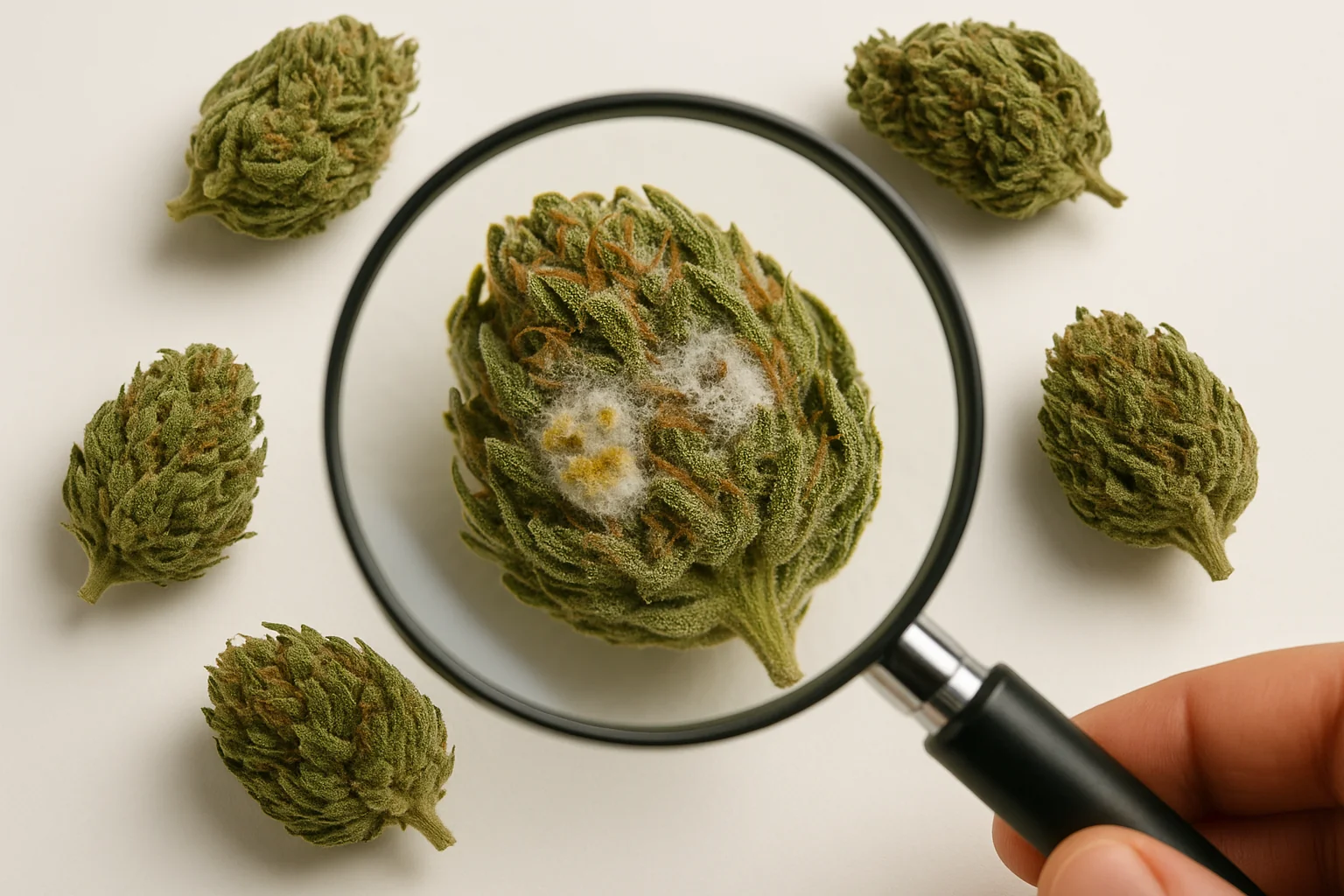
Surface mold on hemp flower appears as white, gray, or greenish powdery spots - visible to the naked eye as a dull coating on the outer surface of the bud. If you have a magnifying glass (10-30x), distinguishing mold from trichomes is simple: trichomes are transparent or milky-white crystals on the stems, glands that secrete cannabinoids, with a characteristic shine. Mold is dull, powdery fibers with no shine, lacking the regular shape of trichomes.Gargani et al., Mycopathologia, 2011).
Bud rot (Botrytis cinerea, gray mold) is sneakier, as it attacks the inside of a dense bud - externally the plant may look normal. Signs of bud rot: brown areas inside the bud visible after breaking it, gray fluffy coating inside, soft or wet consistency in the center of the bud instead of being firm. Bud rot is one of the most common pathogens in European hemp cultivation, especially in humid seasons.
We have noticed that customers often confuse two phenomena: natural "kief" (trichome powder that falls to the bottom of the packaging) with mold. Kief is a golden or greenish-yellow powder with a shine - it is concentrated trichomes. Mold is white, gray, or green, dull, and appears on the buds themselves, not at the bottom of the packaging. If you see golden powder at the bottom of the bag - that's a good sign. A white coating on the buds - that's a cause for concern.
How to assess dried cannabis by sight and touch?
Visual assessment of the flower starts with color. Healthy, well-dried, and preserved flower has vibrant colors - shades of green from light to dark green, often with orange or rusty hairs (pistils) and visible trichome crystals. Too old or poorly stored flower is pale, brown, or yellowish - cannabinoids and chlorophyll degrade, and the color fades.
Touch says a lot about moisture. Properly dried flower is resilient - it bends slightly under your finger but is neither wet nor brittle. If the flower crumbles to powder when touched, it is overdried. If it is sticky, wet, or soft like a sponge - it is too moist and at risk of mold. Stem test: gently try to break a thinner stem of the bud. It should snap with a light crunch. If it bends flexibly like rubber - there is too much moisture. If it crumbles without resistance - there is too little.
How to choose cannabis dried flowers with a guarantee of microbiological quality?
Organoleptic assessment - sight, smell, touch - is useful, but not sufficient to detect all microbiological threats. Early mold, bacteria, and some chemical contaminants are invisible and undetectable by the naked senses. Therefore, a laboratory analysis certificate (COA) with a microbiological panel is the only reliable method for verifying the safety of hemp flower.
A good COA for dried cannabis should include at least: THC and CBD results (HPLC or GC method), terpene panel, testing for Aspergillus fumigatus, Aspergillus flavus, Aspergillus niger, and Aspergillus terreus (four main species hazardous to health), testing for total mold and yeast count (TYMC), testing for Salmonella spp. and E. coli, and a pesticide panel. Producers who commission full microbiological testing cost more but provide real safety documentation.
When purchasing hemp flower online, ask the seller about the currency of the COA - the certificate should be issued no earlier than 6-12 months ago and refer to a specific batch of the product (lot number/batch), not generally to the strain. An old COA from the previous year says nothing about the current batch of the product, as growing, storage, and transport conditions change between batches.
A practical rule when buying: compare the COA date with the expiration or production date on the packaging. If the certificate is older than a year from the purchase date or lacks a batch number linking the packaging to a specific test - treat it as a reason for further inquiry. Reputable CBD flower sellers in Poland provide current COAs on the product page or send them upon request via email. A lack of willingness to provide the COA is one of the easiest warning signs when purchasing cannabis products.
Frequently Asked Questions
What does mold smell like on dried cannabis?
Mold on hemp flower smells musty, damp, and earthy - similar to wet hay, old bread, or a basement. A characteristic ammonia smell is also present with more advanced spoilage. Healthy flower smells floral-resinous with distinct terpene notes - citrus, pine, or herbal - without any mustiness.
Is mold on dried cannabis dangerous?
Yes. Inhaling or consuming flower contaminated with mold is risky, especially for individuals with asthma, weakened immunity, or mold allergies. Aspergillus fumigatus - one of the most common mold pathogens in Cannabis - can cause pulmonary aspergillosis.Gargani et al., Mycopathologia, 2011). Never use dried cannabis with visible signs of mold.
What does mold look like on dried cannabis?
Mold appears as white, gray, or greenish powdery spots - a dull coating visible to the naked eye or under a magnifying glass. It differs from trichomes: trichomes are shiny, transparent crystals on the stems; mold is dull, powdery fibers without shine. Bud rot (gray mold) attacks from the inside of the bud - breaking the bud reveals a brown, fluffy interior.
How to tell if dried cannabis is over-dried or too old?
Overdried flower crumbles in your fingers almost to powder and loses its characteristic terpene aroma - it smells like grass or hay without a distinct scent. Trichomes change color from transparent and milky to amber and brown under a magnifying glass - this indicates oxidation of cannabinoids and degradation of these compounds with prolonged storage.
How to store dried cannabis to avoid mold?
Optimal conditions are 59-63% RH humidity, 15-21°C temperature, and no direct UV light. Use airtight glass jars with a humidity regulator (62% RH pack). Avoid plastic bags - plastic does not regulate humidity and builds static charges that damage trichomes.
Can cannabis look good and still be spoiled?
Yes. Early-stage mold, bacterial contamination, and pesticide residues are not always visible to the naked eye. Therefore, it is important to choose products with a COA from an independent laboratory confirming the absence of harmful microorganisms and chemical residues.
What is bud rot and how does it differ from mold?
Bud rot (Botrytis cinerea) is a gray mold that attacks the inside of dense buds from the inside out. Externally, the bud may appear normal. Signs include: brown interior when the bud is torn open, gray fluffy coating inside, and a soft texture at the center. It is one of the most common pathogens in European cannabis cultivation, difficult to detect without breaking open the bud.
This article is informational and educational in nature. It contains internal links to products available in the u Bucha store. Prices and specifications may change - please check the current data on the product page before purchasing.
Author: Michał Waluk · Published: 2026-05-04 · Updated: 2026-05-04