
Coenzyme Q10 for the heart and energy: what studies say and what follows after 40
Q-SYMBIO, KiSel-10, and coenzyme Q10 with statins: how many people were studied, how long the observation lasted, and which endpoint was truly significant.
Coenzyme Q10 returns in the discussion about the heart for two reasons: it participates in energy production in mitochondria, and the heart muscle works continuously. However, more numbers have accumulated around this substance than have actually been measured. Popular guides report reductions in mortality without specifying which arm of the study they refer to, and they mix primary endpoints with secondary ones. This text organizes three studies on which the entire discussion about coenzyme Q10 and the heart stands, and shows what was actually measured in them: whom was studied, for how long, which form of the substance was administered, and who funded the study. In two of these three studies, the preparation came from its manufacturer, and in one, the most frequently cited result was not the one for which the study was designed.
KEY INFORMATION
• W badaniu Q-SYMBIO (Mortensen i wsp., JACC Heart Failure, 2014) primary endpoints after 16 weeks did not change significantly. The difference appeared only after two years.
• Q-SYMBIO administered ubiquinone, not ubiquinol. A study examining one form says nothing about the other.
• Meta-analiza w Mayo Clinic Proceedings (Banach i wsp., 2015) did not show a significant benefit from coenzyme Q10 for muscle pain after statins.
• In the KiSel-10 study, the preparations were provided by their manufacturer, who also funded part of the analyses.
• Sklep u Bucha ma koenzym Q10 w kategorii suplementy, but there is no selenium or ubiquinol.
How does coenzyme Q10 work in the heart muscle?
Coenzyme Q10 transfers electrons in the inner mitochondrial membrane, between complexes I and II and complex III of the respiratory chain. Without this transport, ATP production is disrupted. Cardiomyocytes are among the cells with the highest density of mitochondria in the body, so the heart's demand for an efficient respiratory chain is higher than in most tissues.
In the body, the substance exists in two forms, which cells continuously convert into one another. Ubiquinone is the oxidized form, ubiquinol is the reduced form, and it is attributed with antioxidant activity. This difference has practical significance because clinical studies were conducted on specific preparations, not on abstract coenzyme Q10.
The link between deficiency and heart disease has been described for a long time. Q-SYMBIO notes in its introduction that low levels of coenzyme Q10 in the heart muscle are associated with the severity of heart failure. However, this is an observation of co-occurrence, not evidence that supplementing the deficiency reverses the disease. Low levels may just as well be a consequence of the disease as its cause, and with such a serious condition, both possibilities are open. Distinguishing correlation from causation is the foundation of all further reading of the studies described below.
What did the Q-SYMBIO study really measure?
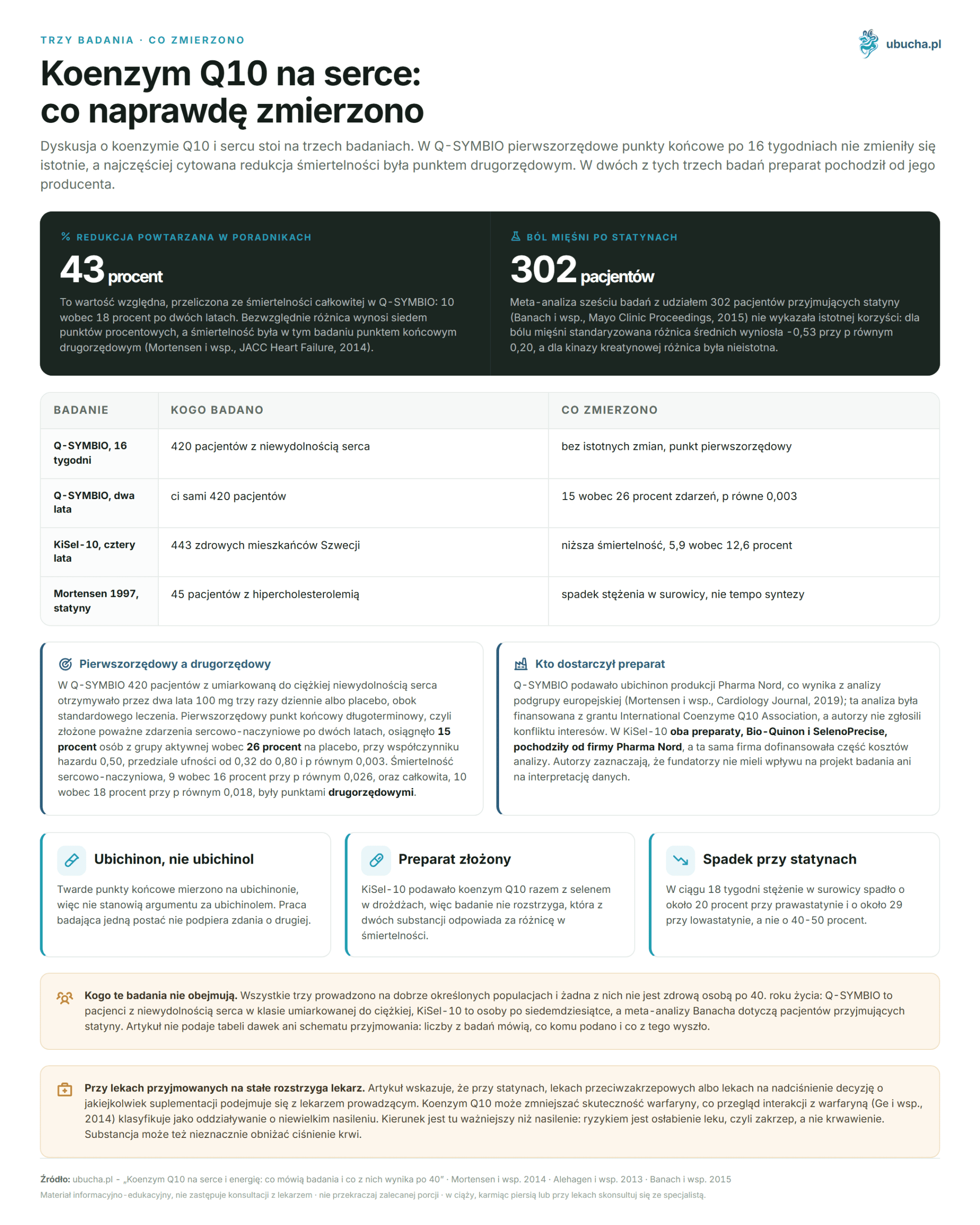
Q-SYMBIO is a multicenter, randomized, double-blind study in which 420 patients with moderate to severe heart failure received coenzyme Q10 at a dose of 100 mg three times a day or a placebo, alongside standard treatment, for two years.
The primary short-term endpoints, assessed after 16 weeks, are changes in NYHA class, the six-minute walk test result, and NT-proBNP levels. The publication states outright that there were no significant changes in any of these. Guides citing this study usually omit this sentence.
The primary long-term endpoint, which is the composite of major cardiovascular events after two years, was achieved by 15 percent of patients taking coenzyme Q10 compared to 26 percent on placebo, with a hazard ratio of 0.50, a confidence interval from 0.32 to 0.80, and a p-value of 0.003. Cardiovascular mortality was 9 versus 16 percent with a p-value of 0.026, and overall mortality was 10 versus 18 percent with a p-value of 0.018, which were secondary endpoints. secondary. The reduction of 43 percent cited in guides is that second number converted to a relative value. Absolutely, the difference is seven percentage points.
The study reported ubiquinone Pharma Nord production, as indicated by the analysis of the European subgroup (Mortensen i wsp., Cardiology Journal, 2019). This analysis was funded by a grant from the International Coenzyme Q10 Association, and the authors reported no conflicts of interest.
Does coenzyme Q10 alleviate muscle pain after statins?
The mechanism is real and well described. Statins inhibit HMG-CoA reductase, which is the first step in the mevalonate pathway, from which both cholesterol and coenzyme Q10 are derived. The decrease in serum levels is measured, but not to the extent that is often repeated online.
In the study referenced by most guides (Mortensen i wsp., Molecular Aspects of Medicine, 1997), 45 patients with hypercholesterolemia received increasing doses of lovastatin or pravastatin for 18 weeks. Serum levels dropped from 1.27 to 1.02 mmol/l with pravastatin and from 1.18 to 0.84 mmol/l with lovastatin, which is about 20 and about 29 percent, not 40-50 percent. Simvastatin was not included in the study, and serum levels were measured, not the rate of synthesis.
Collectively, the effect was calculated by a meta-analysis of eight placebo-controlled arms (Banach i wsp., Pharmacological Research, 2015): the weighted average difference was -0.44 μmol/l with a confidence interval from -0.52 to -0.37, expressed in concentration units, not in percentages.
A separate question is whether supplementing this deficiency has any benefits. A meta-analysis of six studies involving 302 patients taking statins (Banach i wsp., Mayo Clinic Proceedings, 2015) did not show significant benefit: for muscle pain, the standardized mean difference was -0.53 with a p-value of 0.20, for creatine kinase the difference was not significant, and no dose-dependent relationships were found.
What did the KiSel-10 study with selenium show?
KiSel-10 included 443 healthy residents of Sweden aged 70 to 88 (Alehagen i wsp., International Journal of Cardiology, 2013). Participants took 200 mg of coenzyme Q10 and 200 μg of selenium in yeast or a placebo for four years, with an average follow-up of 5.2 years.
Cardiovascular mortality was 5.9 percent in the active group compared to 12.6 percent in the placebo group, with a p-value of 0.015. NT-proBNP levels were lower in the active group, and the heart function assessment result in the echocardiogram was better. The authors of the ten-year observation (Alehagen i wsp., PLoS One, 2015) themselves call their findings hypothesis-generating and emphasize that the sample was small. It maintained lower cardiovascular mortality, not, as is sometimes written, echocardiographic improvement.
The layer that guides remain silent about: both preparations, Bio-Quinon and SelenoPrecise, came from Pharma Nord, and the same company funded part of the analysis costs. The authors note that the funders had no influence on the study design or data interpretation. This does not invalidate the result, but the reader has the right to know. Moreover, it was a combined preparation, so the study does not determine which of the two substances is responsible for the difference.
Is there a basis for combining coenzyme Q10 with omega-3 acids?
Both substances are lipophilic and both are associated with heart health, but the evidence pertains to different endpoints. A review of omega-3 acids (Mozaffarian i Wu, Journal of the American College of Cardiology, 2011) summarizes that the intake of long-chain n-3 acids lowers plasma triglyceride levels, resting heart rate, and blood pressure.
This same review contains a caveat that disappears in guides. Direct antiarrhythmic action has been demonstrated in experimental studies, but, as the authors write, it is difficult to document in humans. Atrial fibrillation was explicitly mentioned among the endpoints with conflicting results, alongside heart attack without death, ischemic stroke, and heart failure. The statement that omega-3s reduce the risk of atrial fibrillation is therefore stronger than what the review states.
The most consistent benefit in observational data and randomized studies concerns mortality from coronary artery disease and sudden cardiac death. National and international guidelines have converged on the recommendation for the general population to eat at least two servings of fatty fish per week. There is no study that has tested the combination of coenzyme Q10 with omega-3 acids as a whole, so we are talking about two separate sets of evidence, not a studied combination.
What does this mean for someone over 40?
The most honest answer is: less than most texts about coenzyme Q10 promise. All three studies described were conducted on well-defined populations, and none of them is a healthy forty-year-old. Q-SYMBIO involved patients with moderate to severe heart failure. KiSel-10 involved individuals in their seventies. The meta-analyses by Banach concern patients taking statins.
Transferring results from such a population to a healthy person over forty is inference, not a reading. The same applies to the form of the substance: cardiological studies with hard endpoints were conducted on ubiquinone, so they do not constitute an argument for ubiquinol, even if it is better absorbed.
Therefore, you will not find a dosage table or a dosing scheme here. The numbers from the studies mentioned above indicate what was given to whom and what the outcomes were, not how much you should take. If you are taking statins, anticoagulants, or antihypertensive medications, make any supplementation decisions with your attending physician. Coenzyme Q10 may reduce the effectiveness of warfarin, which classifies as a minor interaction (Ge et al., 2014). The direction here is more important than the intensity: the risk is the weakening of the drug, meaning thrombosis, not bleeding. More about the substance itself, its forms, and who has been studied beyond cardiology can be found in the article Coenzyme Q10: what it is and when it is worth supplementing in the u Bucha store, where omega-3 acid preparations are also available. The store does not carry selenium or separate ubiquinol, so the set from the KiSel-10 study cannot be recreated there. If you are looking for a broader perspective on supplementation at this age, check out the article.
Frequently Asked Questions
Does coenzyme Q10 reduce mortality in individuals with heart failure?
In the Q-SYMBIO study, cardiovascular mortality after two years was 9 percent compared to 16 percent in the placebo group, with p equal to 0.026. However, this was a secondary endpoint, and primary short-term endpoints after 16 weeks did not change significantly.
Does coenzyme Q10 alleviate muscle pain after statins?
A meta-analysis of six studies involving 302 patients, published in Mayo Clinic Proceedings in 2015, did not show a significant benefit. For muscle pain, the p-value was 0.20, and for creatine kinase, the difference was also insignificant. The authors call for larger studies.
How much do statins lower coenzyme Q10 levels?
In Mortensen's 1997 study, serum concentration decreased by about 20 percent with pravastatin and by about 29 percent with lovastatin over 18 weeks. The 2015 meta-analysis reports a weighted average difference of -0.44 μmol/l. The repeated figure of 40-50 percent does not come from any of these studies.
Does the KiSel-10 study result pertain to coenzyme Q10 itself?
No. Participants received a combined preparation, meaning 200 mg of coenzyme Q10 along with 200 μg of selenium, so the study does not determine which substance is responsible for the difference in mortality. Both preparations were provided by their manufacturer, who also funded part of the analyses.
Ubiquinone or ubiquinol for the heart?
Cardiological studies with hard endpoints, including Q-SYMBIO, were conducted on ubiquinone. This does not mean that ubiquinol works worse, only that there is no data for it. A study examining one form does not support a statement about the other.
Does coenzyme Q10 interact with medications?
The best-documented case concerns warfarin: coenzyme Q10 may weaken its anticoagulant effect, thus increasing the risk of thrombosis, not bleeding. The substance may also slightly lower blood pressure. When taking medications regularly, discuss supplementation with your doctor.
Koenzym Q10 znajdziesz w kategorii suplementy and the review Supplements for men over 40 CBD and postpartum depression: what the studies say Supplements for seniors.
This article is for informational and educational purposes and does not constitute medical advice. Before starting supplementation, consult your doctor, especially if you are taking medications regularly, are pregnant or breastfeeding, or have a chronic illness.
Author: Michał Waluk · Opublikowano: 2026-05-28 · Aktualizacja: 2026-08-16