
Field horsetail for hair and nails (silicon): how to use
Field horsetail and silicon for hair and nails. What does the EU monograph allow, how much silica is actually absorbed, and what are the risks of confusing it with marsh horsetail.
Field horsetail is mainly sold in Poland with a slogan about hair and nails, based on one argument: no other herb contains as much silicon. The content is indeed high. The problem arises a step further, with the question of how much of that silicon actually comes from the plant and enters the body, and what field horsetail is allowed for in the European Union. Answers to both questions are documented, and both are less convenient than product descriptions suggest. We have gathered them along with two safety issues that are usually not mentioned in Polish guides: one regarding the species that can be a contaminant in poorly harvested raw material, and the other regarding what the famous warning about vitamin B1 really concerns.
KEY INFORMATION
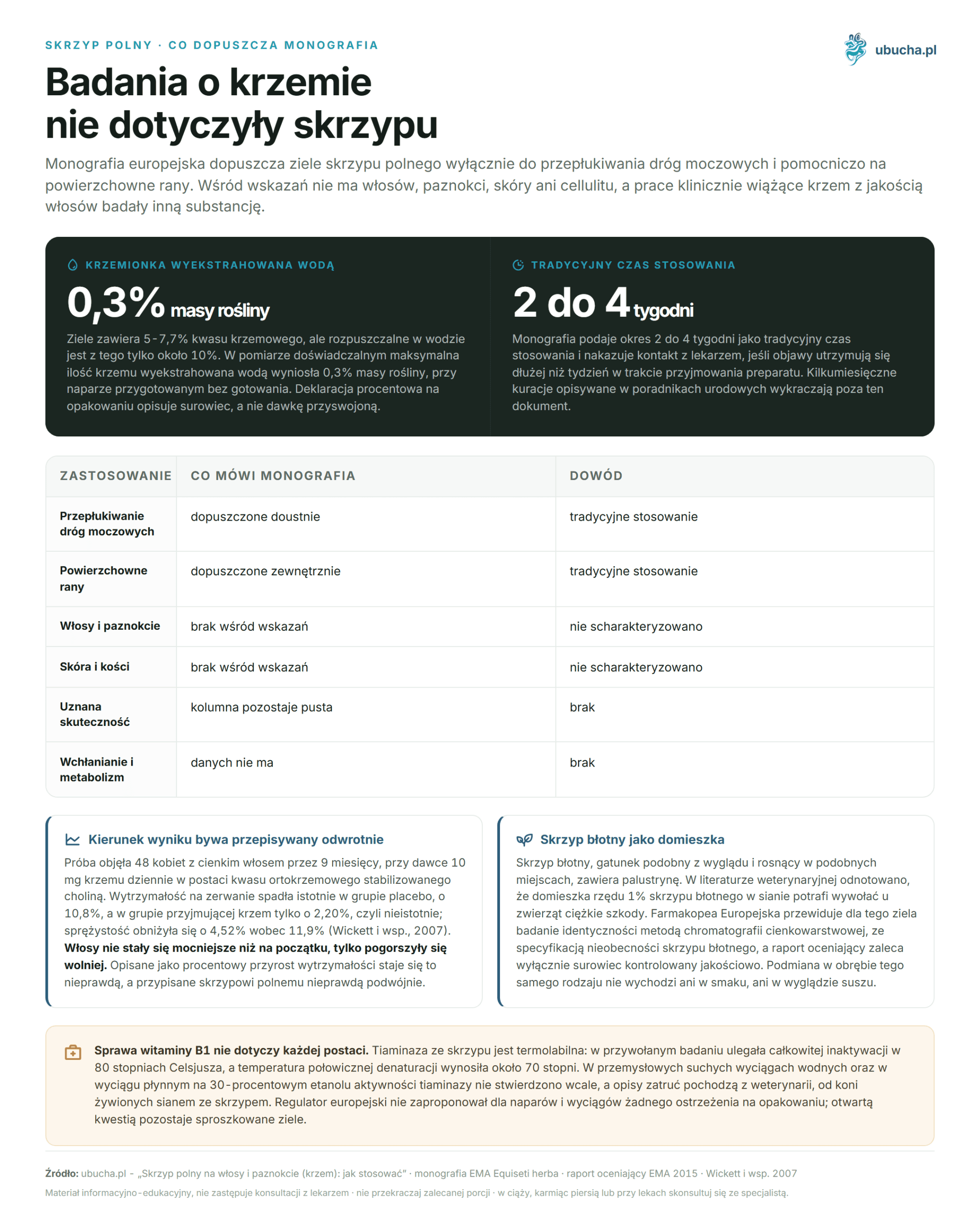
• The European Union monograph allows field horsetail herb only for rinsing the urinary tract and as an adjunct for superficial wounds, not for hair or nails (monografia EMA, Equiseti herba).
• The herb contains 5-7.7% silicic acid, but only about 10% of that amount dissolves in water.
• The recommended duration of use is 2-4 weeks, not several months; if symptoms persist beyond a week, the monograph advises seeing a doctor.
• Marsh horsetail, which looks similar, contains toxic palustrin and can be a contaminant in raw material harvested by unqualified individuals.
What is documented about field horsetail, and what is not?
The European monograph classifies field horsetail herb as a traditional herbal medicinal product and indicates two uses. The oral use involves increasing urine output to rinse the urinary tract, as an adjunct for minor ailments in this area. The external use pertains to supporting the treatment of superficial wounds. The column for raw materials with recognized efficacy remains empty.
Among the indications, there are no mentions of hair, nails, skin, or cellulite. This is not an oversight by the regulator. The assessing report noted the position of the panel of the European Food Safety Authority from 2009, stating that field horsetail has not been sufficiently characterized for maintaining skin, hair, or bones (EMA assessing report, Equisetum arvense L., herba, 2015).
A tradition of use in this area exists, and the report mentions it alongside several other folk applications, from stopping bleeding to baths for rheumatic ailments. However, tradition is a descriptive, not a evidential category: the registration of a traditional herbal product does not require efficacy studies, only documented thirty years of use. A review of the pharmacology of the entire genus confirms the same distribution of emphasis, indicating diuretic action as the only confirmed effect in humans (Boeing i wsp., Evidence-Based Complementary and Alternative Medicine, 2021). If you are interested in this direction, we have gathered it in a text about natural support for the kidneys and urinary tract.
How much silicon actually passes from horsetail into the body?
Content and bioavailability are two different matters, and with horsetail, they diverge drastically. The herb contains about 5-7.7% silicic acid, which is indeed a high value for a plant. However, only about 10% of that is water-soluble.
Experimental measurement shows this even more sharply. The silicon content in the whole plant is about 5%, while the maximum amount that can be extracted with water is 0.3% of the plant's mass, with an infusion prepared without boiling. The authors of another study conclude that the high silica content simply cannot be extracted by ordinary tea brewing; soaking the raw material and boiling it for several hours significantly increases yield. This is why the monograph recommends preparing the infusion by boiling the herb for 5-15 minutes, rather than pouring boiling water over it for a moment.
The practical conclusion is inconvenient for both popular forms. A homemade infusion extracts a fraction of silica, and a capsule with declared standardization for silicon dioxide refers to the content in powder, not how much of it will be absorbed. The percentage declaration on the packaging is therefore information about the raw material, not a promise of the absorbed dose. The assessing report closes this matter with one sentence: there is no data on the absorption, distribution, metabolism, and excretion for this raw material.
Do studies on silicon and hair concern horsetail?
They do not. Clinical studies linking silicon to hair quality examined orthosilicic acid stabilized with choline, a synthetically produced substance with a different chemical form than plant silica. This distinction disappears in commercial descriptions, yet it is the foundation of the entire argument.
In the first of these trials, 50 women with sun-damaged skin took 10 mg of silicon daily in this form or a placebo for 20 weeks. Skin roughness parameters improved, and the subjective assessment of hair and nail brittleness was significantly lower after 20 weeks than at the start (Barel i wsp., Archives of Dermatological Research, 2005). The second trial involved 48 women with fine hair, over 9 months, at the same dosage. The tensile strength significantly decreased in the placebo group by 10.8%, while in the silicon group, it only decreased by 2.20%, which is not significant. Hair elasticity decreased by 4.52% compared to 11.9% in the placebo group, and the cross-sectional area of the hair increased (Wickett i wsp., Archives of Dermatological Research, 2007).
Note the direction of this result, as it is often misrepresented. The hair did not become stronger than at the beginning. It deteriorated more slowly than in the placebo group. This is a real observation, but when described as a percentage increase in strength, it becomes misleading, and attributing it to field horsetail is doubly misleading. The studies on horsetail and nails mentioned in the report involved an external preparation combining an extract with a sulfur donor, applied to the nail plate for 28 and 14 days, rather than oral supplementation.
How long can horsetail be used and who should avoid it?
The European monograph states that herbal preparations are traditionally used for a period of 2 to 4 weeks. It separately notes that if symptoms persist for more than a week while taking the preparation, one should contact a doctor or pharmacist. This is a completely different time horizon than the several-month treatments described in beauty guides.
The contraindications are brief and specific. Hypersensitivity to the raw material excludes its use. It is also excluded in any condition where fluid intake is recommended to be limited, including severe heart and kidney diseases. For preparations other than teas, the monograph requires ensuring adequate fluid intake. Use in children under 12 years of age is not recommended due to a lack of data.
Safety during pregnancy and breastfeeding has not been established, and due to insufficient data, the monograph does not recommend use during this period. External preparations should not be applied to the breast of a breastfeeding woman. There is no data on the impact on fertility. In the drug interaction section, there is a note of no reports, so widespread warnings about combining horsetail with lithium have no basis in this document. The evaluating report indicates another lead that guides do not mention: in interaction studies using aqueous extracts, inhibition of CYP2C8 and CYP1A2 enzymes was observed, and this result was recommended to be considered in clinical assessment. Additionally, there are two observations from the literature: caution in individuals with impaired potassium metabolism due to the high potassium content in horsetail, and possible digestive discomfort with prolonged use.
How does field horsetail differ from marsh horsetail?
By the fact that one is a pharmacopoeial raw material, while the other contains a compound considered toxic. Marsh horsetail, a species similar in appearance and growing in similar places, contains palustrin. Veterinary literature has noted that an admixture of about 1% of marsh horsetail in hay can cause severe harm to animals.
The evaluating report states the matter plainly: adulteration of the raw material with marsh horsetail and several other species is possible. Therefore, the European Pharmacopoeia provides for the identification of this herb using thin-layer chromatography, with a specification for the absence of marsh horsetail. The recommendation for patients in this document is unequivocal: only consume quality-controlled raw material from a pharmacy, as admixture is possible when harvested by unqualified individuals.
This is why self-harvesting horsetail in a meadow is a bad idea, even if species identification seems certain. Substitution within the same genus is invisible to the buyer and does not manifest in taste or appearance of the dried herb. Laboratory testing determines this, which home harvesting does not pass. Our store does not carry field horsetail in any form, so for raw material with confirmed identity, go to the pharmacy.
Where did the issue of thiaminase come from, and does it concern every preparation?
Horsetail contains thiaminase, an enzyme that breaks down vitamin B1, and this is a documented fact, but it is usually described without three caveats that the evaluating report has gathered, which change the conclusion. First: the enzyme is thermolabile. In the cited study from 1993, it was completely inactivated at 80 degrees Celsius, and the half-life denaturation temperature was about 70 degrees.
The second caveat is even more important. In industrial dry aqueous extracts and in liquid extract with 30% ethanol, no thiaminase activity was found at all. The third concerns humans: in traditional European medicinal use, no brain damage was observed in individuals with thiamine deficiency, nor toxic reactions resembling nicotine poisoning. Descriptions of poisoning come from veterinary medicine, from horses fed hay with horsetail, and these drive the warnings transcribed into guides for humans.
The regulator drew a proportional conclusion from this: for preparations covered by the monograph, namely infusions and extracts, no warning was proposed on the packaging, as the enzyme is destroyed by both boiling and ethanol extraction. The issue of powdered herb remains open, which does not undergo either process. The Canadian regulator went further and requires manufacturers to demonstrate that products from field horsetail are free from thiaminase activity. Therefore, the recommendation for routine supplementation of vitamin B1 with any form of horsetail has no support in the European assessment, and for dried herb for infusion and extracts, it is irrelevant.
Frequently Asked Questions
Does field horsetail work for hair and nails?
There is no evidence that meets regulatory requirements. The European monograph allows the herb only for rinsing the urinary tract and as an adjunct for superficial wounds, and the panel of the European Food Safety Authority concluded in 2009 that the raw material has not been sufficiently characterized for maintaining hair, skin, and bones.
How much silica does field horsetail contain and how much of it is absorbed?
The herb contains 5-7.7% silicic acid, but about 10% of that is water-soluble. In an experimental study, the maximum amount of silicon extracted with water was 0.3% of the plant's mass with an infusion made without boiling. The percentage declaration on the packaging describes the raw material, not the absorbed dose.
How long can field horsetail be used?
The European monograph states a period of 2 to 4 weeks as the traditional duration of use and advises contacting a doctor if symptoms persist for more than a week during the intake of the preparation. Several months of treatments described in beauty guides exceed this document.
Did studies on silicon for hair concern field horsetail?
No. They studied orthosilicic acid stabilized with choline, a substance with a different chemical form than plant silica. In the trial involving 48 women over 9 months, hair in the placebo group weakened by 10.8%, while in the silicon group, it weakened by 2.20% (Wickett i wsp., 2007). This is a slowdown of deterioration, not an enhancement.
Can field horsetail be used during pregnancy and breastfeeding?
It is not recommended. Safety has not been established, and due to insufficient data, the European monograph advises against use during pregnancy and breastfeeding. External preparations should not be applied to the breast of a nursing woman. There is no data on the impact on fertility.
Should vitamin B1 be taken with horsetail?
There is no basis for this with infusions and extracts. Thiaminase from horsetail is thermolabile and its activity has not been detected in industrial water extracts or in ethanol extract. Reports of poisoning come from veterinary medicine; such events have not been observed in humans in traditional European use. The issue of powdered herb remains open.
Can field horsetail be harvested by oneself?
It's better not to. There is a possibility of confusion with marsh horsetail, which contains toxic palustrin, and identifying it by the appearance of the dried herb is unreliable. The European Pharmacopoeia requires chromatographic testing for this raw material to confirm the absence of marsh horsetail, and the assessing report recommends using only qualitatively controlled material.
If you are looking for verifiable ways to improve hair condition, we have prepared separate texts on this, how hemp oil affects hair and scalp oraz o tym, whether apple cider vinegar really works on hair.
This article is for informational and educational purposes and does not constitute medical advice. Before starting supplementation, consult your doctor, especially if you are taking medications regularly, are pregnant or breastfeeding, or have a chronic illness.
Author: Michał Waluk · Opublikowano: 2026-07-06 · Aktualizacja: 2026-08-16