
CBD Capsules: Who Are They Better For Than Oil and How to Dose Them
CBD capsules or oil? A comparison of bioavailability, onset time, dosing, and convenience. For whom are capsules a better choice and when does oil win.
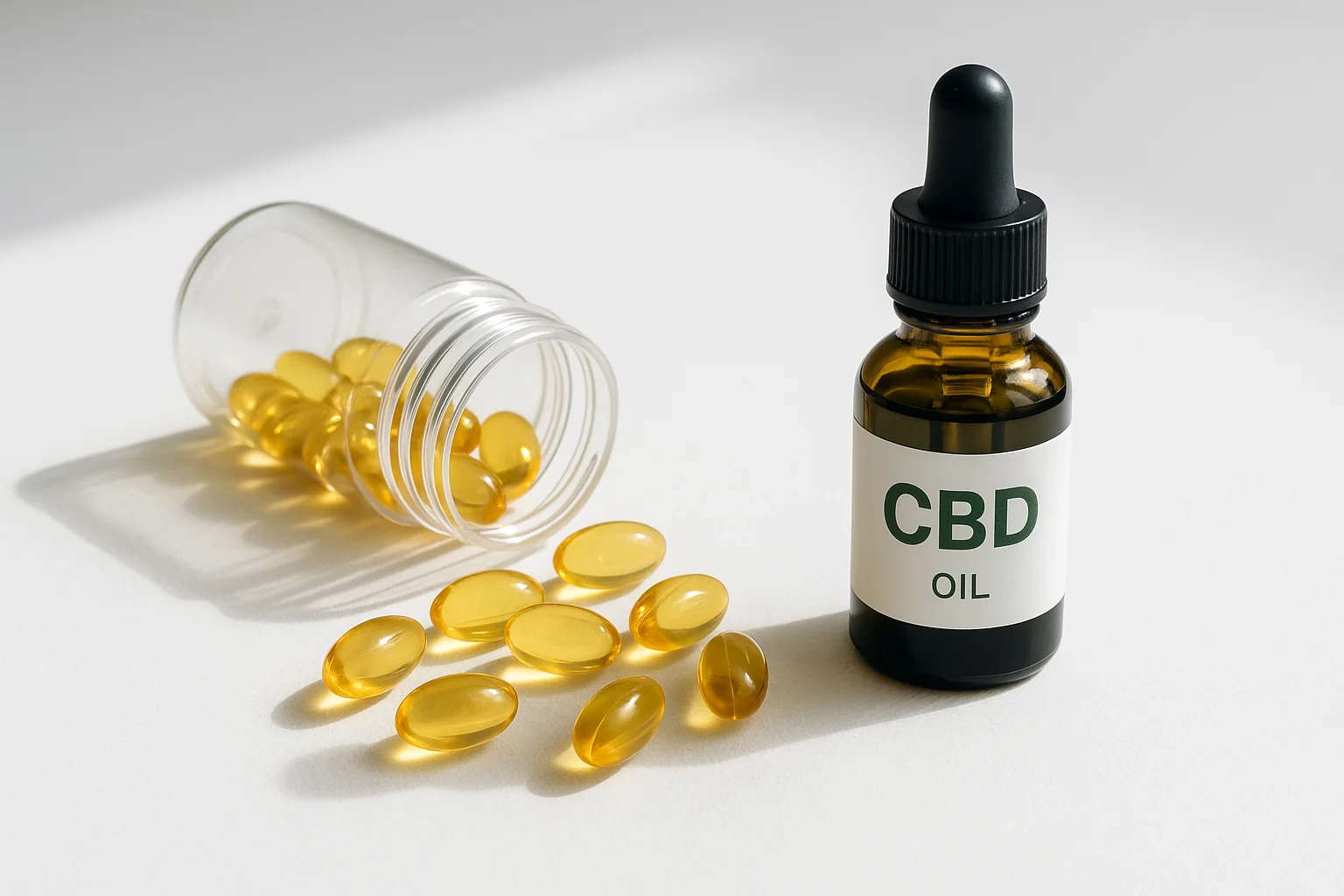
CBD oil is the most popular form of cannabidiol — but it’s not the only one and not always the best. CBD capsules are gaining more and more supporters, especially among those who do not accept the taste of cannabis, need precise dosing, or value discretion. Do CBD capsules work the same as oil? Almost — but with important differences in bioavailability, onset time, and convenience, which can be decisive for specific individuals. This article compares both forms fairly: it does not promote one at the expense of the other, but shows when a capsule wins and when it’s worth sticking with oil.
KEY INFORMATION
• The bioavailability of sublingual CBD oil is about 30%, while that of oral capsules is 6–15% on an empty stomach and 20–25% after a fatty meal (Millar et al., Molecules, 2019).
• Capsules act 1–2 hours slower than oil, but provide a more stable level of CBD in the blood for 6–8 hours.
• The first-pass effect in the liver is the main reason for the lower bioavailability of capsules — but it can be partially neutralized by taking them with a meal containing fats.
• Capsules are preferred when: the taste of oil is unacceptable, traveling, doses are set by a doctor, and for daily supplementation routines.
• Oil is preferred for: fast action, flexible dosing, and maximum bioavailability.
How CBD is Absorbed from a Capsule — First-Pass Effect and Bioavailability
Bioavailability is the percentage of the active substance that actually enters the bloodstream. For CBD capsules, the first-pass effect is crucial: CBD swallowed in a capsule reaches the small intestine, where it is absorbed by the mucosa, and then passes through the portal vein to the liver. The liver metabolizes some of the CBD before it reaches the bloodstream — which drastically reduces bioavailability.
Review Millar et al. (Molecules, 2019) summarized pharmacokinetic data for various forms of CBD: oral bioavailability for CBD in capsules or gel capsules is 6–15% on an empty stomach — depending on the formulation, type of carrier, and individual metabolic properties. This is significantly less than sublingual (~30%) or inhalation (~50–60%). However, it is the same amount of CBD reaching the brain and tissues — just with a delay and after a higher dose.
A way to partially bypass the first-pass effect: take capsules with a meal rich in fats. Fats stimulate the secretion of bile, which emulsifies CBD, improving its absorption in the intestines. A study Birnbaum et al. (Epilepsia, 2019) showed a 4-fold increase in Cmax (maximum concentration in the blood) of CBD when taken after a high-fat meal compared to fasting. This is a practical tip that can balance the difference in bioavailability between capsules and oil.
CBD Capsules vs Oil — Detailed Comparison of Properties
Instead of a vague "one is better than the other" — it is worth comparing both forms based on specific parameters. This will allow each person to choose the form suitable for their situation.
Taste and Acceptability: CBD oil has a characteristic herbal cannabis taste, which is a barrier for many people. Capsules have no taste — making them the preferred option for those sensitive to flavors or averse to herbal notes. This is a simple but often decisive difference.
Dosing Precision: Capsules win hands down. Each capsule contains a precisely specified amount of CBD (e.g., 10 mg or 25 mg) — without the need to count drops, calibrate a pipette, and assess the viscosity of the oil. With doses precisely tailored by a doctor or in clinical protocols, capsules are more reliable.
Discretion and Convenience While Traveling: Capsules look like a regular supplement — without the characteristic dropper bottle. They are easier to pack for a trip, take discreetly at work or during a meeting. They are also less frequently questioned by airlines than liquid oil (although CBD is legal in Poland).
Bioavailability and Onset Time: Here oil wins — but with the caveat that capsules with a fatty meal significantly close the gap. If you need quick on-demand action — sublingual oil. If you want a stable level of CBD throughout the day — capsules.
Stability and Durability: CBD oils are sensitive to light and temperature — requiring storage in a cool, dark place. Capsules in a dark blister or airtight jar are generally more resistant to storage conditions.
When are CBD capsules clearly the better choice?
CBD capsules have an advantage in several specific situations — and it's worth knowing them before you choose a form of supplementation.
Taste issues and reflux: People with acid reflux, GERD (gastroesophageal reflux disease), or simply with a particular sensitivity to herbal taste will have a better experience with capsules. MCT oil can exacerbate symptoms in some individuals — a gelatin-coated capsule is neutral for the stomach.
Regular, long-term supplementation: If CBD is part of your daily supplementation routine (just like vitamins or magnesium), the capsule fits naturally into this scheme. "Take 2 capsules with breakfast" is behaviorally simpler than "measure 4 drops under the tongue, hold for 90 seconds".
Travel and work: When traveling, capsules are incomparably more convenient. They do not leak, do not require special transport conditions, and do not look "alternative" during baggage checks. For managers traveling for work or people on business trips — capsules are the obvious choice.
Dosing by a doctor: If your doctor or pharmacist has prescribed you a specific dose of CBD — e.g. "20 mg twice a day" — capsules are more precise than oil. Clinical studies often use capsules precisely because they ensure certainty regarding the dose.
Our observations: Users transitioning from oil to capsules often say the same thing: "more convenient, though I wait a bit longer for the effect". For people using CBD for sleep — a capsule taken an hour before bed often works better than oil just before falling asleep, because the longer release time covers the entire night. This is a practical observation that explains the popularity of capsules for insomnia.
When does CBD oil win over capsules?
Oil has its undeniable advantages that capsules cannot replicate without compromise. Knowing when it is the better choice is an important part of a conscious approach to CBD.
Quick on-demand action: In cases of acute pain, panic attacks, intense situational anxiety, or severe menstrual pain — sublingual oil acts within 15–45 minutes. The capsule takes 1–2 hours, which may be too slow in an emergency. Oil remains the "on-demand" form.
Flexible dosing: When experimenting to find your optimal dose, oil offers full flexibility — you can add 1 drop (2.5–5 mg), increase the dose by half on a tougher day, or decrease it when the effects are too strong. 10 mg capsules do not allow for such precision in "steps".
Maximum bioavailability: If you care about the lowest effective costs (how much CBD enters the bloodstream for each zloty) — sublingual oil is more efficient. With the same amount of CBD in oil, you'll get ~2x more substance into the bloodstream than from a capsule.
Learn more about how to choose the concentration of CBD oil in the article Which CBD concentration to choose.
Dosing CBD capsules — a practical scheme
Due to the lower and slower bioavailability of capsules, dosing is somewhat different than with sublingual oil. Here’s a scheme based on clinical data and pharmacokinetics:
Starting dose: 1 capsule of 10 mg in the morning with breakfast for 7–10 days. Observe the effects — for some individuals, 10 mg/day may be sufficient as a long-term dose for mild conditions (stress, prevention, general support). If you do not feel any effects after 2 weeks, that is a clear signal to increase the dose, not to give up on CBD.
Target dose — mild to moderate conditions: 1 capsule 10 mg in the morning + 1 capsule 10 mg in the evening (20 mg/day). The evening dose positively affects sleep — the capsules release CBD gradually over 6–8 hours, covering the night.
Target dose — moderate to severe conditions: 1–2 capsules 25 mg per day (25–50 mg). This range has been used in clinical studies for chronic pain, anxiety disorders, and drug-resistant epilepsy. At higher doses, enzymatic monitoring (ALAT, ASPAT) is important after 3 months.
The principle of "with a meal": Always take CBD capsules with a meal containing fats. It doesn't have to be lunch — breakfast with avocado, salmon, olive oil, or nuts is sufficient. The bioavailability effect increases 2–4 times, which means a realistically higher dose without the need to change the product. This principle is particularly important for CBD capsules, where every percent of absorbed substance matters — unlike oil, where absorption through the mucous membrane is independent of diet.
How to dose CBD oil can be found in the article Dosing CBD — how many drops to take.
Can CBD capsules be combined with oil?
Yes — and this is a strategy used by some experienced CBD users. The logic is simple: a capsule in the morning provides a stable CBD background throughout the day (sustain effect), while the oil sublingually provides a quick on-demand effect (boost effect). This combination of two pharmacokinetic profiles complements each other.
Example combined scheme: 10 mg CBD capsule for breakfast (stable level for 6–8 hours) + 10% oil available in case of sudden pain or strong anxiety (5–10 mg sublingually, effect after 20–30 minutes). The total daily dose then amounts to 15–25 mg — and this while maintaining form flexibility. However, it is worth remembering that when combining forms, the CBD dose adds up, so this should be taken into account in the context of a safe daily limit.
According to EFSA (European Food Safety Authority), the safe daily dose of CBD for adults is 70 mg/day as a guideline upper limit for supplementation. Clinical studies on epilepsy used doses of 10–20 mg/kg/day — but these are medical situations under strict supervision, not wellness supplementation. In a standard wellness context, 20–50 mg/day is a reasonable and safe range.
What does the CBD capsule market look like in Poland and what to look for on the label?
The CBD capsule market in Poland is developing dynamically, but the quality of products is very varied. When buying CBD capsules, check the label and the COA (Certificate of Analysis) for several key parameters:
CBD content per capsule: Must be clearly stated in mg — not just as a percentage. "10 mg of CBD per capsule" is specific; "2% CBD" without stating the mass of the capsule's content — insufficient.
Type of extract: Full-spectrum, broad-spectrum, or isolate — each has different properties. The COA should show the cannabinoid profile and confirm that THC does not exceed 0.3% (the legal limit for hemp products in Poland).
Carrier and additional ingredients: Many capsules contain MCT oil or olive oil as a carrier for CBD — which is beneficial for bioavailability. Check if the capsule contains additives you may be allergic to (e.g., beef gelatin if you follow a vegetarian or halal diet).
Laboratory certificate (COA): Every reliable manufacturer provides a COA from an independent laboratory. Check the date of the analysis (not older than 12 months) and whether the certificate includes pesticide, heavy metal, and microbiology analysis — not just CBD content.
More about how to read CBD certificates can be found in the article How to read a CBD certificate (COA).
Full-spectrum CBD capsules vs isolate — does it matter?
Just like oils, CBD capsules can be made from full-spectrum extract (full spectrum — CBD + other cannabinoids + terpenes + trace THC up to 0.3%), broad-spectrum (without THC), or from CBD isolate (pure CBD 99%). The difference has practical significance:
Full-spectrum capsules: Entourage effect — the synergistic action of cannabinoids, terpenes, and flavonoids — can provide a stronger therapeutic effect at the same dose of CBD. Study Russo (British Journal of Pharmacology, 2011) described this effect as "additive or synergistic" compared to the isolate. In chronic pain, inflammatory conditions, and anxiety — full-spectrum is preferred.
CBD isolate in capsules: No THC — important for individuals undergoing anti-doping tests or drug tests at work. Capsules with 99% CBD isolate carry zero risk of THC detection while retaining all the properties of cannabidiol itself. The lack of entourage effect can be attempted to be compensated with a higher dose — but this is debatable. You can read more about drug tests and CBD in the article Does CBD show up on drug tests?.
Broad-spectrum capsules: A compromise between full-spectrum and isolate — they contain many cannabinoids and terpenes but no THC. This is an option for those seeking the entourage effect with zero THC risk. Broad-spectrum is also better tolerated by individuals sensitive to trace amounts of THC, which can cause feelings of anxiety in some.
Frequently Asked Questions
Do CBD capsules work the same as oil?
Capsules and oil contain the same CBD, but they have different bioavailability and onset times. Oil taken sublingually achieves ~30% bioavailability and takes effect after 15–45 minutes. Capsules achieve 6–15% on an empty stomach (up to 25% with a fatty meal) and take effect after 1–2 hours, but more steadily and for a longer duration. The review by Millar et al. (Molecules, 2019) confirms these pharmacokinetic differences.
How much CBD do typical capsules contain?
Standard CBD capsules contain 10 mg or 25 mg of CBD per capsule. With a target dose of 20 mg/day, you need 2 capsules of 10 mg or 1 capsule of 25 mg (and you can add the rest in the evening).
When should you choose CBD capsules over oil?
Capsules are better: when you do not accept the taste of oil, need discretion while traveling, want precise dosing without counting drops, or are looking for long-lasting, stable effects throughout the day or night.
What is the bioavailability of CBD capsules?
The bioavailability of CBD capsules is 6–15% on an empty stomach and about 20–25% after a fatty meal. The study by Birnbaum et al. (Epilepsia, 2019) showed a 4-fold increase in Cmax of CBD when taken after a high-fat meal — which is the simplest method to improve the effectiveness of capsules.
How to dose CBD capsules?
Start with 10 mg in the morning for 7–10 days. If the effect is insufficient, increase to 20 mg/day (2×10 mg) or 25 mg. Always take with a fatty meal. Evaluate effects after at least 4 weeks of regular use.
Do CBD capsules work slower than oil?
Yes — capsules take effect after 1–2 hours compared to 15–45 minutes for sublingual oil. However, capsules maintain a stable level of CBD for 6–8 hours, without the peaks and troughs typical of oil. In chronic conditions (night pain, daytime anxiety), a slower but stable profile may be more beneficial.
This article is for informational and educational purposes. It contains internal links to products available in the u Bucha store. Prices and specifications may change — please check the current data on the product page before purchasing.
Author: Michał Waluk · Published: 2026-05-04 · Updated: 2026-05-04