
Ibogaine - the most risky psychedelic and research on addiction.
Ibogaina: bezpieczenstwo, przeciwwskazania i interakcje. Edukacja u Bucha.
Ibogaine evokes particular emotions in the scientific community: on one hand, descriptions of dramatic remissions of opioid addiction after a single session, on the other hand, confirmed lethal potential due to cardiotoxicity. No other substance studied in the context of psychedelic therapy has such a dramatic risk-benefit profile. This article presents the state of scientific knowledge as of 2026 - the mechanism of action, data on effectiveness in addictions, safety profile, and a table of contraindications - for educational and informational purposes only. Ibogaine is a substance that requires exceptional caution, and its use outside a strictly supervised clinical context with cardiac monitoring poses a serious life threat.
KEY INFORMATION
• Ibogaine prolongs the QTc interval and can cause fatal arrhythmias - in uncontrolled conditions, mortality is estimated at 1:300 sessions (Cherian et al., Nature Medicine, 2024).
• The Stanford study on veterans (2024) showed an 88% decrease in depression and an 87% decrease in anxiety after 30 days - but without a placebo group.
• Ibogaine is not listed on the Polish controlled substances list, but it is also not a drug - it operates in a legal grey area.
• The combination of ibogaine with opioids or QTc prolonging medications is a direct life-threatening risk.
What is ibogaine and how does it work pharmacologically?
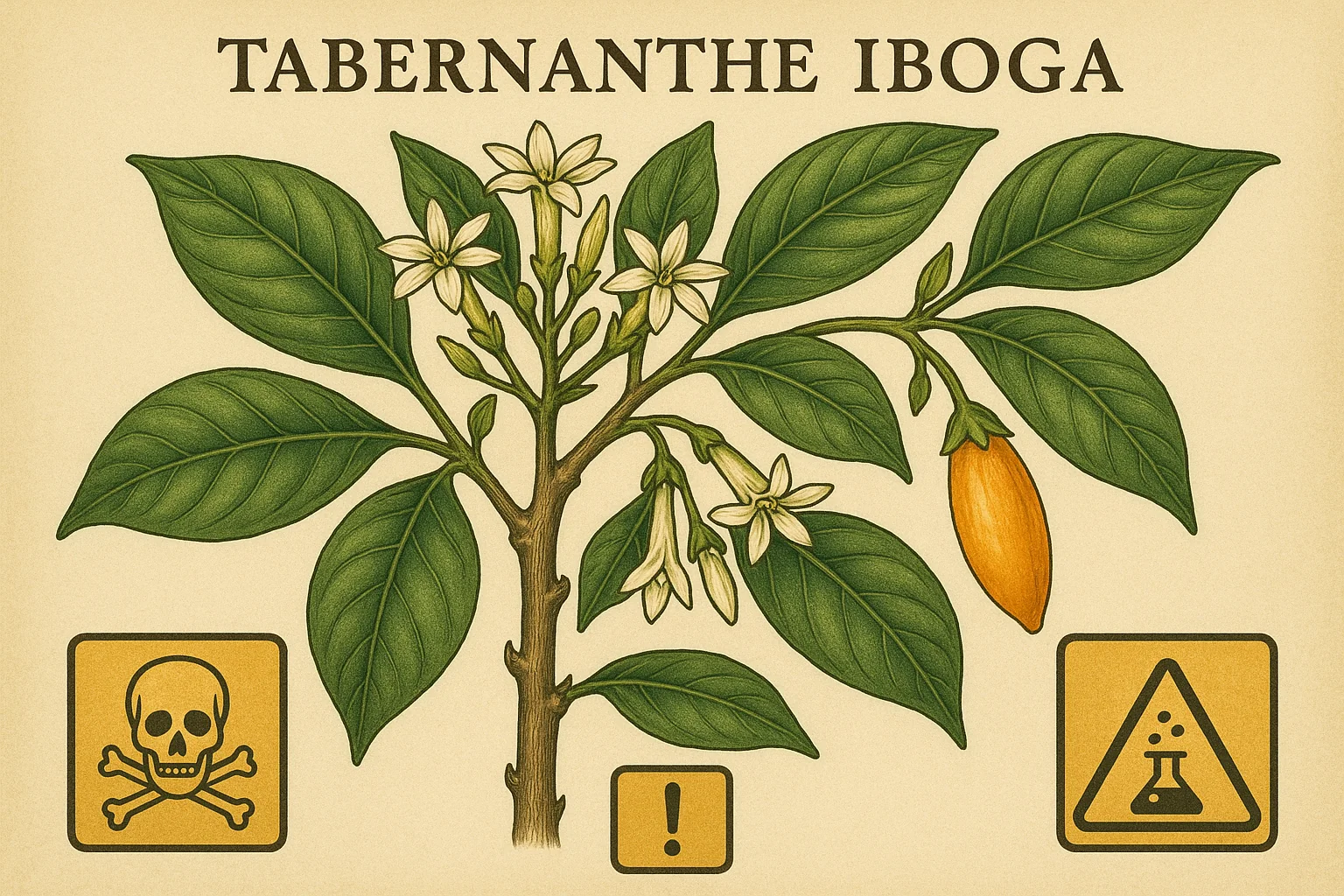
Ibogaine is an indole alkaloid isolated from the bark of the Tabernanthe iboga root - a plant that grows in Central Africa, where it has been used for centuries in initiation ceremonies of the Bwiti tradition in Gabon. Pharmacologically, it is exceptionally complex: it acts simultaneously as an antagonist of NMDA and opioid receptors (kappa and mu), a serotonin and dopamine reuptake inhibitor, a sigma-2 receptor ligand, and nAchR (Noller et al., Substance Abuse and Rehabilitation, 2018).
This multidirectional action is both a source of therapeutic interest and a reason for a complex safety profile. Blocking opioid receptors reduces withdrawal symptoms in individuals addicted to opioids. The effect on dopamine reduces drug cravings. Activity on NMDA is associated with dissociative effects and the so-called 'memory film' - an intense, dreamlike experience of past episodes that is a central element of the ibogaine experience.
Ibogaine is metabolized in the liver to noribogaine, which has a longer half-life (24-72 hours) and also exhibits biological activity - particularly in reducing drug cravings. This is why the effects of ibogaine can last for days or weeks after a single session.
Safety table - contraindications, interactions, and warning signs.
The table below is the most important part of this article. Ibogaine has an exceptionally long list of contraindications compared to other psychedelic substances. The data comes from clinical protocols, case reports, and safety reviews.
| Category | Details | Risk level |
|---|---|---|
| Cardiac conditions (history) | Coronary artery disease, ventricular arrhythmias, cardiomyopathy, congenital heart anomalies | ABSOLUTE |
| Prolonged QTc on ECG | QTc >450 ms in men, >470 ms in women before the session. | ABSOLUTE |
| QT prolonging medications | SSRIs (fluoxetine, citalopram), antibiotics (azithromycin, clarithromycin), methadone, antimalarials | ABSOLUTE |
| Active use of opioids | Heroina, morfina, oksykodon, buprenorfina - ryzyko paradoksalnych interakcji i sinergii kardiotoksycznej | ABSOLUTE |
| Severe liver dysfunction | Cirrhosis, hepatitis - ibogaine metabolized by CYP2D6; toxic accumulation. | ABSOLUTE |
| Pregnancy and lactation | No safety data; embryotoxic effects described in animal models | ABSOLUTE |
| Active psychosis / schizophrenia | Risk of exacerbating psychosis; no clinical data for this population | ABSOLUTE |
| Epilepsja | Ibogaine may lower the seizure threshold | ABSOLUTE |
| Uncontrolled hypertension | Systolic blood pressure above 160 mmHg - ibogaine may temporarily raise it. | WYSOKIE |
| MAOIs and RIMAs | Risk of serotonin syndrome due to the action of ibogaine on the serotonin system | ABSOLUTE |
What do studies say about ibogaine in addiction?
The biggest impetus for renewed interest in ibogaine was the clinical observations from the 1980s and 1990s: a single ibogaine session in individuals addicted to heroin reduced withdrawal symptoms and decreased drug cravings for weeks or months. Observational studies from Brazil, New Zealand, and the Netherlands confirmed these effects - but without randomization and control groups.
A breakthrough was the study by Cherian et al. published in Nature Medicine in 2024, conducted on 30 U.S. Army veterans with PTSD and addictions. Results after 30 days: 88% reduction in depression symptoms (measured by HAMD), 87% reduction in anxiety, significant improvement in functioning. These are impressive numbers - but the study lacked a placebo group and randomization, which limits the strength of causal inference (Cherian et al., Nature Medicine, 2024).
The FDA granted ibogaine Breakthrough Therapy Designation for the treatment of opioid addiction in 2024 - which accelerates the clinical research pathway, but does not yet mean registration. The first Phase 2 RCTs are underway. Meanwhile, several centers in Europe (Netherlands, Switzerland, Portugal) and several in Mexico offer ibogaine therapy under various legal frameworks - with varying quality of medical oversight.
We have noticed that ibogaine is almost absent in the Polish public debate - unlike psilocybin or MDMA, which appear in mainstream media. This can be paradoxically dangerous: individuals seeking alternatives for opioid addiction may encounter unverified offers for ibogaine sessions without awareness of the cardiovascular risks. Education on the safety of ibogaine is more urgent than education on its therapeutic potential.
Why is the cardiotoxicity of ibogaine such a unique problem?
Ibogaine and its metabolite noribogaine block hERG potassium channels (Kv11.1) in the heart muscle. This is the same mechanism by which many cardiological drugs and antidepressants prolong the QT interval. Prolongation of QTc above 500 ms poses a risk of torsades de pointes - a polymorphic ventricular tachycardia that can progress to ventricular fibrillation and sudden cardiac arrest (Noller et al., Substance Abuse and Rehabilitation, 2018).
The problem is exacerbated by the duration of ibogaine's action: the full experience lasts 12-24 hours, and the cardiotoxic effects of the metabolite noribogaine can persist for 48-72 hours. This means that cardiac monitoring must last at least 3 days, not just a few hours as with psilocybin. Centers without continuous ECG monitoring and defibrillation capabilities should not conduct ibogaine sessions.
From our editorial observation, publicly available descriptions of ibogaine sessions outside medical centers rarely mention cardiac monitoring as a standard. Meanwhile, an analysis of 30 deaths reported by Stanford showed that almost all occurred in conditions without continuous ECG monitoring or in the presence of prohibited substances (methadone, other opioids) - factors that an experienced center would exclude at the qualification stage.
Frequently Asked Questions
What is ibogaine and where does it come from?
Ibogaine is an indole alkaloid isolated from the root of the plant Tabernanthe iboga, which grows in Central Africa. Pharmacologically, it acts on multiple systems simultaneously: it antagonizes NMDA and opioid receptors, inhibits the reuptake of serotonin and dopamine. This makes its action profile exceptionally complex and requires special caution (Noller et al., Substance Abuse and Rehabilitation, 2018).
Why is ibogaine considered the most dangerous psychedelic?
Ibogaine prolongs the QTc interval on the ECG, which can lead to fatal cardiac arrhythmias (torsades de pointes). The mortality rate in uncontrolled conditions is estimated at about 1 in 300 sessions. Stanford Medicine published data on 30 deaths, most of which occurred outside supervised centers with cardiac monitoring (Cherian et al., Nature Medicine, 2024).
Does ibogaine really treat addictions?
Research indicates promising results in opioid addiction - a Stanford study on 30 veterans showed an 88% decrease in depression and a 87% decrease in anxiety after 30 days. However, the lack of randomized controlled trials with a placebo group means that the level of evidence is insufficient for clinical registration. The FDA granted Breakthrough Therapy Designation in 2024, which accelerates research (Cherian et al., Nature Medicine, 2024).
What is the legal status of ibogaine in Poland?
Ibogaine is not listed on the Polish list of controlled substances (Act on Counteracting Drug Addiction). It is also not a registered drug. Its status is a legal gray area - it is not illegal like THC, but it is not approved for medical use. In several European countries (Netherlands, Portugal), ibogaine clinics operate under various legal frameworks.
What should be absolutely avoided in the context of ibogaine?
Absolute contraindications include: any cardiovascular diseases, prolonged QTc on EKG, use of QT-prolonging medications (SSRIs, azithromycin, methadone), use of opioids, alcoholism with liver damage, and pregnancy. Ibogaine outside a supervised center with cardiac monitoring poses a serious life threat (Noller et al., Substance Abuse and Rehabilitation, 2018).
Status prawny ibogainy w Polsce i Europie - co wiemy w 2026 roku?
Ibogaine is not listed in the catalog of psychotropic substances or narcotics attached to the Act on Counteracting Drug Addiction (Journal of Laws from 2023). This means that its possession and use are not explicitly prohibited under this law - unlike THC, psilocybin, or MDMA. However, the absence of a ban is not the same as legalization or medical approval. Ibogaine is also not a registered medicinal product in Poland or the EU.
In Europe, the legal situation is varied. In the Netherlands, ibogaine operates in a so-called gray regulatory area - several clinics conduct sessions in the absence of a clear ban, although without any industry regulation or safety standards imposed by law. In Portugal, where decriminalization applies to the possession of small amounts of all substances, ibogaine clinics operate openly. Switzerland allows the use of ibogaine under specific medical conditions based on individual permits.
In the Polish context, a key question is: can a person arriving in Poland with an ibogaine preparation legally acquired abroad face legal issues? The answer is ambiguous and depends on the interpretation of law enforcement agencies. Caution and legal consultation are advisable before taking any action.
Clinical prospects - when might ibogaine become a drug?
The road to clinical registration for ibogaine is long and uncertain, but it gained momentum in 2024. The FDA granted ibogaine Breakthrough Therapy Designation for the treatment of opioid addiction - which means that the agency deemed the preliminary evidence sufficiently promising to accelerate the clinical research pathway. This is not registration, but an important institutional signal.
The main obstacle remains cardiotoxicity. Researchers from UCSF and Stanford are working on ibogaine analogs that do not affect hERG channels - maintaining therapeutic activity without the risk of arrhythmias. Preliminary preclinical data from 2023 on animal models are promising, but there is still a long way to go before clinical trials in humans. If these trials are successful, a safe ibogaine analog could become a viable therapeutic option within a decade (Cherian et al., Nature Medicine, 2024).
This article is for informational and educational purposes and does not replace consultation with a doctor. If you are pregnant, breastfeeding, taking medications, or have chronic conditions, consult the use of supplements or herbs with a specialist.
Author: Michał Waluk · Published: 2026-05-04 · Updated: 2026-05-04