
CB1 receptor kinetics - why tolerance depends on the rate of receptor internalization.
Kinetyka receptora CB1 — mechanizm dzialania wyjasniony prosto, w oparciu o badania. u Bucha.
Regular THC users know this well: the same dose that used to work strongly barely does anything after a few weeks. This is not psychological adaptation - it is the physical "hiding" of CB1 receptors from the surface of nerve cells. Bhattacharyya and colleagues described that after activation by THC, the CB1 receptor is phosphorylated by GRK kinases, after which beta-arrestin directs it into the cell interior in the process of internalization (Bhattacharyya et al., Molecular Pharmacology, 2017). The faster the receptor is internalized, the faster tolerance builds up. This article explains the molecular mechanism of this process and what it means for cannabinoid users.
KEY INFORMATION
• Tolerance to THC results from the internalization of CB1 receptors - their physical removal from the cell surface via the GRK/beta-arrestin pathway (Bhattacharyya et al., Molecular Pharmacology, 2017).
• The density of CB1 in the brains of THC users is 20-40% lower compared to non-users - a reversible effect after 4 weeks of abstinence.
• Desensitization (minutes) and internalization (hours) are two separate stages of building CB1 tolerance.
• CBD, not being a CB1 agonist, does not induce internalization of this receptor - it may even slow down tolerance when used concurrently with THC.
How the CB1 receptor works at all - a reminder.
The CB1 receptor (cannabinoid type 1) is a G protein-coupled receptor of the Gi/o class - its activation inhibits the production of cAMP and blocks N and P/Q type calcium channels, while simultaneously opening GIRK potassium channels. Net effect: CB1 activation decreases neuronal excitability and inhibits the release of neurotransmitters (glutamate, GABA, dopamine - depending on the location). This is the mechanism underlying the analgesic, anxiolytic, and psychoactive effects of cannabinoids.
The CB1 receptor is one of the most densely expressed receptors in the brains of vertebrates. It is particularly densely distributed in the basal ganglia, cerebellum, hippocampus, and neocortex. This rich expression reflects the crucial role of the endocannabinoid system in modulating synaptic transmission across a wide range of neuronal circuits.
Under physiological conditions, the CB1 receptor is activated by endocannabinoids - anandamide and 2-AG - synthesized "on demand" in the postsynaptic neuron and acting retrogradely, inhibiting the release of neurotransmitters from the presynaptic neuron. THC mimics endocannabinoids but acts much longer and non-selectively - activating CB1 for a longer time and in many places simultaneously.
Desensytyzacja CB1: pierwszy etap tolerancji (minuty-godziny)
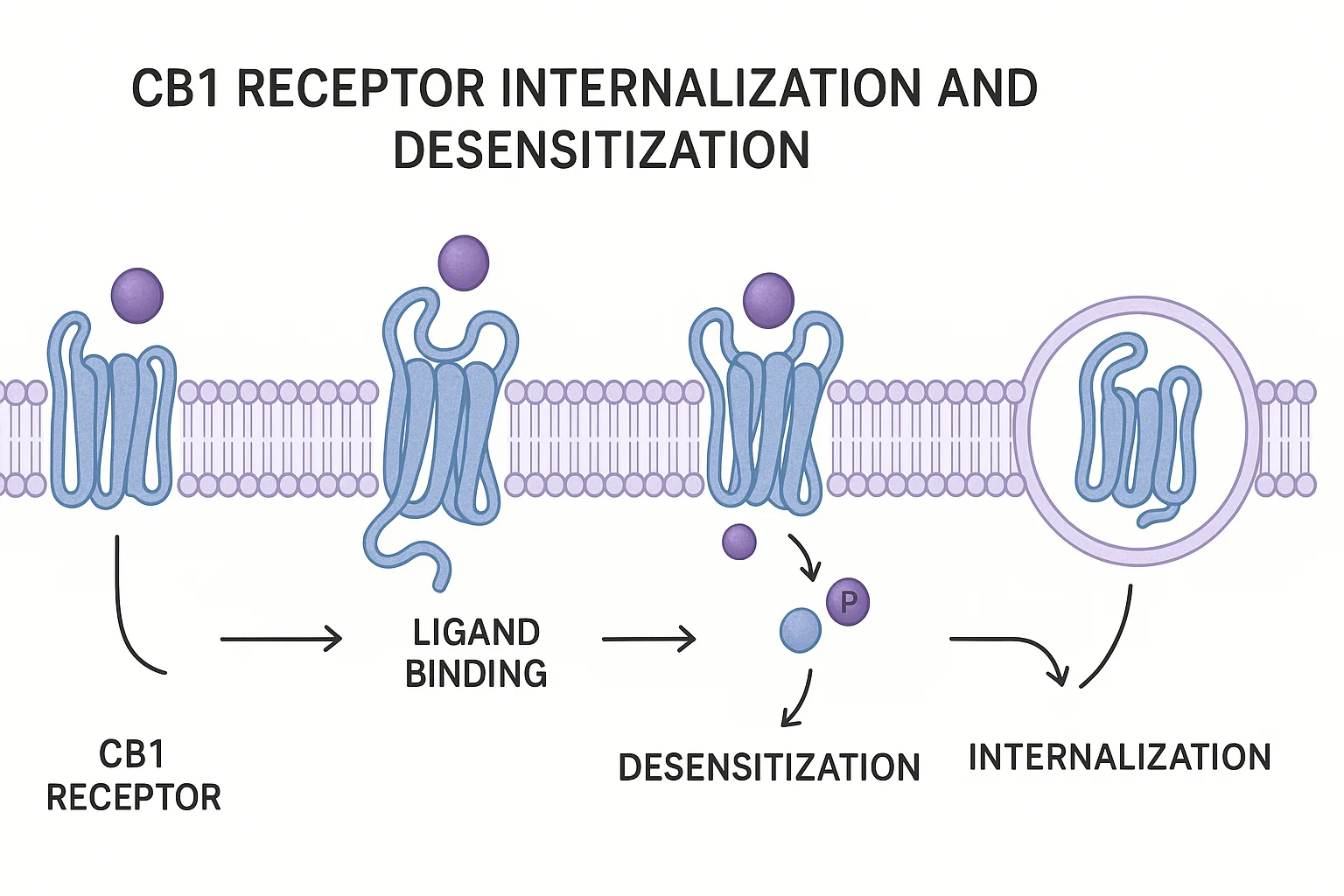
When the CB1 receptor is continuously activated by an agonist (THC, but also high doses of 2-AG), GRK2 and GRK3 kinases (G protein-coupled receptor kinases) phosphorylate the cytoplasmic tail of the receptor. This phosphorylation decreases the receptor's affinity for G protein - the receptor is "less productive" even though it is still present on the cell membrane. This is desensitization.
We have noticed that many popular explanations of cannabinoid tolerance confuse desensitization with internalization, treating them as one process. Meanwhile, these are two separate stages with different kinetics: desensitization occurs within minutes and is quickly reversible after the agonist is removed, while internalization takes hours and is only reversible after days. For the practical strategy of "T-break" (break from use), this distinction matters: a few days' break mainly resets desensitization, while a few weeks are needed for full renormalization of CB1 density.
Desensitization is a rapid mechanism protecting the neuron from excessive stimulation - useful in physiology when 2-AG is released in bursts. However, in the context of chronic THC use, it becomes the first step towards tolerance. If the agonist (THC) is still present after desensitization, the next stage is triggered.
Internalizacja CB1: drugi etap tolerancji (godziny-dni)
After phosphorylation by GRK, the CB1 receptor recruits beta-arrestin. Beta-arrestin has two functions: it uncouples the receptor from G protein (enhancing desensitization) and links the receptor to adaptor proteins AP-2, which initiate the formation of a clathrin-coated vesicle. The receptor is pulled into the cell in an endosome - this is internalization (Bhattacharyya et al., Molecular Pharmacology, 2017).
Inside the cell, the CB1 receptor reaches early endosomes, from where it can take two paths: recycling (returning to the cell membrane after the agonist is removed) or lysosomal degradation (permanent removal of the receptor). With short-term stimulation, recycling predominates. With chronic THC use, the proportion of degradation increases - resulting in a permanent decrease in CB1 receptor density on the membrane.
| Tolerance stage | Mechanism | Duration | Reversibility |
|---|---|---|---|
| Desensitization | Phosphorylation by GRK2/3 - uncoupling from G protein | Minuty-godziny | Rapid (hours after removal of the agonist) |
| Internalization | Beta-arrestin + clathrin - removal from the membrane to endosomes | Godziny-dni | Days (recycling) or weeks (if degradation) |
| Downregulation (chronically) | Reduced synthesis of new CB1 receptors | Weeks | 4-8 tygodni abstynencji |
What do neuroimaging studies say about CB1 density in humans?
Hirvonen and colleagues used a PET scan with a radioligand selective for CB1 ([18F]FMPEP-d2) to measure CB1 receptor density in the brains of regular marijuana users and in a control group. Daily marijuana users for at least a year had 20% lower radioligand binding in the cortex, amygdala, and hippocampus compared to non-users (Hirvonen et al., Molecular Psychiatry, 2012).
A key finding of this study: after 4 weeks of abstinence, CB1 density returned to levels seen in non-users in almost all examined brain regions. This is direct evidence that CB1 downregulation in humans is reversible - but requires several weeks, not days. A "T-break" (tolerance break) lasting 1-2 days has limited value in terms of receptor normalization.
It is worth noting that the decrease in CB1 density is not solely negative. Studies on chronic pain models suggest that chronic activation of CB1 by endocannabinoids in inflammatory states is a protective adaptation. CB1 downregulation after excessive THC stimulation may be a manifestation of natural homeostasis - not pathology.
Does CBD protect against THC tolerance?
CBD is not an agonist of the CB1 receptor - it does not activate it directly and does not induce desensitization or internalization via the GRK/beta-arrestin pathway. Moreover, several in vitro studies suggest that CBD may act as an allosteric modulator of CB1, altering the receptor's conformation in a way that reduces the efficiency of its desensitization by agonists. In other words: CBD, when used alongside THC, may slow the onset of tolerance.
Our observations suggest that the concept of "CBD protects CB1 from THC tolerance" is an interesting hypothesis that would empirically explain the observed differences between users of full-spectrum hemp extracts and purified THC. However, there are very few direct clinical studies confirming this effect in humans so far. It remains a hypothesis indirectly supported by in vitro data and animal models.
Regional selectivity of CB1 tolerance - why the brain tolerates THC unevenly
THC tolerance does not develop uniformly across all brain regions. Autoradiographic and PET studies show that the rate of CB1 internalization differs between areas - which has significant clinical implications. The cerebellum and basal ganglia (responsible for motor coordination) develop tolerance faster than the hippocampus (memory) or prefrontal cortex (cognitive functions). This explains the observation that in experienced THC users, motor effects and the "feeling of intoxication" diminish faster than effects on working memory and executive functions.
Why do different regions tolerate THC differently? The density of CB1 and the activity of GRK2/3 differ anatomically. In the cerebellum, CB1 is extremely dense, but GRK3 is particularly active there - leading to rapid phosphorylation and internalization. In the prefrontal cortex, CB1 is less dense, but the GRK2/GRK3 ratio favors slower internalization. The result: the prefrontal cortex "holds" CB1 on the membrane longer, which means cognitive effects of THC persist longer even after overall tolerance develops.
Practical implication: a "T-break" may not be sufficient to fully restore CB1 sensitivity across all regions simultaneously. Regions with faster internalization (cerebellum) rebuild receptor density faster. Regions with slower internalization but deeper transcriptional downregulation (cortex, hippocampus) may require longer abstinence. Hirvonen's study confirmed heterogeneity: after 2 weeks of abstinence, normalization was regionally uneven, fully achieved only after 4 weeks (Hirvonen et al., Molecular Psychiatry, 2012).
The beta-arrestin pathway of CB1 and tolerance - new drugs based on signaling bias
Understanding that CB1 tolerance depends on the beta-arrestin pathway (internalization), while therapeutic effects depend on the Gi/o pathway (analgesia, anxiolysis), has opened a new direction for research: CB1 ligands with "bias" towards the Gi/o pathway and minimal activation of beta-arrestin. Such "biased agonists" of CB1 could provide therapeutic effects with minimal tolerance.
Several pharmaceutical groups are working on such molecules. PrNMI and similar experimental compounds have shown in rodent models that "Gi-biased" CB1 agonists provide analgesia comparable to THC but with a significantly slower development of tolerance. This is analogous to research on "Gi-biased" opioids (TRV130/oliceridine) - a strategy that has been tested, although full clinical success remains challenging to achieve. THCV, as a partial agonist of CB1 with a different signaling profile than THC, may be a natural example of partial "bias" within phytocannabinoids - although this interpretation requires further verification.
Frequently Asked Questions
Why do effects weaken after regular THC use?
THC tolerance results from the internalization of CB1 receptors - the physical removal of them from the neuron's surface via the GRK/beta-arrestin pathway. Fewer CB1 receptors on the membrane means a weaker response to the same dose of THC. Long-term use also leads to reduced synthesis of new receptors (downregulation) (Bhattacharyya et al., Molecular Pharmacology, 2017).
What is CB1 receptor internalization?
Internalization is the process in which the activated CB1 receptor is phosphorylated by the GRK2/3 kinase, after which beta-arrestin binds and recruits the clathrin machinery. The receptor is pulled into the cell in an endosomal vesicle. It can then return to the membrane (recycling) or be degraded in the lysosome.
How quickly does tolerance to THC return after a break?
The density of CB1 receptors in the cerebral cortex of regular marijuana users normalizes to levels seen in non-users after 4 weeks of abstinence - this has been demonstrated in PET studies (Hirvonen et al., Molecular Psychiatry, 2012). Short "T-breaks" lasting a few days mainly reset desensitization, not full receptor density.
Does CBD cause tolerance through CB1?
CBD is not a CB1 agonist and does not activate it directly. Therefore, CBD does not lead to the internalization of CB1 receptors in the same way as THC. Some in vitro studies suggest that CBD may even slow down CB1 desensitization through allosteric modulation - potentially providing protective effects when used alongside THC.
What is the difference between CB1 desensitization and internalization?
Desensitization is a rapid (minutes) process of reducing receptor response through GRK phosphorylation - the receptor remains on the membrane but is less efficiently coupled to G protein. Internalization is a later (hours) process of physically moving the receptor from the membrane into the cell. Tolerance is the sum of both, with internalization having greater long-term significance.
This article is for informational and educational purposes and does not constitute legal advice. The legal status described in the article is valid as of the publication date - regulations regarding cannabis may change. Consult a lawyer or current legal acts before making decisions.
Author: Michał Waluk · Published: 2026-05-04 · Updated: 2026-05-04