
CBD and the 5-HT2A receptor - a psychedelic receptor viewed differently than with LSD
CBD a receptor 5-HT2A — mechanizm dzialania wyjasniony prosto, w oparciu o badania. u Bucha.
LSD, psilocybin, and mescaline induce psychedelic effects by activating the 5-HT2A serotonin receptor. CBD acts on the same receptor - but in exactly the opposite way. Bhattacharyya and colleagues demonstrated in neuroimaging studies that CBD, as a 5-HT2A antagonist, reduces brain activity typical of psychoactive states induced by strong agonists of this receptor (Bhattacharyya et al., Journal of Psychopharmacology, 2012). This is one of the key reasons why CBD does not induce intoxication despite acting on the 'psychedelic' receptor - and why it may partially neutralize the effects of THC. This article explains the mechanism and its implications.
KEY INFORMATION
• CBD acts as an antagonist or inverse agonist of the 5-HT2A receptor - it blocks it instead of activating it like LSD or psilocybin (Bhattacharyya et al., Journal of Psychopharmacology, 2012).
• The 5-HT2A receptor is the main target of classical psychedelics, densely expressed in layer V of the neocortex - particularly in the visual and prefrontal areas.
• CBD's antagonism towards 5-HT2A explains why CBD can alleviate dysphoria and paranoia induced by THC.
• The concept of 'signal bias' explains why different ligands of the same receptor produce extremely different effects.
What is the 5-HT2A receptor and where is it located?
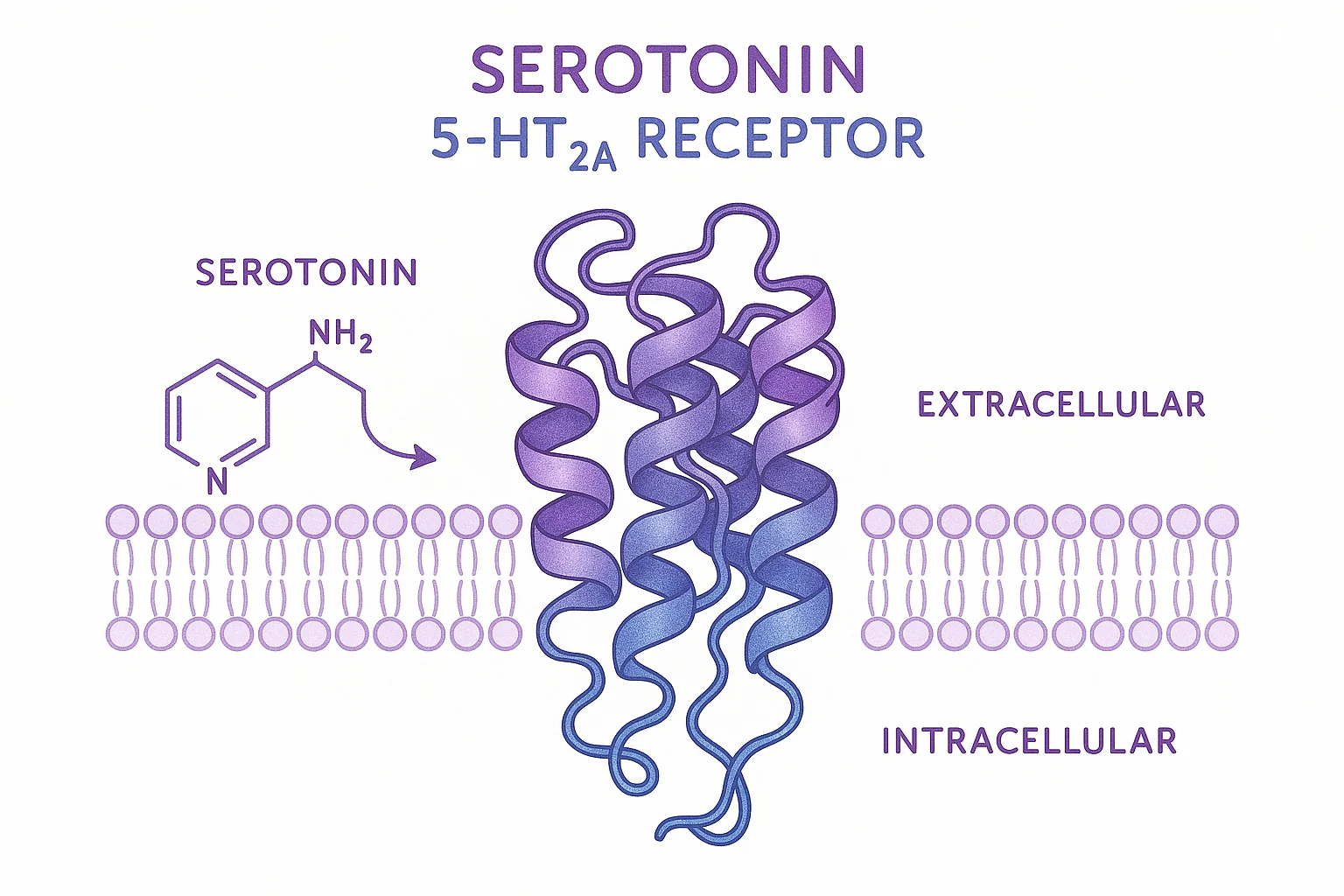
The 5-HT2A receptor belongs to the subtype of serotonin receptors coupled with the Gq protein. Upon activation, it triggers phospholipase C, leading to an increase in intracellular calcium and activation of protein kinase C. In the neocortex, the receptor is particularly densely expressed in layer V of pyramidal neurons - cells that integrate information from various brain regions and send signals to subcortical structures.
Its location in the visual cortex explains the visual hallucinations induced by 5-HT2A agonists. Its location in the prefrontal cortex explains changes in self-awareness and cognitive abilities. The receptor is also present in the amygdala, hippocampus, and basal ganglia, which explains the wide spectrum of effects of classical psychedelics beyond pure visual hallucinations.
Beyond psychedelic effects, the 5-HT2A receptor regulates essential daily processes: synaptic plasticity through BDNF expression (brain-derived neurotrophic factor), modulation of glutamatergic and dopaminergic transmission, as well as circadian rhythms. Atypical antipsychotic medications (clozapine, olanzapine, aripiprazole) are strong antagonists of 5-HT2A - this is one of the mechanisms of their effectiveness in schizophrenia.
How does CBD interact with the 5-HT2A receptor?
CBD shows affinity for the 5-HT2A receptor, but acts differently than psychedelics. Radioligand binding studies and functional tests have shown that CBD behaves as a competitive antagonist - it occupies the binding site and blocks access to endogenous serotonin and exogenous agonists, without activating its own signal through Gq. Some studies suggest that CBD may be an inverse agonist, actively reducing the receptor's baseline activity below resting levels (Ibeas Bih et al., Frontiers in Pharmacology, 2015).
We have noted that the difference between 'antagonist' and 'inverse agonist' seems a technical nuance, but it has real clinical significance. An antagonist blocks activation - the effect is neutral. An inverse agonist suppresses even the baseline activity of the receptor - the effect is active inhibition. If CBD is an inverse agonist of 5-HT2A, it may exert a stabilizing effect on the brain even without competing with other ligands. This is an important hypothesis, especially in the context of CBD research in schizophrenia and cannabis-induced psychosis.
In clinical studies, Bhattacharyya and colleagues compared the effects of THC, CBD, and placebo on brain activation measured by fMRI. THC increased activity in the amygdala and striatum during threat processing. CBD reduced this activity below placebo levels. Interestingly, the effect of CBD was observed without the presence of THC - suggesting that CBD modulates serotonin and dopamine pathways independently of THC.
Comparison: how CBD, LSD, and serotonin act differently on 5-HT2A
The concept of 'functional selectivity' or 'signal bias' explains how different molecules binding to the same receptor can elicit completely different cellular effects. It is not just the fact of receptor occupation that matters, but what conformation the ligand induces in the receptor and which intracellular proteins this conformation recruits.
| Ligand | Type of action on 5-HT2A | Intracellular pathway | Observed effect |
|---|---|---|---|
| Serotonin | Full agonist | Gq + beta-arrestin | Physiological modulation of mood and cognition |
| LSD, psilocybin | Agonist (beta-arrestin bias) | Strong beta-arrestin | Psychedelic effects (hallucinations, ego dissolution) |
| CBD | Antagonist / inverse agonist | Gq and beta-arrestin blockade | Calming effect, potentially antipsychotic |
| Clozapine (medication) | Strong antagonist | Gq blockade | Antipsychotic effect, sedation |
The table reveals something significant: LSD induces hallucinations not because it is 'stronger' than serotonin, but because it prefers the beta-arrestin pathway instead of the classical Gq pathway. This is a different signaling protein in the same cell. By blocking the receptor, CBD excludes the activation of both pathways.
Can CBD alleviate THC-induced psychosis?
THC indirectly increases serotoninergic activity in the brain, including through the 5-HT2A receptor. The dysphoric and paranoid effects of THC are partially mediated by the overactivity of the 5-HT2A pathway in the amygdala and cortex. As an antagonist of this receptor, CBD may suppress these effects. Several RCT studies have tested whether a higher CBD/THC ratio in cannabis translates to a lower risk of psychosis.
Di Forti and colleagues published an epidemiological study in 2019 covering 11 European locations, showing that the use of cannabis with high THC content (above 10%) and low CBD increases the risk of the first episode of psychosis fivefold compared to non-use of cannabis (Di Forti et al., Lancet Psychiatry, 2019). What accounts for this CBD protection? The antagonism of 5-HT2A is one of the proposed mechanisms, alongside its influence on the dopaminergic system.
Our observations indicate that questions about CBD as an 'antidote' to overly strong effects of THC arise regularly. Scientific data suggest some justification for this intuition - particularly through the 5-HT2A mechanism. However, there are no clinical studies confirming a specific dose of CBD effective for immediately neutralizing strong THC in humans. The antagonism of 5-HT2A is likely a mechanism of chronic protection, not acute 'sobering up.'
5-HT2A receptor and CBD studies in schizophrenia
5-HT2A receptor antagonists are among the most important classes of antipsychotic drugs. Clozapine and olanzapine have a higher affinity for 5-HT2A than for D2 dopamine receptors - this is one of the reasons for their effectiveness in negative symptoms of schizophrenia, where classical neuroleptics (which only block D2) fail. CBD, acting similarly on 5-HT2A (though weaker), has become a candidate for research in psychosis.
Mcguire and colleagues conducted an RCT investigating CBD in schizophrenia in patients unresponsive to standard treatment. After 6 weeks of CBD supplementation (150-600 mg daily), a reduction in positive symptoms and overall disease severity was observed compared to placebo (McGuire et al., American Journal of Psychiatry, 2018). This pilot study does not resolve questions about the mechanism but confirms that the effects of CBD in psychosis are clinically measurable.
The 5-HT2A receptor and synaptic plasticity - why psychedelics may be therapeutic
One of the most interesting discoveries in recent years concerns the impact of 5-HT2A receptor activation on the synaptic plasticity of the brain. 5-HT2A agonists - psilocybin, LSD, DMT - induce a dramatic increase in BDNF (brain-derived neurotrophic factor) expression and increase the density of dendrites and synaptic spines in the prefrontal cortex. This is a mechanism potentially responsible for the therapeutic effect of psychedelics in treatment-resistant depression: the brain literally 'rewires' circuits that have become stuck in pathological patterns of thinking.
How does CBD fit into this as a 5-HT2A antagonist? The answer is not straightforward. By blocking 5-HT2A, CBD potentially inhibits this form of synaptic plasticity induced by strong agonists. However, CBD simultaneously raises anandamide levels by inhibiting FAAH - and anandamide, through the CB1 receptor, also induces an increase in BDNF via a different pathway. The balance of these competing effects is unknown. This is an important question for research on the combination of CBD with psychedelic-assisted therapy (PAT) - a growing area of clinical psychiatry.
Bhattacharyya and colleagues examined the effect of CBD on brain activity in healthy volunteers using fMRI. CBD reduced activation of the amygdala and ventral striatum during emotional stimulus processing - areas rich in 5-HT2A receptors. This effect was observed without the presence of THC or psychedelics, suggesting that the baseline tone of 5-HT2A is significant for emotional processing, and its modulation by CBD translates into measurable changes in brain activity (Bhattacharyya et al., Journal of Psychopharmacology, 2012). This is a rare example where the molecular mechanism of CBD (5-HT2A antagonism) has a direct correlate in neuroimaging in humans.
Frequently Asked Questions
What is the 5-HT2A receptor and why is it called psychedelic?
The 5-HT2A receptor is a serotonin receptor coupled with the Gq protein, densely expressed in the neocortex. Its activation by strong agonists - LSD, psilocybin, mescaline - induces hallucinations, synesthesia, and changes in self-awareness. Hence the name 'psychedelic.' In everyday physiology, serotonin activates this receptor, regulating synaptic plasticity and mood.
How does CBD interact with the 5-HT2A receptor?
CBD acts as an antagonist or inverse agonist of the 5-HT2A receptor - it blocks the receptor and may reduce its baseline activity. This is the exact opposite of LSD or psilocybin. CBD occupies the same receptor as psychedelics, but instead of 'turning it on', it suppresses it (Ibeas Bih et al., Frontiers in Pharmacology, 2015).
Can CBD neutralize the effects of THC through the 5-HT2A receptor?
Yes, partially. THC indirectly activates the serotonin pathway through 5-HT2A. CBD, as an antagonist, can limit some of the psychoactive effects of THC - including dysphoria and paranoia. fMRI studies confirm that CBD reduces the reactivity of the amygdala to threat stimuli when administered simultaneously with THC (Bhattacharyya et al., Journal of Psychopharmacology, 2012).
Why doesn't CBD produce psychedelic effects despite acting on 5-HT2A?
Psychedelic effects depend on the receptor conformation induced by the ligand, not just on the occupation of the binding site. LSD prefers the beta-arrestin pathway responsible for hallucinogenic effects. CBD completely blocks the receptor, excluding the activation of both pathways. This is the concept of 'signal bias' - different ligands of the same receptor induce different intracellular effects.
What is the role of the 5-HT2A receptor beyond psychedelic effects?
The 5-HT2A receptor regulates synaptic plasticity (BDNF expression), modulates glutamatergic and dopaminergic transmission, and circadian rhythms. 5-HT2A antagonists are effective antipsychotic drugs (clozapine, olanzapine) used in schizophrenia. CBD, as a 5-HT2A antagonist, may have properties similar to atypical antipsychotics - this was confirmed by a pilot RCT (McGuire et al., American Journal of Psychiatry, 2018).
This article is for informational and educational purposes and does not constitute legal advice. The legal status described in the article is valid as of the publication date - regulations regarding cannabis may change. Consult a lawyer or current legal acts before making decisions.
Author: Michał Waluk · Published: 2026-05-04 · Updated: 2026-05-04