
Glucomannan for satiety and weight - approved by EFSA, but what do RCTs say
Glucomannan for satiety and weight: a reliable answer based on research. u Bucha.
Glucomannan is one of the few ingredients in supplements that has passed through the rigorous EFSA procedure and obtained an approved health claim regarding weight control. The European Food Safety Authority approved in 2010 the claim that 3 g of glucomannan daily contributes to maintaining normal body weight in the context of a low-calorie diet. Sounds good - but what do randomized clinical trials actually show when we translate the certification into numbers? This article explains the mechanism, real effects of RCTs, proper dosing, and limitations of use.
KEY INFORMATION
• EFSA approved the glucomannan claim (3 g/day) as a supplement to a low-calorie diet for weight control (EFSA, 2010).
• A meta-analysis of 8 RCTs showed a weight reduction of about 0.79 kg more than placebo - a real but modest effect (Keithley et al., 2020).
• Glucomannan absorbs up to 50 times its own weight in water, forming a gel that delays gastric emptying.
• Requires a large amount of water with each dose - without it, the gelling effect does not occur properly.
What is glucomannan and how does it work?
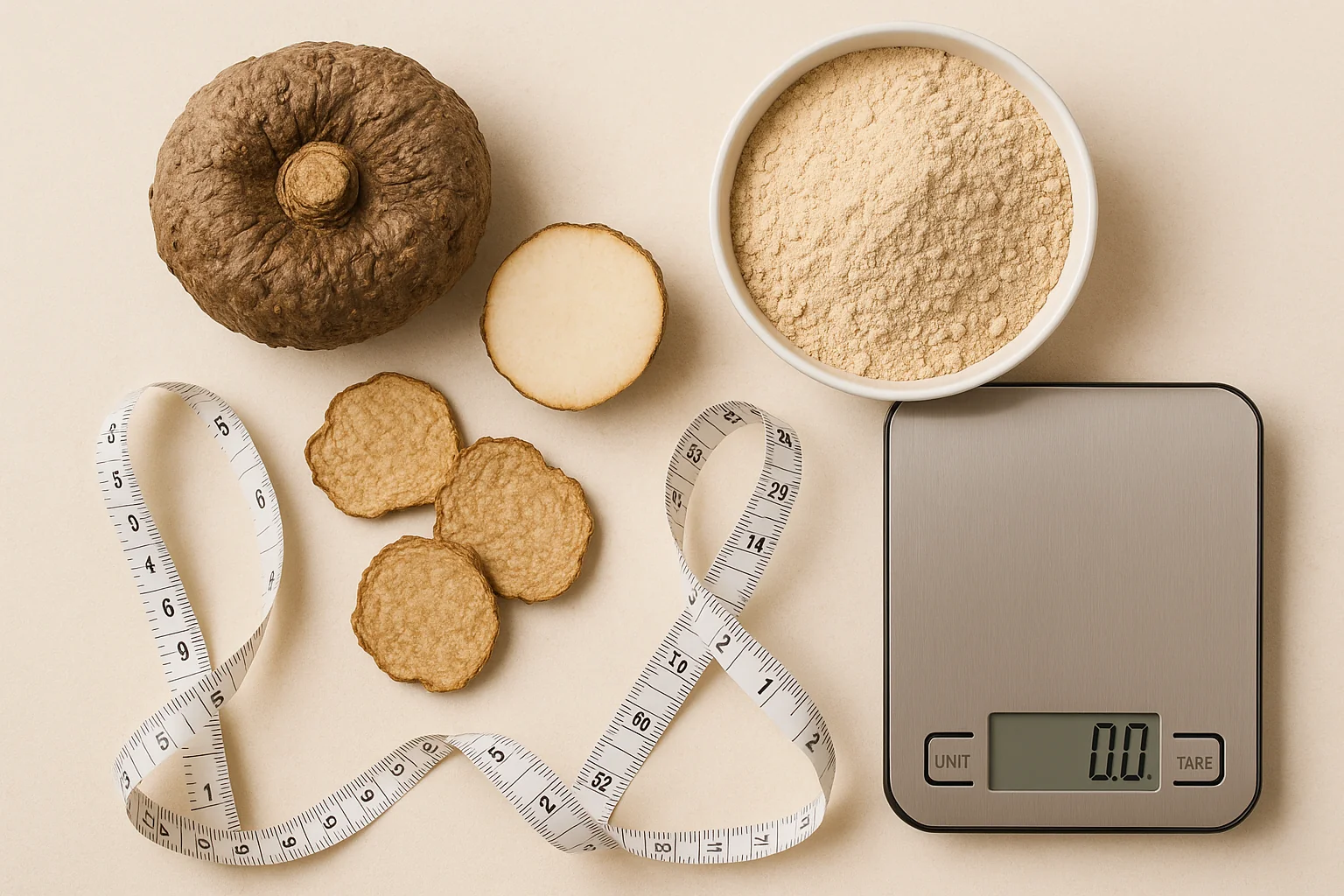
Glucomannan is a polysaccharide derived from the root of the konjac plant (Amorphophallus konjac), cultivated for millennia in East Asia. Its ability to absorb water is exceptional - one gram of glucomannan can absorb up to 50 ml of water and turn into a thick gel. In the context of the digestive system, this means that taken before a meal, it fills the stomach, slows its emptying, and prolongs the feeling of fullness (Keithley and Swanson, Integrative Medicine, 2005).
The mechanism of action of glucomannan is threefold. First, the gel mechanically fills the stomach and signals satiety. Second, it slows the absorption of glucose from the small intestine, alleviating post-meal sugar spikes. Third, it increases the viscosity of intestinal contents, which may reduce cholesterol reabsorption. These three pathways together explain why glucomannan has been studied not only for weight but also for glycemia and lipids.
How does this translate into practice? Imagine that before lunch, you drink a glass of water with a glucomannan capsule. A gel forms in the stomach that occupies real volume. When you sit down to eat 20-30 minutes later, the stomach is already partially 'occupied', and the satiety signals sent to the brain arrive earlier than without the supplement.
What does the EFSA decision from 2010 say?
The EFSA Dietetic Products, Nutrition and Allergies Panel approved in 2010 the health claim: 'Glucomannan in the context of a low-calorie diet contributes to weight loss' (EFSA Journal 2010, 8(10):1798). The approved claim has precise conditions of use.
| Element | EFSA Requirement |
|---|---|
| Daily dose | 3 g (in three portions) |
| Single Dose | 1 g before a meal |
| Time Before a Meal | 15-30 minutes |
| Required Amount of Water | Minimum 1-2 glasses |
| Context of Use | Low-calorie diet |
| Claim scope | Maintaining a healthy body weight |
The condition of a 'low-calorie diet' is crucial and often overlooked in marketing. The EFSA claim does not say that glucomannan alone reduces weight - it states that it supports the effects of a calorie-deficit diet. Without a calorie deficit, glucomannan will not cause weight loss, even with ideal dosing.
We noted in our analysis of studies that many glucomannan supplements on the market contain it in 500 mg capsules - to provide the required 3 g, one would need to take 6 capsules daily (2 before each of the 3 main meals). Manufacturers who declare a dose of 1-2 capsules daily do not meet the EFSA claim conditions, even if they refer to its existence.
What do randomized clinical trials say?
The most comprehensive review is the meta-analysis by Keithley et al. from 2020, which included 8 randomized placebo-controlled trials (Keithley et al., Obesity Reviews, 2020). The total number of participants was 570. The results indicate that glucomannan contributed to a weight reduction of an average of 0.79 kg more than placebo over 4-12 weeks of intervention. The effect is statistically significant, but its scale is modest.
An earlier study by Birketvedt et al. (2005) observed greater effects - about 3.7 kg in 5 weeks with glucomannan powder with inulin - but the methodology raised concerns about controlling participants' diets. More rigorously controlled studies consistently show an effect in the range of 0.5-1.5 kg over placebo.
Sood et al. in a meta-analysis published in the Journal of the American College of Nutrition (2008) summarized data from 14 studies on lipids and glycemia (Sood et al., JACN, 2008). Glucomannan reduced LDL cholesterol by about 10 mg/dl, total cholesterol by about 19 mg/dl, and fasting glucose by about 7 mg/dl. These are additional, weight-independent benefits that may be clinically significant for individuals with dyslipidemia or prediabetes.
Does glucomannan work better in capsules, powder, or gummies?
The form of the supplement matters, as it affects how quickly and where gelling occurs. Capsules with glucomannan may open in the stomach or intestine - the gelling time depends on the manufacturer. Powder dissolved in water before drinking begins to gel earlier. Oral tablets may not dissolve quickly enough for the satiety effect to be optimal before a meal.
In the clinical studies on which the EFSA claim is based, various forms were used, but it was consistently required to be taken with a large amount of water. The timing is key - 15-30 minutes before a meal - not the form. Dry forms (tablets, capsules) require more water than pre-dissolved powder because gelling must occur in the stomach, not in the glass.
Safety and potential interactions
The main risk of glucomannan is esophageal obstruction with insufficient water intake, especially with tablets. The European Medicines Agency (EMA) and EFSA recommend taking it with at least one full glass (200-250 ml) of water with each dose. Individuals with dysphagia or esophageal diseases should not use glucomannan without medical consultation.
Drug interactions are another area requiring caution. Glucomannan slows the absorption of substances from the intestines - this applies to oral medications, including those for diabetes, thyroid, and cholesterol. The recommended interval between glucomannan and medications is at least 2 hours. Individuals taking insulin or hypoglycemic medications should monitor their blood glucose when starting glucomannan, as it may enhance the hypoglycemic effect.
Frequently Asked Questions
What is glucomannan and where does it come from?
Glucomannan is a soluble fiber derived from the root of the konjac plant (Amorphophallus konjac). It absorbs water up to 50 times its own weight, forming a gel that fills the stomach and slows its emptying. EFSA has approved the claim that 3 g of glucomannan daily contributes to maintaining a healthy body weight in the context of a low-calorie diet (EFSA, 2010).
How much weight does glucomannan help to lose according to clinical studies?
A meta-analysis of 8 RCTs from 2020 showed that glucomannan supplementation led to a weight reduction of an average of 0.79 kg more than placebo over 4-12 weeks (Keithley et al., Obesity Reviews, 2020). The effect is statistically significant but modest - it is a dietary supplement, not a standalone weight loss tool.
How to dose glucomannan for it to work?
EFSA requires 3 g daily in 3 doses of 1 g, taken 15-30 minutes before meals, with at least one glass of water with each dose (EFSA, 2010). Glucomannan without sufficient water does not form a proper gel and may cause discomfort or esophageal blockage.
Does glucomannan lower cholesterol and glucose?
Yes. A meta-analysis of 14 studies showed that glucomannan lowered LDL cholesterol by about 10 mg/dl, total cholesterol by about 19 mg/dl, and fasting glucose by about 7 mg/dl (Sood et al., JACN, 2008). The effects are modest but confirmed regardless of the effect on body weight.
Who should not use glucomannan?
Individuals with dysphagia, esophageal or intestinal diseases, as well as those taking oral medications (including for diabetes or thyroid) should consult a doctor. Glucomannan may slow the absorption of medications - the recommended interval is at least 2 hours. Pregnant women should discuss use with a specialist before starting the supplement.
Does the EFSA effect mean that glucomannan really works for weight loss?
The EFSA claim concerns glucomannan as a supplement to a low-calorie diet, not as a standalone weight loss agent. Clinical studies confirm a real but modest benefit - about 0.79 kg more than placebo. Glucomannan works by creating a feeling of fullness and alleviating hunger, not by burning fat. The effect is real and documented, but requires a context of caloric deficit (EFSA, 2010).
Is glucomannan safe for long-term use?
Studies up to 16 weeks show no serious adverse effects at a dose of 3 g daily. The most common complaints are bloating and digestive discomfort in the first days - especially with insufficient water intake. EFSA considers glucomannan safe at approved doses and with proper hydration (EFSA, 2010).
When to take glucomannan - in the morning or in the evening?
Studies evaluated glucomannan taken before main meals, in 3 doses per day. Dividing the doses before breakfast, lunch, and dinner provides a better feeling of fullness than a single morning dose. More important than the time of day is the rhythm - 15-30 minutes before each main meal, with a full glass of water with each dose (Keithley et al., 2020).
This article is for informational and educational purposes and does not replace consultation with a doctor. If you are pregnant, breastfeeding, taking medications, or have chronic conditions, consult the use of supplements or herbs with a specialist.
Author: Michał Waluk · Published: 2026-05-04 · Updated: 2026-05-04