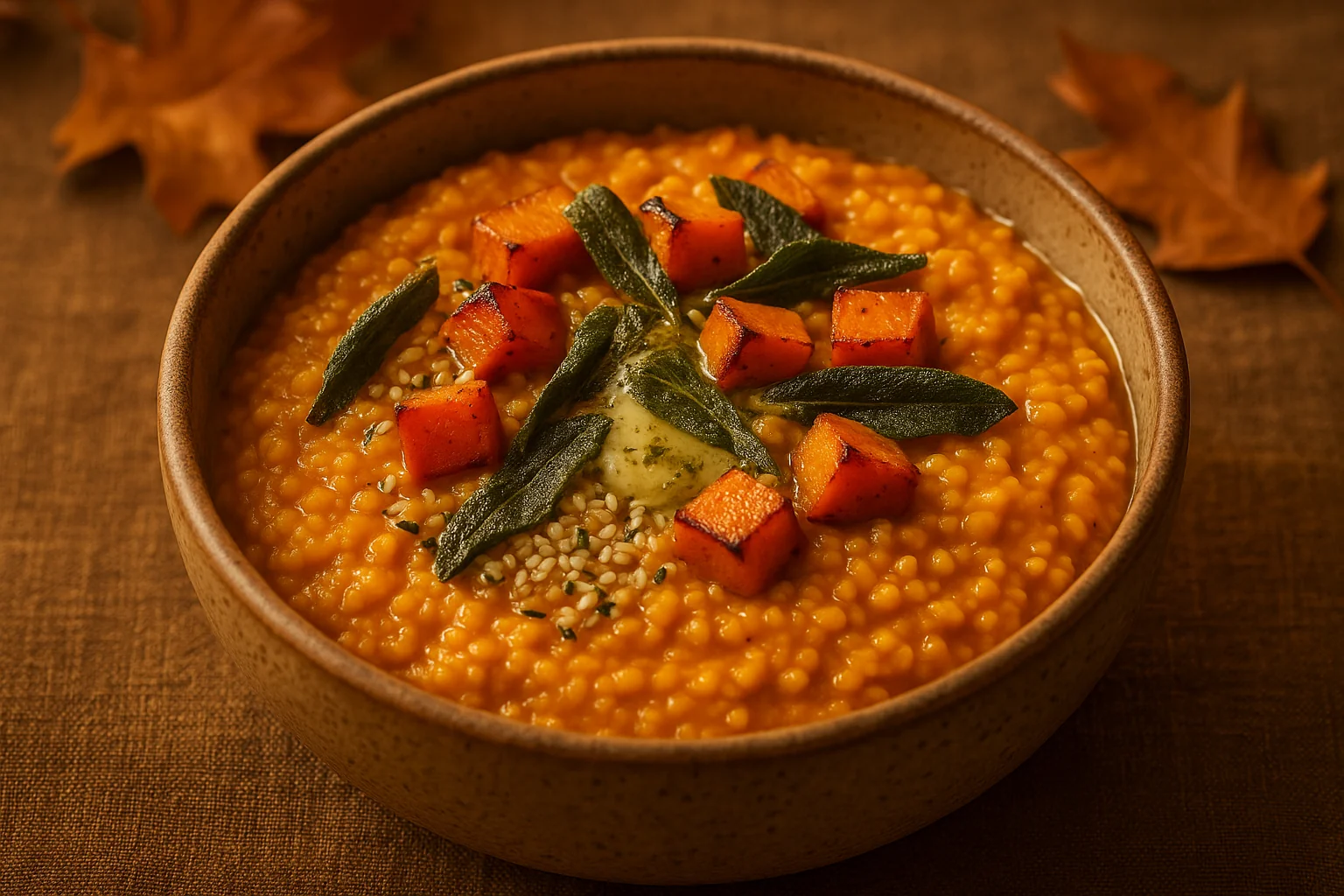

Pumpkin and hemp seed risotto - an autumn dish.
Pumpkin and hemp seed risotto – a creamy autumn dish step by step. Millet and hemp seeds create a protein-rich comfort food. Nutritional values.
Risotto is made with millet instead of arborio rice - and it is no flavor compromise. Millet, cooked using the risotto method with batch broth addition, releases starch and creates a creamy consistency fully comparable to the Italian original. Hokkaido pumpkin adds deep orange color and natural sweetness, while hulled hemp seeds at the end provide creaminess, nuttiness, and complete plant protein. Ready in 45 minutes, perfect for a cool autumn evening. I will show you how to do it step by step.
KEY INFORMATION
• Millet has a glycemic index of about 54 - lower than white rice (GI ~72) and provides about 11 g of protein/100 g dry (USDA FoodData Central, 2023).
• Hulled hemp seeds contain about 31 g of protein per 100 g and all 9 essential amino acids (House et al., Food Chemistry, 2010).
• 3 tablespoons of hemp seeds (30 g) provide about 166 kcal, 9 g of protein, and 14 g of fat (USDA FoodData Central, 2023).
• Hokkaido pumpkin provides about 4 mg of beta-carotene/100 g - a powerful antioxidant that is a precursor to vitamin A.
What does adding hemp seeds to kaszotto provide?
Millet is a valuable grain - it has a low GI of about 54, provides iron and magnesium - but its protein profile is incomplete. Like rice, it is low in lysine. Hemp seeds solve this problem: House et al. (Food Chemistry, 2010) confirm that they contain all 9 essential amino acids, including lysine. The combination of millet and hemp seeds creates an amino acid profile close to the WHO reference protein.
The creamy effect is equally important. The fats from hemp seeds (about 49% of mass, mainly PUFA according to Callaway, Euphytica, 2004) emulsify with the starch of millet in the same way that butter fats do in traditional risotto - creating a creamy consistency without dairy. Magnesium from hemp seeds (about 210 mg/100 g according to USDA FoodData Central) complements the magnesium from millet - together, both ingredients cover over 30% of the daily requirement in one serving.
We noticed in tests that millet reacts to the risotto technique differently than arborio rice - it cooks faster (about 20 minutes instead of 18-22 minutes for arborio) and is easier to overcook. The key is to observe the consistency, not to strictly adhere to the time: when the millet is al dente with a slight resistance, but not a hard center - it's time for the hemp seeds.
Nutritional values - what does this serving provide?
One serving of millet risotto (about 300 g) with millet, pumpkin, and hemp seeds provides about 380-420 kcal, 14 g of protein, 10 g of fat, and 60 g of carbohydrates. Beta-carotene from hokkaido pumpkin (about 4 mg/100 g of flesh) is better absorbed in the presence of fats from hemp seeds - the bioavailability of beta-carotene increases 3-5 times in a meal containing fat compared to a fat-free one.
Ingredients - what do you need?
Proporcje na 3-4 porcje. Czas przygotowania: 15 minut. Czas gotowania: 30 minut.
- 200 g of millet (dry)
- 500 g of hokkaido pumpkin (about 1/2 small pumpkin)
- 4 tablespoons of hulled hemp seeds (plus a teaspoon for decoration)
- 1 large onion
- 2 cloves of garlic
- 700-800 ml of vegetable broth (warm)
- 2 tablespoons of butter or olive oil
- a pinch of nutmeg
- salt and white pepper
- optional: sage leaves, 2 tablespoons of grated Parmesan or nutritional yeast
- 1 tablespoon of oil for roasting pumpkin pieces
How to prepare millet risotto with pumpkin and hemp seeds - step by step?
Cooking millet risotto requires regular stirring and adding broth in batches - just like risotto. This cannot be skipped, as this mechanical stirring releases the starch from the millet and creates creaminess. Roasting some of the pumpkin simultaneously saves time.
Step 1. Prepare the pumpkin and preheat the oven. Preheat the oven to 200°C. Cut the hokkaido pumpkin - leave the skin on (it is edible). Place half of the cubes (about 250 g) on a baking sheet with a tablespoon of oil and a pinch of salt. Bake for 20-25 minutes until golden. The rest of the pumpkin will go into the risotto raw.
Step 2. Rinse the grains and heat the broth. Rinse the millet under cold water for 1 minute - this removes bitterness. Heat the vegetable broth in a small pot and keep it hot throughout the cooking of the risotto.
Step 3. Sauté the onion and grains. In a wide pot, heat butter or oil over medium heat. Add finely chopped onion and sauté for 5 minutes. Add garlic and sauté for 1 minute. Add the rinsed millet and sauté for 2 minutes, stirring constantly - the grains will become golden and aromatic.
Step 4. Add the raw pumpkin and cook in batches. Add the raw pumpkin cubes (about 250 g) to the risotto. Pour in the first ladle of warm broth. Stir every 30 seconds. When the millet absorbs the broth, add another portion. Continue for 20-22 minutes until the millet is creamy and the pumpkin is soft and partially broken down - this is natural and desirable.
Step 5. Add hemp seeds and season. Remove from heat. Stir in the hulled hemp seeds and mix vigorously for 1 minute. Season with salt, white pepper, and nutmeg. Optionally, add a tablespoon of butter or lemon juice. The risotto should be creamy - if too thick, pour in 2-3 tablespoons of broth.
Tips and variations
Kaszotto is a versatile recipe for seasonal modifications:
Sage version. In a small pan, heat a tablespoon of butter and fry 8-10 leaves of fresh sage for 1-2 minutes until crispy. Drizzle this aromatic butter over the finished risotto. Sage and pumpkin is a classic combination in Italian cuisine, which here gains a nutty dimension thanks to the hemp seeds.
Mushroom version. Add 100 g of dried forest mushrooms (soaked and chopped) along with the raw pumpkin. The mushrooms enhance the umami of the risotto and create a deeper, meatier flavor. Use the mushroom broth as part of the broth - it emphasizes the forest aroma.
Apple version. For a sweet-salty contrast: add one sour apple (peeled, diced) along with the pumpkin. The apple will break down during cooking and impart a fruity acidity to the kaszotto, balancing the sweetness of the pumpkin.
Also check out our recipe for risotto with hemp seeds and mushrooms - a close cousin of risotto with the same technique of creaminess using hemp seeds.
Frequently Asked Questions
What is the difference between kaszotto and risotto?
Millet risotto is risotto made with millet instead of arborio rice. Millet has a GI of about 54 - lower than arborio rice (GI ~69) and contains more protein: about 11 g/100 g of dry mass (USDA, 2023). The technique is identical - adding broth in batches releases starch that creates creaminess, enhanced by hemp seeds.
Is millet gluten-free?
Millet is naturally gluten-free with a GI of about 54 - lower than white rice (~72) (Augustin et al., AJCN, 2002). Millet risotto with hemp seeds is completely gluten-free - just ensure that the vegetable broth used does not contain traces of gluten from additives.
How much protein does kaszotto with hemp seeds provide?
One serving with 50 g of millet (dry) and 20 g of hemp seeds provides about 12-15 g of protein. Millet contains about 11 g/100 g (USDA, 2023), hemp seeds about 31 g/100 g with a complete amino acid profile (House et al., 2010).
What type of pumpkin is best for kaszotto?
Hokkaido pumpkin is the best choice - edible skin, intensely orange flesh, and sweet taste. Once cooked, it breaks down perfectly, creamifying the sauce. Butternut squash also works, but requires peeling. The flesh of the pumpkin provides about 4 mg of beta-carotene/100 g - its bioavailability increases several times in the presence of fats from hemp seeds.
This article is for informational and educational purposes and does not replace consultation with a doctor. If you are pregnant, breastfeeding, taking medications, or have chronic conditions, consult the use of supplements or herbs with a specialist.
Author: Michał Waluk · Published: 2026-05-04 · Updated: 2026-05-04