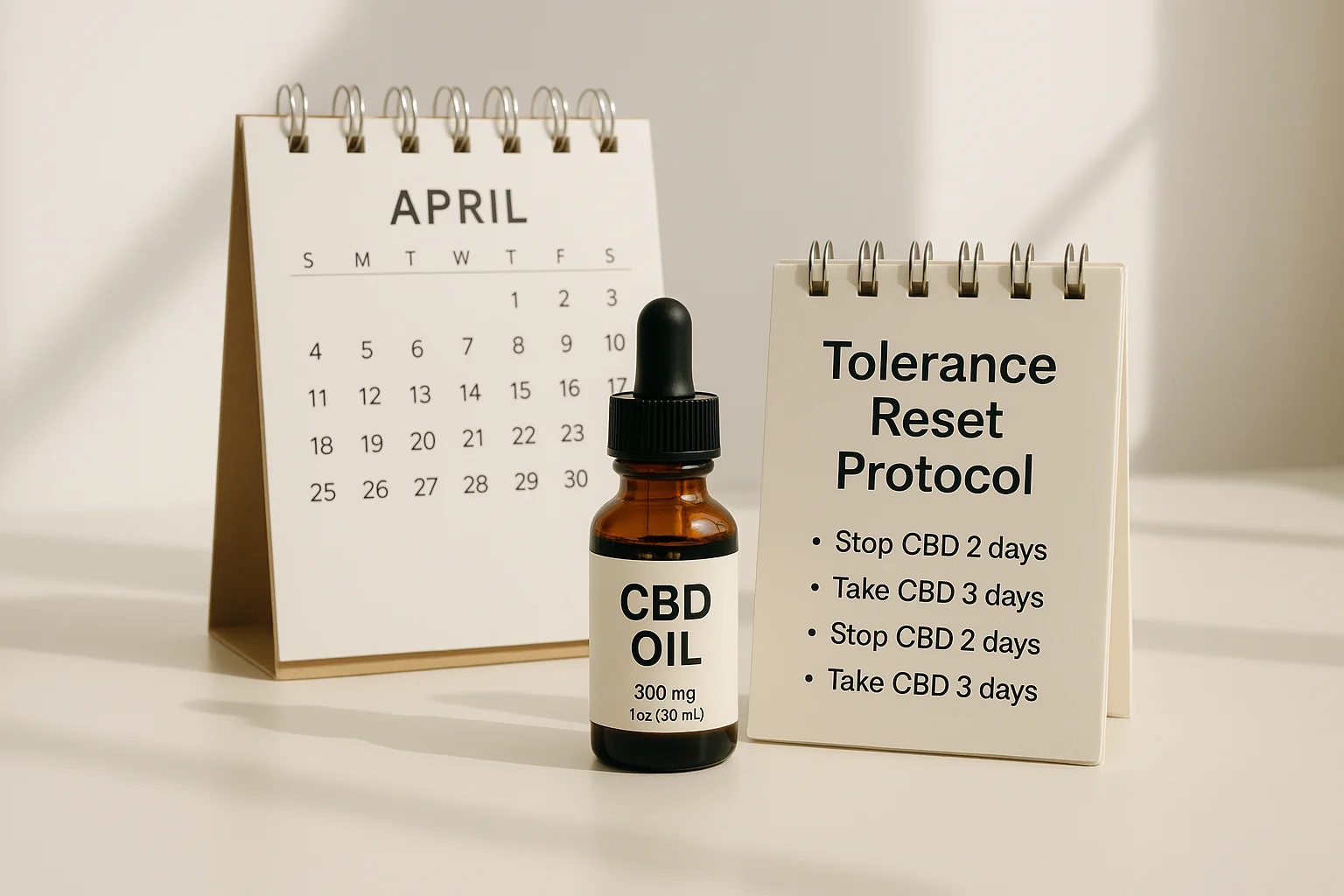

Why did CBD oil stop working - tolerance reset protocol according to Dr. Sulak
Why did CBD oil stop working: research-based answers. u Bucha.
You used CBD for several weeks and felt a noticeable difference. Then - gradually or suddenly - the effect disappeared. You increased the dose, but to no avail. This is one of the most common scenarios reported by CBD users and has its name: reduced sensitivity of the endocannabinoid system. Dr. Dustin Sulak, an osteopath and one of the most cited doctors specializing in cannabinoid medicine, developed a tolerance reset protocol based on a short-term break and re-calibration of the dose. Research on the mechanism indicates that adaptation of CB1 receptors and enzymes regulating endocannabinoids occurs after just a few weeks of regular use (Colizzi & Bhattacharyya, Frontiers in Psychiatry, 2020). This article explains the mechanism and describes step by step how to perform a tolerance reset.
KEY INFORMATION
• CBD operates according to a dose-response curve shaped like a bell curve - above the threshold, the effect decreases (Sulak, Healer.com, 2019).
• Adaptation of ECS receptors occurs after just a few weeks of regular cannabinoid use (Colizzi & Bhattacharyya, 2020).
• Sulak's protocol lasts 2 days - not weeks or months.
• Increasing the dose when the effect is lost is the most common mistake; the solution is to reset and return to a lower dose.
• A dosing journal helps distinguish tolerance from other causes of effect loss.
Why does CBD stop working - mechanism
The endocannabinoid system (ECS) is a homeostatic system - it strives for balance. When you regularly supply it with external cannabinoids, the ECS adapts: it reduces the number of active receptors or lowers their sensitivity. This process is known as desensitization and internalization of receptors. In the case of THC, which directly and strongly activates the CB1 receptor, this effect is quick and pronounced. In the case of CBD - which is not a CB1 agonist but an indirect modulator - adaptation is slower and subtler, but with prolonged use, it may be felt (Colizzi & Bhattacharyya, Frontiers in Psychiatry, 2020).
The second mechanism is the regulation of enzymes that break down endocannabinoids. CBD inhibits, among others, FAAH - the enzyme that degrades anandamide. With prolonged inhibition of FAAH, the body may compensatorily increase its production or activity, causing the level of anandamide to return to baseline despite the use of CBD.
A third reason, often overlooked: variable product quality between batches. A study by Bonn-Miller and colleagues published in JAMA showed that 69% of CBD products on the market contain a different amount of CBD than declared on the label (Bonn-Miller et al., JAMA, 2017). If you just finished one batch of the product and started another, the change in effect may result from differences in actual CBD content - not from tolerance.
Dose-response curve of CBD and the 'sweet spot'
CBD does not work on the principle of 'more = better'. Clinical and preclinical studies indicate a dose-response curve shaped like an inverted U (the so-called bell curve): the effect increases to a certain optimum, and above that dose, it begins to decrease or disappear. Dr. Sulak refers to this point as the 'sweet spot' - the minimum effective dose at which the effect is optimal.
This is illustrated by a study by Crippy and colleagues from 2011: CBD administered at doses of 100 mg and 900 mg reduced social anxiety, but the 300 mg dose yielded significantly better results than both extremes (Crippa et al., Neuropsychopharmacology, 2011). Practical conclusion: when CBD stops working and you increase the dose, you may be moving towards an area where the effect weakens - not strengthens.
Citation capsule (Crippa et al., 2011): In a randomized study, a dose of CBD 300 mg reduced social anxiety more effectively than doses of 100 mg and 900 mg. The authors confirmed the dose-response curve shaped like an inverted U, suggesting the existence of an optimal dosing range - exceeding it does not enhance the effect (Crippa et al., Neuropsychopharmacology, 2011).
Tolerance Reset Protocol by Dr. Sulak - step by step
Dr. Dustin Sulak described his protocol on Healer.com, where he works with patients using medical cannabis. Below is his core translated into practical steps:
Step 1 - baseline assessment (the day before the break). Before discontinuing CBD, assess your condition in 3 areas on a scale of 1-10: level of pain or discomfort, quality of sleep last night, overall level of anxiety or tension. Write down these numbers. They are your baseline.
Krok 2 - przerwa (2 dni). Set CBD aside for 48 hours. Sulak does not recommend longer breaks with just CBD - 2 days are sufficient to partially restore receptor sensitivity. If someone has also been using THC, the break may be longer (7-14 days), but that is a separate issue.
Krok 3 - minidawka (koniec dnia 2). On the evening of the second day, take a fraction of your previous dose - e.g., 1-2 mg of CBD if you were previously using 20-30 mg. Assess your condition after 2-4 hours using the same scale as in step 1. Has anything changed?
Krok 4 - stopniowe podnoszenie dawki. For the following days, increase the dose by 1-2 mg each day, assessing the effect. The goal is to find the minimum dose at which the effect is satisfactory. Often, this is significantly less than your previous dose.
Krok 5 - dziennik. Continue recording the dose and condition assessments in the same format. The journal helps detect when you exceed the sweet spot again or when the effect fades.
We have noticed that users who have gone through the Sulak protocol often discover that their 'new' effective dose after the reset is 2-3 times lower than what they were using before. This does not mean that CBD has become stronger - it means that the ECS receptors have regained the sensitivity they needed.
How to distinguish tolerance from other causes of effect loss?
Before starting the reset protocol, it is worth ensuring that you are indeed dealing with tolerance and not another cause. Here is the differential diagnosis:
- Change of product batch: check the CoA of the current and previous batch. If the actual CBD content differs significantly, the change in effect may stem from this, rather than from tolerance.
- New medication: any new prescription medication that interacts with CYP enzymes can alter CBD metabolism. If the effect faded shortly after starting a new medication, this is a likely cause.
- Lifestyle changes: worsening sleep, sudden stress, changes in diet low in fats - all of these affect the ECS and can weaken the effect of CBD even at the same dose.
- Progression of the condition: if you are using CBD for a specific health purpose and the condition is worsening, CBD may not keep up with the change - this is not tolerance, but insufficient action in the face of increasing need.
Does the tolerance reset work the same for everyone?
The answer is no. Individual differences in CBD metabolism, density of CB1 receptors, and FAAH activity mean that some users will feel the reset effect after 48 hours, others may need a week, and for some, the phenomenon of tolerance may be minimal at all. Genetic polymorphisms of the FAAH enzyme - that is, natural genetic variants of this protein - affect the rate of breakdown of anandamide and likely the susceptibility to CBD tolerance. Individuals with slower FAAH may experience less effect loss than those with the fast variant of the enzyme.
Age and the state of the endocannabinoid system also matter. In seniors, the ECS shows lower baseline levels of endocannabinoids and lower density of CB1 receptors in certain areas of the brain - which may cause both the effect of CBD and the dynamics of tolerance to differ from those in younger adults. This is another argument for an individualized approach and keeping a dosing journal instead of relying on ready-made schemes.
Frequently Asked Questions
Does CBD cause tolerance like THC?
CBD and THC differ in their mechanisms of action on the endocannabinoid system. THC directly activates the CB1 receptor, leading to its desensitization - this is the classic mechanism of tolerance. CBD modulates CB1 indirectly, so tolerance is weaker, although it may occur with prolonged use (Colizzi & Bhattacharyya, Frontiers in Psychiatry, 2020).
What is Dr. Sulak's tolerance reset protocol?
Dr. Dustin Sulak described a protocol based on a 2-day break from cannabinoids, preceded by a baseline assessment of symptoms on a scale of 1-10. After the break, one returns to a fraction of the previous dose and gradually increases to the effective minimum. The goal is to find the sweet spot at a lower dose than before the reset.
How long does the CBD tolerance reset take?
The Sulak protocol involves 2 days without cannabinoids or with a minimal dose. Longer breaks (7-14 days) are used when THC is also being used, but in the case of CBD alone, 48 hours are sufficient to partially restore ECS receptor sensitivity.
Is increasing the dose of CBD the solution when it stops working?
No. CBD operates according to an inverted U-shaped dose-response curve: above a certain threshold, additional milligrams do not enhance the effect and may actually weaken it. A study confirmed that a dose of 300 mg of CBD was more effective than 900 mg in reducing anxiety (Crippa et al., Neuropsychopharmacology, 2011).
When does CBD stop working due to tolerance, and when for other reasons?
Tolerance is just one of the possible causes. Others include: a change in product batch with a different actual CBD content, a new medication interacting, lifestyle changes affecting the ECS, or progression of the condition. A dosing journal helps distinguish these scenarios - especially if the effect diminished after a specific event.
This article is informational and educational in nature. It contains internal links to products available in the u Bucha store. Prices and specifications may change - please check the current data on the product page before purchasing.
Author: Michał Waluk · Published: 2026-05-04 · Updated: 2026-05-04