
Iron overload - overload, oxidation, and who SHOULD NOT supplement
Iron overload: safety, upper limits, and interactions in the table. u Bucha.
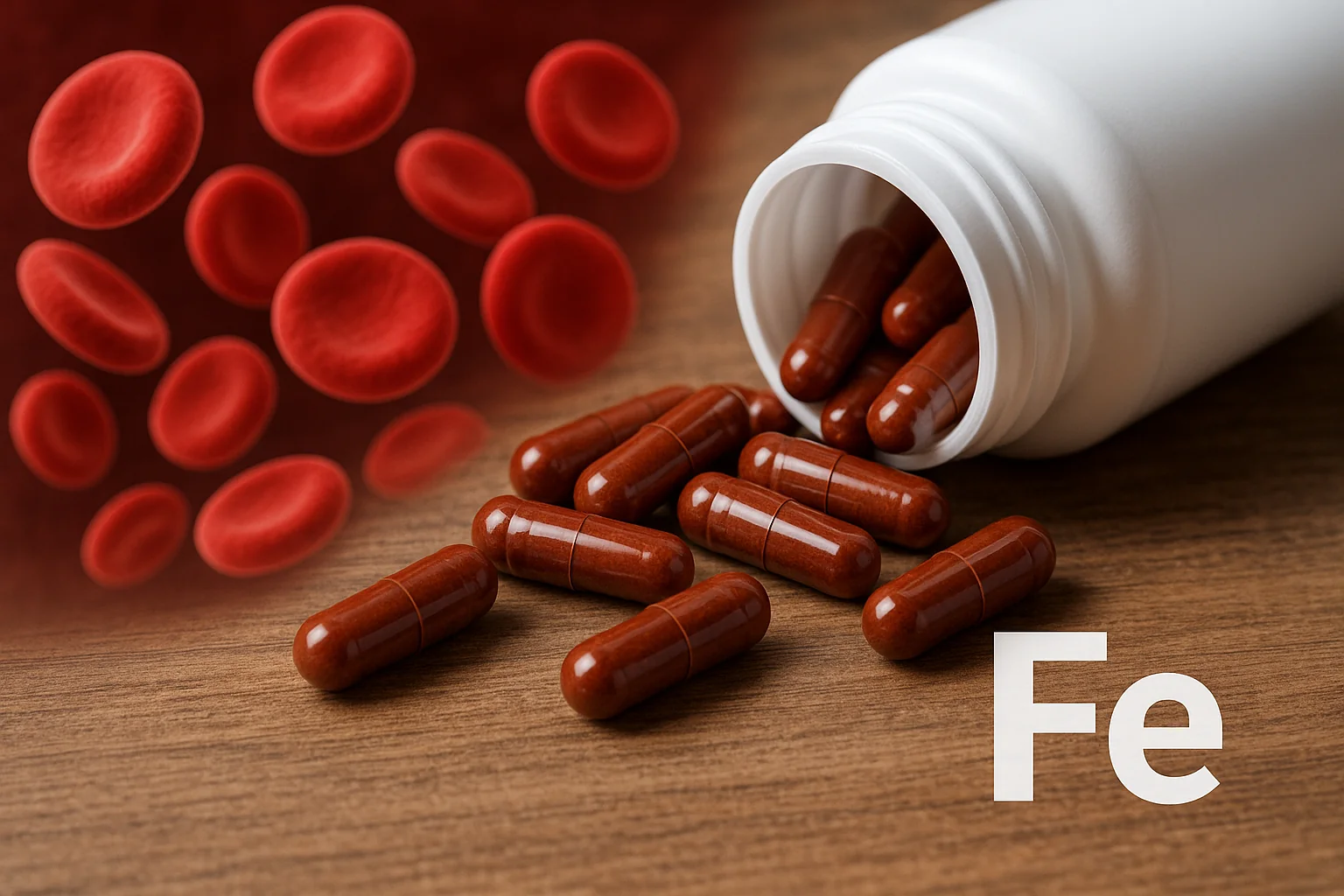
Iron saves lives - but only when it's lacking. The belief that iron supplementation is always safe is one of the more dangerous myths in nutrition. According to the NIH Office of Dietary Supplements, the upper safe limit of iron for adults is 45 mg per day from all sources - and popular preparations often provide 100-200 mg in a single capsule (NIH ODS, 2023). This article explains what happens with excess iron in the body, who is particularly at risk for harm, and what the risk group table looks like.
KEY INFORMATION
• The upper safe limit of iron (UL) for adults is 45 mg/day - NIH ODS, 2023.
• Excess iron catalyzes the Fenton reaction and produces reactive oxygen species that damage DNA and organs.
• Hereditary hemochromatosis affects about 1 in 300 individuals of European descent (Eur J Hum Genet, 2019).
• Men and postmenopausal women rarely have iron deficiency - supplementation without indications increases risk.
• Before iron supplementation, always perform a complete blood count and ferritin test - do not supplement 'preventively'.
How does excess iron damage the body?
Free iron (Fe²⁺) is a strong pro-oxidant. It catalyzes the so-called Fenton reaction - the conversion of hydrogen peroxide into a highly reactive hydroxyl radical that destroys cell membranes, proteins, and DNA strands (Winterbourn, Nat Chem Biol, 2008). This is the same mechanism that underlies organ damage in untreated hemochromatosis over the years.
The body has buffering systems: transferrin transports iron in the blood, and ferritin stores it in cells in a safe form. The problem arises when these systems are overloaded. When transferrin saturation exceeds 70-80%, non-transferrin-bound iron (NTBI) appears in the serum. This pool is the most toxic and easily penetrates the liver, heart, and pancreas.
In a healthy person with normal iron stores, excess iron taken orally will largely be excreted in the stool - regulatory mechanisms (hepcidin) limit absorption. But with high supplemental doses or a genetic defect in regulation (hemochromatosis), these mechanisms fail. The result: iron accumulates for years, causing liver cirrhosis, cardiomyopathy, and diabetes - before the first symptoms appear.
We have noted that the clinical literature consistently highlights one paradox: iron is the only trace element for which the human body lacks an efficient active excretion mechanism. Everything that is not blocked in the intestines by hepcidin ends up in the tissues - and stays there. This is a fundamental difference compared to zinc or selenium, which are actively excreted by the kidneys and in feces.
Risk group table - who SHOULD NOT supplement iron without indications?
Before reaching for an iron supplement, check if you belong to a group where supplementation without confirmed deficiency is potentially harmful. The table below classifies groups by risk level and provides specific diagnostic indications. This is an informational tool - the decision to supplement is made by a doctor based on test results.
| Group | Excess Risk | Reason | What to do |
|---|---|---|---|
| Adult men (18-65 years) | High | No physiological loss of iron due to menstruation; stores increase over the years | Testing before supplementation; supplement only with confirmed deficiency |
| Postmenopausal Women | High | The cessation of menstruation eliminates the main route of iron excretion | Ferritin + complete blood count every 2 years; do not supplement multivitamins with iron without indications |
| HFE mutation carriers (hemochromatosis) | Very high | Genetic regulation defect - iron absorption 3-5× higher than in healthy individuals | Absolute prohibition of supplementation; regular phlebotomies under the supervision of a hematologist |
| Individuals with liver diseases (NAFLD, cirrhosis) | High | The liver is the main storage site for iron; a damaged liver accumulates NTBI | Hepatology consultation before any supplementation |
| Individuals with inflammatory bowel disease (IBD) | Medium-high | Oral iron increases inflammation of the intestinal mucosa; intravenous form recommended | Prefer i.v. iron under the supervision of a gastroenterologist; avoid oral iron salts |
| Individuals regularly receiving transfusions | Very high | Each unit of blood provides about 250 mg of iron - without an excretion mechanism | Iron chelation under the supervision of a hematologist; no additional supplementation |
| Menstruating women (heavy bleeding) | LOW | Regular loss of iron with blood; the most common justified indication for supplementation | Ferrytyna + morfologia; suplementuj przy ferrytynie <30 µg/L |
| Pregnant women | Supervised | Demand increases to 27 mg/day; but excess can harm the fetus | Only preparations recommended by the doctor supervising the pregnancy; do not exceed the prescribed dose |
Hemochromatosis - the most common genetic iron overload disorder
Hereditary hemochromatosis (HFE-HH) affects about 1 in 300 people in the European population, making it the most common monogenic metabolic disorder in this ethnic group (Bacon et al., Eur J Hum Genet, 2020). A mutation in the HFE gene (most commonly C282Y) causes the hepcidin signal to be abnormal - the intestines absorb iron regardless of how much is present in the body.
The paradox of hemochromatosis is that the disease can develop for years without any symptoms. Symptoms - fatigue, joint pain, skin darkening, impotence in men - only appear when iron accumulates to several grams (the norm is 3-4 g). Until that time, the patient feels healthy and - if not genetically tested - may unknowingly supplement iron "for energy", accelerating accumulation.
Treatment of hemochromatosis is effective but requires consistency: phlebotomy (bloodletting) every 1-2 weeks during the induction phase, then 3-4 times a year for life. If the disease is diagnosed before organ damage occurs, the patient has a normal life expectancy. The key is early screening - especially in families with a history of "unclear" cirrhosis, arthropathy, or cardiomyopathy.
How to interpret iron test results? Not just ferritin
Ferritin is the most popular indicator of iron stores, but on its own, it can be misleading. Ferritin is an acute phase protein - its concentration rises in any inflammatory state, infection, autoimmune disease, and even with alcohol consumption - with no relation to the actual iron stores in the body (Camaschella, NEJM, 2015).
A complete iron metabolism diagnosis includes four indicators. Serum ferritin reflects long-term reserves - but only in the absence of inflammation. Transferrin saturation (TSAT) indicates what percentage of transferrin is saturated with iron - values above 45% suggest excess. TIBC (total iron-binding capacity) is inversely proportional to reserves. Serum iron concentration fluctuates daily and has limited interpretative value on its own. Only the combination of these four parameters provides a picture of whether iron levels are normal, too high, or too low.
Clinical practice shows that primary care physicians most often order only ferritin. This leads to errors on both sides: elevated ferritin in an inflammatory state is mistakenly interpreted as excess (when there is none), and normal ferritin during active inflammation can mask a true deficiency. If your doctor has only ordered ferritin and you have inflammation or an active infection, the result may be misleading.
Iron interactions with medications and other supplements
Iron interacts with several groups of medications that are popular in the Polish population. Proton pump inhibitors (omeprazole, pantoprazole) reduce the absorption of non-heme iron because they decrease stomach acidity necessary for converting Fe³⁺ to Fe²⁺ (NIH ODS, 2023). Tetracyclines and quinolones form insoluble chelates with iron, reducing the absorption of both substances - iron decreases the effectiveness of the antibiotic, and the antibiotic blocks iron. Levothyroxine (Euthyrox) requires a 4-hour gap after taking iron - iron binds to thyroid hormone in the intestine.
At the supplementation level: vitamin C (ascorbic acid) can increase the absorption of non-heme iron by up to three times, so its use when supplementing iron can disrupt the intended dosing effect and lead to higher absorption than planned. Zinc and calcium compete with iron for the same intestinal transporters - taking them together reduces iron absorption. Therefore, iron supplements are usually taken 2 hours before or after other minerals.
Symptoms of acute and chronic iron overload
Acute iron poisoning - most often in children who accidentally ingested iron supplement tablets intended for adults - is a life-threatening condition. Symptoms include vomiting, diarrhea, abdominal pain, and in more severe cases, shock and multi-organ failure. The upper toxic dose is about 20 mg of iron per kg of body weight - for a child weighing 15 kg, this is just 3 tablets of a typical 100 mg preparation.
Chronic iron overload is insidious. Initially: fatigue, joint pain (especially fingers, hips), abdominal pain, decreased libido. In later stages: elevated liver enzymes, heart rhythm disturbances, diabetes (pancreatic damage). The skin darkens - hence the historical name "the disease of bronze diabetics". In advanced stages: liver cirrhosis and atherosclerotic heart due to iron deposits in the heart muscle.
A key warning signal: fatigue and "brain fog" in a man over 40 who has never been tested for iron metabolism and has taken iron-containing supplements in multivitamins for many years. This is one of the most commonly overlooked patterns in clinical practice.
Frequently Asked Questions
What is the upper safe limit of iron for adults according to EFSA?
EFSA has established a tolerable upper intake level (UL) of iron for adults at 40 mg per day from supplements and fortified foods combined. The NIH Office of Dietary Supplements provides a similar value - 45 mg/day for individuals over 14 years of age (NIH ODS, 2023). Doses above these limits require medical supervision.
Who absolutely should not supplement iron without testing?
Individuals with hereditary hemochromatosis, men over 50 without confirmed deficiency, postmenopausal women without anemia, and individuals with liver diseases. In these groups, excess iron accumulates in organs and leads to cirrhosis, cardiomyopathy, and diabetes - often without symptoms for many years (Bacon et al., 2020).
How does excess iron damage cells?
Free iron (Fe²⁺) catalyzes the Fenton reaction, producing hydroxyl radicals that destroy cell membranes, proteins, and DNA. This mechanism is identical to that which causes organ damage in hemochromatosis - the liver, heart, and pancreas are the most susceptible (Winterbourn, 2008).
Does high ferritin always indicate excess iron?
No. Ferritin is an acute phase protein - it rises in any inflammatory state regardless of iron stores. Only the combination of ferritin with transferrin saturation (TSAT) and TIBC allows distinguishing real iron excess from elevated ferritin caused by inflammation (Camaschella, NEJM, 2015).
Can heme iron from meat also cause overload?
Yes, although it is more difficult than with supplements. Heme iron is absorbed at 15-35%. With an HFE mutation, even a normal diet rich in red meat can lead to gradual iron accumulation - which is why genetic testing and possible restriction of offal and red meat are recommended in families with a history of hemochromatosis.
This article is for informational and educational purposes and does not replace consultation with a doctor. If you are pregnant, breastfeeding, taking medications, or have chronic conditions, consult the use of supplements or herbs with a specialist.
Author: Michał Waluk · Published: 2026-05-04 · Updated: 2026-05-04