


Berberine vs metformin: depth of scientific evidence
Berberine vs metformin: what original studies show, where the evidence ends, and why a supplement cannot be exchanged for a prescription drug without a doctor.
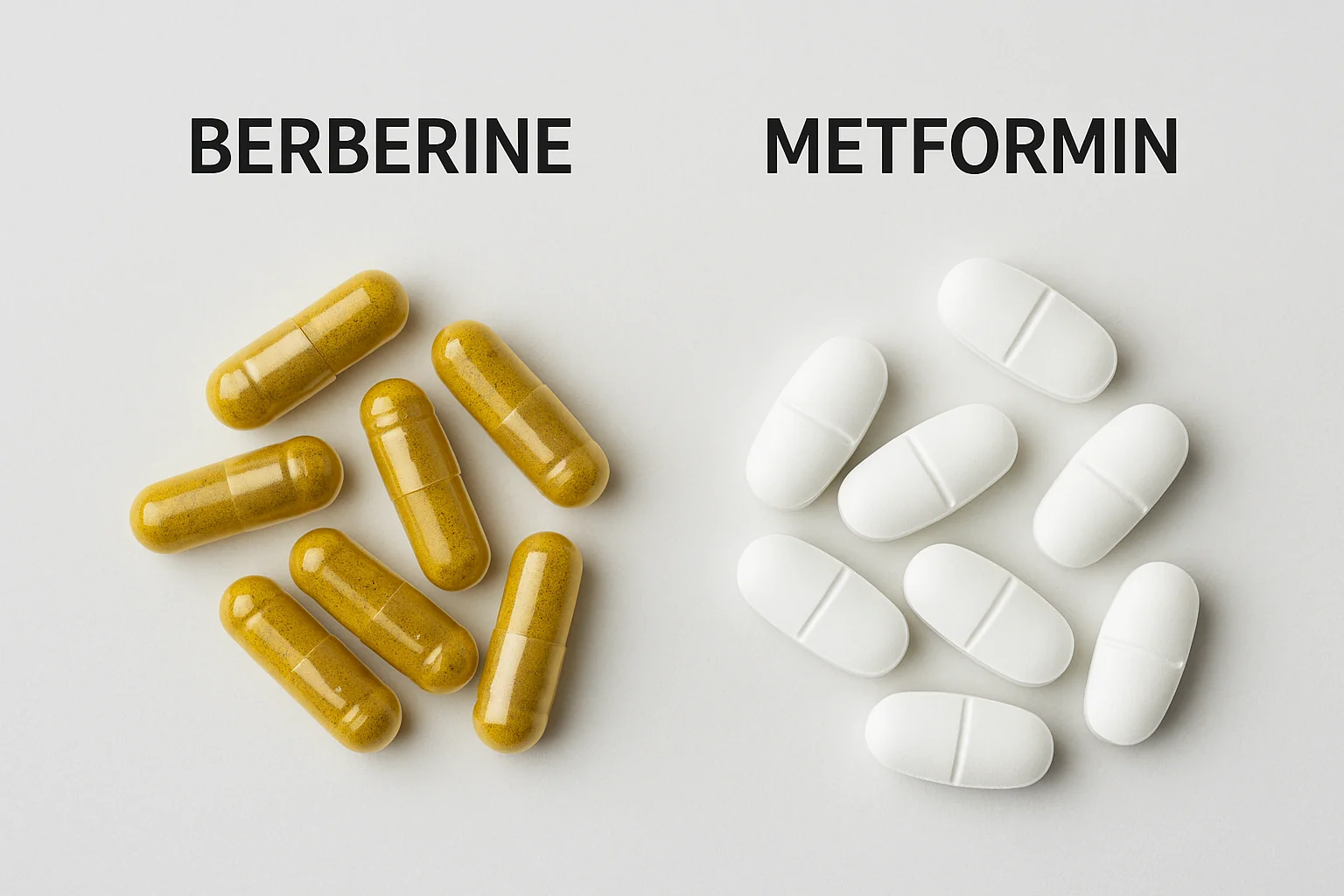
Berberine is sometimes called natural metformin, and this comparison sells it better than any description of its composition. There is indeed a common point: both substances lead to the activation of AMPK and both lower glycemia. The rest of the picture looks different. Metformin has a randomized trial with a median follow-up of 10.7 years, during which it reduced the number of deaths from any cause by 36% in overweight individuals with type 2 diabetes (UKPDS 34, Lancet, 1998). Berberine has a set of short trials, most often three months long. Does this mean it doesn't work? It doesn't. It means we know much less about it and that we know different things. Below we show what the original works say about both substances and where the evidence ends and marketing begins.
KEY INFORMATION
• In the UKPDS 34 trial, metformin reduced the number of deaths from any cause by 36% with a median follow-up of 10.7 years (UKPDS Group, Lancet, 1998).
• In the European Union, berberine is sold as a dietary supplement, not as a diabetes medication.
• Berberine inhibits CYP2D6 and CYP3A4, thus altering the concentrations of many drugs in the blood.
• Never stop taking metformin on your own.
Can berberine replace metformin?
No. Metformin is a prescription drug tested in a randomized trial with a median follow-up of 10.7 years: in the metformin group, the risk of death from any cause was 36% lower, and the risk of death from diabetes was 42% lower than with conventional treatment (UKPDS 34, Lancet, 1998). Berberyna nie ma badania tej klasy.
The difference is not that one substance works and the other does not. It lies in what is known about the effects of their use over the years. Studies on berberine measure glycemia, glycated hemoglobin, and lipids, which are intermediate parameters. UKPDS measured diabetes complications and deaths. These are two different levels of certainty, and no meta-analysis of intermediate parameters elevates berberine to that second level.
The practical conclusion is brief: if you are taking metformin, do not stop it on your own and do not reduce the dose after reading an article on the internet, including this one. Stopping a hypoglycemic medication without supervision risks losing glycemic control, and the effects are only visible in the results after months. The decision to change treatment is made by the attending physician based on your tests. The reverse situation, i.e., adding berberine to metformin on your own, is also not neutral: both lower glycemia, so together they may lower it more than you planned.
How do berberine and metformin act on the AMPK pathway?
Both lead to the activation of AMPK kinase, but they approach it from different angles. Metformin activates AMPK in hepatocytes, and blocking this kinase negates its effect on glucose production by the liver (Zhou et al., Journal of Clinical Investigation, 2001). This is the first coherent description of the mechanism of this drug.
Berberine targets the same metabolic node through a different pathway. In rat muscle cells, it stimulates glucose uptake regardless of insulin concentration, strongly phosphorylates AMPK and p38 MAPK, and the effect disappears after blocking either of these kinases (Cheng i in., Biochimica et Biophysica Acta, 2006). It should be clarified what this work is: a study on a cell line, not on patients.
The second mechanism of berberine has no counterpart on the metformin side. The oral bioavailability of berberine is very low, so a significant part of its action takes place in the intestine, interacting with the microbiota, which itself changes under its influence (Cheng i in., Journal of Pharmaceutical Analysis, 2022). The authors of this review consider this interaction a condition for understanding the mechanism, rather than a proven benefit for the patient.
The overlapping mechanisms explain the similar direction of action. They do not explain the similar certainty of the outcome, as this comes from studies on humans, not from the description of the signaling pathway.
What does the point-by-point comparison of berberine and metformin show?
The table below compares both substances according to legal status, mechanism, and quality of evidence. The numbers come from studies cited in this article, not from supplement manufacturers' materials.
| Feature | Berberine | Metformin |
|---|---|---|
| Status | Suplement diety, bez recepty | Prescription medication |
| AMPK activation | Demonstrated in rat muscle cells (Cheng et al., 2006) | Demonstrated in hepatocytes and muscles (Zhou et al., 2001) |
| Najszersze badanie u ludzi | Meta-analysis of 27 trials, 2569 patients (Lan et al., 2015) | Randomized trial, median 10.7 years (UKPDS 34) |
| Hard endpoints | Brak danych | Overall deaths reduced by 36%, diabetes-related deaths by 42% |
| Fasting glucose | 0.52 mmol/l lower than with placebo (Liu et al., 2025) | Hemoglobina glikowana 7,4% wobec 8,0% w grupie kontrolnej |
| Cholesterol LDL | 0.50 mmol/l lower than with placebo (Liu et al., 2025) | No hypolipidemic indication |
| Typowy czas obserwacji | Three months | Do kilkunastu lat |
| Drug interactions | Hamowanie CYP2D6 i CYP3A4 (Bathaei i in., 2025) | Opisane w charakterystyce produktu leczniczego |
| Who determines the dosage | Producent suplementu | Attending physician |
The columns of this table are not symmetrical, and that is its content. On the berberine side are laboratory parameters from short trials, while on the metformin side are complication numbers from a decade-long study. Comparing them side by side does not equate the two substances but shows how much more the former lacks to reach the status of the latter.
What have clinical studies on berberine really shown?
The most frequently cited work is the pilot study by Yin and colleagues from 2008. In its first part, 36 individuals with newly diagnosed type 2 diabetes were randomly assigned to berberine or metformin at 0.5 g three times a day for three months. Glycated hemoglobin decreased in the berberine group from 9.5% to 7.5% (Yin et al., Metabolism, 2008).
The authors described the hypoglycemic effect of berberine as similar to that of metformin, and this single sentence forms the basis of all subsequent marketing. The rest of the work appears more modest: in the second part, 48 individuals with poorly controlled diabetes received berberine as an adjunct to their existing treatment, glycated hemoglobin decreased from 8.1% to 7.3%, and transient gastrointestinal complaints occurred in 34.5% of participants. The authors themselves referred to their work as a pilot study.
A broader picture is provided by a meta-analysis of 27 randomized trials involving 2569 patients. Berberine added to lifestyle changes reduced fasting glucose, postprandial glucose, and glycated hemoglobin more than lifestyle changes alone, but in direct comparison with oral antidiabetic medications, the difference did not reach statistical significance (Lan i in., Journal of Ethnopharmacology, 2015).
A newer meta-analysis of placebo-controlled trials confirms the direction and provides figures: fasting glucose lower by 0.52 mmol/l, triglycerides by 0.37 mmol/l, LDL cholesterol by 0.50 mmol/l, waist circumference smaller by 3.3 cm. Berberine did not change blood pressure. The authors conclude that it may be a valuable supplement and that better-designed trials are needed (Liu i in., Frontiers in Pharmacology, 2025).
Jakie interakcje lekowe ma berberyna?
Berberine alters the activity of enzymes that metabolize most drugs. A review of data on barberry and berberine indicates an effect on isoforms CYP3A4/5, CYP2D6, CYP2C9, CYP2E1, and CYP1A1/2, with the authors considering the inhibition of CYP2D6 and CYP3A4 as the most clinically significant (Bathaei i in., Naunyn-Schmiedeberg’s Archives of Pharmacology, 2025).
What this means for the home medicine cabinet. CYP3A4 is responsible for the metabolism of some statins and cyclosporine, while CYP2D6 is responsible for the metabolism of many psychiatric medications and beta-blockers. Inhibition of these enzymes means that the same tablet results in higher drug concentrations in the blood. The authors of the review conclude with a recommendation to inquire about potential interactions before recommending barberry.
We have noticed in conversations with clients that the most frequent inquiries about berberine come from those who are already taking something regularly: a statin, a blood pressure medication, or an antidepressant. This is precisely the group for whom self-purchasing is the most risky. Berberine does not behave like an herbal tea, but rather like a substance with a measurable impact on drug metabolism.
The practical rule is simple. Show your doctor or pharmacist a list of everything you are taking before adding berberine to it. Interactions through cytochrome P450 do not present warning symptoms that could be recognized at home.
Who should not use berberine?
A toxicological review of barberry and berberine recommends caution in three specific situations: during pregnancy, in newborns, and in cases of glucose-6-phosphate dehydrogenase deficiency. The same study lists dose-dependent adverse effects, including gastrointestinal irritation and jaundice (Rad i in., Iranian Journal of Basic Medical Sciences, 2017).
Additionally, there is a group that texts about berberine often overlook: individuals already treated with hypoglycemic medications. Adding another substance that lowers blood sugar to metformin or a sulfonylurea derivative increases the risk of hypoglycemic episodes, and with sulfonylurea derivatives, hypoglycemia can be severe.
Caution is also required for individuals with liver disease. Berberine is metabolized with the involvement of cytochrome P450, and impaired liver function alters its fate in the body. If you have elevated liver enzyme levels, the topic of berberine begins with a visit to the doctor, not with a purchase.
Breastfeeding is a separate issue. There is too little data on the transfer of berberine into milk to recommend anything, and regarding newborns, the cited toxicological review advises caution. A lack of data is not evidence of safety, but rather a lack of evidence in both directions.
What is known about berberine in polycystic ovary syndrome?
A meta-analysis of 10 randomized studies involving 713 women with PCOS showed that berberine added to conventional treatment improved the ovulation rate (RR 1.41) and the clinical pregnancy rate (RR 1.96), and also lowered luteinizing hormone and total testosterone levels (Ha i Song, Explore, 2024).
Note the word "added." In this meta-analysis, berberine was an adjunct therapy, compared to conventional treatment alone, not a replacement. This is a completely different research question than "does berberine replace metformin in PCOS," and this study does not provide answers to the latter.
The authors themselves caution that further clinical studies are needed before definitive conclusions can be drawn. In practice, this means discussing with a gynecologist or endocrinologist, not self-purchasing, especially since hormonal preparations are often used concurrently in PCOS, which berberine may alter the metabolism of.
We have noticed that inquiries about berberine in the context of PCOS most often come from individuals who poorly tolerate metformin in terms of stomach issues. The motivation is understandable, but berberine also causes gastrointestinal discomfort: in a pilot study by Yin and colleagues, it occurred in 34.5% of participants. Switching one substance for another for this reason is not an obvious win.
Which products at u Bucha contain barberry?
The u Bucha store does not have a product with berberine and does not pretend to. In the entire catalog, checked on August 8, 2026, no product has berberine or barberry in its name. Barberry appears as one of the ingredients in three oil macerates from the Aura Care line.
| Product | What distinguishes it | Price | Koszt 1 ml |
|---|---|---|---|
| Aura Care Adaptogeny Cukier w Normie 15 ml | Barberry 300 mg per serving, alongside gurmar, chaga, white mulberry, and cinnamon | 99.00 PLN | 6.60 zł |
| Aura Care Podjadanie STOP 15 ml | Indian barberry 200 mg per serving, alongside gurmar and lion's mane | 99.00 PLN | 6.60 zł |
| Aura Care Healthy Liver 15 ml | Barberry 75 mg per serving, a formula built around milk thistle | 99.00 PLN | 6.60 zł |
The conversion factor here is the cost of one milliliter, as the manufacturer provides the serving in drops, and the number of drops in the bottle is only given for some products. Prices are sourced from the store's API and are valid as of August 8, 2026.
Three clarifications to avoid misunderstandings. None of these products are medications or standardized extracts of berberine; the manufacturer declares oil macerates with a DER of 1:1. None are indicated for diabetes. None are an alternative to pharmacotherapy conducted by your doctor.
Frequently Asked Questions
Can berberine replace metformin?
No. Metformin is a prescription medication, tested in a randomized trial with a median follow-up of 10.7 years, in which it reduced the number of deaths from any cause by 36% (UKPDS 34, 1998). Berberine is a dietary supplement and there is no study measuring hard endpoints. Never discontinue metformin without your doctor's decision.
How does berberine lower glucose levels?
In rat muscle cells, berberine stimulates glucose uptake regardless of insulin concentration, strongly phosphorylating AMPK and p38 MAPK; blocking either of them negates the effect (Cheng i in., 2006). This is cellular-level work, so it describes the mechanism, not the effectiveness in patients.
How many studies does berberine have compared to metformin?
The largest meta-analysis of berberine included 27 randomized studies involving 2569 patients (Lan i in., 2015), with a typical observation period of three months. Metformin has the UKPDS 34 trial behind it with a median observation of 10.7 years and measurements of mortality and complications. This is a difference in depth, not in the direction of results.
What side effects does berberine have?
In the pilot study by Yin and colleagues, transient gastrointestinal complaints occurred in 34.5% of participants (Metabolism, 2008). The toxicological review also mentions dose-dependent gastrointestinal irritation and jaundice and recommends caution during pregnancy, in newborns, and with glucose-6-phosphate dehydrogenase deficiency.
What dose of berberine was used in studies?
In the pilot study by Yin and colleagues, patients received 0.5 g of berberine three times a day for three months (Metabolism, 2008). This is not a dose approved by any regulatory body, as berberine is not a drug. The supplement dosage is determined by the manufacturer, and in the case of ongoing pharmacotherapy, it should be established with a doctor.
Does berberine work in polycystic ovary syndrome?
A meta-analysis of 10 randomized studies involving 713 women with PCOS showed that adding berberine to conventional treatment improved the ovulation rate and the rate of clinical pregnancies and reduced total testosterone (Ha i Song, 2024). Berberine was an adjunct therapy there, not a replacement for treatment.
Herbal and vitamin preparations from the shelf at u Bucha can be found in the category Supplements; discuss the choice of a specific preparation for chronic treatment with your doctor beforehand.
This article is for informational and educational purposes and does not constitute medical advice. Before starting supplementation, consult your doctor, especially if you are taking medications regularly, are pregnant or breastfeeding, or have a chronic illness.
Author: Michał Waluk · Opublikowano: 2026-08-05 · Aktualizacja: 2026-08-08