
Supplements for adrenal fatigue: ashwagandha, B5, and rhodiola
A systematic review from 2016 did not confirm the existence of adrenal fatigue. We check what studies have shown about ashwagandha, rhodiola, B5, and vitamin C.
Type "adrenal fatigue" into the search engine, and you will find supplementation protocols, diets, and dosage tables. Look for the term "adrenal fatigue" in the scientific publication database, and you will come across a systematic review whose title states outright: adrenal fatigue does not exist. This discrepancy does not mean that the symptoms are fabricated. It means that the name given to them describes a mechanism that no one has confirmed by measurement. Below you will find what can be defended today: what exactly has been checked and with what results, what diseases need to be excluded by a doctor before you reach for anything from the shelf, and how the studies on ashwagandha, rhodiola, vitamin B5, and vitamin C look, when to read them carefully to the end, along with the results section, and not just the summary.
KEY INFORMATION
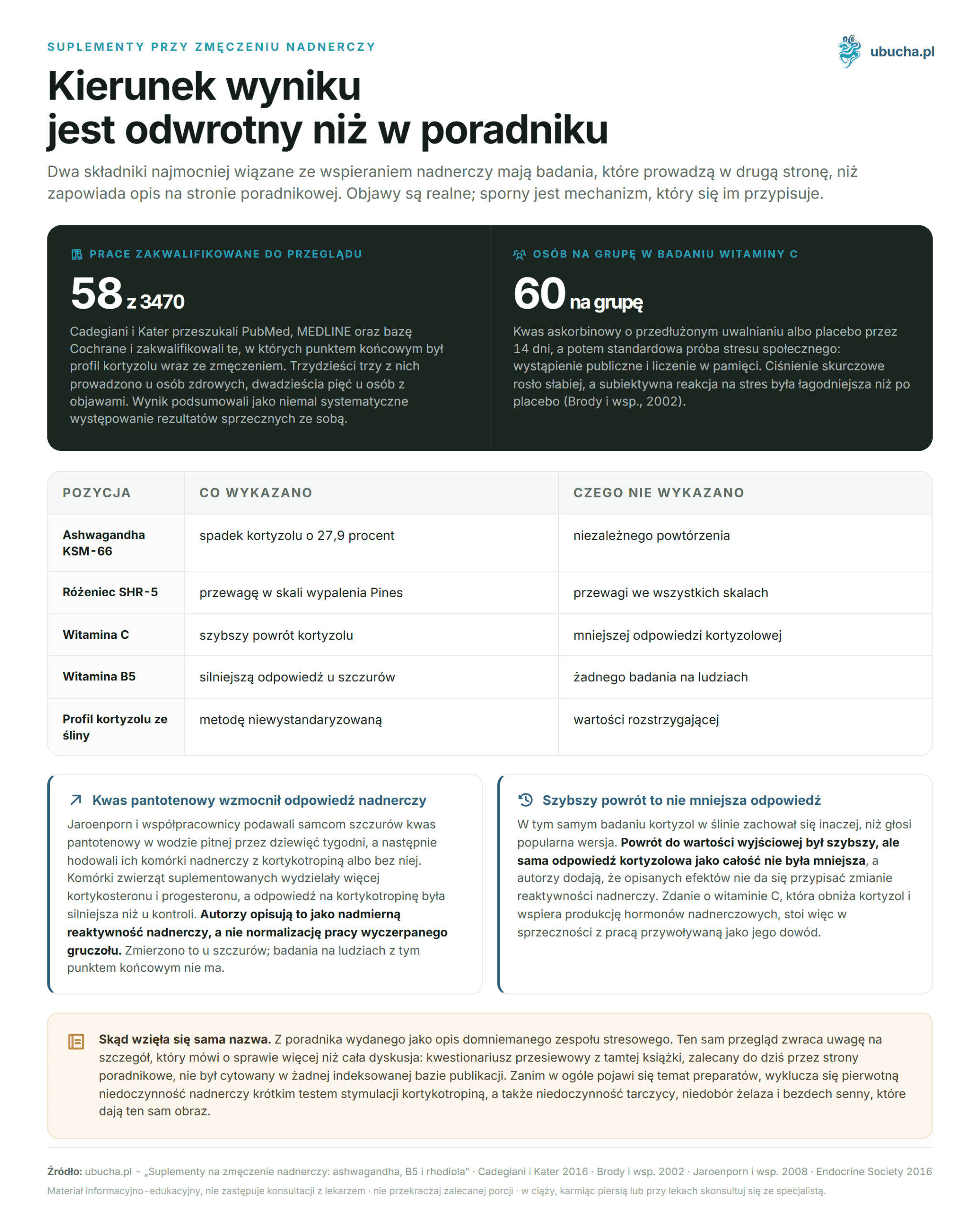
• The systematic review by Cadegiani and Kater (BMC Endocrine Disorders, 2016) analyzed 58 studies on cortisol and found no confirmation for "adrenal fatigue" as a disease entity.
• In the study by Chandrasekhar (Indian Journal of Psychological Medicine, 2012) involving 64 individuals with chronic stress, serum cortisol levels decreased by 27.9 percent after 60 days compared to 7.9 percent in the placebo group.
• Brody et al. (Psychopharmacology, 2002) noted a faster return of cortisol to baseline after vitamin C, but not a smaller overall cortisol response.
• Primary adrenal insufficiency is diagnosed by a corticotropin stimulation test and is treated continuously with hormones, not adaptogens.
Is "adrenal fatigue" a real diagnosis?
This is not a unit recognized by any endocrinological society, and attempts to find evidence for it have ended in negative results. Cadegiani i Kater (BMC Endocrine Disorders, 2016) They searched PubMed, MEDLINE, and the Cochrane database, and from 3470 articles found, they qualified 58, in which the endpoint was cortisol profile along with fatigue or energy levels.
Thirty-three of these studies were conducted on healthy individuals, and twenty-five on those with symptoms. The most commonly used measurements were direct cortisol measurement upon awakening, cortisol response to awakening, and the daily rhythm of cortisol in saliva. The authors summarized the result as an almost systematic occurrence of contradictory results, regardless of the quality and validation of the tests used. The final conclusion is that adrenal fatigue remains a myth.
So where did this name come from? From the guide "Adrenal Fatigue: The 21st Century Stress Syndrome," whose author was the first to describe the alleged syndrome. This same review points out a detail that says more about the matter than the entire discussion: the screening questionnaire from that book, still recommended by guide websites, was not cited in any indexed publication database.
The symptoms are completely real. Chronic fatigue, cognitive fog, and poor stress tolerance are reasons why people visit doctors. The only disputed aspect is the mechanism attributed to them.
So what happens to the HPA axis?
The popular explanation speaks of desensitization of glucocorticoid receptors, weakening of negative feedback, and flattening of the daily cortisol curve. This is a hypothesis, not a conclusion. If the data confirmed it, the 2016 review would have found a consistent pattern, but it found a lack of one.
The authors also pointed out why this happened. They mention the heterogeneity of research designs, the descriptive nature of most studies, poor quality of fatigue assessment, cortisol measurement methodology not recognized by endocrinologists, and drawing conclusions about causality from simple correlations. These are criticisms of the research methods, not of the patients.
This leads to a practical consequence that will save money. The commercial four-day cortisol profile from saliva, advertised as a way to detect "adrenal fatigue," belongs precisely to the group of measurements that the review indicated as non-standardized. Its result does not resolve anything either way.
An honest summary is as follows: the hypothalamic-pituitary-adrenal axis does indeed respond to chronic stress and is an actively researched area, but there is currently no cortisol profile that would allow for a diagnosis in a specific individual. We have gathered more about the stress mechanisms in our post on this topic. what really lowers cortisol.
When should you see an endocrinologist?
Before the topic of supplements even arises, primary adrenal insufficiency, or Addison's disease, must be ruled out. This is a life-threatening condition treated with constant hormone administration under a doctor's supervision, not with herbs.
Guidelines Endocrine Society (Journal of Clinical Endocrinology and Metabolism, 2016) They recommend conducting exclusion tests for every patient with symptoms indicating this disease, and the diagnostic threshold should be lowered for those in acute condition and for those with predisposing factors. Pregnant women with unexplained, persistent nausea, fatigue, and low blood pressure are mentioned separately.
The standard tool for diagnosis is a short corticotropin stimulation test. If it cannot be performed immediately, guidelines recommend screening in the form of morning ACTH and cortisol measurement in plasma. Determining the cause includes validated measurement of antibodies against 21-hydroxylase; if the result is negative, other causes are sought.
Symptoms for which one should not delay: severe weakness with persistent low blood pressure, low sodium levels in the blood, darkening of the skin, gums, scars, unexplained weight loss, and increased nausea or vomiting that worsens with stress. The Task Force itself worked without corporate funding, which is worth noting in the guidelines.
What did the study on ashwagandha really show?
This is the most cited trial on this topic and one of the few where the decrease in cortisol was reported as a percentage. Chandrasekhar, Kapoor i Anishetty (Indian Journal of Psychological Medicine, 2012) They included 64 adults with a history of chronic stress in the study. The trial was single-center, prospective, randomized, with a double-blind design and a placebo group.
Participants took one capsule twice daily for 60 days; the capsule in the experimental group contained 300 mg of highly concentrated, full-spectrum ashwagandha root extract. On day 60, the experimental group showed significant improvement in all applied stress assessment scales compared to placebo, and serum cortisol levels were noticeably lower. The decrease was 27.9 percent from baseline, while in the placebo group it was 7.9 percent.
The full text of the study adds two things that the summary does not include, which change the way the results are interpreted. The extract used is KSM-66, standardized by HPLC for a content of at least 5 percent withanolides, supplied by the manufacturer, Ixoreal Biomed. This does not invalidate the result, but the reader has the right to know who supplied the tested preparation.
The rest of the limitations are typical for this field: one center, 64 people, two months of observation, lack of independent replication in the same setup. This is the strongest evidence available, which says as much about ashwagandha as it does about the state of the entire field.
Does vitamin B5 support the adrenal glands?
The biochemical basis is undeniable, clinical evidence is virtually non-existent, and the only direct study leads in the opposite direction than what the guides suggest. Pantothenic acid is a precursor of coenzyme A, without which steroid hormone synthesis in the adrenal cortex does not occur. That's the textbook.
Direct data must be sought in animals. Jaroenporn i wsp. (Biological and Pharmaceutical Bulletin, 2008) They administered pantothenic acid to male rats in drinking water for nine weeks, and then cultured their adrenal cells with or without corticotropin or prolactin. The cells of the supplemented animals secreted more corticosterone and progesterone under basal conditions, and their response to corticotropin was stronger than that of control animals.
Note the direction of this result. The authors describe it as excessive adrenal reactivity to corticotropin stimulation. This is not "normalization" or "support for an exhausted gland," but rather an enhancement of the response, and it was measured in rats, not in humans.
The good news is the prevalence of this vitamin in food. Poultry, eggs, avocados, and legumes provide enough of it that deficiency in a person eating a varied diet is rare. Until a study on humans with this endpoint is conducted, B5 remains a biochemical hypothesis in this role, not a proven intervention.
What is known about rhodiola and vitamin C?
Both items have studies on humans, but they say something narrower than is summarized. Olsson, von Schéele i Panossian (Planta Medica, 2009) They conducted a double-blind study with 60 individuals meeting the Swedish criteria for fatigue syndrome. Thirty individuals received SHR-5 extract at a dose of 576 mg daily, and thirty received placebo for 28 days.
Improvement occurred in both groups, which the authors directly call the placebo effect. The extract gained an advantage over placebo in the Pines burnout scale and in some attention indicators in the CCPT II test, and the cortisol response to awakening stress differed significantly between the groups. The authors' conclusion: anti-fatigue action with improved concentration ability and reduced cortisol response to awakening in patients with burnout. We write more broadly about this plant in our post on rhodiola rosea.
Vitamin C has a study that is worth reading to the end. Brody i wsp. (Psychopharmacology, 2002) They administered extended-release ascorbic acid or placebo for 14 days to 60 healthy young individuals in each group, and then subjected the participants to a standard social stress test, consisting of public speaking and counting in memory. In the vitamin C group, systolic blood pressure increased less than in the placebo group, and the subjective stress response was milder.
However, cortisol behaved differently than the popular version suggests. The return of cortisol in saliva to baseline values was faster, but the overall cortisol response was not lower. The authors add that the described effects cannot be attributed to changes in adrenal reactivity. Therefore, the statement about vitamin C that "lowers cortisol and supports the production of adrenal hormones" contradicts the work cited as its evidence.
What other causes of fatigue should be ruled out?
Before chronic fatigue is attributed to the stress axis, one must go through a list of conditions that present an identical picture but have treatments with proven efficacy. Each of them is diagnosed through testing, not an online questionnaire.
- hypothyroidism and Hashimoto's disease
- anemia and iron deficiency with low body stores
- type 2 diabetes and insulin resistance
- bezdech senny i inne zaburzenia oddychania podczas snu
- depression and anxiety disorders that require psychiatric treatment
- vitamin B12 deficiency, described separately in the entry about vitamin B12 and fatigue
The common feature of this list is simple: each item has a laboratory or imaging test that confirms or rules it out, as well as a treatment with documented efficacy. Supplementation with adaptogens does not treat any of them and may delay diagnosis if it replaces a visit to the doctor. This is a practical reason why the order matters more than the choice of the preparation.
It is also worth noting the overlap of symptoms. Hypothyroidism, iron deficiency, and sleep apnea present the same picture as the described "adrenal fatigue": morning exhaustion despite a full night’s sleep, decreased concentration in the afternoon, and poorer exercise tolerance. Without blood tests and an interview, they cannot be distinguished from one another, and each is treated differently. Therefore, the first step is a referral, not an order.
Where to start before reaching for a supplement?
From the things that provide the background for every intervention in stress studies, not from a capsule. No preparation can compensate for the stimulus that maintains the stress response, and no clinical trial has tested a supplement in isolation from sleep, food, and movement.
Regular sleep times make the biggest difference because the daily rhythm of cortisol secretion is directly related to them. It’s about a consistent bedtime and wake-up time, even on weekends, as well as a dark and cool room. Irregular sleep undermines every other element of the plan.
The second element is glycemic stability. Sharp drops in glucose levels after a meal rich in simple sugars trigger a counter-regulatory response involving cortisol, so meals containing protein and fat smooth this pathway regardless of what else you consume.
The third is moderate-intensity exercise spread throughout the week. A single intense effort raises cortisol temporarily, while regular activity is associated with a more favorable daily pattern. And the fourth element, the most challenging: naming the stressor that sustains it all. Without this step, the other three work uphill.
Frequently Asked Questions
Is adrenal fatigue an accepted medical diagnosis?
No. The systematic review by Cadegiani and Kater from 2016 included 58 studies on cortisol and found no confirmation for this entity; the authors call it a myth. No endocrinological society recognizes it. The symptoms of fatigue and poor stress tolerance remain real.
Is it worth doing a cortisol profile from saliva?
Commercial assessments of the daily rhythm of cortisol in saliva are among the methods that the 2016 review indicated as unstandardized and not recognized by endocrinologists. Their result does not determine a diagnosis. Adrenal diagnostics is conducted by a doctor based on tests recommended in the guidelines.
How many people were studied in the ashwagandha trial?
Sixty-four individuals with chronic stress in their history, over 60 days, in a double-blind placebo-controlled design. Serum cortisol levels decreased by 27.9 percent compared to baseline, with 7.9 percent in the placebo group. The extract studied was provided by its manufacturer.
Does vitamin C lower cortisol?
Not in the way it is often repeated. In Brody’s 2002 study, ascorbic acid accelerated the return of cortisol in saliva to baseline values, but did not reduce the overall cortisol response. The authors note that the effect cannot be attributed to changes in adrenal reactivity.
Does vitamin B5 help with adrenal fatigue?
There are no human studies to confirm this. Pantothenic acid is a precursor of coenzyme A, needed for the synthesis of steroid hormones, but the only direct study in rats showed excessive adrenal reactivity to corticotropin, not normalization of their function.
When does fatigue require an urgent visit to the doctor?
When it is accompanied by persistent low blood pressure, low sodium levels in the blood, darkening of the skin, gums, or scars, unexplained weight loss, or increased nausea and vomiting. The Endocrine Society guidelines recommend diagnostics for primary adrenal insufficiency in such cases.
Adaptogenic preparations in the store ubucha.pl are gathered in the category adaptogens.
This article is for informational and educational purposes and does not constitute medical advice. Before starting supplementation, consult your doctor, especially if you are taking medications regularly, are pregnant or breastfeeding, or have a chronic illness.
Author: Michał Waluk · Opublikowano: 2026-05-28 · Aktualizacja: 2026-08-16