
Why are even 69% of CBD products poorly labeled - studies on mislabeling
Why even 69% of CBD products may be poorly labeled: research-based answers. u Bucha.
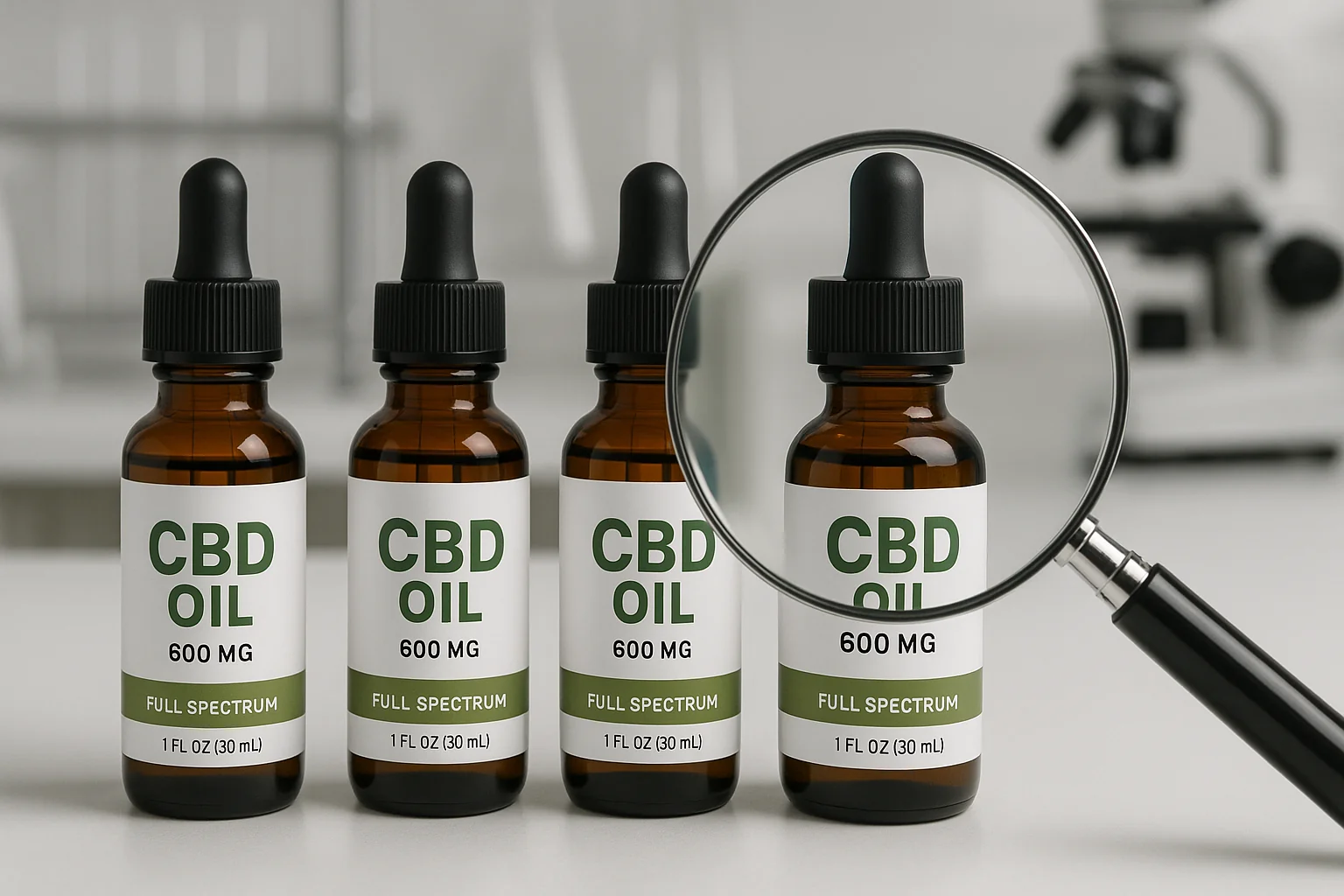
In 2017, a prestigious JAMA A study was published that shook the CBD industry. Bonn-Miller and colleagues examined 84 CBD products purchased from 31 online companies and found that only 31% of them were correctly labeled - 69% contained a different amount of CBD than stated on the label (Bonn-Miller et al., JAMA, 2017). Seven years later, the problem has not disappeared: further European and American studies confirm that mislabeling remains a common practice in the CBD market. This article explains why this happens, how it affects consumers, and how a CoA certificate protects against buying a pig in a poke.
KEY INFORMATION
• 69% of CBD products were mislabeled in a study of 84 samples from 31 companies (Bonn-Miller et al., JAMA, 2017).
• 21% of products contained detectable THC despite the absence of such information on the label.
• A European study showed that only 38% of CBD products fell within a ±20% deviation from the declaration (Pavlovic et al., Medicines, 2018).
• A CoA (Certificate of Analysis) from an ISO 17025 laboratory is the only way to verify the product's composition.
• CBD degradation during storage is one of the physical reasons for discrepancies between the label and the composition.
What exactly did the 2017 JAMA study reveal?
The study by Bonn-Miller and colleagues was the first systematic market study of CBD products. 84 products were purchased from 31 companies selling online in the USA: oils, capsules, and vape liquids. Each product was tested using high-performance liquid chromatography (HPLC) - the standard of pharmaceutical analytics.
The results were clear and concerning. 42% of products contained more CBD than declared on the label. 26% contained less. Only 31% fell within an acceptable deviation of ±10% from the declared content. Particularly significant: 21% of products contained detectable THC - a psychoactive substance whose presence was not stated on the label. This means that a consumer buying a product described as 'THC-free' or 'broad-spectrum' could unknowingly consume THC (Bonn-Miller et al., JAMA, 2017).
The authors noted that inflated CBD content (42% of cases) is not inherently 'better' for the consumer - it means unpredictable dosing and undermines trust in the labeling system. A product with twice the CBD content than declared, when dosed inaccurately, can lead to taking excessively high doses or a false sense of security.
Is mislabeling a problem only in the USA?
European data confirm that the problem is global and structural. The 2018 study by Pavlovic and colleagues analyzed 29 CBD products available on the European market, including in Germany, Austria, and Switzerland. The results were similar to those in the USA: only 38% of products fell within a ±20% deviation from the declared CBD content. An additional 45% were significantly below the declaration, and 17% above (Pavlovic et al., Medicines, 2018).
A 2020 study conducted by the Dutch RIVM (Rijksinstituut voor Volksgezondheid en Milieu) examined 46 CBD products from Dutch stores and found that 25% contained more THC than permissible national limits. The authors pointed to the lack of mandatory certificates for finished products as the main systemic cause of this situation (RIVM, 2020).
Citation capsule (Bonn-Miller et al., JAMA, 2017): 69% of the 84 tested CBD products were mislabeled. 21% contained detectable THC not stated on the label. The authors stated that the results 'underscore the need for regulation of the CBD market and mandatory testing of the finished product before sale' (Bonn-Miller et al., JAMA, 2017).
Why are CBD products mislabeled?
The reasons for mislabeling are varied and do not always stem from the manufacturer's bad intentions. Here are four main mechanisms:
CBD degradation during storage. CBD oxidizes under the influence of light, heat, and air. A product tested immediately after production may contain the declared amount of CBD, but after several months of storage in inappropriate conditions - it may not. A study by Pacifici and colleagues from 2017 showed that CBD stored in inappropriate conditions (room temperature, light exposure) degrades by 20-30% within 6 months (Pacifici et al., Drug Testing and Analysis, 2017).
Production errors. Mixing CBD extract with a carrier (MCT, olive oil) requires precision. Inconsistent mixing leads to varying concentrations of CBD in different parts of the bottle. The first and last milliliters from the same bottle may contain significantly different amounts of CBD.
Lack of market regulations. In the European Union, CBD products are classified as dietary supplements or novel food, but the obligation to conduct tests on the finished product before sale is not enforced in practice across all countries. The manufacturer may test the raw extract, but standard tests on the finished product are not required for every batch.
Intentional overstatement. In a highly competitive pricing environment, some producers intentionally declare a higher CBD content than is actually in the product - as a marketing tool. This is a case that is difficult to distinguish from a production error without laboratory testing.
How does CoA protect the consumer?
A CoA (Certificate of Analysis) is a report from laboratory tests conducted by an independent laboratory on a specific batch of the product. A reliable CoA includes: the exact CBD content in mg/ml or mg/g (with the possibility of comparison to the label), a full cannabinoid profile (CBD, THC, CBG, CBN, CBC), results for pesticides, heavy metals (lead, cadmium, arsenic, mercury), and mycotoxins, the date of testing, and the batch number.
A key question when evaluating a CoA: does the laboratory have ISO 17025 accreditation? This accreditation guarantees that the laboratory uses approved analytical methods and is regularly audited. A certificate from a non-accredited laboratory has lower evidential value.
We have noticed that consumers often check the CoA only for CBD content, overlooking the section on THC and heavy metals. Meanwhile, it was the undetected THC that caused positive drug test results in several documented cases of CBD users in Poland. Reading the full CoA - all sections - is as important as the CBD content itself.
How has the CBD market improved (or not) since 2017?
The Bonn-Miller study was published in 2017 - eight years have passed. Has anything changed? The answer is cautiously optimistic, but not enthusiastic. In the USA, several states with a regulated cannabis market have introduced a requirement for testing each batch of product before sale by laboratories accredited by the state regulatory body. The result is measurable: market studies in Colorado and California after 2020 showed a lower percentage of mislabeled products than before regulation - about 30-40% instead of 69%.
In the European Union, regulations remain fragmented. CBD as a novel food has been subject to registration since 2021, but regulations regarding mandatory testing of finished products vary between countries. Poland does not have a central registry requiring CoA for CBD products sold as supplements. This means that the burden of quality verification still rests on the consumer - who should actively request the CoA before purchase, rather than relying on the regulator to protect them.
A good market practice, though not a legal obligation, is for the manufacturer to publish the current CoA for each batch of the product - with the LOT number and testing date - directly on the website. Several European and Polish companies are voluntarily implementing this standard. This is a minimal signal of credibility that buyers should check before purchasing.
Frequently Asked Questions
What did the 2017 JAMA study on CBD labels reveal?
The Bonn-Miller study and colleagues analyzed 84 CBD products from 31 online companies. 69% of the products were mislabelled: 42% contained more CBD than declared, 26% less. Alarmingly, 21% contained detectable THC despite the absence of such information on the label (Bonn-Miller et al., JAMA, 2017).
How to check if a CBD product is correctly labelled?
Request a CoA from an independent laboratory accredited to ISO 17025. The CoA should include: cannabinoid profile with exact values in mg/ml, information about THC (in Poland below 0.2%), results for pesticides and heavy metals, and the date and batch number. Compare the declared CBD content with the laboratory result.
Is mislabeling CBD a problem only in the USA?
No. A European study of 29 products found that only 38% fell within the acceptable deviation of ±20% from the declared CBD content (Pavlovic et al., Medicines, 2018). The lack of mandatory quality standards for CBD supplements in the EU means that quality control rests with the manufacturer or the buyer.
Why do CBD manufacturers mislabel products?
Reasons include: degradation of CBD during storage (oxidation), errors in mixing the extract with the carrier, lack of mandatory testing of finished products in many countries, and in some cases, intentional overstatement of CBD content for marketing purposes.
What does CoA mean and how to read it?
CoA is a report from laboratory tests confirming the composition of the product. Key elements: CBD content in mg/ml (compare with the label), THC content (below 0.2% in Poland), results for heavy metals and pesticides. Check if the laboratory has ISO 17025 accreditation - this guarantees the reliability of the results.
This article is informational and educational in nature. It contains internal links to products available in the u Bucha store. Prices and specifications may change - please check the current data on the product page before purchasing.
Author: Michał Waluk · Published: 2026-05-04 · Updated: 2026-05-04