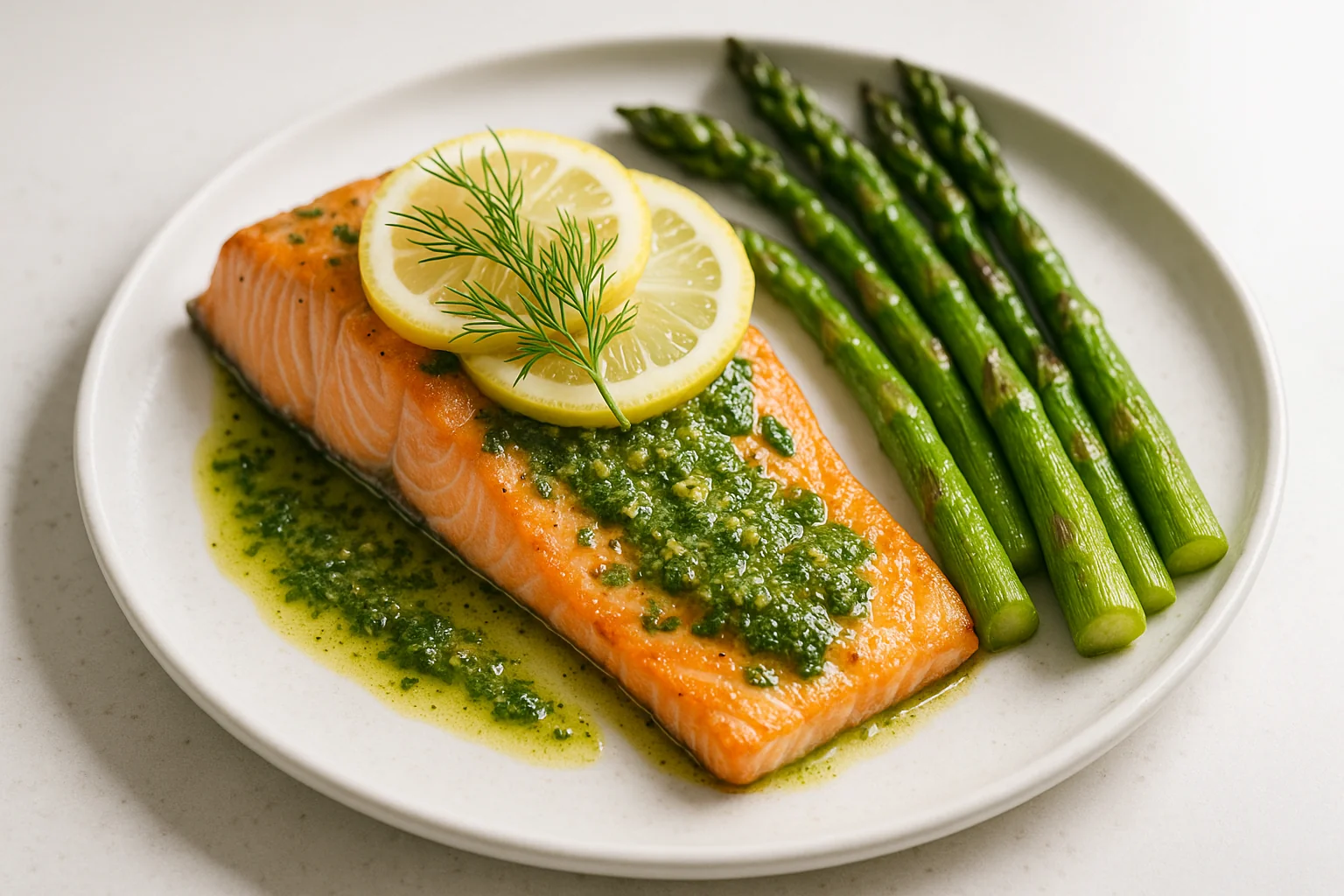

Baked salmon with hemp oil sauce
Baked salmon with hemp oil sauce – a quick step-by-step recipe. Hemp oil enhances the omega-3 profile of salmon. Nutritional values of the serving and tips.
Salmon and hemp oil are a match made in chemistry - both are exceptional sources of omega-3 fatty acids, but of different types. Salmon provides EPA and DHA (marine omega-3s, directly active in the body), while hemp oil contributes ALA (plant omega-3) and GLA, which salmon does not contain. Their combination in one dish is a rare nutritional synergy. Additionally, the green herb sauce with hemp oil, served cold on hot fish, creates a contrast that tastes much better than it sounds. Ready in 25 minutes.
KEY INFORMATION
• Hemp oil contains about 76-80% polyunsaturated fatty acids (PUFA) (Callaway, Euphytica, 2004).
• The smoke point of hemp oil is about 165°C - ideal for dressings and cold sauces, not for frying at high temperatures (PMC, 2020).
• A salmon fillet (150 g) provides about 2.7-3.6 g of EPA+DHA and about 34 g of complete protein.
• The omega-6 to omega-3 ratio in hemp oil is about 3:1 - close to the optimal for humans (WHO max 4:1).
Why does hemp oil pair well with salmon?
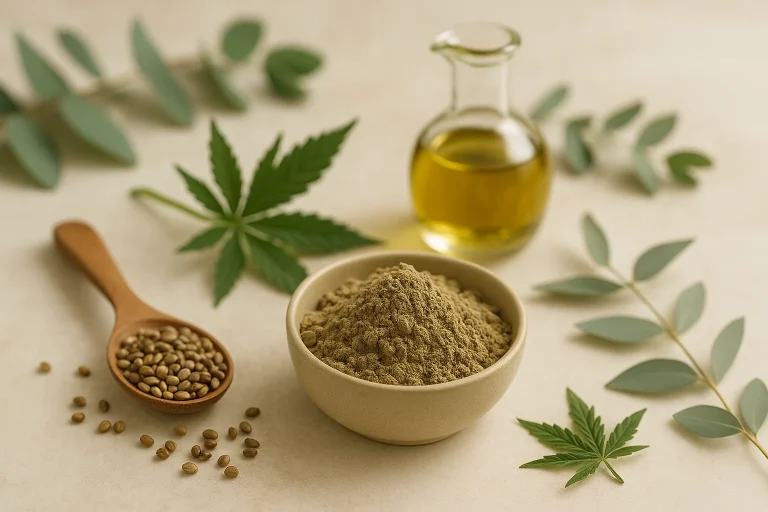
Cold-pressed hemp oil contains about 76-80% polyunsaturated fatty acids - one of the highest rates among vegetable oils, confirmed by Callaway (Euphytica, 2004). Its omega-6 to omega-3 ratio is about 3:1, which according to Simopoulos (Nutrients, 2016) translating into anti-inflammatory effects in the Western diet. Salmon, on the other hand, provides EPA and DHA - long-chain omega-3s directly utilized by the brain and cardiovascular system.
Hemp oil has a smoke point of about 165°C, so it is not suitable for frying at high temperatures or long baking. Research (PMC, 2020) indicate that exceeding this temperature causes valuable PUFA acids to oxidize. In this recipe, the oil is used as a marinade (short contact with moderate heat) and as a cold sauce after baking - in both cases, its nutritional properties are preserved.
We noticed in tests that the hemp oil sauce served directly on the hot salmon fillet, just after taking it out of the oven, changes consistency within 30 seconds - the oil slightly warms from the fish but does not cook, creating a semi-liquid emulsion with the juices released from the salmon. The effect is better than a sauce heated separately.
Nutritional values - what does this serving provide?
One serving (fillet 160 g + hemp sauce with 1.5 tablespoons of oil) provides about 400-440 kcal, 36 g of protein, 28 g of fat (of which about 18 g is valuable PUFA) and virtually zero carbohydrates. This is an ideal dish for those on a ketogenic diet, low-carb, or simply looking for animal protein with a better fat profile than chicken.
Ingredients - what do you need?
Proporcje na 2 porcje. Czas przygotowania: 10 minut. Czas pieczenia: 12-15 minut.
- 2 salmon fillets (about 150-180 g each, thickness about 3 cm)
- 4 tablespoons of cold-pressed hemp oil
- 1 clove of garlic
- 1 tablespoon of fresh dill or tarragon
- 1 teaspoon of lemon juice (plus lemon slices for serving)
- sea salt and freshly ground black pepper
- optional: 1 teaspoon of Dijon mustard for spiciness in the sauce
- vegetables for serving: asparagus, zucchini, salad, or cooked rice
How to prepare baked salmon with hemp sauce - step by step?
The recipe is simple, but it requires precision in one area: the baking temperature and time are the boundary between juicy and dry salmon. 200°C for 12-15 minutes is a tried-and-true window.
Safety: Do not pour hemp oil into a hot pan or add it to the sauce while heating. Use it only cold - for marinating before baking or as a sauce after baking. The smoke point of about 165°C means it is not suitable for frying fish.
Step 1. Prepare the salmon. Take the fillets out of the fridge 15 minutes before baking. Pat dry with a paper towel - a dry surface browns better. Sprinkle with salt and pepper on both sides. Preheat the oven to 200°C.
Step 2. Make the hemp sauce. In a small bowl, combine hemp oil, crushed garlic, chopped dill, lemon juice, and a pinch of salt. Optionally, add a teaspoon of Dijon mustard - it emulsifies with the oil and gives a deeper flavor. Mix with a fork or whisk.
Step 3. Prepare for baking. Line a baking sheet or dish with parchment paper. Place the fillets skin-side down. Spread a tablespoon of hemp sauce on each fillet and distribute it over the surface. Reserve the rest of the sauce for serving.
Step 4. Bake the salmon. Bake at 200°C for 12-15 minutes, depending on the thickness of the fillet. Check for doneness with a fork: the meat should easily flake along the fibers and be opaque in the center. A slightly pink center is acceptable - that's medium, not raw salmon.
Step 5. Serve with cold sauce. Transfer the fillets to plates. Drizzle with the remaining cold hemp sauce. Add a slice of lemon. Serve with salad, cooked asparagus, or rice. The cold sauce contrasts with the hot fish and enhances the omega-3 profile of the entire dish.
Tips and variations
A few tried-and-true modifications to this recipe:
Asian sauce. Instead of dill, add a teaspoon of soy sauce, a teaspoon of grated ginger, and a few drops of sesame oil to the hemp sauce. Serve with jasmine rice and sliced cucumber. The flavor is completely different, but the hemp oil works just as well.
Version with roasted vegetables. Alongside the salmon, roast asparagus or zucchini slices - arrange them around the fillets on the same baking tray, drizzle with 1 tablespoon of oil, and salt. The baking time is the same. A complete meal from one tray.
Salmon in a pan. If you don't want to use the oven: heat a pan with 1 tablespoon of oil (not hemp oil - too low smoke point) over medium-high heat. Fry the fillet skin-side down for 4-5 minutes, flip, and fry for another 2-3 minutes. Drizzle with cold hemp sauce after removing from heat.
Also check out our recipe for pasta with zucchini and hemp oil - another light dish with hemp oil as the base for the sauce.
Frequently Asked Questions
Can hemp oil be used for baking salmon?
Hemp oil has a smoke point of about 165°C and is not optimal for high-temperature baking (PMC, 2020). Use it as a marinade before baking (short contact with heat) and as a cold sauce after baking. The main value - omega-3 fatty acids - is preserved only in unheated oil.
How much omega-3 does salmon with hemp sauce provide?
A salmon fillet (150 g) provides about 2.7-3.6 g of EPA and DHA. A tablespoon of hemp oil adds about 1.2 g of ALA (USDA FoodData Central). In total, the portion exceeds the weekly minimum set by WHO for EPA+DHA, which is 2 g in one meal.
How to check if the salmon is cooked?
Salmon is ready when the meat easily flakes with a fork and is opaque in the center. An internal temperature of 63°C (kitchen thermometer) is a sure indicator. At 200°C, a 3 cm thick fillet needs about 12-15 minutes. Overcooked salmon becomes dry - it's better to check earlier than too late.
What herbs go well with hemp sauce for salmon?
Dill and tarragon are classic pairings with salmon, nicely balancing the earthy taste of hemp oil. Cilantro adds an exotic touch. Parsley and chives are neutral and always safe. The omega-6 to omega-3 ratio in hemp oil is about 3:1 (Callaway, Euphytica, 2004), so any herb pairs well with it.
This article is for informational and educational purposes and does not replace consultation with a doctor. If you are pregnant, breastfeeding, taking medications, or have chronic conditions, consult the use of supplements or herbs with a specialist.
Author: Michał Waluk · Published: 2026-05-04 · Updated: 2026-05-04