
Astaksantyna - najsilniejszy antyoksydant? dawkowanie (tabela)
Astaxanthin: dosage table, how much to take, when and how to start. Practical guide at u Bucha.
Astaxanthin is a carotenoid produced by microalgae Haematococcus pluvialis, which in laboratory measurements shows antioxidant strength 6000 times higher than vitamin C and 550 times higher than vitamin E (Ambati et al., Marine Drugs, 2014). This is why it gives salmon meat and shrimp shells their pink color. Clinical studies confirm its effects on skin, muscle regeneration, and eye protection, and the range of doses used in these studies is surprisingly narrow. This guide collects everything in one table.
KEY INFORMATION
• Astaxanthin from H. pluvialis algae has 6000x stronger antioxidant activity than vitamin C (Ambati et al., 2014).
• The standard clinical dose is 4-12 mg daily - depending on the supplementation goal.
• It is lipophilic: absorption significantly increases after a fatty meal, similar to vitamin D.
• A meta-analysis from 2022 confirmed its beneficial effects on the skin: elasticity, hydration, and wrinkles (Juturu et al., Nutrients, 2022).
• Synthetic astaxanthin (from petrochemicals) differs in the profile of stereoisomers from the natural one and is not used in supplements for humans.
What is astaxanthin and where does it come from?
Astaxanthin belongs to the group of xanthophyll carotenoids. The microalga Haematococcus pluvialis produces it as a natural protection against oxidative stress caused by UV radiation or nutrient deficiencies. Under stress conditions, the astaxanthin content in the dry mass of algae can reach 4% (Ambati et al., Marine Drugs, 2014). This is why this compound has caught the attention of scientists studying longevity.
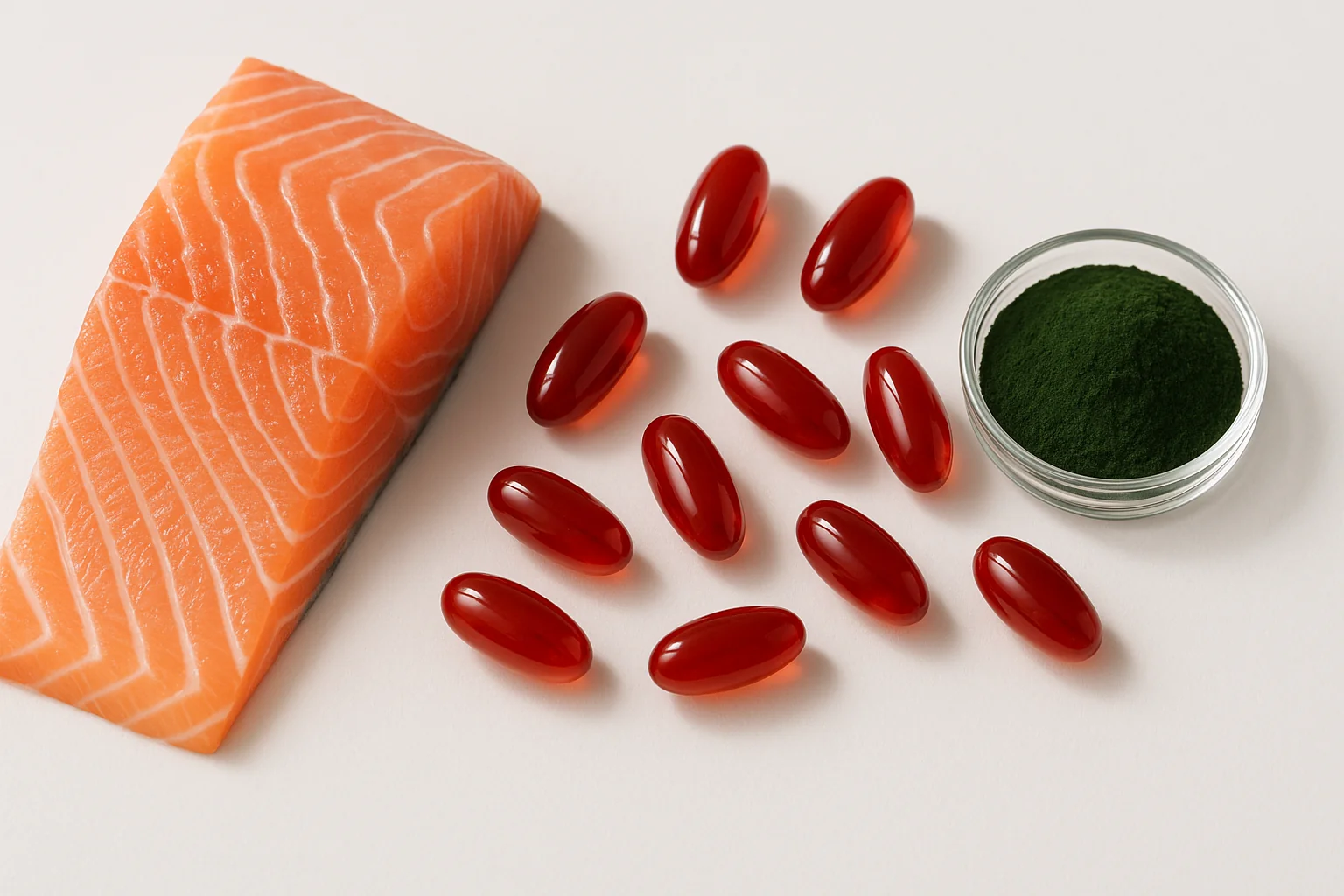
Salmon, shrimp, and flamingos have pink or orange coloration precisely because astaxanthin accumulates in their tissues. Wild Atlantic salmon contains 5-10 mg of astaxanthin per 100 g of flesh, but its main dietary source for humans is farmed salmon. The problem is that to achieve clinical doses from food, you would have to eat salmon every day. Supplementation solves this problem.
How does natural astaxanthin differ from synthetic? Natural comes from H. pluvialis and consists mainly of the 3S,3'S isomer, which also dominates in human tissues. Synthetic astaxanthin is a racemic mixture, produced petrochemically from acetylcyclohexanone. It is legal in feeds for farmed fish but is not used in supplements intended for humans. On the label, look for the description "from Haematococcus pluvialis" or "natural astaxanthin."
The mechanism of action of astaxanthin differs from that of vitamin C or E. Because it is lipophilic, it integrates directly with cell membranes and lipoproteins. Its unique feature is "bridging" across the entire lipid bilayer of the membrane - one end of the molecule reaches the outer surface, while the other reaches the inner surface. This allows it to neutralize free radicals both inside and outside the membrane. No other known carotenoid works this way.
Dawkowanie astaksantyny - tabela
The range of doses used in clinical studies is 4-12 mg per day, with different goals requiring different doses and duration of use. Astaxanthin acts cumulatively, and its concentration in tissues reaches a plateau after several weeks of regular use. The table below organizes data from the most important clinical studies according to the supplementation goal (Ambati et al., Marine Drugs, 2014).
| Supplementation goal | Starting Dose | Standard dose | Maximum dose | When to take | Form and notes |
|---|---|---|---|---|---|
| Skin and antioxidant action | 2 mg/dzien | 4-6 mg/dzien | 8 mg/day | With a fatty meal | Effects after 8-16 weeks; with capsules containing oil for bioavailability |
| Sports and recovery | 4 mg/day | 8-12 mg/dzien | 12 mg/day | With a fatty meal | Min. 8 weeks; peak effect after 12 weeks of use |
| Eyes and vision | 2 mg/dzien | 6 mg/day | 12 mg/day | With a fatty meal | Accumulates in the retina; studies on eye fatigue (astaxanthin + zeaxanthin) |
| General supplementation | 2 mg/dzien | 4 mg/day | 8 mg/day | With a fatty meal | Safe dose for long-term use; no established UL by EFSA |
How to read this table? Start with the initial dose for the first 2 weeks, observing tolerance. Then switch to the standard dose for your goal. The capsule form filled with oil (e.g., algal or sunflower oil) provides significantly better absorption than dry powder in a capsule, as astaxanthin dissolves in fats. Reputable manufacturers indicate the form on the label.
Astaxanthin for the skin - what do studies say?
Among all the applications of astaxanthin, its effects on the skin have the best-documented clinical basis. A meta-analysis including 8 randomized clinical trials showed a statistically significant improvement in hydration, elasticity, and reduction of wrinkles at doses of 4-8 mg over 8-16 weeks (Juturu et al., Nutrients, 2022). This is a rare consistency of results in supplementation studies.
How does astaxanthin work on the skin? Its main mechanism is the protection of skin lipids from peroxidation caused by UV radiation and reactive oxygen species. A study by Tominaga and colleagues showed that 4 mg of astaxanthin daily for 6 weeks reduced wrinkle parameters in the outer corners of the eyes in women over 40 (Tominaga et al., Journal of Clinical Biochemistry and Nutrition, 2012).
It is also worth emphasizing that astaxanthin works both externally (creams) and internally (capsules). Studies indicate that a combination of oral and topical administration yields better results than either method alone. However, capsules have the advantage of reaching the skin from the bloodstream, penetrating into skin layers that creams do not reach.
We have noticed that people asking about astaxanthin for the skin often expect results after 2-3 weeks. This is too short a time. The skin renewal cycle lasts 4-6 weeks, and the first measurable changes in elasticity and hydration appear in studies after 8 weeks. Patience is a key condition for assessing effectiveness.
Astaxanthin for athletes - recovery and endurance
Studies involving athletes show two main directions: reducing oxidative muscle damage after exercise and potential improvement in endurance. A study by Nakagawa and colleagues found that 4 mg of astaxanthin daily for 6 months significantly reduced blood lactate levels during a submaximal cycling test (Nakagawa et al., Journal of Clinical Biochemistry and Nutrition, 2011).
The mechanism of action in sports differs from what you would expect from a typical pre-workout supplement. Astaxanthin does not act immediately like caffeine. It works cumulatively, reducing long-term oxidative stress levels in muscle cells. The result is less damage after intense effort and a quicker readiness for the next training session.
The study by Ikeuchi and colleagues on mice showed an 8.8% extension of time to exhaustion at a dose corresponding to a human dose of 4-8 mg per day (Ikeuchi et al., Biological and Pharmaceutical Bulletin, 2006). Data on humans are more cautious but indicate a similar direction. For amateur athletes, the recovery effect is more pronounced than the direct increase in performance.
From our experience, athletes most often abandon astaxanthin after 4-5 weeks because they "feel nothing." This is a mistake stemming from the expectation of effects similar to creatine. Astaxanthin does not provide noticeable stimulation or a pump. Its effects are subtle and measurable only after 8-12 weeks in the form of better tolerance for intense training and a shorter period of soreness.
What to combine astaxanthin with and what to avoid?
Astaxanthin works synergistically with other antioxidants, as different compounds protect different cellular compartments. Vitamin C acts in aqueous environments, astaxanthin in lipid membranes, and vitamin E at the interface of these environments. Combining them creates complete antioxidant protection, as confirmed by studies on oxidative models (Ambati et al., Marine Drugs, 2014).
Resveratrol is another ingredient that works well with astaxanthin. Resveratrol modulates the SIRT1 and NF-kB pathways, while astaxanthin acts by suppressing reactive oxygen and nitrogen species. Both ingredients have documented anti-inflammatory effects, but through different mechanisms. No negative interactions between these compounds have been reported.
What to avoid? There are no documented dangerous interactions of astaxanthin with medications, but exercise caution with anticoagulants. Astaxanthin may slightly inhibit platelet aggregation. If you are taking warfarin or clopidogrel, inform your doctor about any supplements you add to your regimen. This is a general principle, not a specific warning solely regarding astaxanthin.
Astaxanthin can change skin pigmentation at very high doses, giving it a slightly yellow or orange tint. At clinical doses of 4-12 mg, this is not a practical problem, but at doses above 20 mg, the carotenoid effect may be visible to the naked eye. Doses above 20 mg have no clinical justification for a healthy adult.
We noticed an interesting difference between astaxanthin from oil capsules and dry powder capsules. Manufacturers using sunflower or algae oil as a carrier report significantly higher concentrations of astaxanthin in plasma after a single dose. There is no dedicated head-to-head RCT for different forms, but pharmacokinetic data from studies on lipophilic carotenoids consistently indicate 2-4 times higher concentrations when administered with fat compared to dry capsules.
Frequently Asked Questions
How much astaxanthin should I take daily?
The standard dose is 4-12 mg per day, depending on the goal. For skin and general supplementation, 4-6 mg is sufficient. In sports studies, 8-12 mg was used. Clinical studies confirm the safety of doses up to 12 mg with long-term use (Ambati et al., Marine Drugs, 2014). Start with 2-4 mg for the first 2 weeks to assess tolerance.
When to take astaxanthin - in the morning or evening?
The time of day is of secondary importance. The most important thing is to take astaxanthin with a meal containing fats, as it is lipophilic and requires fat for absorption. A tablespoon of olive oil, a handful of nuts, or avocado with a meal is a sufficient carrier. Regularity and consistency are more important than the specific time of taking the supplement.
Where does astaxanthin in supplements come from?
Natural astaxanthin in supplements comes from the microalga Haematococcus pluvialis. On the label, look for the description "from Haematococcus pluvialis" or "natural astaxanthin." Synthetic astaxanthin, used in fish feed, has a different profile of stereoisomers and is not used in supplements intended for humans. The content of astaxanthin in the dry mass of algae can reach 4% (Ambati et al., 2014).
Does astaxanthin help with skin?
Yes, clinical studies confirm this. A meta-analysis of 8 RCT studies showed an improvement in hydration, elasticity, and reduction of wrinkles after 8-16 weeks of using a dose of 4-8 mg per day (Juturu et al., Nutrients, 2022). Effects do not appear quickly - the skin renewal cycle is at least 4-6 weeks. Expect results after 2-4 months of regular use.
Can astaxanthin be combined with vitamin C and resveratrol?
Yes, this is a safe and biochemically justified combination. Astaxanthin protects lipid membranes, vitamin C acts in aqueous environments, and resveratrol modulates metabolic pathways. Together, they encompass different mechanisms of antioxidant protection. No negative interactions between these ingredients have been reported. In cases of chronic diseases or medication use, consult your protocol with a doctor.
This article is for informational and educational purposes and does not replace consultation with a doctor. If you are pregnant, breastfeeding, taking medications, or have chronic conditions, consult the use of supplements or herbs with a specialist.
Author: Michał Waluk · Published: 2026-05-04 · Updated: 2026-05-04