
Beta-alanina - dawkowanie, na co i czy warto (tabela)
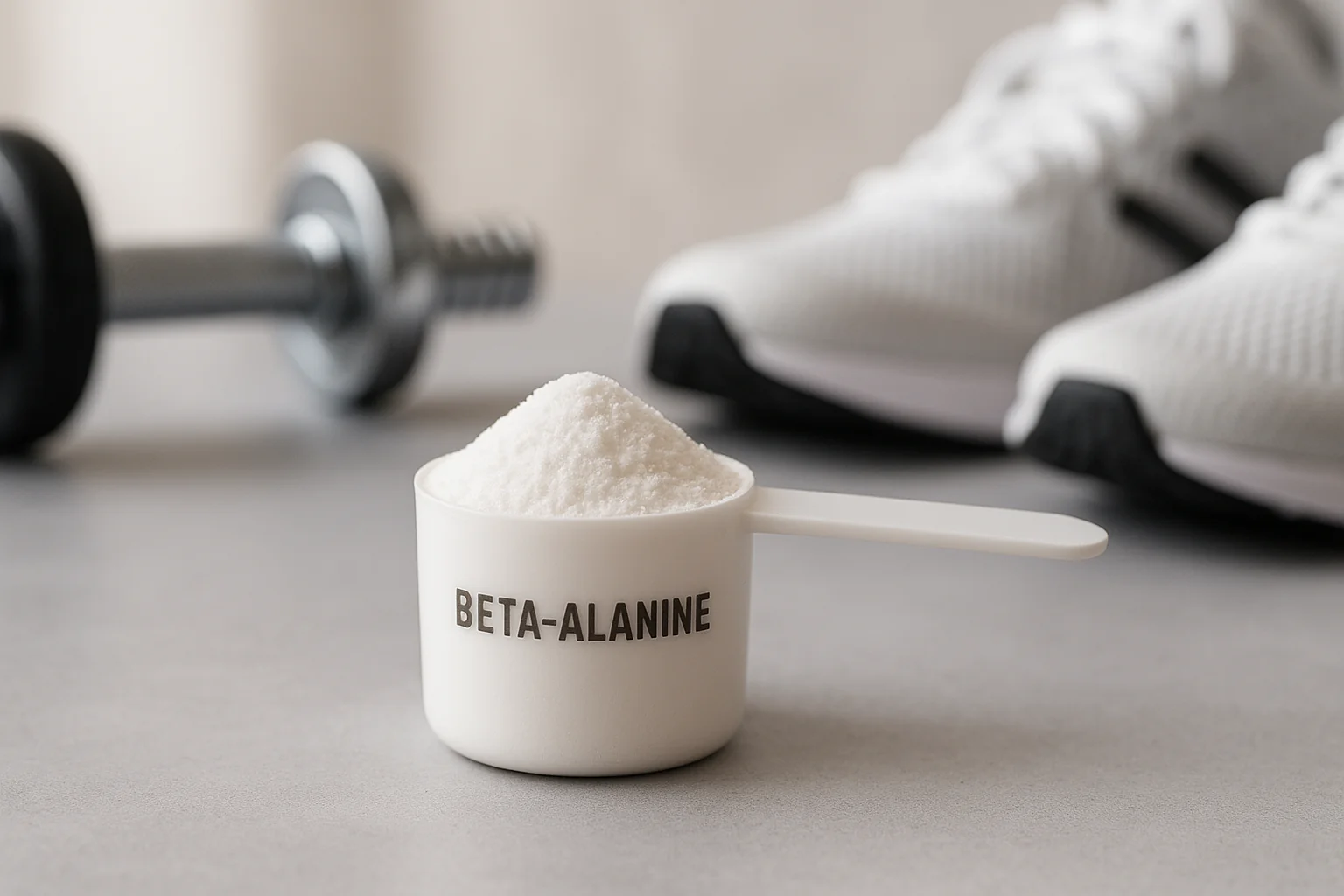
Beta-alanine: dosage table, how much to take, when, and how to start. Practical guide from u Bucha.
Beta-alanine is one of the most researched sports supplements. A meta-analysis by Hobson et al. (Amino Acids, 2012), which included 15 studies with 360 participants, showed that beta-alanine supplementation significantly improves performance in efforts lasting from 1 to 4 minutes. If you train interval-style, practice combat sports, crossfit, or strength-endurance activities, this amino acid has specific applications for you. In this article, you will find a dosage table, an explanation of tingling, timing tips, and practical advice on combining with other supplements.
KEY INFORMATION
• Beta-alanine improves performance in efforts lasting 1-4 minutes - this is confirmed by a meta-analysis of 15 studies (Hobson et al., Amino Acids, 2012).
• The ISSN recommends 3.2-6.4 g daily in divided doses as an effective supplementation protocol (Trexler et al., JISSN, 2015).
• Tingling (paresthesia) is a harmless side effect, not an allergic reaction - it can be reduced by dividing doses.
• Effectiveness requires a minimum of 4 weeks of daily supplementation - the timing of a single dose is less important than regularity.
• Best effect in interval sports, crossfit, and intense strength sets.
What is beta-alanine and how does it work in muscles?
Beta-alanine is a non-protein amino acid that combines with histidine in the body to form carnosine - a dipeptide stored in skeletal muscles. Supplementation with beta-alanine increases carnosine levels in muscles by 40-80% after 4-10 weeks, as confirmed by the study by Harris and colleagues (Amino Acids, 2006). Carnosine acts as a buffer for hydrogen ions (H+) that accumulate during intense effort and lower muscle pH, causing a burning sensation and fatigue.
During intense exercise, anaerobic glycolysis produces lactic acid, which dissociates into lactate and H+ ions. It is the excess H+ that lowers the pH of the muscles and inhibits the activity of enzymes involved in contraction. Carnosine binds these ions, slowing down acidification and delaying the moment when the muscles "give up". The result is the ability to perform more repetitions or maintain a higher pace for a longer time.
Beta-alanine is the limiting amino acid for carnosine synthesis. Histidine is available in the body in sufficient amounts, while beta-alanine comes solely from food or supplementation. Meat and fish provide it in small amounts, but not enough to significantly increase carnosine levels. Hence, supplementation makes sense for active athletes, especially vegetarians and vegans, who have lower baseline carnosine levels.
We have noticed that many athletes associate beta-alanine exclusively with strength training. However, scientific evidence indicates the greatest effect in efforts lasting 1-4 minutes - which means that time trial cyclists, kayakers, MMA fighters, and swimmers may benefit more than those doing easy sets with long breaks.
Dawkowanie beta-alaniny - tabela
The optimal dose of beta-alanine depends on the goal, level of advancement, and tolerance to tingling. The ISSN recommends 3.2-6.4 g daily in divided doses as an effective range for improving performance (Trexler et al., JISSN, 2015). A loading protocol of 4-6 g daily for the first 4-6 weeks accelerates the saturation of carnosine in the muscles, after which one can switch to a maintenance dose of 1.6-3.2 g daily.
| Goal / Purpose | Starting Dose | Standard dose | Maximum dose | When to take | Forma / Uwagi |
|---|---|---|---|---|---|
| Endurance (sport) | 2 g / day | 3.2-4.8 g / day | 6.4 g / day | Divided doses 2-4 times/day | Minimum 4 weeks of continuous supplementation |
| Building mass (gym) | 2 g / day | 3.2-5 g / day | 6.4 g / day | Together with a meal or before training | Works with sets to failure and short breaks |
| General supplementation | 1.6 g / day | 2-3.2 g / day | 4 g / day | Any time, with a meal | SR (sustained release) form reduces tingling |
Carnosine saturation is not a one-time effect - it builds up gradually over several weeks. After the supplementation ends, carnosine levels decrease slowly, with an estimated half-life of the effect lasting several weeks (Baguet et al., Amino Acids, 2009). This means that missing a few days does not negate the effect, but a long break requires rebuilding levels.
Tingling after beta-alanine - what is it and is it dangerous?
Skin tingling, or paresthesia, is the most common side effect of beta-alanine. It usually appears within 15-20 minutes of ingestion and lasts up to 60 minutes. The study by Bacheder and colleagues (J Neurosci, 2009) explained the mechanism: beta-alanine activates the MrgprD receptor in sensory nerve fibers of the skin. This is a neurological reaction, not allergic or toxic, and is not related to inflammation.
Tingling most often affects the face, neck, hands, and ears. Its intensity depends on the single dose - the higher the dose taken at once, the stronger the effect. This is why dosing protocols divide the daily amount into 2-4 smaller portions of 0.8-1.6 g. For most people, tingling decreases after a few weeks of regular supplementation, suggesting some degree of receptor tachyphylaxis.
Can tingling be completely eliminated? Slow-release (sustained release, SR) forms significantly reduce it, as they slow down the absorption of the amino acid. A study by Decombaz et al. confirmed that SR beta-alanine causes weaker paresthesias with comparable effectiveness in raising carnosine levels (Amino Acids, 2012). If tingling is uncomfortable for you, the SR form is a sensible choice.
Beta-alanine before or after training? When to take it?
Beta-alanine works differently than classic "acute" supplements like caffeine or citrulline. Its effect does not depend on a single spike in the bloodstream, but on the gradual saturation of carnosine in muscle tissue. ISSN studies confirm that regularity for at least 4 weeks is important, rather than the timing of intake relative to training (Trexler et al., JISSN, 2015). In plain terms: timing is less important than daily consistency.
Practically, it is most convenient to take beta-alanine with meals, which also reduces the intensity of tingling. Taking it with food does not lower bioavailability. Many people combine it with a pre-workout meal or breakfast. On non-training days, continue supplementation at the same dose - carnosine saturation is a continuous process and does not stop on rest days.
From our experience, individuals who take beta-alanine in a large single dose right before training often discontinue the supplement after a few days due to strong tingling. Dividing the daily dose into two portions - e.g., in the morning with coffee and in the afternoon with lunch - significantly improves comfort and ensures that supplementation is maintained for the required minimum of 4 weeks.
How long does loading take? Full saturation of carnosine at a dose of 4-6 g daily is achieved after about 4-6 weeks. At lower doses (1.6-3.2 g daily), the effect is slower but achievable after 8-12 weeks. Carnosine levels can be maintained with a maintenance dose of 1.6-3.2 g daily after the loading phase.
What to combine beta-alanine with?
Beta-alanine belongs to supplements that clearly benefit from being combined with other ingredients that have complementary mechanisms. The classic strength stack described in the literature is a combination with creatine. A study by Zoeller and colleagues (Int J Sport Nutr Exerc Metab, 2007) showed that the combination of creatine and beta-alanine resulted in a greater increase in lean body mass than either of these supplements used separately.
Pre-workout stack: beta-alanine, creatine, citrulline
This is the most popular combination in strength and interval sports. Beta-alanine buffers muscle acidosis, creatine provides phosphocreatine for strength and power in short efforts, and citrulline improves blood flow and accelerates ammonia removal. Each of these supplements works through a different mechanism, so the effects add up. There are no known adverse interactions.
Beta-alanine and caffeine
Caffeine and beta-alanine make a safe combination. Caffeine blocks adenosine receptors and acts acutely - the effect begins after 30-60 minutes and wears off after a few hours. Beta-alanine works long-term by saturating carnosine. Together, they can be used without the risk of pharmacokinetic interactions. Popular pre-workout blends often contain both ingredients for this reason.
Beta-alanine and baking soda (sodium bicarbonate)
Sodium bicarbonate (NaHCO3) is another acidity buffer, but it works extracellularly - in the space outside the muscle cell. Beta-alanine works intracellularly through carnosine. The study by Dionne and colleagues (Eur J Sport Sci, 2015) suggests that these two buffers may complement each other, although additive effects have not yet been fully confirmed. Sodium in sports doses (0.3 g/kg) can cause stomach discomfort in some individuals - it is worth testing cautiously.
Frequently Asked Questions
How many grams of beta-alanine should I take daily?
The standard dose is 3.2-6.4 g daily, divided into 2-4 portions of 0.8-1.6 g. The ISSN recommends this range for improving performance (Trexler et al., JISSN, 2015). New users should start with 2 g daily and gradually increase the dose over 2-4 weeks to assess tolerance to tingling and avoid excessive paresthesia.
Why does beta-alanine cause tingling?
Tingling (paresthesia) is the result of the activation of MrgprD receptors in sensory nerve fibers of the skin by beta-alanine (Bacheder et al., J Neurosci, 2009). It is not an allergic reaction or a signal of tissue damage. It can be minimized by splitting the daily dose into smaller servings or choosing a sustained release (SR) form.
Beta-alanine before or after training?
Beta-alanine works by gradually saturating carnosine in the muscles, so the timing of a single dose is not critically important. Daily regularity for a minimum of 4 weeks is important. It can be taken with meals at any time. Continue supplementation on non-training days - carnosine saturation does not stop on rest days.
What does beta-alanine work on and who benefits the most?
Beta-alanine improves performance in efforts lasting 1-4 minutes by buffering muscle acidosis. The meta-analysis by Hobson and colleagues (Amino Acids, 2012) confirmed a significant improvement in performance in this group of efforts. The greatest benefits are seen by athletes in interval sports, CrossFit, combat sports, kayakers, and cyclists competing in time trials.
Can beta-alanine be combined with creatine and citrulline?
Yes, this is a classic and well-researched pre-workout stack. Creatine provides phosphocreatine for strength and power, citrulline improves blood flow and removes ammonia, while beta-alanine buffers muscle acidity. A study by Zoeller and colleagues (Int J Sport Nutr Exerc Metab, 2007) showed that the combination of beta-alanine with creatine yielded better results than each ingredient alone.
This article is for informational and educational purposes and does not replace consultation with a doctor. If you are pregnant, breastfeeding, taking medications, or have chronic conditions, consult the use of supplements or herbs with a specialist.
Author: Michał Waluk · Published: 2026-05-04 · Updated: 2026-05-04