
CBDA and CBC, lesser-known cannabinoids: what are they and what for (table)
CBDA and CBC are lesser-known cannabinoids of cannabis. What has been specifically demonstrated for each of them, in which animals and cells, and what is missing in these studies.
The conversation about cannabis usually starts and ends with CBD and THC. Meanwhile, the plant produces over a hundred cannabinoids, some of which have their own distinct biological effects. CBDA and CBC are increasingly appearing on the labels of full-spectrum products and in research summaries, usually with descriptions stronger than the data behind them. This article collects what has actually been demonstrated for both compounds, and for each finding, it states how it was measured: in cell culture, in rats, in shrews, or in humans. This distinction determines how many of these promises hold true. We also show how to recognize a product that actually contains either of these compounds, as the brand name is no indication.
KEY INFORMATION
• CBDA is the acidic precursor form of CBD, present in the fresh plant; heating removes the carboxyl group and converts it into CBD.
• CBDA does not have a higher affinity for the 5-HT1A receptor than CBD; it has been shown to enhance the activation of this receptor by an agonist and acts more strongly than CBD against nausea in rats and vomiting in shrews (Bolognini, Br J Pharmacol, 2013).
• CBC does not stimulate the CB1 receptor, but is a selective agonist of CB2 with higher efficacy than THC in a cell system (Udoh, Br J Pharmacol, 2019).
• None of these compounds have been studied in randomized clinical trials in humans.
• CBD is not authorized as a novel food in the European Union, and the sanitary notification of this status does not change.
How does CBDA differ from CBD?
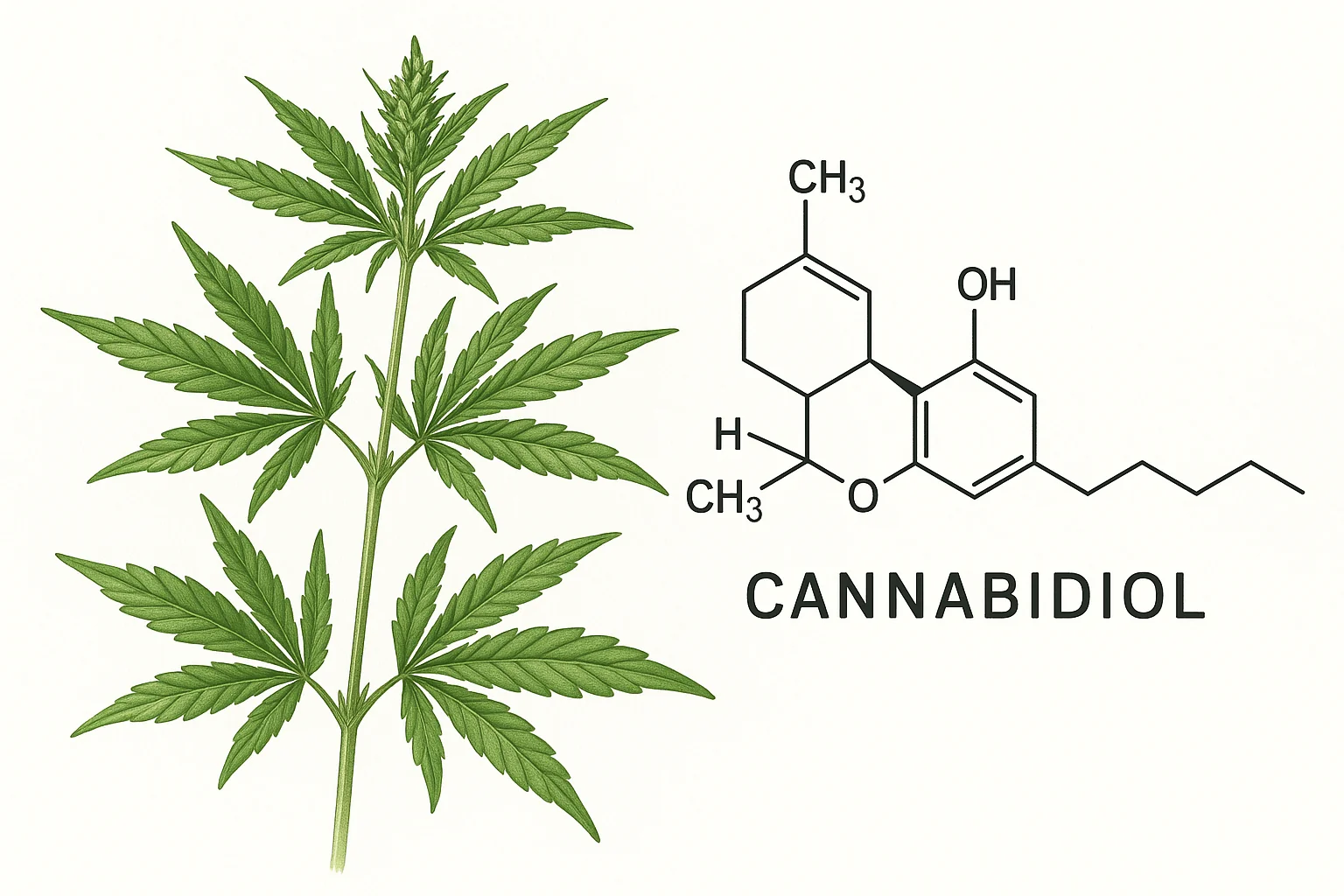
The difference is one chemical group and the way it disappears. A living cannabis plant does not produce CBD directly. It synthesizes cannabidiolic acid, or CBDA, from the parent compound CBGA. Only heating triggers decarboxylation, removes the carboxyl group, and converts CBDA into CBD. This occurs during drying, vaporization, smoking, and baking, which is why processed products usually contain no CBDA at all.
For years, it was treated as an inactive raw material. This perception has changed, but it has changed in a narrower scope than product descriptions suggest. The demonstrated effect pertains to the serotonin receptor 5-HT1A, not cannabinoid receptors, and does not involve stronger binding to this receptor. In a functional test on rat brainstem membranes, CBDA at concentrations from 0.1 to 100 nanomoles increased the maximum response induced by the agonist 8-OH-DPAT, thus enhancing receptor activation rather than occupying it.
The distinction between acidic and active forms is described more broadly in the entry about acidic forms of cannabinoids. It is worth knowing, as it determines whether a given product can actually contain what the label promises.
What has actually been demonstrated for CBDA in studies?
The evidence is animal-based and concerns nausea and vomiting. In a study published in British Journal of Pharmacology CBDA at doses of 0.1 and 0.5 mg per kilogram, administered intraperitoneally to house shrews, reduced toxin- and motion-induced vomiting and delayed the first vomiting episode. In rats, CBDA at doses of 0.01 and 0.1 mg per kilogram suppressed the aversive reaction induced by lithium chloride, and the effect was blocked by a 5-HT1A receptor antagonist. The CB1 receptor antagonist did not change anything, confirming that the pathway runs beyond the cannabinoid system (Bolognini, Br J Pharmacol, 2013).
The authors compared CBDA with CBD and found that it acts significantly stronger, both in inhibiting vomiting and in enhancing the activation of the 5-HT1A receptor. This is a real result, and there is no reason to downplay it. However, it has two limitations that supplement descriptions remain silent about: it concerns animal species in which vomiting can be modeled, and it involves intraperitoneal administration rather than oral.
No randomized clinical trial with CBDA in humans has been published. The statement "CBDA alleviates nausea" therefore describes the result in rats and shrews, not a clinical finding. No one has made the translation to an oral dose in humans.
What is known about CBC?
CBC, or cannabichromene, is produced in the plant from cannabichromenic acid, which comes from the same parent compound as CBDA. The distinction of CBC is that it targets different receptors than CBD. A study in British Journal of Pharmacology showed that in cells with human cannabinoid receptors, CBC stimulates CB2 but does not stimulate CB1, and its efficacy against CB2 is higher than that of THC. Continuous presence of the compound led to a decrease in CB2 receptors on the cell surface and the attenuation of the response (Udoh, Br J Pharmacol, 2019).
The lack of action on CB1 is the reason why CBC does not induce intoxication; that receptor is responsible for the psychoactivity of THC. The distribution of both receptors is described in our post about receptorach CB1 i CB2.
The second described mechanism is the inhibition of the deactivation of endocannabinoids and the stimulation of the TRPA1 channel. Caution is warranted here, as the study that presents this description as background also checked its effects, and the result was mixed: in mice, CBC normalized accelerated peristalsis induced by inflammation but did not change motility in healthy animals, and in an ex vivo study, it did not change the concentrations of endocannabinoids in the tissue at all. Neither cannabinoid receptor antagonists nor the TRPA1 antagonist blocked the effects (Izzo, Br J Pharmacol, 2012). The mechanism is therefore open and not established.
How do temperature and light affect CBDA and CBC?
CBDA is thermally unstable by definition, as its conversion to CBD is a reaction that occurs under heat. Any process involving heating, such as vaporization, cooking, and extraction at elevated temperatures, shifts the product profile towards CBD. Preserving CBDA requires unheated raw material and cold extraction.
| Feature | CBDA | CBC | CBD for comparison |
|---|---|---|---|
| Full name | kwas kannabidiolowy | kannabichromen | kannabidiol |
| The pathway of formation in the plant | z CBGA | z CBGA przez CBCA | z CBDA po dekarboksylacji |
| Receptor CB1 | no significant action | nie pobudza | weak action |
| Opisany cel molekularny | nasilanie aktywacji 5-HT1A | CB2 agonism, TRPA1 channel | 5-HT1A, TRPV1, FABP proteins |
| Na czym zmierzono | rats, shrews, binding tests | cell lines, mice | badania kliniczne u ludzi |
| Stability in heat | niska, przechodzi w CBD | higher than CBDA | high |
The second factor changing the cannabinoid profile over time is light, which is why oils are sold in dark bottles. A product sitting for months in a transparent package may have lower concentrations than those stated in the analytical certificate prepared right after production. We discuss storage conditions in detail in our post about storing CBD oil.
How to recognize a product containing CBDA or CBC?
The analytical certificate is decisive, not the trade name. The terms "raw" and "unrefined" suggest the preservation of the acidic form, but they do not guarantee anything by themselves. A certificate with a full cannabinoid profile shows whether CBDA or CBC was detected at all and in what quantity. Products based on CBD isolate contain neither, as isolation removes everything except one molecule.
It is also important to remember the legal status. CBD is not an authorized novel food in the European Union, and submitting a sanitary notification does not change this status. The EFSA panel established a provisional safe dose of 0.0275 mg per kilogram of body weight per day, which is about 2 mg daily for a person weighing 70 kg, and noted that safety cannot be established for individuals under 25 years of age, pregnant and breastfeeding women, and those taking medications (EFSA, EFSA Journal, 2026).
For CBC itself, the picture is even more cautious. A review from 2024 notes that products with this cannabinoid have entered hand sales and are widely used with little evidence of their safety and efficacy or none at all (Sepulveda, J Pharmacol Exp Ther, 2024). W sklepie u Bucha odmiany bogate w CBD oraz w CBG znajdziesz w kategorii dried flower; the content of acidic forms and rarer cannabinoids can only be read from the laboratory report of a specific batch.
Frequently Asked Questions
What is the difference between CBDA and CBD?
CBDA is the acidic precursor form of CBD, present in fresh, unheated plants. Heating removes the carboxyl group and converts it into CBD. CBDA has its own effects: it enhances the activation of the serotonin receptor 5-HT1A and in animal models inhibits vomiting more strongly than CBD.
Does CBDA alleviate nausea in humans?
This has not been studied. The results come from rats and house shrews that were administered the compound intraperitoneally at doses of fractions of a milligram per kilogram (Bolognini, Br J Pharmacol, 2013). A randomized clinical trial with CBDA in humans has not been published.
Are CBDA and CBC psychoactive?
No. None of these compounds stimulate the CB1 receptor, responsible for the psychoactive effects of THC. CBC, on the other hand, stimulates the CB2 receptor, primarily present in immune system cells, which does not produce a psychoactive effect.
Does CBC increase anandamide levels?
CBC is described as a compound that inhibits the deactivation of endocannabinoids, but a study investigating this pathway in the intestines of mice found no change in endocannabinoid concentrations in the tissue, and the effects of CBC were not blocked by cannabinoid receptor antagonists or the TRPA1 antagonist. The mechanism remains open.
How to check if a product contains CBDA or CBC?
Only through an analytical certificate with a full cannabinoid profile. The names "raw" and "full spectrum" are not guarantees. Products based on CBD isolate do not contain any of these compounds, as the isolation process removes everything except one molecule.
This article is for informational and educational purposes only and does not constitute medical advice. Before starting to use hemp or CBD for therapeutic purposes, consult your doctor, especially if you are taking other medications, are pregnant, or breastfeeding.
Author: Michał Waluk · Opublikowano: 2026-07-03 · Aktualizacja: 2026-08-16