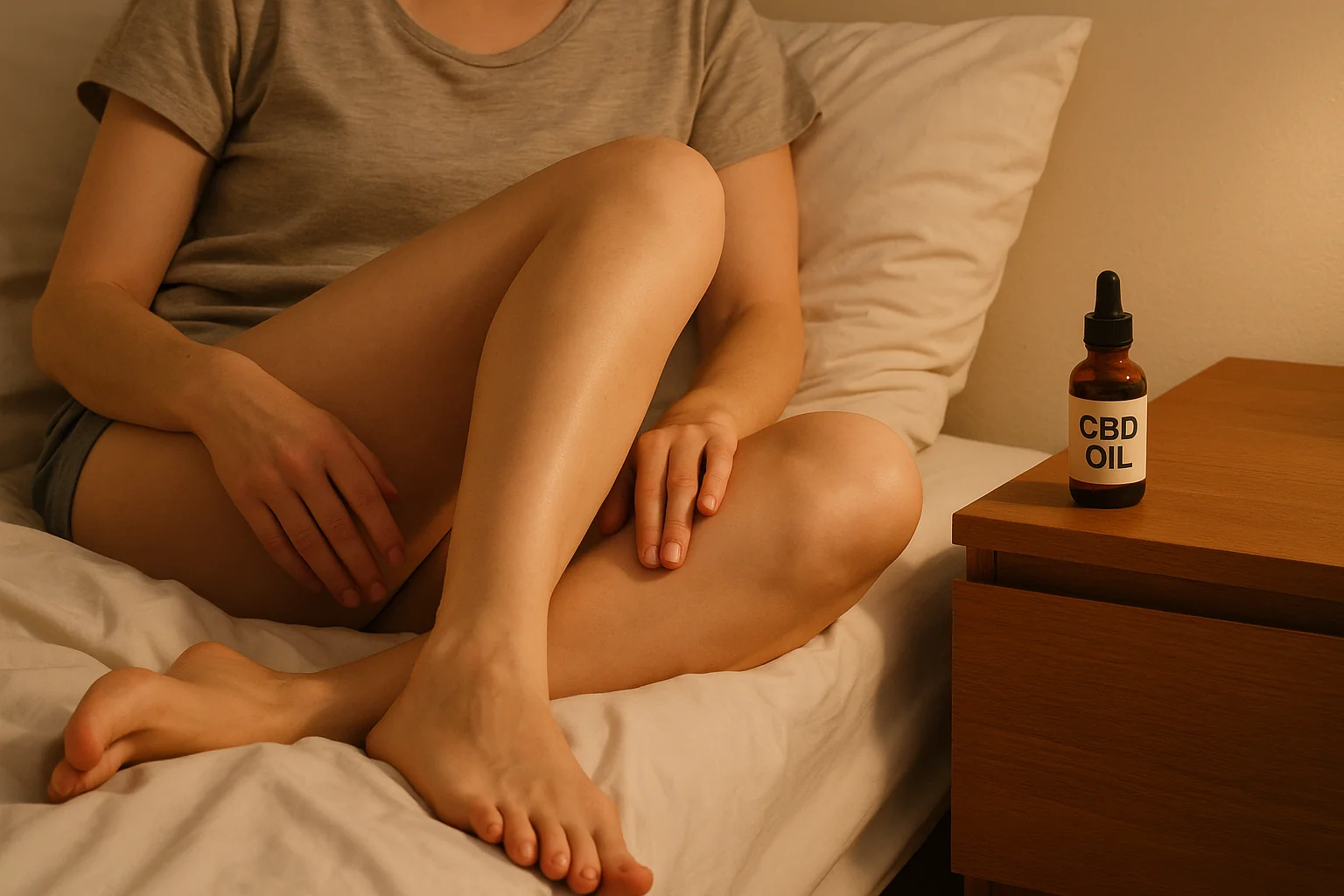

CBD for restless legs syndrome (RLS): does it work (FAQ)
CBD for restless legs syndrome: the case descriptions concerned cannabis, not CBD, and a newer trial of a THC-CBD preparation was open. What is known and what is not.
The question about CBD for restless legs syndrome comes up regularly and usually receives a more certain answer than the literature allows. In guideline texts, there is a statement about a '2020 study in which six patients felt a significant improvement after CBD.' We checked it at the source, and neither the year nor the substance matches: the description referred to six individuals using cannabis, not taking pure cannabidiol, and was published in 2017. This difference determines everything else, as cannabis containing THC and isolated CBD are not the same evidence. A newer trial from 2026 also concerned a combined product, not just CBD. Below, we separate what has actually been studied from what has been added along the way, and show what truly starts with this diagnosis.
KEY INFORMATION
• The case description cited as evidence concerned cannabis, not CBD itself, and was published in 2017 (Megelin i Ghorayeb, Sleep Medicine 2017).
• The current Cochrane review finds no clear evidence that CBD-dominant products reduce neuropathic pain (Ateş i in., Cochrane 2026).
• A meta-analysis of 97 studies indicates a prevalence of restless legs syndrome of about 3% in adults, higher in women (Broström i in., J Sleep Res 2023).
• Before considering anything else, it is worth checking ferritin levels: iron deficiency is a reversible cause of symptoms.
• EFSA cannot determine the safety of CBD in individuals taking medications, which describes the majority of patients with this diagnosis.
What is restless legs syndrome and where to start?
It is a neurological disorder characterized by an urge to move the legs, accompanied by unpleasant sensations in the limbs. Symptoms occur or worsen at rest, primarily in the evening and at night, and temporarily subside with movement. The result is chronically shortened and fragmented sleep.
How common this diagnosis is depends on the counting method. A meta-analysis involving 97 studies and 483,079 participants from 33 countries reports a corrected overall prevalence of 3 percent in the adult population, with a confidence interval from 1.4 to 3.8 percent. In women, it was 4.7 percent, and in men, 2.8 percent. The authors note that the result depends on methodological quality and sampling method (Broström i in., J Sleep Res 2023). The circulating figure of 15 percent in guidelines does not correspond to this basis.
However, the first step does not lead to any supplement. Iron deficiency in the brain is one of the described mechanisms of this disorder, and an international working group has developed separate guidelines for iron treatment based on a review of 299 studies. Oral iron was considered possibly effective for individuals whose serum ferritin levels do not exceed 75 micrograms per liter (Allen i in., Sleep Medicine 2018). Testing ferritin is a cheap examination that can indicate a reversible cause, and the decision about treatment is made by a doctor.
Has anyone studied CBD in restless legs syndrome?
Not directly. The study referenced by the guidelines exists, but it speaks of something else. It is titled 'Cannabis for restless legs syndrome: a report of six patients,' published in Sleep Medicine 2017, and describes six individuals who reported symptom relief after using cannabis (Megelin i Ghorayeb, Sleep Medicine 2017).
The discrepancy between this description and what is made of it has three layers. The year cited in guideline texts is 2020, while the study is from 2017. The substance described in the title is cannabis, which contains THC, not isolated cannabidiol. Finally, the type of publication: a case report of six patients is an observational report, without a control group, without blinding, and without random assignment. No conclusions about efficacy can be drawn from it, regardless of how convincing the patient reports are.
The same author returned to the topic twice. In 2020, he described additional patients and summarized that the benefit of cannabis in treatment-resistant patients should be verified by solid clinical studies (Ghorayeb, Sleep and Breathing 2020). In the 2021 review, he repeated this statement almost verbatim. In other words, the researcher whose work is cited as evidence himself writes that there is still no evidence.
The latest interventional trial does not close anything here, but it is worth knowing. In Journal of Neurology 2026, an open study was described, without a control group and without blinding, involving 18 individuals with restless legs syndrome, 16 of whom had multiple sclerosis. A combined product with a composition of 2.7 milligrams of THC to 2.5 milligrams of CBD was evaluated. The severity of symptoms on the IRLS scale significantly decreased after one month and three months, while the sleep efficiency and time to fall asleep did not change significantly. After one year, 66.7 percent of participants continued treatment (Lillo Triguero i in., J Neurol 2026). An open study in a narrow group does not determine efficacy, and the tested product was again not pure CBD.
What does the latest Cochrane review say about cannabinoids?
It states that there is a lack of clear evidence of efficacy, and for CBD-dominant products, this is particularly evident. The update of the Cochrane review on cannabinoids in chronic neuropathic pain was published in 2026 and replaced the version from 2018, which older texts still cite as current.
It included 21 studies and 2,187 participants, including six new trials with 450 individuals. Five studies concerned CBD-dominant products. For this group, the authors found no clear evidence of pain reduction by at least half, with the certainty of evidence rated as very low. For balanced products combining THC with CBD, a slight improvement in overall patient assessment was noted, but the authors themselves emphasize that the effect was not clinically significant, while the number of participants discontinuing due to adverse effects increased (Ateş i in., Cochrane Database of Systematic Reviews 2026).
This finding has indirect relevance to our question, as it concerns neuropathic pain, not restless legs syndrome. That is why it needs to be cited: since in a well-studied adjacent indication, CBD-dominant products do not show a clear effect, transferring expectations to an indication that is completely unstudied has no basis. Differences between types of pain are described separately in a text about nociceptive and neuropathic pain.
Does CBD improve sleep enough to help?
The data is weaker than its popularity suggests. The most frequently cited work is a retrospective review of psychiatric clinic documentation, rather than a study with a control group. Records of 103 adults were reviewed, and 72 individuals were included in the analysis: 47 primarily reported anxiety, while 25 primarily reported sleep disorders.
The results varied between these two areas. Anxiety scores decreased in the first month for 57 individuals, or 79.2 percent, and remained lowered until the end of the observation period. Sleep scores improved in the first month for 48 individuals, or 66.7 percent, but fluctuated in the following months. Doses ranged from 25 to 175 milligrams per day, with nearly all patients receiving 25 milligrams in capsule form. CBD was well tolerated by all except three individuals, and the authors conclude that controlled clinical trials are needed (Shannon et al., The Permanente Journal 2019).
The statement about fluctuations in sleep scores is one that usually gets omitted in reprints, and without it, the picture becomes overly optimistic. The lasting improvement pertained to anxiety, not sleep. We explore the topic of sleep itself more broadly in the text about CBD for insomnia.
What risks does CBD pose when taken with prescription medications?
Real and well-documented, and particularly significant in this diagnosis, as most patients take medications chronically. A review of the registration documentation for CBD products revealed adverse effects in nearly half of users, with a clear dose-dependent relationship. Commonly mentioned effects include:
- increased levels of aminotransferases, which are liver enzymes,
- drowsiness,
- sleep disorders,
- infekcje,
- anemia.
Interactions are a separate issue. CBD interacts with the enzymes CYP3A4 and CYP2C19, as well as with P-glycoprotein, which are pathways through which the body processes and eliminates many commonly used medications. The authors describe CBD as both a perpetrator and a victim of interactions and recommend that doctors monitor, reduce the dose of the primary medication, or choose an alternative therapy, especially for patients taking multiple medications at once (Brown i Winterstein, J Clin Med 2019). Which specific medications used in this diagnosis are relevant is determined by a doctor or pharmacist based on a complete list of medications taken, not by an article.
It is also important to know the limit set by the authority. The European Food Safety Authority established a temporary safe dose of CBD in 2026 at 0.0275 milligrams per kilogram of body weight per day, which is about 2 milligrams for a person weighing 70 kilograms, and referred this only to supplements with a purity of at least 98 percent. Separately, it stated that safety cannot be established for individuals under 25 years of age, for pregnant and breastfeeding women, and for individuals taking medications simultaneously (EFSA, 2026). This last group is precisely the reader of this text. A similar divide between hope and evidence is described in the text about CBD for trigeminal neuralgia.
Frequently Asked Questions
Does CBD help with restless legs syndrome?
This cannot be said today. There is no study with a control group that would examine CBD alone in this diagnosis. The description of six cases from 2017 concerned cannabis, and the trial from 2026 involved a preparation combining THC with CBD and was open, without blinding and without a control group.
Where did the statement about the 2020 study come from?
From the confusion of two publications by the same author. The description of six patients comes from 2017, and in 2020, a brief report on additional patients was published. In both texts, cannabis is mentioned, and in both, the author writes that the matter should be resolved by solid clinical studies.
Will CBD replace medications prescribed for this condition?
No. Pharmacological treatment has documented efficacy, and CBD has none in this indication. Discontinuing or changing medication on your own can exacerbate symptoms. Any changes should be discussed with the treating neurologist.
Where to start if this syndrome is suspected?
From a diagnosis by a doctor and from measuring ferritin. Iron deficiency is one of the reversible causes of symptoms, and international guidelines indicate a serum ferritin concentration of up to 75 micrograms per liter as the threshold at which iron treatment may be effective.
Can CBD interact with medications?
Yes. CBD interacts with the enzymes CYP3A4 and CYP2C19 as well as with P-glycoprotein, which are pathways for the processing and excretion of many medications. The authors of the review noted adverse effects in nearly half of the users, depending on the dosage. Check your list of medications with your doctor or pharmacist.
Does CBD improve sleep?
The data is ambiguous. In a retrospective review of 72 psychiatric outpatient records, sleep scores improved in the first month for 66.7 percent, but fluctuated in the following months. The effect on anxiety proved to be more lasting than on sleep.
What dose of CBD is used for this diagnosis?
There is no established dose because there are no studies on this indication, and it is a neurological condition requiring medical supervision. However, it is worth knowing the official limit: EFSA has set a temporary safe dose at 0.0275 milligrams per kilogram of body weight per day.
This article is for informational and educational purposes only and does not constitute medical advice. Before starting to use hemp or CBD for therapeutic purposes, consult your doctor, especially if you are taking other medications, are pregnant, or breastfeeding.
Author: Michał Waluk · Opublikowano: 2026-07-03 · Aktualizacja: 2026-08-16