
CBD's impact on the brain and nervous system: what neurology and research say.
How CBD affects the brain: 5-HT1A and GABA-A receptors, neuroprotection, memory, anxiety, and the only neurological indication with drug registration.
Today, two extremely different things are said about the effect of CBD on the brain: either that it is a substance with unproven effects, or that it protects neurons and rebuilds the nervous system. The truth lies in a less flashy but much more interesting place. The neurobiology of cannabidiol is well described at the receptor level, fairly well in animal models, and very modestly in humans, with one neurological indication having full drug registration. Below, we go through the mechanisms one by one, distinguishing between what has been measured in humans and what in mice.
KEY INFORMATION
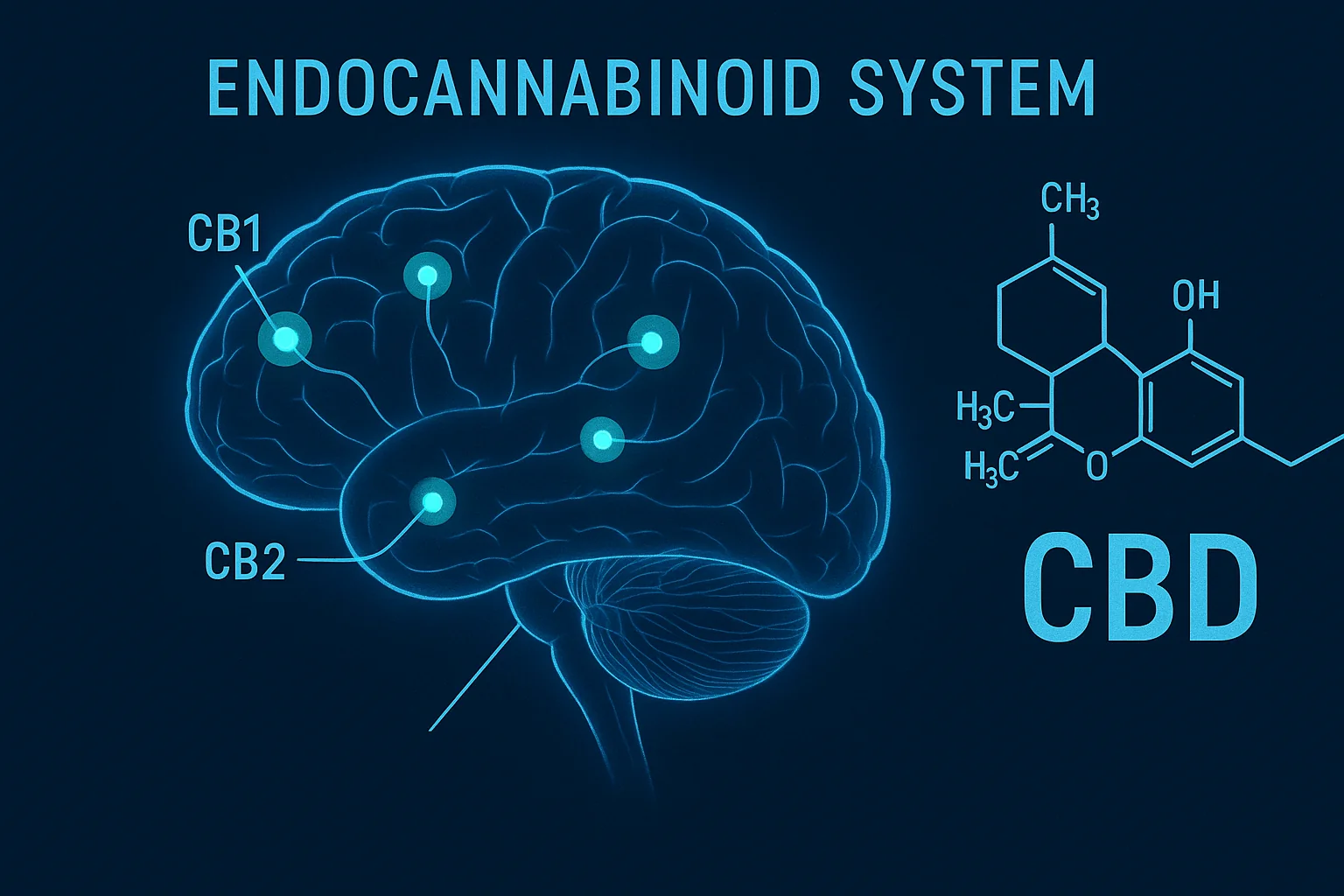
• CBD does not stimulate the CB1 receptor; it mainly acts through 5-HT1A, GABA-A, TRPV1, and inhibits the FAAH enzyme.
• Blocking the 5-HT1A receptor abolishes the anxiolytic effect of CBD in animals (Resstel et al., 2009).
• Jedyne zarejestrowane wskazanie neurologiczne to lekooporne padaczki Dravet i Lennox-Gastaut.
• Data on neuroprotection comes from animal models; there are no such studies in humans.
• A review of clinical data did not show any potential for addiction (Iffland and Grotenhermen, 2017).
How does CBD affect the brain?
Unlike THC, and this distinction is the basis for everything else. THC stimulates the CB1 receptor in the brain, which is responsible for the psychoactive effect. CBD does not do this. It behaves towards CB1 as a negative allosteric modulator, meaning it changes the shape of the receptor so that it responds less to its own agonists, including THC.
Thus, CBD exerts its effects through different pathways. It acts directly on serotonin receptors 5-HT1A, affects GABA-A receptors, interacts with TRPV1 channels involved in nociception, and inhibits the FAAH enzyme that breaks down anandamide, thereby increasing the concentration of this endogenous cannabinoid. The review by Campos et al. (Philosophical Transactions of the Royal Society B, 2012) collects these pathways and points out something significant: none of them dominates, and the profile of action depends on the dose and biological context.
This has a practical consequence that is rarely discussed. Since CBD is not a CB1 agonist, conclusions from studies on marijuana, THC, or synthetic cannabinoids cannot be transferred to it. Meanwhile, this is frequently done in popular texts, and the difference can be not only quantitative but also directional.
| Molecular target | Co robi CBD | Effect | Gdzie zbadane |
|---|---|---|---|
| Receptor CB1 | modulacja negatywna | weakens the effects of THC | ludzie, obrazowanie |
| 5-HT1A Receptor | direct stimulation | reduction of anxiety, response to stress | gryzonie |
| GABA-A Receptor | modulacja dodatnia | mild calming | cell studies |
| Enzym FAAH | hamowanie | increase in anandamide concentration | ludzie, schizofrenia |
| TRPV1 Channel | modulacja | effect on pain conduction | gryzonie, hodowle |
The last column of this table is more important than the first three. When reading about CBD, it is worth asking each time on whom a given thing was measured, because the difference between cell culture and a clinical study with randomization is not a matter of certainty level, but two different types of knowledge. Cell culture indicates that something is possible. A clinical study indicates that something happens in a human taking a specific dose.
What does CBD do with serotonin and GABA?
It acts on both systems, but not in the way one might expect from psychiatric medications. CBD does not increase serotonin levels in the synaptic cleft, as SSRI medications do. It binds directly to the 5-HT1A receptor, and that is sufficient to induce a behavioral effect.
The strongest evidence for this pathway is negative and therefore particularly convincing. Resstel et al. (British Journal of Pharmacology, 2009) demonstrated that administering an antagonist of the 5-HT1A receptor znosi abolishes the anxiolytic and cardiovascular effects of CBD in a model of acute stress. Earlier work by Campos and Guimarães (Psychopharmacology, 2008) showed the same after injecting CBD directly into the periaqueductal gray matter. If removing one receptor eliminates the effect, that receptor is essential to the mechanism.
The situation is different with GABA. Bakas et al. (Pharmacological Research, 2017) demonstrated that CBD acts on GABA-A receptors as a positive allosteric modulator, meaning it enhances the response to GABA itself rather than replacing it. This is the same type of mechanism as with benzodiazepines, although at a different site on the receptor and with a significantly weaker effect. This is part of the calming action, but it also explains why CBD does not induce sedation comparable to sleeping pills.
Positive modulation has a built-in safety mechanism that agonism lacks. Since CBD only enhances the response to its own GABA, its action ends where the activity of the system itself ends. A substance that directly stimulates the receptor would act independently of how much GABA is in the synapse and could inhibit the nervous system without limitation. This is one of the reasons for the favorable safety profile of cannabidiol and also why one should not expect it to have the potency of a sleeping medication.
Not all of these pathways operate at the same concentrations, and this is probably the most commonly overlooked nuance. Some of the described effects only appear at concentrations achieved with therapeutic doses from clinical studies, which means hundreds of milligrams. At ten milligrams from the oil, some of these mechanisms simply do not activate, although popular literature lists them en masse as if they always occur simultaneously.
Does CBD protect neurons?
In animal and cellular models, yes, but it is unknown in humans. This distinction is often blurred throughout the topic and is the most significant because it determines whether someone will start treating the supplement as a disease prevention.
The mechanism is credible. CBD exhibits antioxidant activity independent of cannabinoid receptors, limits the production of pro-inflammatory cytokines, and reduces microglial activation, which are the immune cells of the brain, whose chronic activation is associated with neurodegenerative diseases. Campos et al. (2012) describe these effects based on preclinical studies.
What is lacking is human studies. No clinical work has yet been published showing that CBD slows the progression of Alzheimer's disease, Parkinson's disease, or multiple sclerosis. Animal models in neurology have a particularly poor history of translatability: dozens of neuroprotective substances in mice have proven useless in studies involving patients. Caution here is not an exaggeration, but a conclusion drawn from the experience of the entire field.
It is important to understand where this discrepancy comes from, as it is not a matter of researchers' negligence. Animal models of neurodegeneration usually replicate one mechanism of disease, artificially induced in a young, healthy organism over weeks. Alzheimer's disease in humans develops over twenty years, involves several overlapping processes at once, and begins long before the first symptom. A substance that blocks one pathway in mice encounters a process in patients that is already advanced and multifaceted.
Additionally, there is the blood-brain barrier and the issue of dosage. The concentrations of CBD at which protective effects are observed in cell cultures can be higher than those achievable in the brain after oral intake of the supplement. The oral bioavailability of cannabidiol is low and variable (Millar i in., Frontiers in Pharmacology, 2018), so the path from the test tube to the neuron has several bottlenecks, each of which can individually nullify the effect.
Does CBD stimulate the formation of new neurons?
In the hippocampus of mice subjected to chronic stress, such an effect has been observed, but transferring this to humans is currently speculative. Neurogenesis in adult mammals occurs in a narrow area of the dentate gyrus of the hippocampus, and its role in humans remains a subject of debate among neurobiologists.
Studies on rodents indicate that the anxiolytic effect of CBD under chronic stress disappears when neurogenesis is blocked, suggesting that it is not a side effect but rather a component of the mechanism. This is an interesting finding because it connects two phenomena usually described separately: the formation of neurons and mood regulation.
However, three caveats must be made immediately. The doses used in these studies, converted to body weight, significantly exceed what a person takes from oil. The effect was observed in stressed animals, not in healthy ones. Moreover, the very existence of significant neurogenesis in the brain of an adult human is sometimes questioned. Therefore, CBD supplementation for 'neuron rebuilding' lacks empirical support.
The mechanism itself, however, remains worth noting for another reason. For decades, it has been assumed that chronic stress and depression damage the hippocampus, and antidepressants work, among other things, by restoring neurogenesis. If CBD fits into this same pattern, then its effect on mood would not be a simple calming effect but something that unfolds over time, requiring weeks of regular use. This also aligns with user reports, who most often describe a gradual improvement rather than an effect after the first dose.
However, treat this as a hypothesis worth knowing, not as a reason for use. The difference between 'the mechanism is likely' and 'the substance works in humans' is a chasm in neurology, across which more promising molecules have fallen than in any other field of medicine.
In which neurological diseases does CBD have confirmed effects?
In two forms of drug-resistant childhood epilepsy and only in the form of a registered medication. This is the only area where CBD has undergone a full clinical research pathway with randomization and has received marketing authorization as a medicinal product.
We are talking about Dravet syndrome and Lennox-Gastaut syndrome, and since 2019 also about tuberous sclerosis. The preparation is used in doses of 10-20 mg per kilogram of body weight per day, which for an adult would mean 700-1400 mg daily. In comparison, a typical dose from oil is 10-50 mg. The difference here is not a few percent, but several dozen times, and this explains why the results of these studies say nothing about the effects of the supplement.
It is also worth noting a borderline case. Leweke et al. (Translational Psychiatry, 2012) compared CBD with amisulpride in patients with schizophrenia and obtained comparable improvement in symptoms with better tolerance, linking the effect to an increase in anandamide levels. This is a psychiatric study, not a neurological one, and it did not lead to registration, but it is among the best-designed studies on CBD in humans.
The registration in epilepsy also changed something that goes beyond the indication itself. Only the registration studies provided solid data on the pharmacokinetics, drug interactions, and hepatic safety of cannabidiol, as required by the approval process. All our knowledge that CBD inhibits CYP3A4 and raises the levels of clobazam comes from this pathway, not from studies on supplements. Paradoxically, therefore, supplements benefit from the safety established during the drug's approval process, which they do not sell.
How does CBD affect memory and concentration?
In healthy individuals, no improvement has been demonstrated, and marketing suggesting otherwise is several steps ahead of the data. The most interesting results concern not what CBD does on its own, but what it does in the presence of THC.
Bhattacharyya i in. (Neuropsychopharmacology, 2010) administered THC or CBD to volunteers and imaged brain activity using functional resonance imaging. Both substances affected the same areas but in opposite directions: THC disrupted processing in the striatum and prefrontal cortex and intensified psychotic symptoms, while CBD acted conversely.
For practice, this means two things. CBD may weaken some of the adverse effects of THC, which is significant for full-spectrum products. However, it does not mean that it improves memory or attention in someone who does not consume THC. We have developed the topic of mental work separately in the text about CBD a koncentracji.
There is also a third possibility, which some users describe and which cannot be confirmed or dismissed: improvement in focus resulting from reduced anxiety rather than from an effect on attention. If someone cannot work because tension distracts them every few minutes, then reducing that tension will improve efficiency, even though the ability to concentrate remains unchanged. The effect is real, just the mechanism is different than advertised.
The opposite side also exists. Drowsiness is one of the most commonly reported side effects of CBD, and at higher doses, it can directly worsen performance on tasks requiring alertness. For someone who reaches for oil before work, the dose determines the direction of the effect, making this one of the few areas where 'more' almost certainly means 'worse'.
What does CBD do for anxiety and stress response?
It has the strongest data in humans among all discussed areas, but with one caveat that changes the entire practical interpretation: it concerns single doses in the range of hundreds of milligrams.
Crippa i in. (Journal of Psychopharmacology, 2011) they studied patients with generalized social anxiety, illustrating brain flow after administering CBD and observing changes in limbic areas corresponding to anxiety reduction. In another study by this team, a single dose of 600 mg reduced anxiety before public speaking in previously untreated individuals.
Let's compare this to the reality of the store shelf. Six hundred milligrams is roughly the content of an entire bottle of 5% oil with a capacity of 10 ml, taken at once. No one uses CBD this way, and the results obtained at such doses do not translate to four drops in the evening. A series of cases by Shannon et al. (Permanente Journal, 2019) describes improvements in sleep and anxiety reduction at 25-75 mg per day, but this is a clinical observation without a control group. We have gathered the details in an article about CBD for neurosis and anxiety..
The dose-effect relationship here is atypical and worth knowing before someone starts increasing doses on their own. In anxiety studies, an inverted U-shaped curve was observed: medium doses worked better than low ones, but also better than high ones. At the highest studied amounts, the anxiolytic effect weakened instead of increasing. The intuition of 'if it helps, I'll take more' fails with this substance.
The second thing concerns what was actually measured. All strong studies on CBD and anxiety relate to acute situations: public speaking, experimentally induced stress, single exposure. Chronic anxiety disorders treated for weeks are a completely different clinical problem, and there is practically no solid data on CBD for this application. Transferring results from a one-time test to daily use over months is a leap that the data does not justify.
Is CBD safe for the brain?
The safety profile is good, and the most common issues do not concern the brain itself, but interactions with medications. The review by Iffland and Grotenhermen (Cannabis and Cannabinoid Research, 2017) gathered clinical and preclinical data, finding no potential for addiction or withdrawal syndrome.
The side effects that occur are predictable: drowsiness, diarrhea, dry mouth, appetite changes, and fatigue, usually above 100 mg per day. In epilepsy studies, at doses several dozen times higher, elevated liver enzymes were also noted, especially with concurrent use of valproate.
However, the most important practical issue concerns metabolism. CBD inhibits cytochromes CYP3A4 and CYP2C19, through which a significant portion of psychiatric and neurological medications pass, including antiepileptics and some antidepressants. With ongoing neurological or psychiatric pharmacotherapy, discussing with the attending physician is not a formality. We have outlined the issue of safe ranges separately in a text about how much CBD can be taken daily.
It is also worth mentioning something that is often confused with the action of CBD itself. Full-spectrum products contain trace amounts of THC, below the legal threshold, but not zero. For most people, this does not matter; however, at very high doses of oil or with particular sensitivity, the total of these amounts becomes non-negligible. If you want to completely exclude THC, the right choice is an isolate or a broad-spectrum product, not a reduced dose of full spectrum.
There is also no data on long-term use. Studies typically lasted weeks, rarely months, so the question of what daily CBD intake over a decade does simply has no answer. This is not a warning signal, but a gap in knowledge, and with a substance used chronically, it is worth naming it directly instead of replacing it with assurances of natural origin.
Frequently Asked Questions
How does CBD affect the brain?
Not like THC. CBD does not stimulate the CB1 receptor but acts as a negative allosteric modulator towards it, exerting its effects mainly through the 5-HT1A receptors, GABA-A, TRPV1 channels, and by inhibiting the FAAH enzyme that breaks down anandamide (Campos i in., 2012).
Does CBD protect neurons?
In animal and cellular models, it exhibits antioxidant and anti-inflammatory effects that limit neuronal damage. In humans, there are no studies confirming the neuroprotective effect, so transferring these results to the prevention of neurodegenerative diseases has no basis.
Does CBD cause addiction?
No. The review of clinical and preclinical data did not show any potential for addiction or withdrawal syndrome (Iffland and Grotenhermen, 2017). CBD does not act psychoactively in the way characteristic of THC.
How does CBD affect serotonin levels?
It does not raise its concentration like SSRIs. It acts directly on the 5-HT1A receptor, and blocking this receptor in animals abolishes the anxiolytic effect of CBD (Resstel i in., 2009).
Does CBD improve concentration and memory?
In healthy individuals, there is no data to confirm this. Imaging studies show an impact on areas processing emotions and weakening some effects of THC (Bhattacharyya i in., 2010), co nie jest tym samym co poprawa funkcji poznawczych.
Czy CBD zapobiega chorobom neurodegeneracyjnym?
There is no evidence for this in humans. The data comes from animal models and cell cultures, and no clinical study has shown that CBD delays the onset or progression of Alzheimer's, Parkinson's, or multiple sclerosis.
How much CBD should I take for the nervous system?
There are no established doses for such indications. In anxiety studies, doses of 300-600 mg were used at once, many times more than the typical supplement dose, which is 10-50 mg per day. The results of those studies do not translate to doses from oil.
You can find the oils available in the store in the category hemp oils.
This article is for informational and educational purposes and does not constitute medical advice. Before starting to use cannabis or CBD for therapeutic purposes, consult a doctor, especially if you are taking other medications, are pregnant, or breastfeeding.
Author: Michał Waluk · Opublikowano: 2026-06-22 · Aktualizacja: 2026-08-07