
Hemp oil vs CBD oil - what are the differences and which one to choose
Hemp oil vs CBD oil: comparison, differences, and what to realistically choose. Table and specific tips from u Bucha.
This is one of the most common shopping mistakes in the cannabis category: a customer looks for CBD oil, adds hemp seed oil to their cart, and wonders why they don't feel any effect. A study published in JAMA showed that nearly 70% of consumers cannot correctly distinguish between these two products based on the label (Bonn-Miller et al., JAMA, 2017). This article explains the differences in a concrete way: where each product comes from, what it contains, what it is used for, and how to avoid being misled when purchasing.
KEY INFORMATION
• Hemp seed oil does NOT contain cannabinoids - it is pressed from seeds, not from flowers or leaves.
• CBD oil comes from the flowers and leaves of the plant and contains cannabidiol (CBD) and other phytochemicals.
• Hemp oil is a culinary product with omega-3/6/9; CBD oil is a supplement that affects the endocannabinoid system.
• The price says it all: hemp seed oil costs 15-40 PLN for 250-500 ml, CBD oil - 50-300 PLN for 10 ml.
• Confusing both products is one of the most common mistakes when shopping in the cannabis category.
Where Does Hemp Seed Oil and CBD Oil Come From?
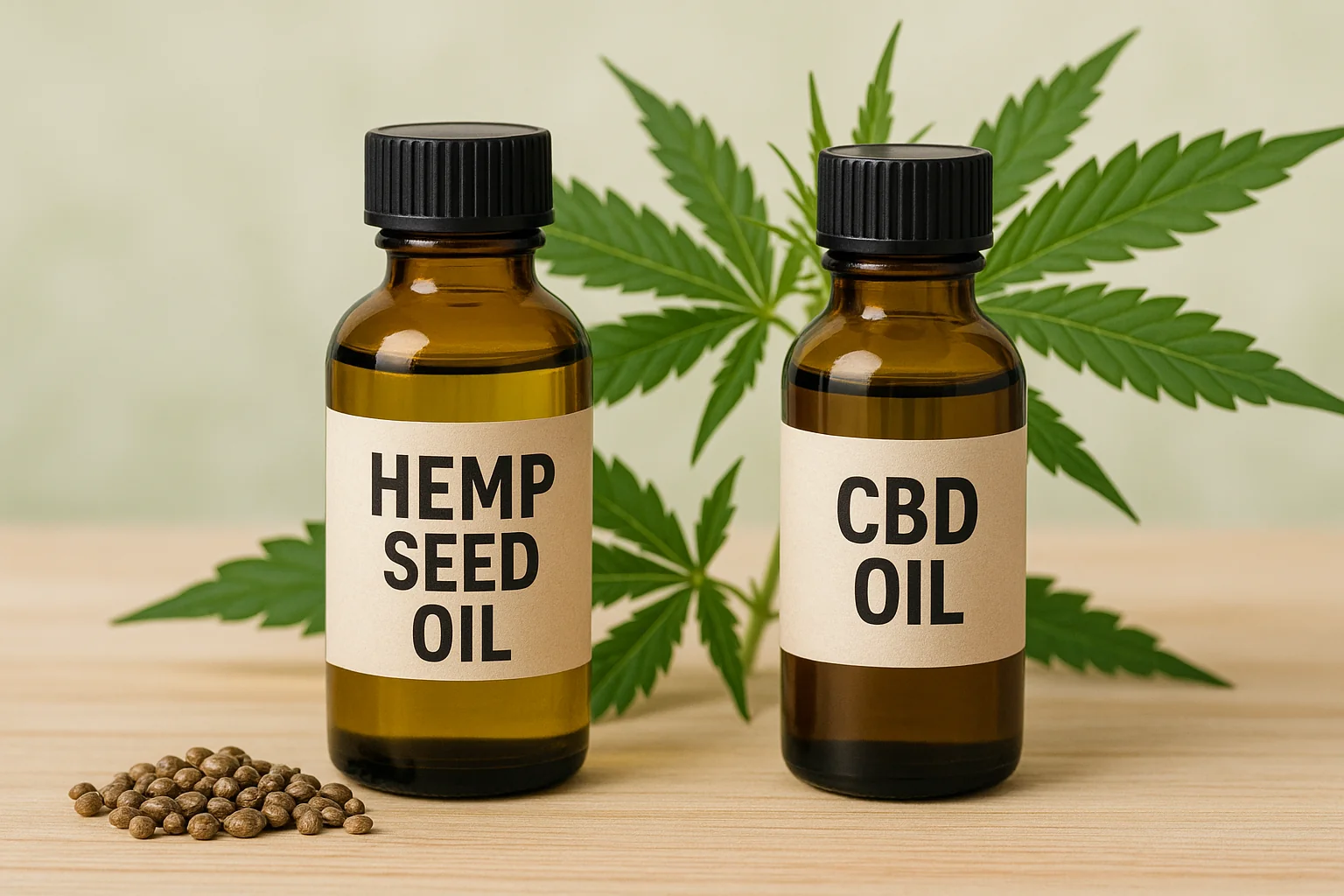
Both substances come from the same plant - Cannabis sativa L. - but from completely different parts of it. This is a key point that explains everything else. Hemp seed oil, also known as hemp seed oil, is mechanically pressed from seeds. Hemp seeds naturally do not contain cannabinoids: no CBD, no THC. Studies confirm this: hemp seeds are a rich source of omega-3 and omega-6 fatty acids in a ratio of about 3:1, considered beneficial for human health (Rodriguez-Leyva & Pierce, Nutrition & Metabolism, 2010), but they do not contain cannabinoids.
Cannabinoids are produced exclusively in the resin glands of the flowers and leaves of the plant, known as trichomes. CBD oil is derived from the extract of these parts of the plant - usually by CO2 extraction or ethanol. The extract contains cannabidiol (CBD), and depending on the production process: also terpenes, flavonoids, and other phyto-substances. This is why hemp flowers are incomparably more expensive to process than seeds. Pressing seeds is a simple mechanical process; extraction from flowers requires precise equipment, temperature and pressure control, and subsequent standardization.
It's also worth knowing that these two parts of the plant may be sourced from different strains. Hemp seed oil often comes from high-yield seed strains. CBD oils are produced from strains with high CBD content in the flowers. Cultivation, harvesting, and processing are completely separate production chains.
Hemp oil vs CBD oil - comparison table
The quickest way to remember the differences is to compare them side by side. The table below compares both products according to features that have practical significance when purchasing. One important note: none of these columns is better than the other - they are simply two different products with different purposes.
| Feature | Hemp Seed Oil | CBD Oil |
|---|---|---|
| Raw material | Hemp seeds | Hemp Flowers and Leaves |
| Main Active Ingredient | Omega-3, Omega-6, Omega-9 Fatty Acids | Cannabidiol (CBD) |
| Cannabinoids | None (traces) | CBD + possibly other phytonutrients |
| Color and flavor | Greenish-yellow, nutty | Dark, herbal |
| Main application | Culinary, cosmetics | Dietary supplement, wellness |
| Effect on the ECS system | None directly | Yes - cannabidiol interacts with endocannabinoid receptors. |
| Price (10 ml) | 5-15 PLN | 50-300 PLN |
| Where to buy | Grocery store, health food | Pharmacy, CBD store, online |
Hemp seed oil - uses and nutritional values
Hemp seed oil contains omega-3 and omega-6 fatty acids in a ratio of about 3:1, considered close to optimal for human health (Rodriguez-Leyva & Pierce, Nutrition & Metabolism, 2010). This is a valuable advantage over sunflower oil, which has an omega-6 to omega-3 ratio of up to 75:1 - too high a level of omega-6 without balancing omega-3 is associated with inflammatory conditions.
In the kitchen, hemp oil works great cold: as an addition to salads, smoothies, or bread. It is not suitable for frying, as it has a low smoke point (about 165°C) and oxidizes under high temperatures. Its nutty flavor is pronounced, so it pairs well with stronger flavors.
In cosmetics, hemp seed oil is used as an ingredient in creams and body lotions. Fatty acids strengthen the skin's hydrolipid barrier. Important: cosmetic manufacturers often label it as "Cannabis sativa seed oil" - the mere presence of this name in a cream does not mean that the cream contains CBD or other cannabinoid phyto-substances.
Citation capsule (Rodriguez-Leyva & Pierce, 2010): Hemp seed oil contains omega-3 and omega-6 fatty acids in a ratio of about 3:1, considered close to optimal for human health. The authors indicate that regular consumption of hemp oil may support cardiovascular health due to its favorable fatty acid profile (Rodriguez-Leyva & Pierce, Nutrition & Metabolism, 2010).
CBD oil - what is it and how does it work?
CBD oil is an extract from the flowers and leaves of the cannabis plant, and its main active ingredient is cannabidiol. According to the World Health Organization report from 2018, CBD does not show addictive potential and has a good safety profile in humans (WHO Expert Committee on Drug Dependence, WHO, 2018). This is important information for those who are concerned that supplementing with hemp oil carries a risk of addiction.
Cannabidiol interacts with the endocannabinoid system (ECS) - a network of receptors and neurotransmitters present throughout the body. The ECS regulates many physiological processes: sleep, mood, stress response, pain perception. CBD does not bind directly to CB1 and CB2 receptors as strongly as THC, but modulates their activity and affects other signaling pathways, including the serotonin receptor 5-HT1A.
We have noticed that consumers often ask why CBD oil "does not work" immediately. The endocannabinoid system does not respond to a single dose like, for example, caffeine. Regular supplementation over several weeks usually yields clearer effects than a one-time dose, due to the cumulative effect of CBD on receptors and the body's homeostasis mechanisms.
CBD oils also differ in spectrum: full-spectrum contains the complete profile of phytochemicals from the plant, broad-spectrum removes THC while retaining other components, and isolate is pure cannabidiol without any accompanying compounds. Ethan Russo described the entourage effect phenomenon: phytochemicals from cannabis work synergistically and mutually modify their properties (Russo, Frontiers in Plant Science, 2019).
How to read labels to avoid confusing products?
Labels on cannabis products can be misleading, sometimes intentionally. EU regulations do not prohibit the use of graphics with cannabis leaves or the word "cannabis" on a product that does not contain CBD. A few specific tips can help avoid confusion with every purchase.
Keywords to look for
On the label of hemp seed oil, you will find: "Cannabis sativa seed oil", "hemp seed oil" or "hemp seed oil" as the ingredient name. No information about mg of CBD. On the label of CBD oil, you will find: "cannabidiol", "CBD extract", "hemp extract" or "full-spectrum hemp oil" and a declaration in mg, e.g. "500 mg CBD" or "1000 mg CBD". The number in mg is the most reliable signal that you are dealing with CBD oil, not culinary oil.
Price as an indicator
Price is one of the most practical filters. Hemp seed oil available for 10-15 PLN for 250 ml in a supermarket does not contain CBD, cannot contain CBD, and should not be purchased with that intention. CBD oil at the same price should raise suspicions about quality or actual cannabidiol content. The extraction of CBD from hemp flowers, standardization, and laboratory testing have real costs that the manufacturer must include in the price.
CoA certificate as proof of composition
Every reputable CBD oil manufacturer provides a CoA (Certificate of Analysis) from an independent laboratory. The report should include a cannabinoid profile, results of tests for heavy metals, and pesticide residues. Lack of a CoA is a signal that it is unclear what is actually in the bottle. Hemp seed oil manufacturers do not certify in this way because there is no cannabinoid whose content needs to be verified.
Can you use hemp oil and CBD oil simultaneously?
Yes - and this combination makes practical sense. Hemp seed oil consumed as fat in the diet can increase the bioavailability of CBD taken at the same time. CBD is a lipophilic substance, so it is absorbed much better in the presence of fats. The study by Millar and colleagues even showed four times higher bioavailability of CBD taken with a fatty meal compared to taking it on an empty stomach (Millar et al., Pharmaceuticals, 2019).
Practically, it looks like this: a tablespoon of hemp seed oil added to a salad or smoothie in the morning, and CBD oil taken sublingually with the same meal. Hemp oil provides omega-3 and omega-6 fatty acids, and the presence of fat improves CBD absorption. Both products serve different purposes - omega for cell membranes and cardiovascular health, CBD for the endocannabinoid system - and do not interact with each other.
The only situation where the combination requires caution is if you are taking medications metabolized by CYP450 enzymes in the liver. CBD can alter the metabolism rate of some prescription medications. Hemp seed oil does not affect this metabolic pathway. If you are taking medications, consulting a doctor before incorporating CBD oil is simply good practice.
We have noticed that customers who understand this difference often start using both products in parallel: hemp oil in the kitchen as a daily source of omega-3, CBD oil as a supplement. This is a more conscious approach than choosing one "instead of" the other, as they are not competing products but rather complementary.
What to choose: hemp oil or CBD oil?
The decision should be based on purpose, not price or packaging. Both products are valuable, but they address different needs. Confusing them is like comparing olive oil to aspirin just because both are liquids.
Choose hemp seed oil if: you are looking for a plant-based source of omega-3 and omega-6 fatty acids, you want to diversify your diet with a healthy culinary oil, you are looking for an ingredient for homemade cosmetics, or you have a limited budget and care about the nutritional values of plant fats. It is a food product with real dietary value and zero risk of being confused with an active pharmacological substance.
Choose CBD oil if: you are looking for a supplement that affects the endocannabinoid system, you care about supporting sleep quality or reducing tension, a doctor or dietitian has recommended cannabidiol supplementation, or you want to consciously supplement your daily routine with cannabis phytochemicals. Remember to look for a product with a CoA certificate and clearly stated CBD content in mg.
We have noticed that some customers do not need to choose. Hemp seed oil in the diet and CBD oil as a supplement are two non-overlapping products that can be used concurrently. Hemp oil will not enhance the effect of CBD oil, but it provides independent benefits from omega fatty acids.
Frequently Asked Questions
Does hemp seed oil contain CBD?
No. Hemp seed oil is pressed from the seeds of the plant, which naturally do not contain cannabinoids. Cannabinoids are produced in the flowers and leaves, not in the seeds. Hemp seed oil is a food product rich in omega-3 and omega-6 fatty acids, but without any cannabinoid effects (Rodriguez-Leyva & Pierce, Nutrition & Metabolism, 2010).
How to recognize on the label whether it is hemp oil or CBD?
Look for keywords: "Cannabis sativa seed oil" or "hemp seed oil" means oil without CBD. "Cannabidiol", "CBD extract" or "hemp extract" in the ingredients indicates a product with CBD. A declaration in mg, e.g. "500 mg CBD", always indicates CBD oil, not culinary oil.
Which oil is better for cooking - hemp or CBD?
For cooking, use only hemp seed oil. It is rich in omega-3 and omega-6 fatty acids in a beneficial ratio of 3:1, as confirmed by the study by Rodriguez-Leyva (Nutrition & Metabolism, 2010). CBD oil should not be heated - high temperatures degrade cannabidiol. CBD oil is intended for sublingual use or as a supplement, not for frying or baking.
Is CBD oil more expensive than hemp oil?
Yes, significantly. Hemp seed oil costs 15-40 PLN for 250-500 ml in Poland, as its production is simple: pressing seeds. CBD oil costs 50-300 PLN for 10 ml, as extraction from hemp flowers, standardization, and laboratory testing are complex and costly. The price reflects different production processes and different applications.
How to choose between hemp oil and CBD oil?
If you are looking for a culinary product with omega-3/6 - choose hemp seed oil. If you are looking for a supplement that affects the endocannabinoid system, sleep, relaxation, or tension reduction - choose CBD oil. These are two different products with different purposes. Confusing them is one of the most common mistakes when shopping in the cannabis category.
This article is for informational and educational purposes and does not replace consultation with a doctor. If you are pregnant, breastfeeding, taking medications, or have chronic conditions, consult the use of supplements or herbs with a specialist.
Author: Michał Waluk · Published: 2026-05-04 · Updated: 2026-05-04