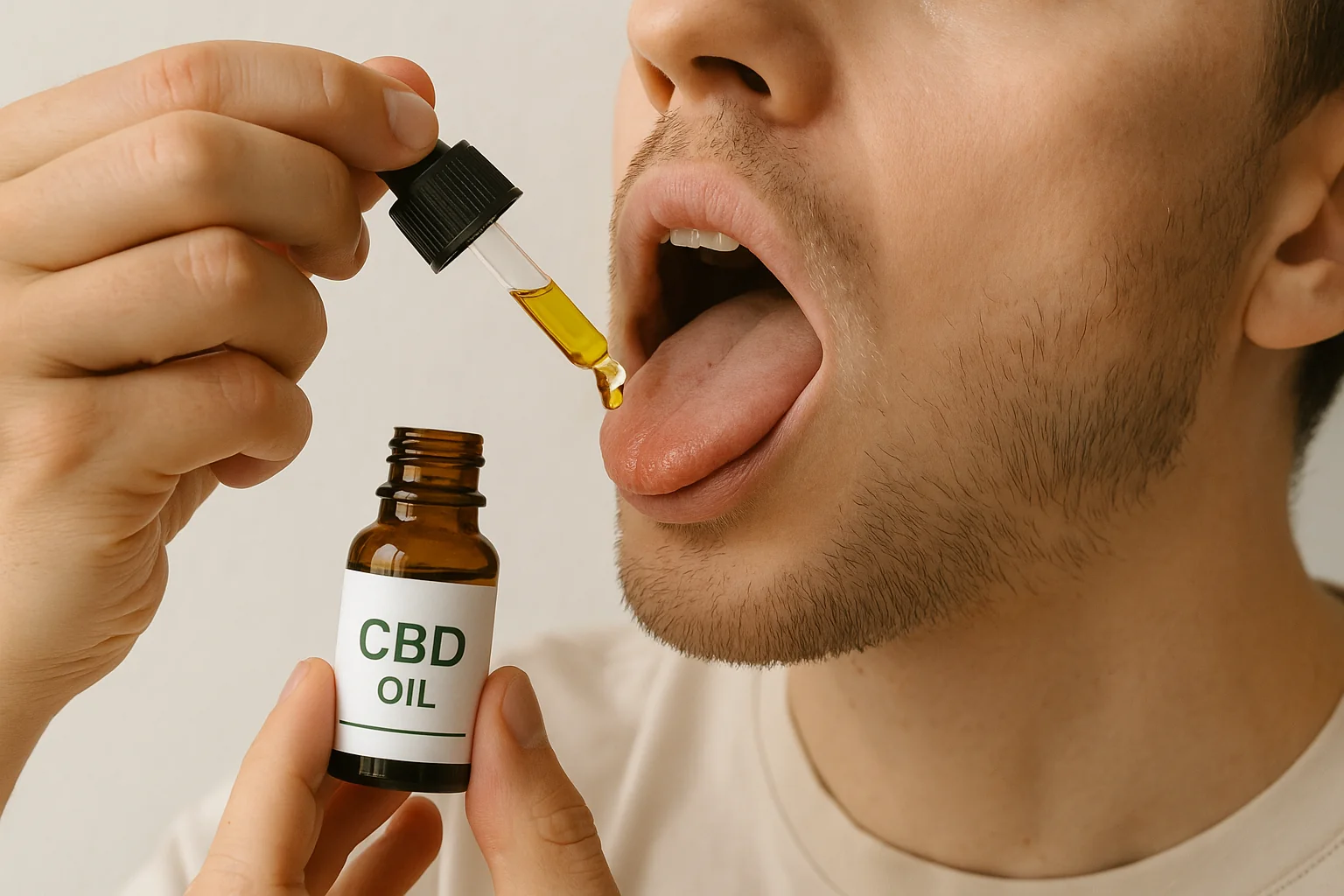

How to use CBD oil: sublingually, swallow, or mix with food
No one has measured the bioavailability of CBD orally or sublingually. However, the effect of a fatty meal was measured: exposure increases 4 to 10 times. Check the data.
On the label of CBD oil, you will almost always find the same sentence: a few drops under the tongue, hold for a minute, then swallow. It sounds like a conclusion from a study. It is not. When tracing pharmacokinetic publications from the last twenty years, it turns out that two things stated online with precision to the percentage have never been measured in humans: how much CBD from a swallowed drop reaches the blood and how much from that held under the tongue. However, something else has been measured that changes the result several times, and almost no one talks about it: whether there is a fatty meal in the stomach. This article separates measured numbers from repeated ones and shows what this means for a person who has a bottle of oil at home.
KEY INFORMATION
• The only absolute bioavailability of CBD measured in humans is 31% for smoking (Millar et al., Frontiers in Pharmacology, 2018).
• A fatty meal increased total CBD exposure by 4 to 9.7 times in three independent studies.
• No study has checked how many seconds to hold the oil under the tongue.
• A meta-regression of 39 studies did not show an advantage of mucosal administration over oral.
How much CBD from the oil actually reaches the blood?
Nie wiadomo. Millar i wsp. (Frontiers in Pharmacology, 2018) reviewed 24 pharmacokinetic studies of CBD in humans and found that the only route for which anyone measured absolute bioavailability is smoking: 31%. For oral and sublingual administration, no study even attempted such a trial, although intravenous preparations needed for measurement exist.
The numbers circulating in product descriptions sound precise: 6% orally, 13 to 19% sublingually, sometimes 20 to 35%. They do not come from measurements in humans. They originated from calculations on animal models, from relative comparisons between two preparations, or simply from one secondary publication being copied by others. When you trace a citation to a citation, the trail ends on a text that does not provide a source.
Absolute bioavailability is the ratio: how much substance entered circulation after oral administration compared to how much entered after intravenous administration of the same dose. Without an intravenous arm, it cannot be calculated. All we have for CBD administered orally are relative values: peak concentration (Cmax) and area under the curve (AUC), compared between preparations or between fasting and post-meal states.
This has practical consequences when shopping. If a seller claims that their oil has a bioavailability of 20%, there is nothing to support that. Defensible comparisons always take the form of 'this preparation under these conditions produced a concentration so many times higher than that one,' rather than 'it absorbs at such percentages.'
Why is it said that sublingual administration works stronger?
Due to anatomy, not measurement. Blood from the mucous membrane under the tongue returns to the heart via the neck veins, bypassing the portal vein and liver. Blood from the intestine first goes to the liver, where enzymes break down part of the dose before it reaches the general circulation. This mechanism is real and well described for many drugs.
The problem arises when jumping from mechanism to numbers. The statement "sublingual administration bypasses first-pass metabolism" is correct as a description of the pathway. The statement "this allows for three times more absorption" is not, because no one has measured in humans what portion of the drop actually passes through the mucous membrane and what is swallowed with saliva during that minute.
This second question is not trivial. The space under the tongue is small, the oil is thick, and it spreads throughout the oral cavity. You swallow saliva reflexively every few dozen seconds, even if you try not to. Realistically, a significant portion of the dose still reaches the stomach, and the sublingual route adds an unknown remainder. As long as that remainder remains unknown, the advantage of sublingual administration is a hypothesis, not a fact.
Do studies confirm the advantage of sublingual administration?
No, and those that compared the routes directly point in the opposite direction. Moazen-Zadeh i wsp. (Cannabis and Cannabinoid Research, 2024) They collected 112 research arms from 39 studies in healthy adults. After accounting for the dose, mucosal administration was associated with lower peak concentration and lower total exposure than oral.
This result is surprising, so it needs to be read carefully. The oral arms included doses from 0.42 to 6000 mg, while the mucosal ones only from 5 to 50 mg, so the comparison is based on a statistical model, not on the same individuals. All mucosal preparations in this comparison are sprays, not oil in drops.
There is also a crossover study. Arout i wsp. (Cannabis and Cannabinoid Research, 2025) They administered 10 mg of CBD in grape seed oil orally to twelve individuals once, and a mucosal spray with 10 mg of CBD once, on an empty stomach, with blood samples taken at sixteen points over a day. The oral extract produced a higher peak concentration and reached it faster than the spray.
Review O’Sullivan i wsp. (Pharmaceuticals, 2024) It summarizes the same from the formulation side: mucosal and transdermal routes deliver CBD to circulation more slowly than oral and inhaled, and there is simply no evidence that any route provides a better therapeutic effect. The comparison of these three studies is what is usually missing in guides: none confirm the advantage of holding it under the tongue. However, they do not imply that holding it under the tongue is useless, only that there is no data defending it as a method that is inherently better.
How long should you hold CBD oil under your tongue?
There is no answer to this from the study. We searched the European PMC database and queries about the duration of holding oil under the tongue return not a single paper that compared in humans 30, 60, and 120 seconds and measured how it changes CBD concentration in the blood. The numbers on the labels are a convention of manufacturers.
Since no one has measured this, every second given remains a guess. This does not mean you should swallow it immediately. It means there is no basis to treat 90 seconds as a threshold below which "you lose the effect," nor to convert shortening this time into a percentage of the lost dose. Values like "60% less CBD in the blood" do not come from any measurement.
From what is known about the mechanism itself, sensible action is straightforward. Place drops under the tongue, not on its surface, wait as long as you can without reflexively swallowing, then swallow the rest. The swallowed part does not go to waste; it is absorbed from the intestine, just more slowly. If the taste makes you shorten this time to a few seconds, eating something fatty will change much more than racing against the clock.
How much does a meal increase CBD absorption?
Several times, and this is the only element of the entire puzzle measured independently several times. Taylor i wsp. (CNS Drugs, 2018) They administered 1500 mg of CBD on an empty stomach and after a fatty meal: peak concentration increased 4.85 times, and total exposure 4.2 times. The time to peak did not change.
U Birnbaum et al. (Epilepsia, 2019) The effect was even greater. Eight patients with epilepsy took a capsule of pure CBD once on an empty stomach and once after a high-fat meal, 840 to 860 kcal. The peak concentration increased on average fourteen times, and the area under the curve four times. The confidence interval for Cmax itself ranged from 7.5 to 31.9, showing how much the result depends on the individual.
The objection that both studies used therapeutic doses far from the contents of a shelf bottle is reasonable. It is answered by Saals i wsp. (Scientific Reports, 2025): eleven healthy individuals, once 70 mg of CBD from hemp extract, crossover design. A fatty meal raised the peak concentration 17.4 times and total exposure 9.7 times. The authors also observed a double peak of concentration after the meal, associated with lymphatic transport and enterohepatic circulation. Three studies, three different doses, the same direction.
What meal and how to mix oil with food?
The studies used standardized meals, about 800 to 900 kcal with a high fat content. No one checked whether a tablespoon of oil or a handful of nuts gives the same effect. The direction is certain, the threshold is not: it is unknown how many grams of fat the difference starts.
Practically, this means that you are closest to the study conditions when taking oil with a normal meal containing fat, rather than a symbolic teaspoon of something fatty on an empty stomach. Scrambled eggs, oatmeal with peanut butter, or full-fat yogurt fit here better than dry toast.
Mixing oil with water, juice, or black coffee has no justification. CBD does not dissolve in water, so instead of reaching the body, it settles on the walls of the cup. Coffee with milk or coconut milk is a different situation, as fat is present in it. Be more cautious with cooking than guides suggesting specific temperature thresholds: there are no data indicating what portion of CBD survives frying or baking. It is safer to add oil to a dish that is already cooked and cooled.
A separate issue is the condition of the bottle itself. Light and heat degrade cannabinoids, so oil kept on a windowsill will gradually deviate from what the label claims, and you will feel this as a weakening effect of the method. You can find details in the article How to store CBD oil.
How to choose a method for your goal?
It is wiser to choose based on what has been measured rather than on promises from the label. The effect of a meal has been measured. The percentages of bioavailability, the time held under the tongue, and the dose conversions between routes of administration remain unmeasured. The table below separates these two categories.
| Situation | What the data says | What to do with this |
|---|---|---|
| You want the greatest exposure | A fatty meal increased Cmax from 4.85 to 17.4 times in three studies | Take the oil with a fatty meal, not on an empty stomach |
| You want a quicker onset | There is no study comparing the action time of the oil under the tongue and when swallowed | Don't count on a difference that no one has demonstrated |
| You're wondering about the holding time | No study compared different times in people | Hold it as long as comfortable, then swallow |
| You want to convert the dose between routes | There is no measured bioavailability for any of the oral routes | Don't multiply the dose based on percentages from the internet |
There remains variability among individuals, which is hard to forget after reading these studies. In Birnbaum et al., the range for peak concentration increase varied from sevenfold to thirty-twofold with the same procedure. The metabolism of CBD depends on liver enzymes, whose activity varies between individuals and changes under the influence of other medications. If you are taking anything regularly, this conversation belongs to a doctor or pharmacist, not to a table in an article. We have described this separately in the texts CBD for seniors and CBD for athletes.
Frequently Asked Questions
How long should you hold CBD oil under your tongue?
No published study in humans has compared different holding times of oil under the tongue and measured how they affect CBD concentration in the blood. The times stated on labels of 60 and 90 seconds are a convention of manufacturers, not a measured result. Hold it as long as you can without reflexively swallowing, then swallow the rest.
Is it better to take CBD on an empty stomach or with a fatty meal?
With a meal. Taylor i wsp. (CNS Drugs, 2018) they noted a 4.2-fold increase in total exposure, Birnbaum et al. (Epilepsia, 2019) fourfold, while Saals et al. reported 9.7 times with 70 mg from hemp extract. This is the best-documented element of the entire oil use.
Ile procent CBD z kropli trafia do krwiobiegu?
No one measured this. Millar i wsp. (Frontiers in Pharmacology, 2018) they reviewed 24 pharmacokinetic studies and found one absolute bioavailability of CBD in humans: 31% for smoking. For the oral and sublingual routes, there is a lack of an intravenous arm, without which such a percentage cannot be calculated.
Can you add CBD oil to food or drinks?
Yes, provided the dish contains fat. CBD does not dissolve in water, so when added to water, juice, or black coffee, it will settle on the walls of the container. Full-fat yogurt, oatmeal with peanut butter, or coffee with coconut milk will work better. Add the oil to a dish that has already cooled down.
How long does it take for CBD oil to work?
In the review by Millar et al., peak concentration after oral and mucosal administration occurred from 0 to 4 hours post-dose. In Taylor et al., at 1500 mg, it was 4 to 5 hours, and a fatty meal did not shift this time. Perceptible onset of action is different from blood concentration and was not measured as accurately.
Can CBD oil be combined with alcohol?
Jedyne badanie tej pary u ludzi, Consroe et al. (Psychopharmacology, 1979), it did not show that CBD exacerbated alcohol-induced motor impairment, and blood alcohol concentration was lower with the combination. There were ten participants, the dose was 200 mg, and no one repeated the result.
You can find the range of oils in the category hemp oils, where stock levels change continuously.
This article is for informational and educational purposes and does not constitute medical advice. Before starting to use cannabis or CBD for therapeutic purposes, consult a doctor, especially if you are taking other medications, are pregnant, or breastfeeding.
Author: Michał Waluk · Opublikowano: 2026-06-22 · Aktualizacja: 2026-08-08